Terry's Astronomy Thread.

Collapse
X
 
  • Time
  • Show
Clear All
new posts
  • Bluearrowll
    ⊙▃⊙
    FFR Simfile Author
    • Nov 2007
    • 7376

    #466
    Re: Terry's Astronomy Thread.

    edit: Front Page posts from September 1, 2012 to February 28, 2013 have been archived into post # 9 to allow me to edit the front page post again. Front page post is now up to date.

    What's in the sky tonight?
    March 9, 2013


    -Comet PANSTARRS now makes its way to the northern hemisphere - however depending on your location it will be difficult to spot today and tomorrow.

    -Look west after sunset near the horizon. Binoculars may be needed to pick Comet PanSTARRS out of the bright sky. Look too early and the sky will be too bright; too late and the comet will be too low. On the altitude scale at left, 10° is about the width of your fist held at arm's length.

    -This diagram is drawn for a viewer near 40° north latitude (Denver, New York, Madrid) 30 minutes after sunset. If you're south of there, the comet will be a little higher above your horizon early in the month than shown here. North of 40°, it will be a little lower early in March than shown here.

    -The Big Dipper glitters high in the northeast these evenings, standing on its handle. You probably know that the two stars forming the front of the Dipper's bowl (currently on top) are the Pointers; they point to Polaris, currently to their left.

    And, you may know that if you follow the curve of the Dipper's handle out and around by a little more than a Dipper length, you'll arc to Arcturus, now rising in the east.

    But did you know that if you follow the Pointers backward the opposite way, you'll land in Leo?

    Draw a line diagonally across the Dipper's bowl from where the handle is attached, continue far on, and you'll go to Gemini.

    And look at the two stars forming the open top of the Dipper's bowl. Follow this line past the bowl's lip far across the sky, and you crash into Capella.

    Astro Picture of the Day:
    March 9, 2013
    Source:
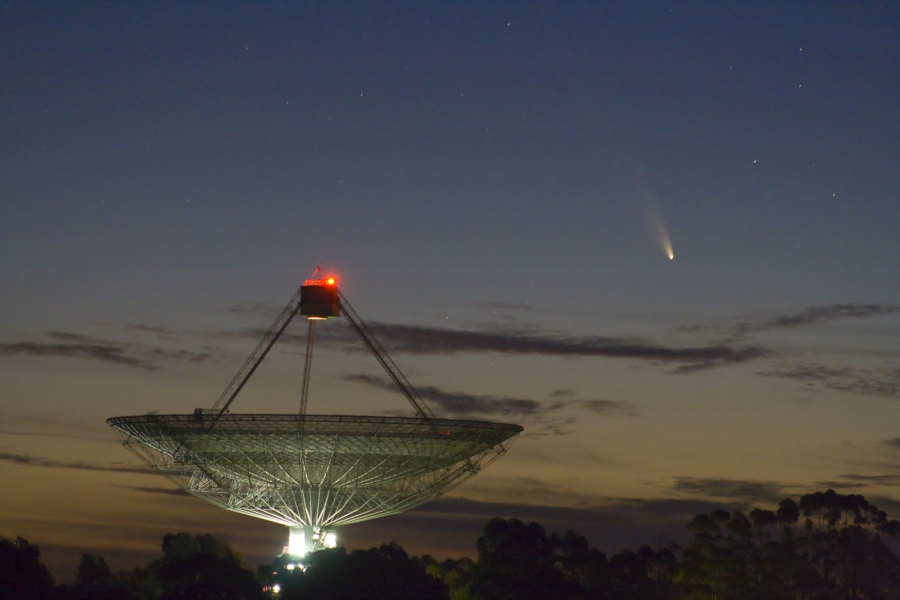
    Sweeping quickly through southern skies on March 5, Comet PanSTARRS (C/2011 L4) follows the Sun toward the western horizon in this twilight scene. In the foreground is Australia's CSIRO Parkes Radio Telescope, a 64 meter wide steerable dish that is no stranger to the space age exploration of comets. In March of 1986 the Parkes dish tracked ESA's Giotto spacecraft as it flew by Comet Halley and received the first ever closeup images of Halley's nucleus. At naked-eye visibility, Comet PanSTARRS made its closest approach to planet Earth on March 5. Its closest approach to the Sun will be on March 10. Heading north, PanSTARRS now begins a much anticipated appearance low in the northern hemisphere's western skies after sunset. On March 12, look for the comet hugging the western horizon near a young crescent Moon.
    Last edited by Bluearrowll; 03-9-2013, 10:15 AM.
    1st in Kommisar's 2009 SM Tournament
    1st in I Love You`s 2009 New Year`s Tournament
    3rd in EnR's Mashfest '08 tournament
    5th in Phynx's Unofficial FFR Tournament
    9th in D3 of the 2008-2009 4th Official FFR Tournament
    10th in D5 of the 2010 5th Official FFR Tournament
    10th in D6 of the 2011-2012 6th Official FFR Tournament

    FMO AAA Count: 71
    FGO AAA Count: 10

    Bluearrowll = The Canadian player who can not detect awkward patterns. If it's awkward for most people, it's normal for Terry. If the file is difficult but super straight forward, he has issues. If he's AAAing a FGO but then heard that his favorite Hockey team was losing by a point, Hockey > FFR
    PS: Cool AAA's Terry
    - I Love You


    An Alarm Clock's Haiku
    beep beep beep beep beep
    beep beep beep beep beep beep beep
    beep beep beep beep beep
    - ieatyourlvllol

    Comment

    • Bluearrowll
      ⊙▃⊙
      FFR Simfile Author
      • Nov 2007
      • 7376

      #467
      Re: Terry's Astronomy Thread.

      Today the thread is one year old! Thank you to everyone for regularly visiting and for your interest in wondering just what is going on outside of the planet. I've kept track of daily and total viewership as the thread aged, and here are some statistics to go with the thread:


      Added to the thread's main post today is new aurora tracker maps that update themselves in the North and South Poles found in the Aurora Tracker tab.

      What's in the sky tonight?
      March 10, 2013


      -Comet PANSTARRS now makes its way to the northern hemisphere - however depending on your location it will be difficult to spot today and tomorrow.

      -Look west after sunset near the horizon. Binoculars may be needed to pick Comet PanSTARRS out of the bright sky. Look too early and the sky will be too bright; too late and the comet will be too low. On the altitude scale at left, 10° is about the width of your fist held at arm's length.

      -This diagram is drawn for a viewer near 40° north latitude (Denver, New York, Madrid) 30 minutes after sunset. If you're south of there, the comet will be a little higher above your horizon early in the month than shown here. North of 40°, it will be a little lower early in March than shown here.

      -It's still winter, and in early evening Vega, the "Summer Star," is nowhere to be seen. But you can always tell where it is. Once again, find the Big Dipper standing in the northeast. The middle star of the Dipper's bent handle is Mizar, with faint little Alcor barely to its lower left. A line from Mizar through Alcor always points to Vega — currently well below the north horizon.

      -Daylight-saving time begins at 2 a.m. Sunday morning in most of North America. Clocks spring ahead an hour.

      Astro Picture of the Day:
      March 10, 2013


      Source:
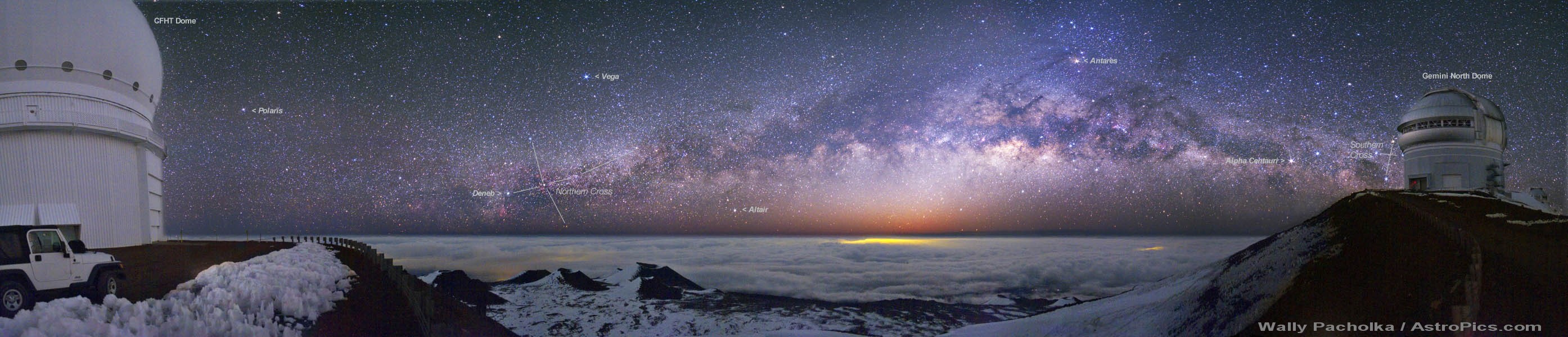
      Aloha and welcome to a breathtaking skyscape. The dreamlike panoramic view looks out from the 4,200 meter volcanic summit of Mauna Kea, Hawai'i, across a layer of clouds toward a starry night sky and the rising Milky Way. Anchoring the scene on the far left is the dome of the Canada-France-Hawaii Telescope (CFHT), with north star Polaris shining beyond the dome to the right. Farther right, headed by bright star Deneb, the Northern Cross asterism is embedded along the plane of the Milky Way as it peeks above the horizon. Both Northern Cross and brilliant white Vega hang over a foreground grouping of cinder cones. Near the center are the reddish nebulae, stars and dust clouds of the central Milky Way. Below, illumination from the city lights of Hilo creates an eerie, greenish glow in the clouds. Red supergiant star Antares shines above the Milky Way's central bulge while bright Alpha Centauri lies still farther right, along the dusty galactic plane. Finally, at the far right is the large Gemini North Observatory. The compact group of stars known as the Southern Cross is just left of the telescope dome.
      1st in Kommisar's 2009 SM Tournament
      1st in I Love You`s 2009 New Year`s Tournament
      3rd in EnR's Mashfest '08 tournament
      5th in Phynx's Unofficial FFR Tournament
      9th in D3 of the 2008-2009 4th Official FFR Tournament
      10th in D5 of the 2010 5th Official FFR Tournament
      10th in D6 of the 2011-2012 6th Official FFR Tournament

      FMO AAA Count: 71
      FGO AAA Count: 10

      Bluearrowll = The Canadian player who can not detect awkward patterns. If it's awkward for most people, it's normal for Terry. If the file is difficult but super straight forward, he has issues. If he's AAAing a FGO but then heard that his favorite Hockey team was losing by a point, Hockey > FFR
      PS: Cool AAA's Terry
      - I Love You


      An Alarm Clock's Haiku
      beep beep beep beep beep
      beep beep beep beep beep beep beep
      beep beep beep beep beep
      - ieatyourlvllol

      Comment

      • EzExZeRo7497
        • Dec 2010
        • 6858

        #468
        Re: Terry's Astronomy Thread.

        Happy birthday Astronomy Thread!!!

        Comment

        • retching oesophagus
          (^._.^) =^-ω-^= (^・o・^)ノ
          • Jan 2008
          • 805

          #469
          Re: Terry's Astronomy Thread.

          hbd thread. now time for some cake!

          Comment

          • Bluearrowll
            ⊙▃⊙
            FFR Simfile Author
            • Nov 2007
            • 7376

            #470
            Re: Terry's Astronomy Thread.

            What's in the sky tonight?
            March 11, 2013


            -Comet PANSTARRS now makes its way to the northern hemisphere - however depending on your location it will be difficult to spot today and tomorrow.

            -Look west after sunset near the horizon. Binoculars may be needed to pick Comet PanSTARRS out of the bright sky. Look too early and the sky will be too bright; too late and the comet will be too low. On the altitude scale at left, 10° is about the width of your fist held at arm's length.

            -This diagram is drawn for a viewer near 40° north latitude (Denver, New York, Madrid) 30 minutes after sunset. If you're south of there, the comet will be a little higher above your horizon early in the month than shown here. North of 40°, it will be a little lower early in March than shown here.

            An accurate visual representation of what you can expect Comet PANSTARRS to look like in the bright twilight:

            Toni Scarmato in Calabria, Italy, latitude 38°, caught this image March 10th in bright twilight using a 300-mm telephoto lens for a 1-second exposure. The frame is just 2.8° tall.

            -It being March, bright Sirius is highest in the south on the meridian after dark. Sirius is the closest naked-eye star that's ever visible from mid-northern latitudes (aside from the Sun). It's only 8.6 light-years away.

            -Using binoculars, look below Sirius by almost a binocular field-of-view for a dimly glowing patch among the stars. This is the open star cluster M41, 2,200 light-years away.

            New Moon (exact at 3:51 p.m. Eastern Daylight Time).

            Astro Picture of the Day:
            March 11, 2013

            Source:
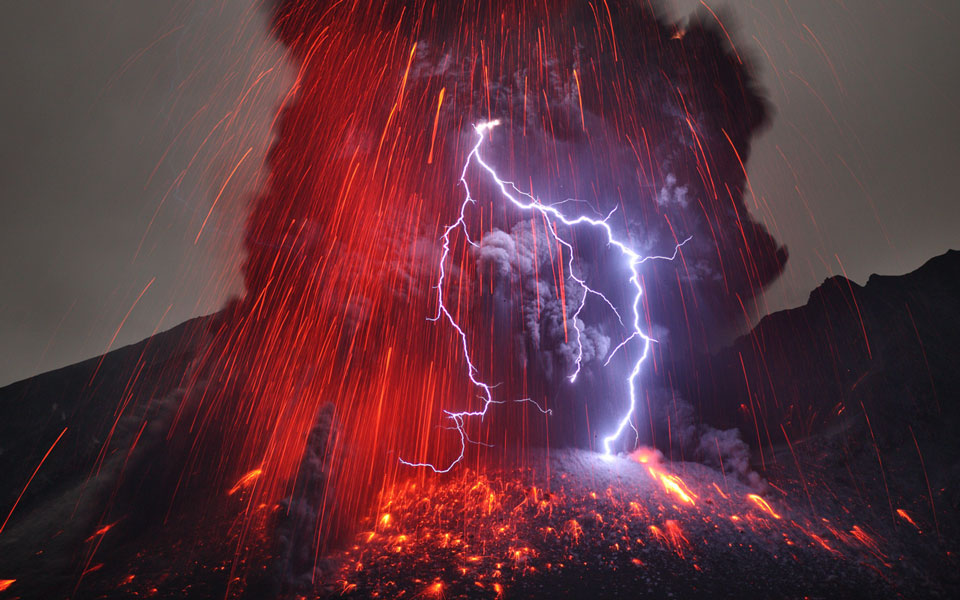
            Why does a volcanic eruption sometimes create lightning? Pictured above, the Sakurajima volcano in southern Japan was caught erupting in early January. Magma bubbles so hot they glow shoot away as liquid rock bursts through the Earth's surface from below. The above image is particularly notable, however, for the lightning bolts caught near the volcano's summit. Why lightning occurs even in common thunderstorms remains a topic of research, and the cause of volcanic lightning is even less clear. Surely, lightning bolts help quench areas of opposite but separated electric charges. One hypothesis holds that catapulting magma bubbles or volcanic ash are themselves electrically charged, and by their motion create these separated areas. Other volcanic lightning episodes may be facilitated by charge-inducing collisions in volcanic dust. Lightning is usually occurring somewhere on Earth, typically over 40 times each second.
            1st in Kommisar's 2009 SM Tournament
            1st in I Love You`s 2009 New Year`s Tournament
            3rd in EnR's Mashfest '08 tournament
            5th in Phynx's Unofficial FFR Tournament
            9th in D3 of the 2008-2009 4th Official FFR Tournament
            10th in D5 of the 2010 5th Official FFR Tournament
            10th in D6 of the 2011-2012 6th Official FFR Tournament

            FMO AAA Count: 71
            FGO AAA Count: 10

            Bluearrowll = The Canadian player who can not detect awkward patterns. If it's awkward for most people, it's normal for Terry. If the file is difficult but super straight forward, he has issues. If he's AAAing a FGO but then heard that his favorite Hockey team was losing by a point, Hockey > FFR
            PS: Cool AAA's Terry
            - I Love You


            An Alarm Clock's Haiku
            beep beep beep beep beep
            beep beep beep beep beep beep beep
            beep beep beep beep beep
            - ieatyourlvllol

            Comment

            • Bluearrowll
              ⊙▃⊙
              FFR Simfile Author
              • Nov 2007
              • 7376

              #471
              Re: Terry's Astronomy Thread.

              What's in the sky tonight?
              March 12, 2013


              -Comet PANSTARRS now makes its way to the northern hemisphere - however depending on your location it will be difficult to spot today and tomorrow.

              -Look west after sunset near the horizon. Binoculars may be needed to pick Comet PanSTARRS out of the bright sky. Look too early and the sky will be too bright; too late and the comet will be too low. On the altitude scale at left, 10° is about the width of your fist held at arm's length.

              -This diagram is drawn for a viewer near 40° north latitude (Denver, New York, Madrid) 30 minutes after sunset. If you're south of there, the comet will be a little higher above your horizon early in the month than shown here. North of 40°, it will be a little lower early in March than shown here.

              An accurate visual representation of what you can expect Comet PANSTARRS to look like in the bright twilight:

              Toni Scarmato in Calabria, Italy, latitude 38°, caught this image March 10th in bright twilight using a 300-mm telephoto lens for a 1-second exposure. The frame is just 2.8° tall.

              -Look very low in the west about 30 minutes after sunset for the thin waxing crescent Moon, not much more than 24 hours old, as shown at right. As seen from North America, Comet PanSTARRS is now left of the Moon by two or three finger-widths at arm's length. It's a hazy "star" with a thin, upward pointing tail only about 1° long. Bring binoculars for a better view.

              -And think photo opportunity! Use a long or zoomed-out lens, and put your camera on a tripod because with a long lens in twilight, exposures won't be short. Experiment with a variety of exposures.

              Astro Picture of the Day:
              March 12, 2013

              Source:
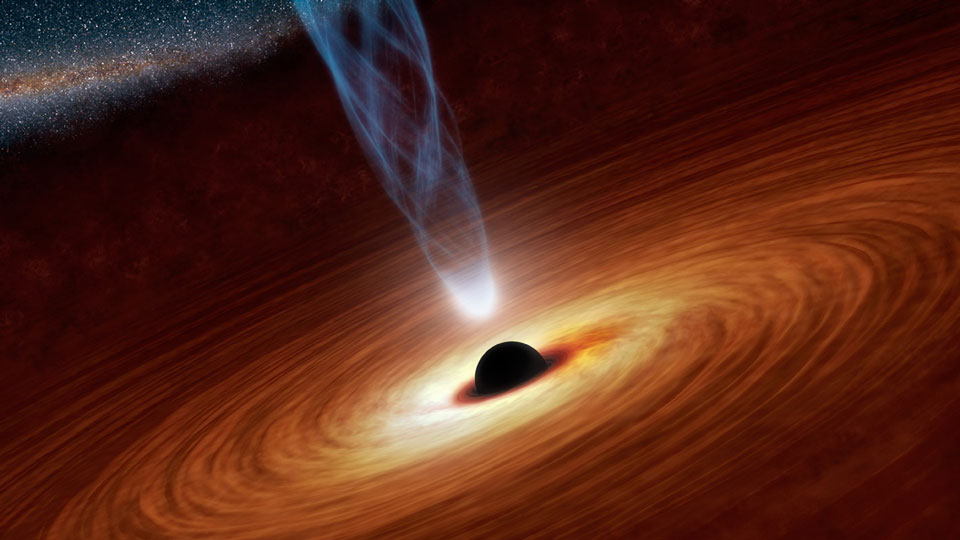
              How fast can a black hole spin? If any object made of regular matter spins too fast - it breaks apart. But a black hole might not be able to break apart - and its maximum spin rate is really unknown. Theorists usual model rapidly rotating black holes with the Kerr solution to Einstein's General Theory of Relativity, which predicts several amazing and unusual things. Perhaps its most easily testable prediction, though, is that matter entering a maximally rotating black hole should be last seen orbiting at near the speed of light, as seen from far away. This prediction was tested recently by NASA's NuSTAR and ESA's XMM satellites by observing the supermassive black hole at the center of spiral galaxy NGC 1365. The near light-speed limit was confirmed by measuring the heating and spectral line broadening of nuclear emissions at the inner edge of the surrounding accretion disk. Pictured above is an artist's illustration depicting an accretion disk of normal matter swirling around a black hole, with a jet emanating from the top. Since matter randomly falling into the black hole should not spin up a black hole this much, the NuSTAR and XMM measurements also validate the existence of the surrounding accretion disk.
              1st in Kommisar's 2009 SM Tournament
              1st in I Love You`s 2009 New Year`s Tournament
              3rd in EnR's Mashfest '08 tournament
              5th in Phynx's Unofficial FFR Tournament
              9th in D3 of the 2008-2009 4th Official FFR Tournament
              10th in D5 of the 2010 5th Official FFR Tournament
              10th in D6 of the 2011-2012 6th Official FFR Tournament

              FMO AAA Count: 71
              FGO AAA Count: 10

              Bluearrowll = The Canadian player who can not detect awkward patterns. If it's awkward for most people, it's normal for Terry. If the file is difficult but super straight forward, he has issues. If he's AAAing a FGO but then heard that his favorite Hockey team was losing by a point, Hockey > FFR
              PS: Cool AAA's Terry
              - I Love You


              An Alarm Clock's Haiku
              beep beep beep beep beep
              beep beep beep beep beep beep beep
              beep beep beep beep beep
              - ieatyourlvllol

              Comment

              • Bluearrowll
                ⊙▃⊙
                FFR Simfile Author
                • Nov 2007
                • 7376

                #472
                Re: Terry's Astronomy Thread.

                What's in the sky tonight?
                March 13, 2013


                -Comet PANSTARRS now makes its way to the northern hemisphere - however depending on your location it will be difficult to spot today and tomorrow.

                -Look west after sunset near the horizon. Binoculars may be needed to pick Comet PanSTARRS out of the bright sky. Look too early and the sky will be too bright; too late and the comet will be too low. On the altitude scale at left, 10° is about the width of your fist held at arm's length.

                -This diagram is drawn for a viewer near 40° north latitude (Denver, New York, Madrid) 30 minutes after sunset. If you're south of there, the comet will be a little higher above your horizon early in the month than shown here. North of 40°, it will be a little lower early in March than shown here.


                Jose Galvez in Washington DC, USA, caught this image March 12th in bright twilight using a SONY DSC-HX200V for a 7-second exposure. The thin crescent moon and comet are clearly visible side by side.

                -Comet PanSTARRS is now below the thickening crescent Moon 30 to 45 minutes after sunset, by about a fist-width at arm's length.

                Astro Picture of the Day:
                March 13, 2013

                Source:
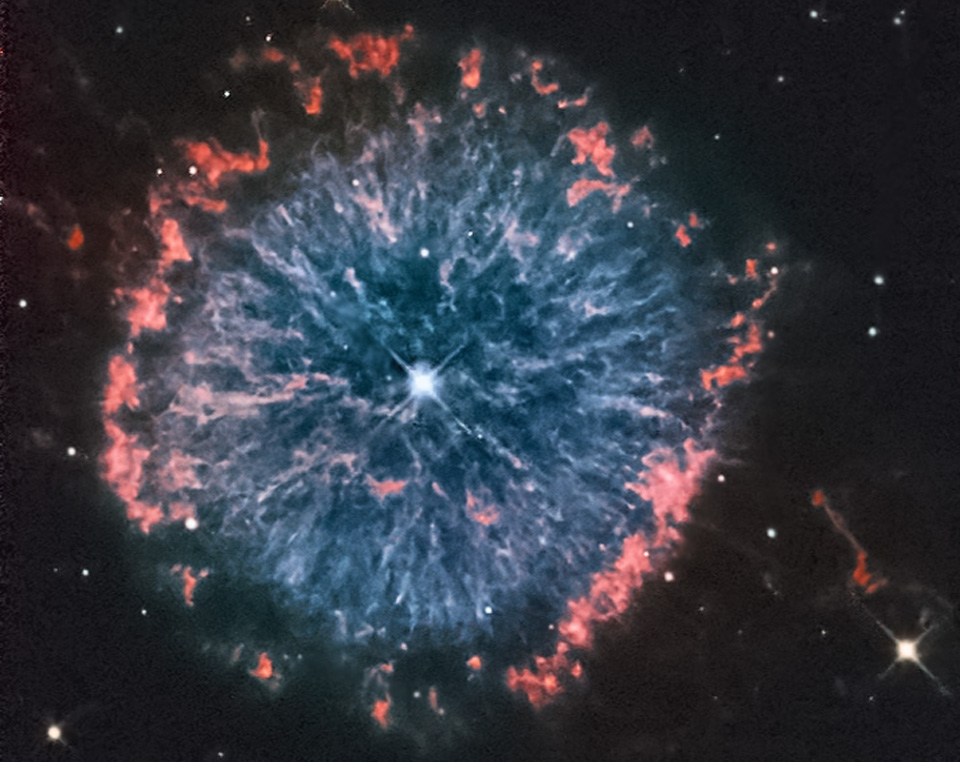
                Planetary nebulae can look simple, round, and planet-like in small telescopes. But images from the orbiting Hubble Space Telescope have become well known for showing these fluorescent gas shrouds of dying Sun-like stars to possess a staggering variety of detailed symmetries and shapes. This composite color Hubble image of NGC 6751, the Glowing Eye Nebula, is a beautiful example of a classic planetary nebula with complex features. It was selected in April of 2000 to commemorate the tenth anniversary of Hubble in orbit, but was reprocessed recently by an amateur as part of the Hubble Legacy program. Winds and radiation from the intensely hot central star (140,000 degrees Celsius) have apparently created the nebula's streamer-like features. The nebula's actual diameter is approximately 0.8 light-years or about 600 times the size of our Solar System. NGC 6751 is 6,500 light-years distant in the high-flying constellation of the Eagle (Aquila).
                1st in Kommisar's 2009 SM Tournament
                1st in I Love You`s 2009 New Year`s Tournament
                3rd in EnR's Mashfest '08 tournament
                5th in Phynx's Unofficial FFR Tournament
                9th in D3 of the 2008-2009 4th Official FFR Tournament
                10th in D5 of the 2010 5th Official FFR Tournament
                10th in D6 of the 2011-2012 6th Official FFR Tournament

                FMO AAA Count: 71
                FGO AAA Count: 10

                Bluearrowll = The Canadian player who can not detect awkward patterns. If it's awkward for most people, it's normal for Terry. If the file is difficult but super straight forward, he has issues. If he's AAAing a FGO but then heard that his favorite Hockey team was losing by a point, Hockey > FFR
                PS: Cool AAA's Terry
                - I Love You


                An Alarm Clock's Haiku
                beep beep beep beep beep
                beep beep beep beep beep beep beep
                beep beep beep beep beep
                - ieatyourlvllol

                Comment

                • Bluearrowll
                  ⊙▃⊙
                  FFR Simfile Author
                  • Nov 2007
                  • 7376

                  #473
                  Re: Terry's Astronomy Thread.

                  What's in the sky tonight?
                  March 14, 2013


                  -Comet PANSTARRS now makes its way to the northern hemisphere - however depending on your location it will be difficult to spot today and tomorrow.

                  -Look west after sunset near the horizon. Binoculars may be needed to pick Comet PanSTARRS out of the bright sky. Look too early and the sky will be too bright; too late and the comet will be too low. On the altitude scale at left, 10° is about the width of your fist held at arm's length.

                  -This diagram is drawn for a viewer near 40° north latitude (Denver, New York, Madrid) 30 minutes after sunset. If you're south of there, the comet will be a little higher above your horizon early in the month than shown here. North of 40°, it will be a little lower early in March than shown here.


                  Source:
                  Piotr Potepa in Torun, Poland, caught this image March 13th in bright twilight using a Nikon D700 for a 3-second exposure. The thin crescent moon owns the night, and the photographer nicely reaches out to the comet.

                  -The place to look for PanSTARRS now is two fists below the crescent Moon in twilight and perhaps a bit to the right.

                  Astro Picture of the Day:
                  March 14, 2013

                  Source:
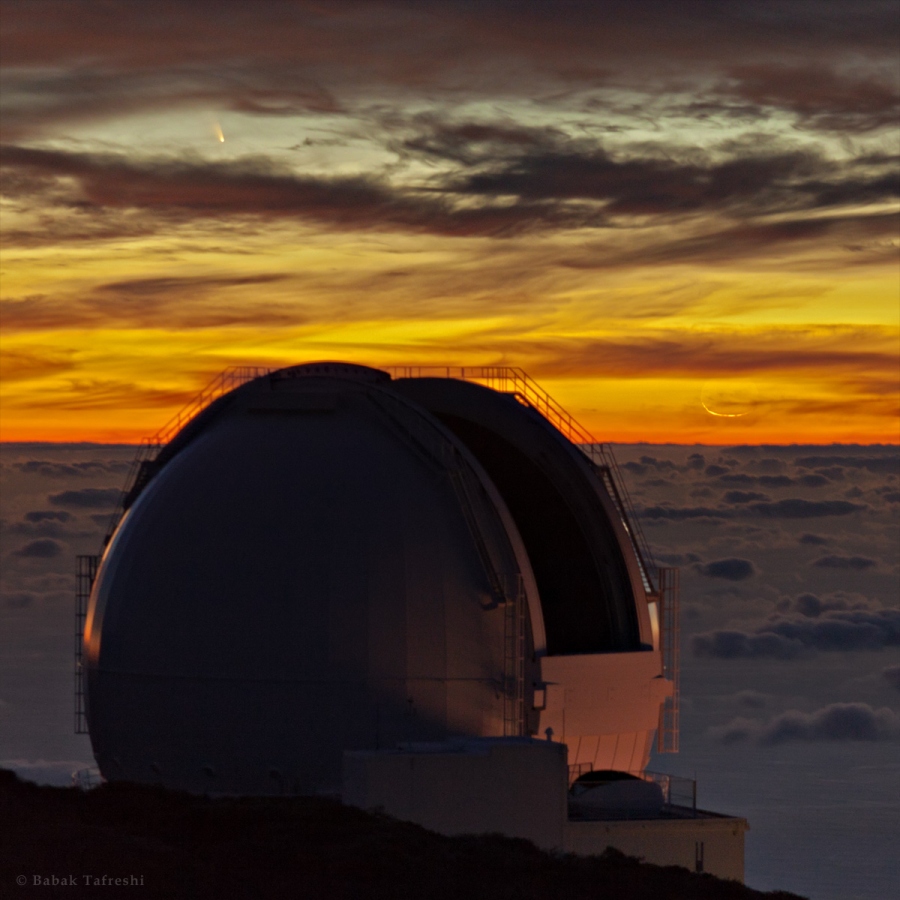
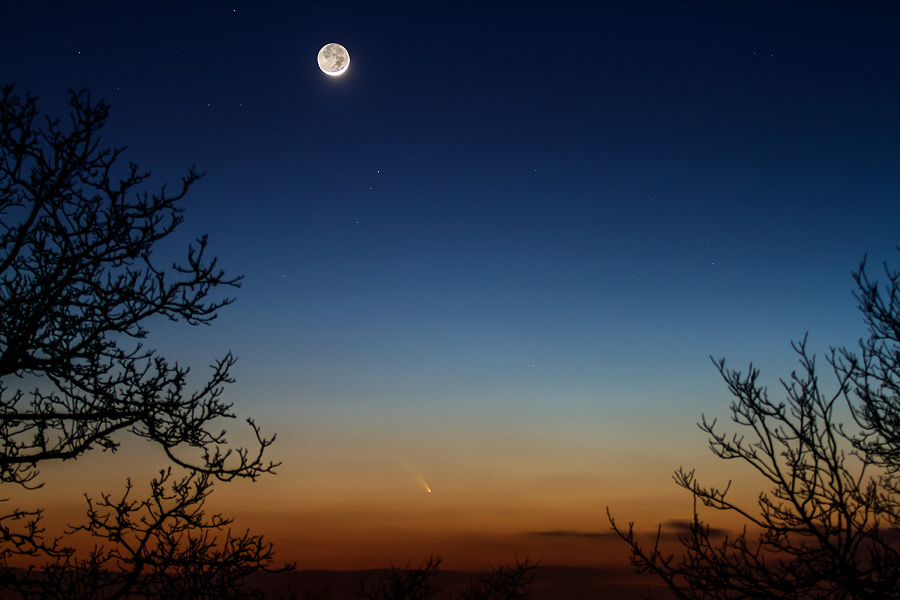
                  In silhouette against the colorful evening twilight glow, clouds part in this much anticipated magic moment. The scene captures naked-eye Comet PanSTARRS peeking into northern hemisphere skies on March 12. The comet stands over the western horizon after sunset, joined by the thin, flattened crescent of a day old Moon. Posing for its own beauty shot, the subtly lit dome of the 4.2 meter William Herschel Telescope is perched above cloud banks on the Canary Island of La Palma. While PanSTARRS has not quite developed into the spectacular comet once hoped for, it is still growing easier to see in the north. In coming days it will steadily climb north, farther from the Sun into darker western evening skies.
                  1st in Kommisar's 2009 SM Tournament
                  1st in I Love You`s 2009 New Year`s Tournament
                  3rd in EnR's Mashfest '08 tournament
                  5th in Phynx's Unofficial FFR Tournament
                  9th in D3 of the 2008-2009 4th Official FFR Tournament
                  10th in D5 of the 2010 5th Official FFR Tournament
                  10th in D6 of the 2011-2012 6th Official FFR Tournament

                  FMO AAA Count: 71
                  FGO AAA Count: 10

                  Bluearrowll = The Canadian player who can not detect awkward patterns. If it's awkward for most people, it's normal for Terry. If the file is difficult but super straight forward, he has issues. If he's AAAing a FGO but then heard that his favorite Hockey team was losing by a point, Hockey > FFR
                  PS: Cool AAA's Terry
                  - I Love You


                  An Alarm Clock's Haiku
                  beep beep beep beep beep
                  beep beep beep beep beep beep beep
                  beep beep beep beep beep
                  - ieatyourlvllol

                  Comment

                  • Bluearrowll
                    ⊙▃⊙
                    FFR Simfile Author
                    • Nov 2007
                    • 7376

                    #474
                    Re: Terry's Astronomy Thread.

                    What's in the sky tonight?
                    March 15, 2013


                    -Comet PANSTARRS now makes its way to the northern hemisphere - however depending on your location it will be difficult to spot today and tomorrow.

                    -Look west after sunset near the horizon. Binoculars may be needed to pick Comet PanSTARRS out of the bright sky. Look too early and the sky will be too bright; too late and the comet will be too low. On the altitude scale at left, 10° is about the width of your fist held at arm's length.

                    -This diagram is drawn for a viewer near 40° north latitude (Denver, New York, Madrid) 30 minutes after sunset. If you're south of there, the comet will be a little higher above your horizon early in the month than shown here. North of 40°, it will be a little lower early in March than shown here.


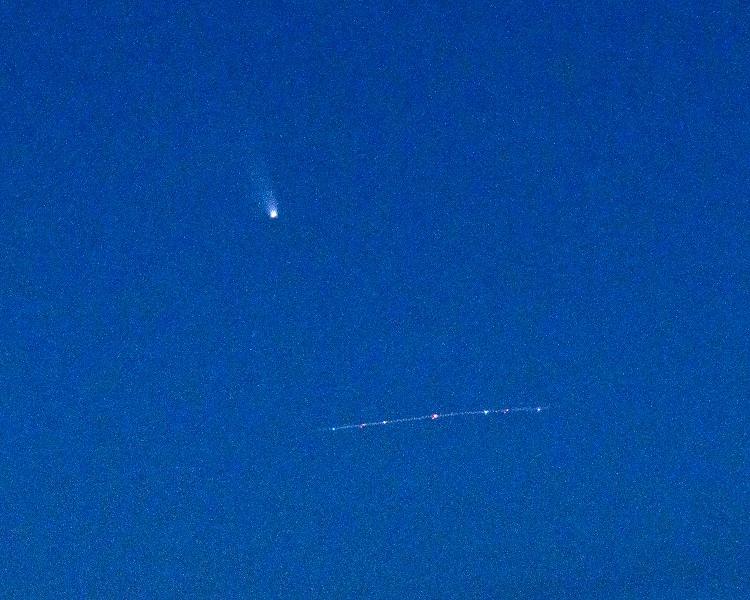
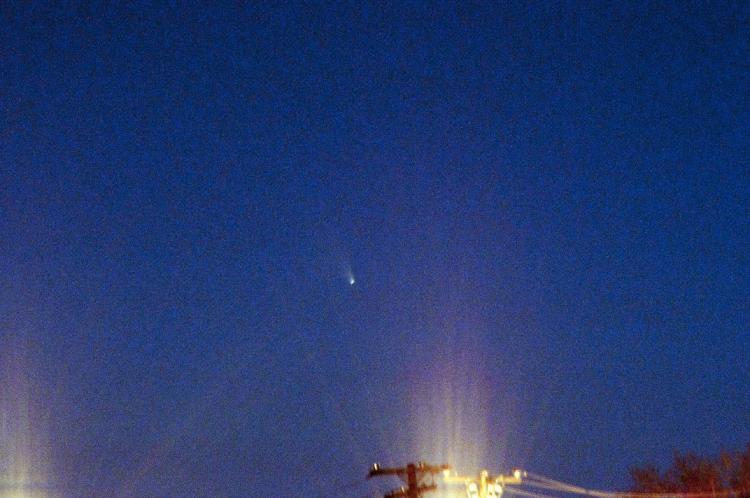
                    Yesterday night instead of playing my tournament song for hours and hours I ventured out into one of the larger parks the city has, Downsview Park for a couple hours to spot Comet PANSTARRS. Two of the resulting images are shown here - one with a distant plane crossing in the distance, the other with an actual size view of PANSTARRS in the distance with a hydro pole as perspective.

                    -Look high above the Moon after dark for the Pleiades. Upper left of the Pleiades shines bright Jupiter with Aldebaran to its left, as shown here.

                    -As soon as it gets dark now, the Big Dipper has climbed as high in the northeast as Cassiopeia has sunk in the northwest.

                    -Watch the Moon wax to, and through, the evening Jupiter group. (Drawn for the middle of North America. European observers: move each Moon symbol a quarter of the way toward the one for the previous date. The Moon is shown three times its actual size.)


                    Astro Picture of the Day:
                    March 15, 2013

                    Source:
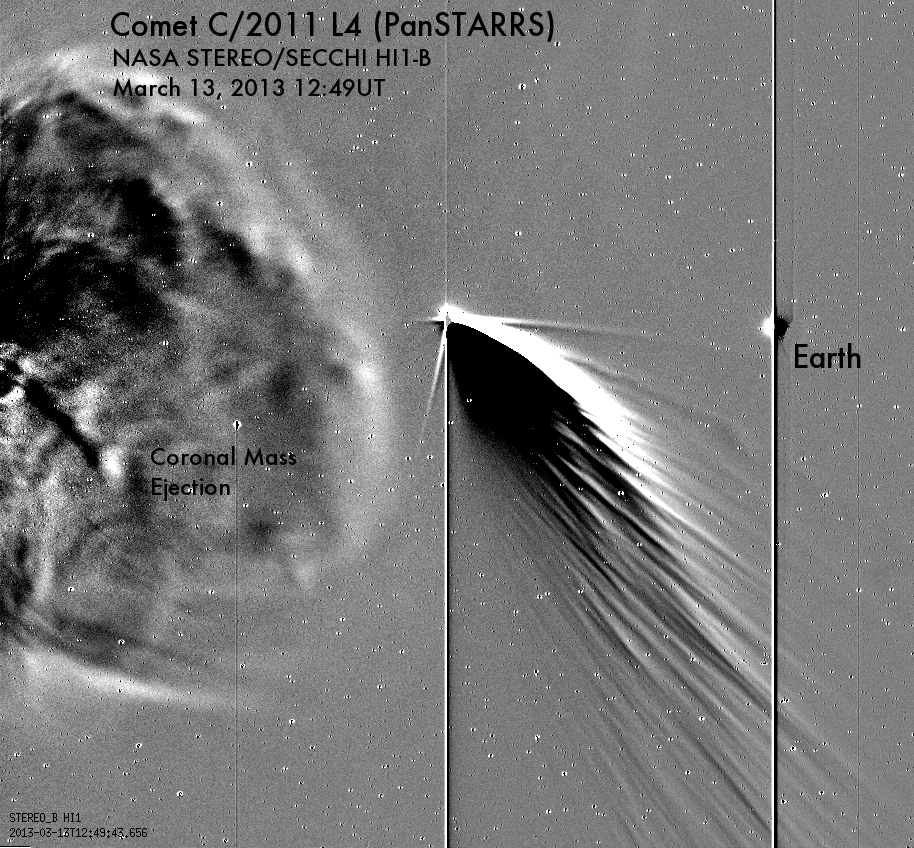
                    After appearing in a popular photo opportunity with a young crescent Moon near sunset, naked-eye Comet PanSTARRS continues to rise in northern hemisphere skies. But this remarkable interplanetary perspective from March 13, finds the comet posing with our fair planet itself - as seen from the STEREO Behind spacecraft. Following in Earth's orbit, the spacecraft is nearly opposite the Sun and looks back toward the comet and Earth, with the Sun just off the left side of the frame. At the left an enormous coronal mass ejection (CME) is erupting from a solar active region. Of course, CME, comet, and planet Earth are all at different distances from the spacecraft. (The comet is closest.) The processed digital image is the difference between two consecutive frames from the spacecraft's SECCHI Heliospheric Imager, causing the strong shadowing effect for objects that move between frames. Objects that are too bright create the sharp vertical lines. The processing reveals complicated feather-like structures in Comet PanSTARRS's extensive dust tail.
                    1st in Kommisar's 2009 SM Tournament
                    1st in I Love You`s 2009 New Year`s Tournament
                    3rd in EnR's Mashfest '08 tournament
                    5th in Phynx's Unofficial FFR Tournament
                    9th in D3 of the 2008-2009 4th Official FFR Tournament
                    10th in D5 of the 2010 5th Official FFR Tournament
                    10th in D6 of the 2011-2012 6th Official FFR Tournament

                    FMO AAA Count: 71
                    FGO AAA Count: 10

                    Bluearrowll = The Canadian player who can not detect awkward patterns. If it's awkward for most people, it's normal for Terry. If the file is difficult but super straight forward, he has issues. If he's AAAing a FGO but then heard that his favorite Hockey team was losing by a point, Hockey > FFR
                    PS: Cool AAA's Terry
                    - I Love You


                    An Alarm Clock's Haiku
                    beep beep beep beep beep
                    beep beep beep beep beep beep beep
                    beep beep beep beep beep
                    - ieatyourlvllol

                    Comment

                    • Bluearrowll
                      ⊙▃⊙
                      FFR Simfile Author
                      • Nov 2007
                      • 7376

                      #475
                      Re: Terry's Astronomy Thread.

                      What's in the sky tonight?
                      March 16, 2013


                      -Comet PANSTARRS now makes its way to the northern hemisphere - however depending on your location it will be difficult to spot today and tomorrow.

                      -Look west after sunset near the horizon. Binoculars may be needed to pick Comet PanSTARRS out of the bright sky. Look too early and the sky will be too bright; too late and the comet will be too low. On the altitude scale at left, 10° is about the width of your fist held at arm's length.

                      -This diagram is drawn for a viewer near 40° north latitude (Denver, New York, Madrid) 30 minutes after sunset. If you're south of there, the comet will be a little higher above your horizon early in the month than shown here. North of 40°, it will be a little lower early in March than shown here.

                      -After dusk, the waxing Moon shines in the west with the Pleiades to its upper right and Jupiter and Aldebaran farther to its upper left, as shown here.

                      -Watch the Moon wax to, and through, the evening Jupiter group. (Drawn for the middle of North America. European observers: move each Moon symbol a quarter of the way toward the one for the previous date. The Moon is shown three times its actual size.)


                      Astro Picture of the Day:
                      March 16, 2013

                      Source:
                      Still looking for that comet? Comet PanSTARRS (C/2011 L4) naked-eye appearance in the northern hemisphere is described by successful comet spotters as a dim star with faint a tail. If you want to catch it the next few days could be your best bet. Start looking low and almost due west about 45 minutes after sunset. Of course, clear skies and a pair of binoculars should help a lot. Sky photographer Jean-Luc Dauvergne found suitable weather and western horizon for this comet and crescent Moon portrait after a road trip on March 13. Seeing PanSTARRS for the first time, he recorded the beautiful twilight scene with a telephoto lens near historical Alesia in France.
                      1st in Kommisar's 2009 SM Tournament
                      1st in I Love You`s 2009 New Year`s Tournament
                      3rd in EnR's Mashfest '08 tournament
                      5th in Phynx's Unofficial FFR Tournament
                      9th in D3 of the 2008-2009 4th Official FFR Tournament
                      10th in D5 of the 2010 5th Official FFR Tournament
                      10th in D6 of the 2011-2012 6th Official FFR Tournament

                      FMO AAA Count: 71
                      FGO AAA Count: 10

                      Bluearrowll = The Canadian player who can not detect awkward patterns. If it's awkward for most people, it's normal for Terry. If the file is difficult but super straight forward, he has issues. If he's AAAing a FGO but then heard that his favorite Hockey team was losing by a point, Hockey > FFR
                      PS: Cool AAA's Terry
                      - I Love You


                      An Alarm Clock's Haiku
                      beep beep beep beep beep
                      beep beep beep beep beep beep beep
                      beep beep beep beep beep
                      - ieatyourlvllol

                      Comment

                      • Bluearrowll
                        ⊙▃⊙
                        FFR Simfile Author
                        • Nov 2007
                        • 7376

                        #476
                        Re: Terry's Astronomy Thread.

                        What's in the sky tonight?
                        March 17, 2013


                        -Comet PanSTARRS, for all the attention it's receiving, has turned out to be barely visible to the unaided eye, and only if you know exactly where to look. That would be low in twilight, due west or just a little to the right of due west now, about 45 minutes after sunset. This week the comet starts fading even as it gains a bit more altitude as seen from the world's mid-northern latitudes. Bring binoculars or, better, a low-power, wide-field telescope.

                        -This diagram is drawn for a viewer near 40° north latitude (Denver, New York, Madrid) 30 minutes after sunset. If you're south of there, the comet will be a little higher above your horizon early in the month than shown here. North of 40°, it will be a little lower early in March than shown here.

                        -The Moon this evening passes right between Jupiter and Aldebaran, depending on your location. Gathered around are the Hyades, and nearby are the Pleiades. Think photo opportunity.

                        -Watch the Moon wax to, and through, the evening Jupiter group. (Drawn for the middle of North America. European observers: move each Moon symbol a quarter of the way toward the one for the previous date. The Moon is shown three times its actual size.)


                        Astro Picture of the Day:
                        March 17, 2013

                        Source:
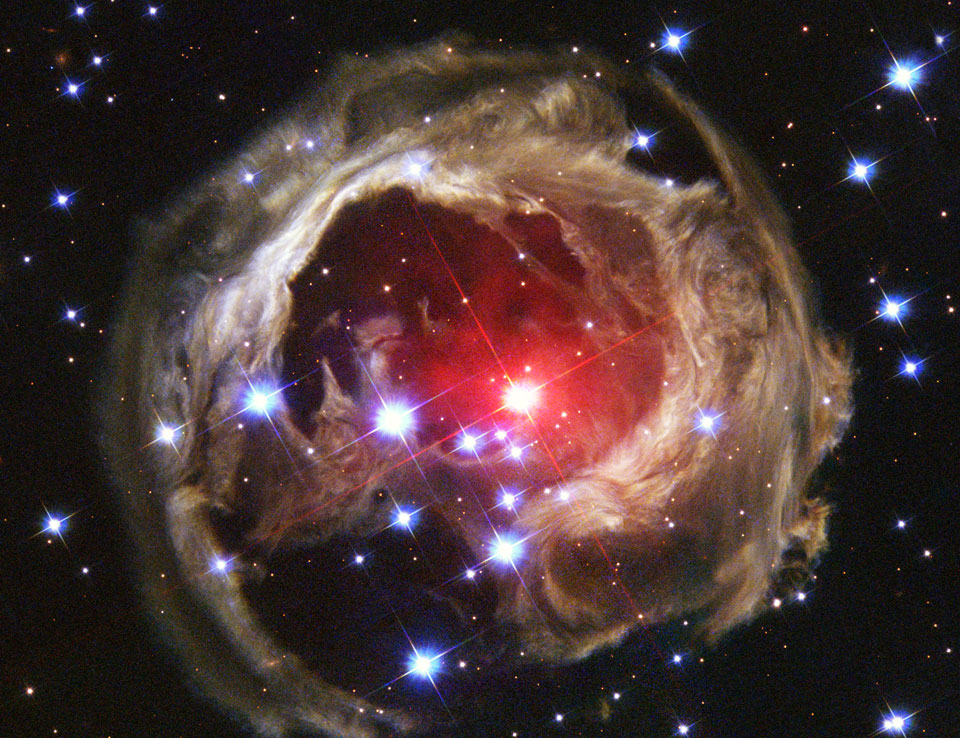
                        What caused this outburst of V838 Mon? For reasons unknown, star V838 Mon's outer surface suddenly greatly expanded with the result that it became the brightest star in the entire Milky Way Galaxy in January 2002. Then, just as suddenly, it faded. A stellar flash like this had never been seen before - supernovas and novas expel matter out into space. Although the V838 Mon flash appears to expel material into space, what is seen in the above image from the Hubble Space Telescope is actually an outwardly moving light echo of the bright flash. In a light echo, light from the flash is reflected by successively more distant rings in the complex array of ambient interstellar dust that already surrounded the star. V838 Mon lies about 20,000 light years away toward the constellation of the unicorn (Monoceros), while the light echo above spans about six light years in diameter.
                        1st in Kommisar's 2009 SM Tournament
                        1st in I Love You`s 2009 New Year`s Tournament
                        3rd in EnR's Mashfest '08 tournament
                        5th in Phynx's Unofficial FFR Tournament
                        9th in D3 of the 2008-2009 4th Official FFR Tournament
                        10th in D5 of the 2010 5th Official FFR Tournament
                        10th in D6 of the 2011-2012 6th Official FFR Tournament

                        FMO AAA Count: 71
                        FGO AAA Count: 10

                        Bluearrowll = The Canadian player who can not detect awkward patterns. If it's awkward for most people, it's normal for Terry. If the file is difficult but super straight forward, he has issues. If he's AAAing a FGO but then heard that his favorite Hockey team was losing by a point, Hockey > FFR
                        PS: Cool AAA's Terry
                        - I Love You


                        An Alarm Clock's Haiku
                        beep beep beep beep beep
                        beep beep beep beep beep beep beep
                        beep beep beep beep beep
                        - ieatyourlvllol

                        Comment

                        • Bluearrowll
                          ⊙▃⊙
                          FFR Simfile Author
                          • Nov 2007
                          • 7376

                          #477
                          Re: Terry's Astronomy Thread.

                          What's in the sky tonight?
                          March 18, 2013


                          -Comet PanSTARRS, for all the attention it's receiving, has turned out to be barely visible to the unaided eye, and only if you know exactly where to look. That would be low in twilight, due west or just a little to the right of due west now, about 45 minutes after sunset. This week the comet starts fading even as it gains a bit more altitude as seen from the world's mid-northern latitudes. Bring binoculars or, better, a low-power, wide-field telescope.

                          -This diagram is drawn for a viewer near 40° north latitude (Denver, New York, Madrid) 30 minutes after sunset. If you're south of there, the comet will be a little higher above your horizon early in the month than shown here. North of 40°, it will be a little lower early in March than shown here.

                          -Look lower right of the Moon this evening for Jupiter, and upper right of the Moon for Beta Tauri (El Nath).


                          Astro Picture of the Day:
                          March 18, 2013

                          Source:
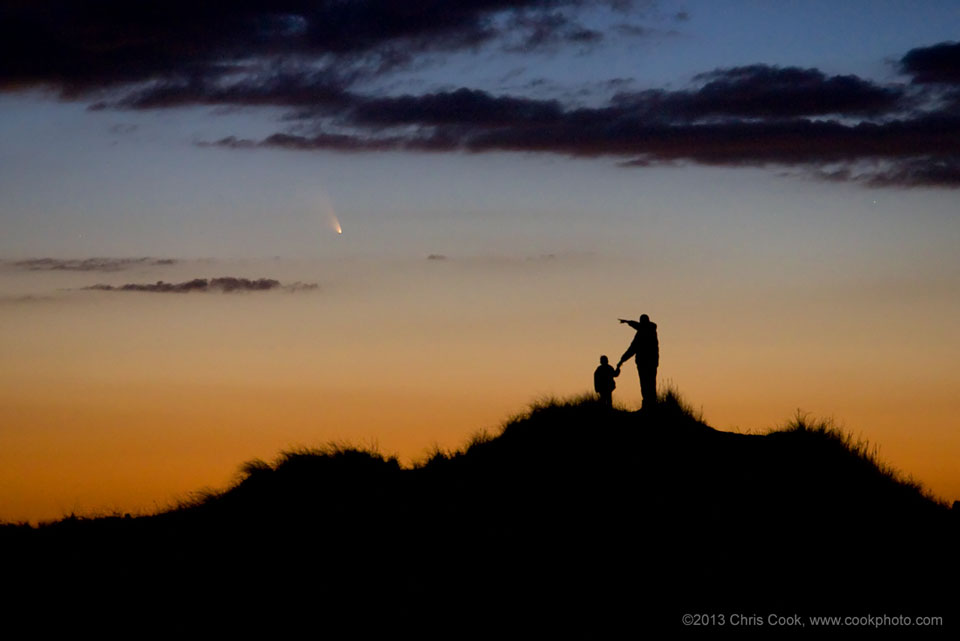
                          Have you seen the comet? As Comet PANSTARRS fades, careful observers - even with unaided eyes - should still be able to find the shedding ice ball on the western horizon just after sunset. Pictured above, Comet PANSTARRS (C/2011 L4) was pointed out from a hilltop last week on First Encounter Beach in Massachusetts, USA. The comet was discovered by - and is named for - the Pan-STARRS astronomical sky survey that discovered it. As the comet now recedes from both the Earth and the Sun, it will remain visible further into the night, although binoculars or a small telescope will soon to be needed to find it.
                          1st in Kommisar's 2009 SM Tournament
                          1st in I Love You`s 2009 New Year`s Tournament
                          3rd in EnR's Mashfest '08 tournament
                          5th in Phynx's Unofficial FFR Tournament
                          9th in D3 of the 2008-2009 4th Official FFR Tournament
                          10th in D5 of the 2010 5th Official FFR Tournament
                          10th in D6 of the 2011-2012 6th Official FFR Tournament

                          FMO AAA Count: 71
                          FGO AAA Count: 10

                          Bluearrowll = The Canadian player who can not detect awkward patterns. If it's awkward for most people, it's normal for Terry. If the file is difficult but super straight forward, he has issues. If he's AAAing a FGO but then heard that his favorite Hockey team was losing by a point, Hockey > FFR
                          PS: Cool AAA's Terry
                          - I Love You


                          An Alarm Clock's Haiku
                          beep beep beep beep beep
                          beep beep beep beep beep beep beep
                          beep beep beep beep beep
                          - ieatyourlvllol

                          Comment

                          • Bluearrowll
                            ⊙▃⊙
                            FFR Simfile Author
                            • Nov 2007
                            • 7376

                            #478
                            Re: Terry's Astronomy Thread.

                            What's in the sky tonight?
                            March 19, 2013


                            -Comet PanSTARRS, for all the attention it's receiving, has turned out to be barely visible to the unaided eye, and only if you know exactly where to look. That would be low in twilight, due west or just a little to the right of due west now, about 45 minutes after sunset. This week the comet starts fading even as it gains a bit more altitude as seen from the world's mid-northern latitudes. Bring binoculars or, better, a low-power, wide-field telescope.

                            -This diagram is drawn for a viewer near 40° north latitude (Denver, New York, Madrid) 30 minutes after sunset. If you're south of there, the comet will be a little higher above your horizon early in the month than shown here. North of 40°, it will be a little lower early in March than shown here.

                            -First-quarter Moon (exact at 1:27 p.m. EDT). This evening the Moon shines between the feet of Gemini and the top of Orion's Club.

                            Astro Picture of the Day:
                            March 19, 2013

                            Source:
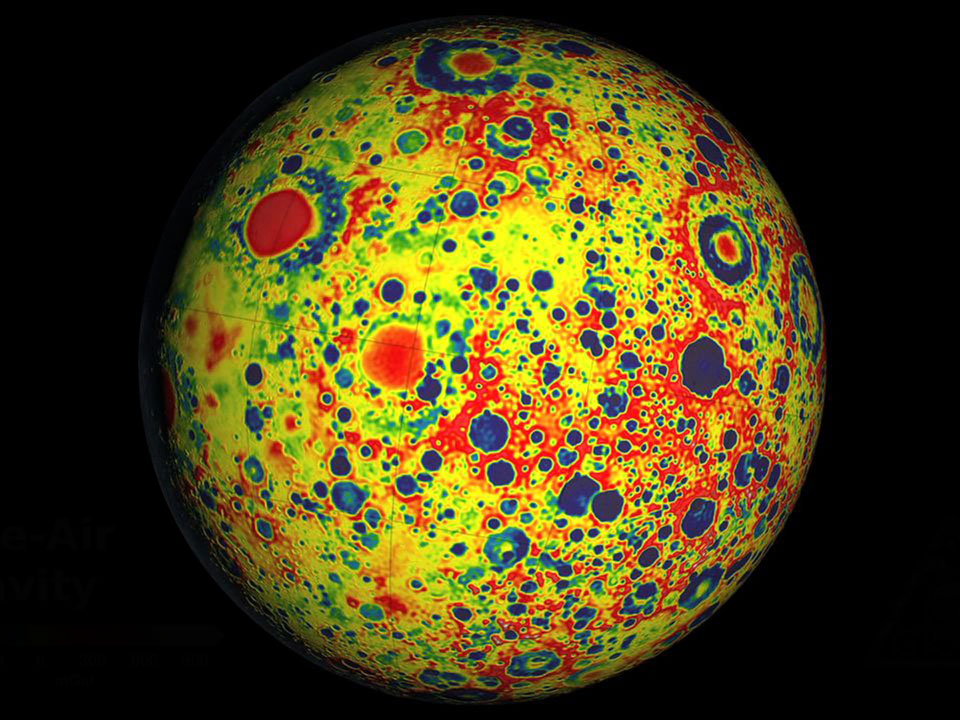
                            How did the Moon form? To help find out, NASA launched the twin Gravity Recovery and Interior Laboratory (GRAIL) satellites in 2011 to orbit and map the Moon's surface gravity in unprecedented detail. Pictured above is a resulting GRAIL gravity map, with regions of slightly lighter gravity shown in blue and regions of slightly stronger gravity shown in red. Analysis of GRAIL data indicates that the moon has an unexpectedly shallow crust than runs about 40 kilometers deep, and an overall composition similar to the Earth. Although other surprising structures have been discovered that will continue to be investigated, the results generally bolster the hypothesis that the Moon formed mostly from Earth material following a tremendous collision in the early years of our Solar System, about 4.5 billion years ago. After completing their mission and running low on fuel, the two GRAIL satellites, Ebb and Flow, were crashed into a lunar crater at about 6,000 kilometer per hour.
                            1st in Kommisar's 2009 SM Tournament
                            1st in I Love You`s 2009 New Year`s Tournament
                            3rd in EnR's Mashfest '08 tournament
                            5th in Phynx's Unofficial FFR Tournament
                            9th in D3 of the 2008-2009 4th Official FFR Tournament
                            10th in D5 of the 2010 5th Official FFR Tournament
                            10th in D6 of the 2011-2012 6th Official FFR Tournament

                            FMO AAA Count: 71
                            FGO AAA Count: 10

                            Bluearrowll = The Canadian player who can not detect awkward patterns. If it's awkward for most people, it's normal for Terry. If the file is difficult but super straight forward, he has issues. If he's AAAing a FGO but then heard that his favorite Hockey team was losing by a point, Hockey > FFR
                            PS: Cool AAA's Terry
                            - I Love You


                            An Alarm Clock's Haiku
                            beep beep beep beep beep
                            beep beep beep beep beep beep beep
                            beep beep beep beep beep
                            - ieatyourlvllol

                            Comment

                            • Bluearrowll
                              ⊙▃⊙
                              FFR Simfile Author
                              • Nov 2007
                              • 7376

                              #479
                              Re: Terry's Astronomy Thread.

                              What's in the sky tonight?
                              March 20, 2013


                              -Comet PanSTARRS, for all the attention it's receiving, has turned out to be barely visible to the unaided eye, and only if you know exactly where to look. That would be low in twilight, due west or just a little to the right of due west now, about 45 minutes after sunset. This week the comet starts fading even as it gains a bit more altitude as seen from the world's mid-northern latitudes. Bring binoculars or, better, a low-power, wide-field telescope.

                              -This diagram is drawn for a viewer near 40° north latitude (Denver, New York, Madrid) 30 minutes after sunset. If you're south of there, the comet will be a little higher above your horizon early in the month than shown here. North of 40°, it will be a little lower early in March than shown here.


                              Source:
                              Comet PanSTARRS on March 17th. Earth's changing viewpoint toward its flat, thin dust tail is making the tail appear wider. Note the hint of a thin, straight ion (gas) tail just to the right of the curving dust tail's edge. Enhanced images show that it's real.

                              -Face southwest after dark. Very high there shines the Moon. Even higher (depending on where you live) are Pollux and Castor. To the Moon's left or lower left is Procyon.

                              -Spring begins in the Northern Hemisphere at the equinox, 7:02 a.m. EDT, when the Sun crosses the equators of both Earth and sky heading north for the year. In the Southern Hemisphere, fall begins.

                              Astro Picture of the Day:
                              March 20, 2013

                              Source:
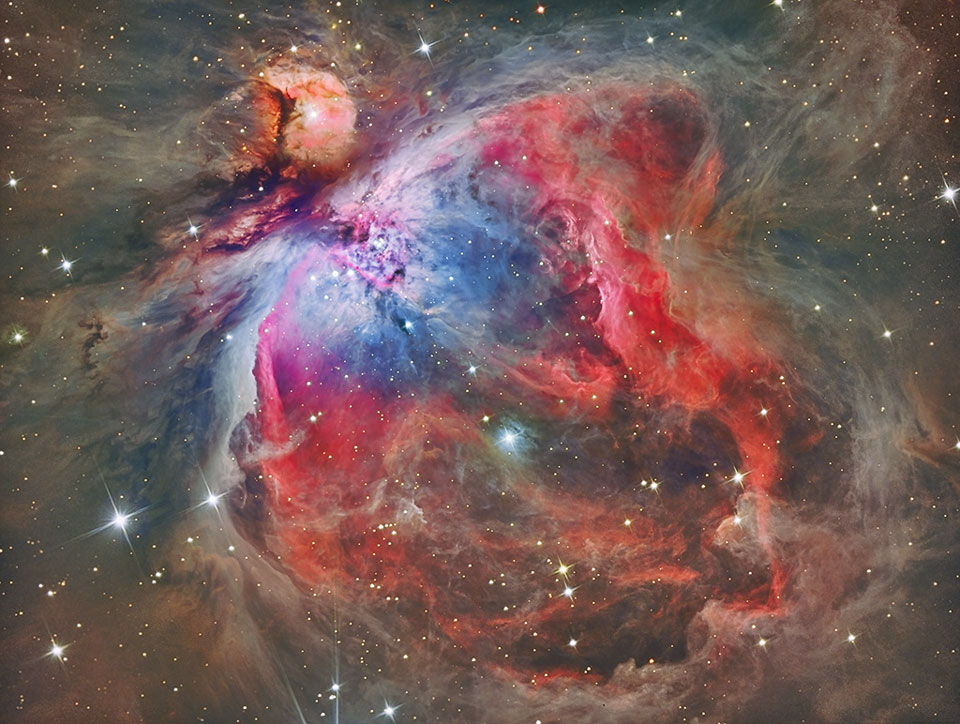
                              The Great Nebula in Orion, an immense, nearby starbirth region, is probably the most famous of all astronomical nebulas. Here, glowing gas surrounds hot young stars at the edge of an immense interstellar molecular cloud only 1500 light-years away. In the above deep image in assigned colors highlighted by emission in oxygen and hydrogen, wisps and sheets of dust and gas are particularly evident. The Great Nebula in Orion can be found with the unaided eye near the easily identifiable belt of three stars in the popular constellation Orion. In addition to housing a bright open cluster of stars known as the Trapezium, the Orion Nebula contains many stellar nurseries. These nurseries contain much hydrogen gas, hot young stars, proplyds, and stellar jets spewing material at high speeds. Also known as M42, the Orion Nebula spans about 40 light years and is located in the same spiral arm of our Galaxy as the Sun.
                              Last edited by Bluearrowll; 03-20-2013, 06:39 AM.
                              1st in Kommisar's 2009 SM Tournament
                              1st in I Love You`s 2009 New Year`s Tournament
                              3rd in EnR's Mashfest '08 tournament
                              5th in Phynx's Unofficial FFR Tournament
                              9th in D3 of the 2008-2009 4th Official FFR Tournament
                              10th in D5 of the 2010 5th Official FFR Tournament
                              10th in D6 of the 2011-2012 6th Official FFR Tournament

                              FMO AAA Count: 71
                              FGO AAA Count: 10

                              Bluearrowll = The Canadian player who can not detect awkward patterns. If it's awkward for most people, it's normal for Terry. If the file is difficult but super straight forward, he has issues. If he's AAAing a FGO but then heard that his favorite Hockey team was losing by a point, Hockey > FFR
                              PS: Cool AAA's Terry
                              - I Love You


                              An Alarm Clock's Haiku
                              beep beep beep beep beep
                              beep beep beep beep beep beep beep
                              beep beep beep beep beep
                              - ieatyourlvllol

                              Comment

                              • Bluearrowll
                                ⊙▃⊙
                                FFR Simfile Author
                                • Nov 2007
                                • 7376

                                #480
                                Re: Terry's Astronomy Thread.

                                What's in the sky tonight?
                                March 21, 2013
                                -High in the south after dusk, the Moon forms part of a big arc with Pollux and Castor to its upper right and Procyon below it.

                                -Saturn (magnitude +0.3, in Libra) rises in the east-southeast around 11 p.m. daylight saving time. Watch for it rising well to the lower left of Spica and farther to the lower right of brighter Arcturus. Saturn shines highest in the south in the early morning hours — more or less between Spica to its right and Antares farther to its lower left.
                                Saturn will come to opposition on the night of April 27th. In a telescope, Saturn's rings are now tilted a wide 19° from our line of sight.

                                Astro Picture of the Day:
                                March 21, 2013

                                Source:
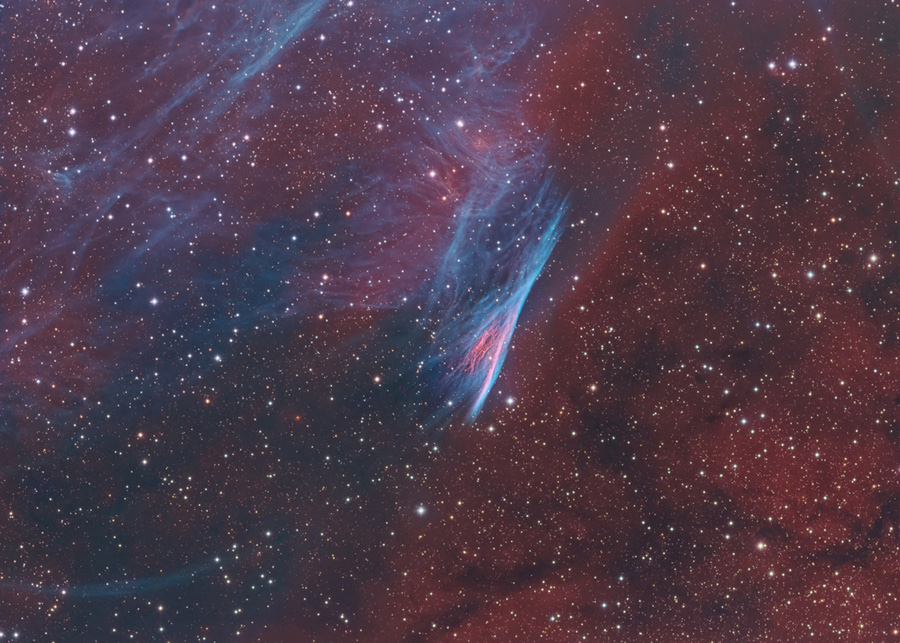
                                Moving left to right near the center of this beautifully detailed color composite, the thin, bright, braided filaments are actually long ripples in a sheet of glowing gas seen almost edge on. The interstellar shock wave plows through space at over 500,000 kilometers per hour. Cataloged as NGC 2736, its elongated appearance suggests its popular name, the Pencil Nebula. The Pencil Nebula is about 5 light-years long and 800 light-years away, but represents only a small part of the Vela supernova remnant. The Vela remnant itself is around 100 light-years in diameter, the expanding debris cloud of a star that was seen to explode about 11,000 years ago. Initially, the shock wave was moving at millions of kilometers per hour but has slowed considerably, sweeping up surrounding interstellar material. In the narrowband, wide field image, red and blue-green colors track the characteristic glow of ionized hydrogen and oxygen atoms.
                                1st in Kommisar's 2009 SM Tournament
                                1st in I Love You`s 2009 New Year`s Tournament
                                3rd in EnR's Mashfest '08 tournament
                                5th in Phynx's Unofficial FFR Tournament
                                9th in D3 of the 2008-2009 4th Official FFR Tournament
                                10th in D5 of the 2010 5th Official FFR Tournament
                                10th in D6 of the 2011-2012 6th Official FFR Tournament

                                FMO AAA Count: 71
                                FGO AAA Count: 10

                                Bluearrowll = The Canadian player who can not detect awkward patterns. If it's awkward for most people, it's normal for Terry. If the file is difficult but super straight forward, he has issues. If he's AAAing a FGO but then heard that his favorite Hockey team was losing by a point, Hockey > FFR
                                PS: Cool AAA's Terry
                                - I Love You


                                An Alarm Clock's Haiku
                                beep beep beep beep beep
                                beep beep beep beep beep beep beep
                                beep beep beep beep beep
                                - ieatyourlvllol

                                Comment

                                Working...