Terry's Astronomy Thread.

Collapse
X
 
  • Time
  • Show
Clear All
new posts
  • Bluearrowll
    ⊙▃⊙
    FFR Simfile Author
    • Nov 2007
    • 7376

    #586
    Re: Terry's Astronomy Thread.

    What's in the sky tonight?
    June 27, 2013
    -Venus (magnitude –3.8) is gaining altitude very gradually, low in the west-northwest in evening twilight. Use binoculars to pick up Pollux and Castor off to its upper right or right.

    -Mars and Jupiter remain hidden in the glare of the Sun.

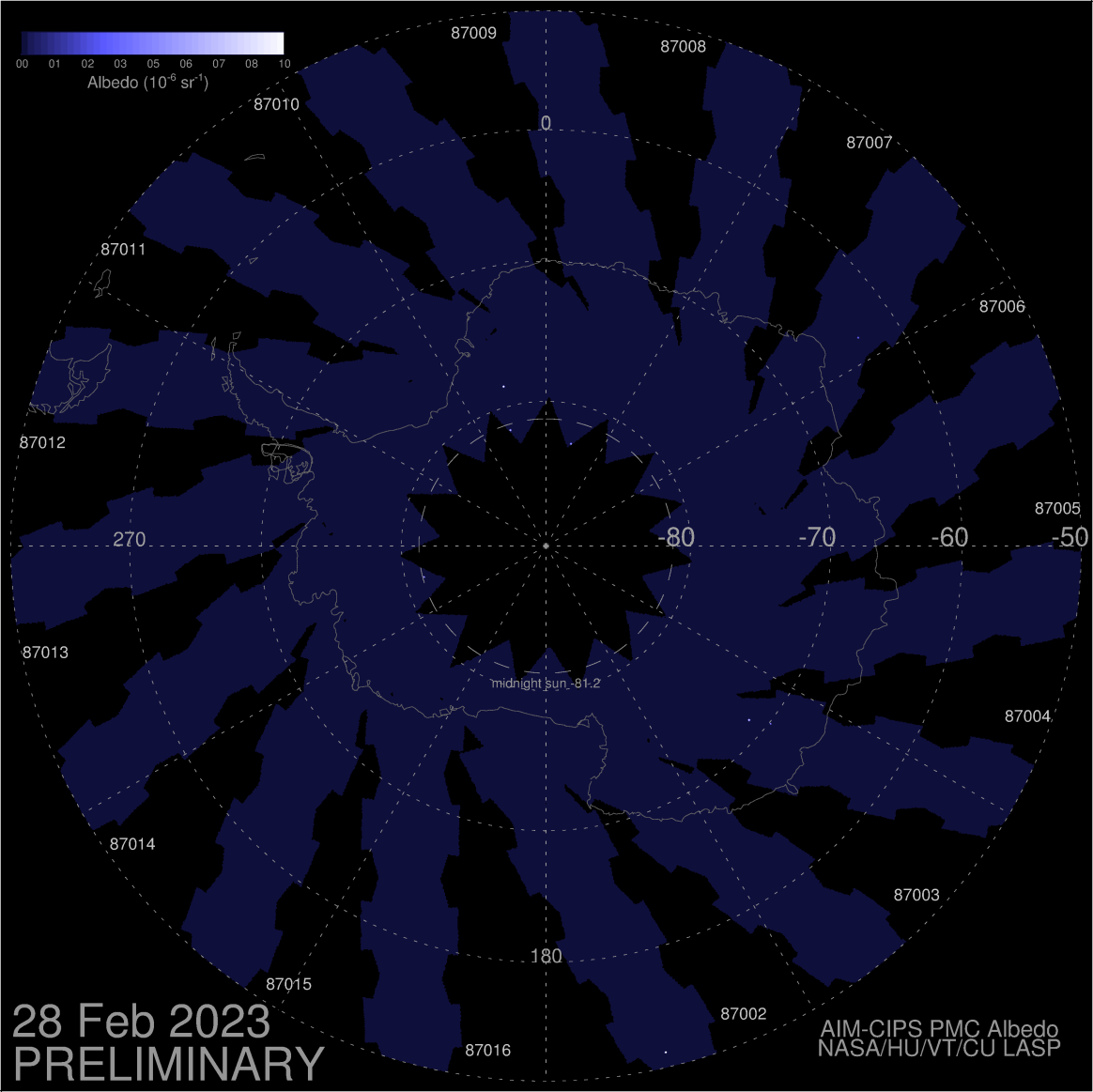
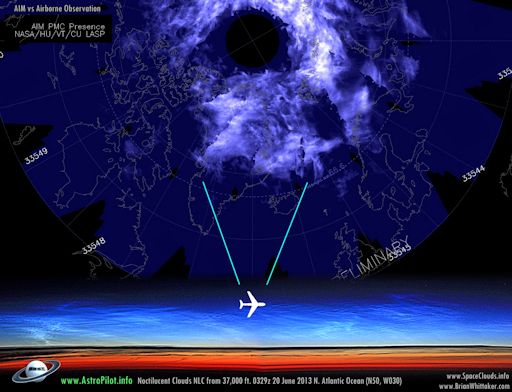
    -Every day, NASA's AIM spacecraft maps the distribution of noctilucent clouds (NLCs) around Earth's north pole. The results are displayed on spaceweather.com in the form of the "daily daisy." On June 20th, pilot Brian Whittaker flew past a vivid display of NLCs over the North Atlantic Ocean and he decided to compare his own view to that of AIM.

    -"Once again, AIM's daily daisy-wheel allowed me to see where the northern horizon noctilucent clouds truly were!" says Whittaker. "This display reached a maximum height of about 10 degrees as seen from 37,000 feet at 50N latitude. It was my 4th and best sighting of 2013 so far."

    -2013 is shaping up to be a good year for NLCs. The clouds surprised researchers by appearing early this year, and many bright displays have already been recorded. Once confined to the Arctic, NLCs have been sighted in recent years as far south as Utah, Colorado, and Nebraska. They might spread even farther south in 2013.

    -Observing tips: Look west 30 to 60 minutes after sunset when the sun has dipped 6o to 16o below the horizon. If you see luminous blue-white tendrils spreading across the sky, you've probably spotted a noctilucent cloud.

    -Here are the results:


    Astro Picture of the Day:
    June 27, 2013

    Source:
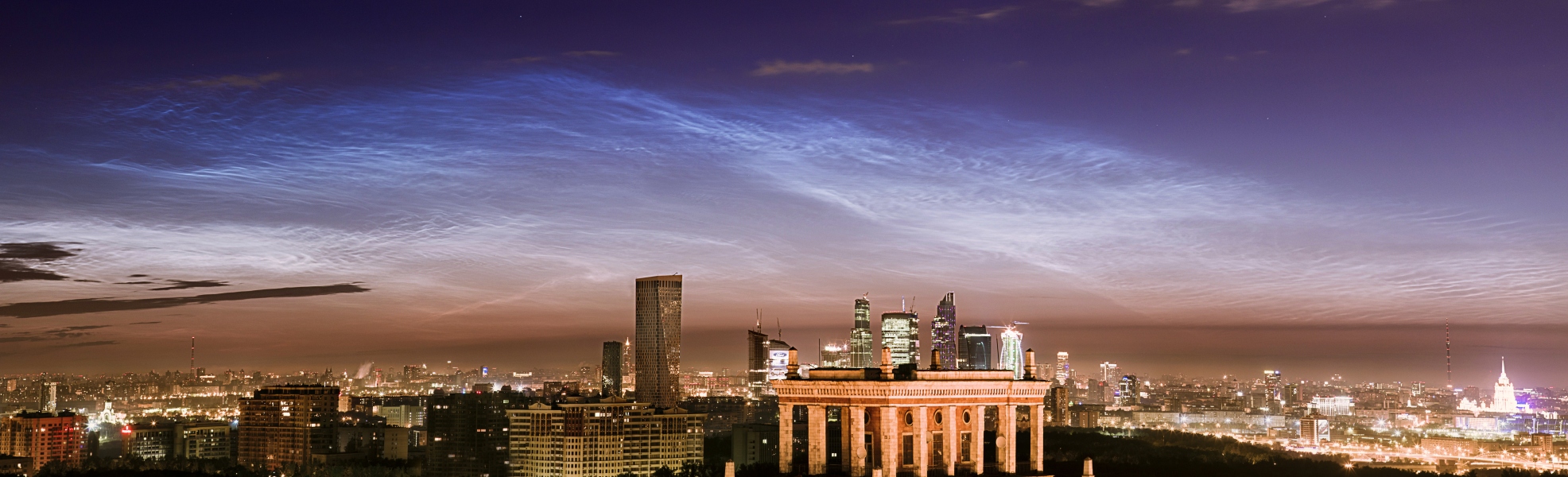
    This panoramic night scene from June 8 looks out across a Moscow skyline from atop the main building of Lomonosov Moscow State University. Shining in the darkened sky above are widespread noctilucent clouds. From the edge of space, about 80 kilometers above Earth's surface, the icy clouds can still reflect sunlight even though the Sun itself is below the horizon as seen from the ground. Usually spotted at high latitudes in summer months the diaphanous apparitions, also known as polar mesospheric clouds, have come early this season. The seasonal clouds are understood to form as water vapor driven into the cold upper atmosphere condenses on the fine dust particles supplied by meteor smoke (debris left by disintegrating meteors) or volcanic ash. Their early start this year may be connected to changing global circulation patterns in the lower atmosphere. During this northern summer, NASA's AIM mission provides daily projections of the noctilucent clouds as seen from space.
    1st in Kommisar's 2009 SM Tournament
    1st in I Love You`s 2009 New Year`s Tournament
    3rd in EnR's Mashfest '08 tournament
    5th in Phynx's Unofficial FFR Tournament
    9th in D3 of the 2008-2009 4th Official FFR Tournament
    10th in D5 of the 2010 5th Official FFR Tournament
    10th in D6 of the 2011-2012 6th Official FFR Tournament

    FMO AAA Count: 71
    FGO AAA Count: 10

    Bluearrowll = The Canadian player who can not detect awkward patterns. If it's awkward for most people, it's normal for Terry. If the file is difficult but super straight forward, he has issues. If he's AAAing a FGO but then heard that his favorite Hockey team was losing by a point, Hockey > FFR
    PS: Cool AAA's Terry
    - I Love You


    An Alarm Clock's Haiku
    beep beep beep beep beep
    beep beep beep beep beep beep beep
    beep beep beep beep beep
    - ieatyourlvllol

    Comment

    • Bluearrowll
      ⊙▃⊙
      FFR Simfile Author
      • Nov 2007
      • 7376

      #587
      Re: Terry's Astronomy Thread.

      What's in the sky tonight?
      June 28, 2013
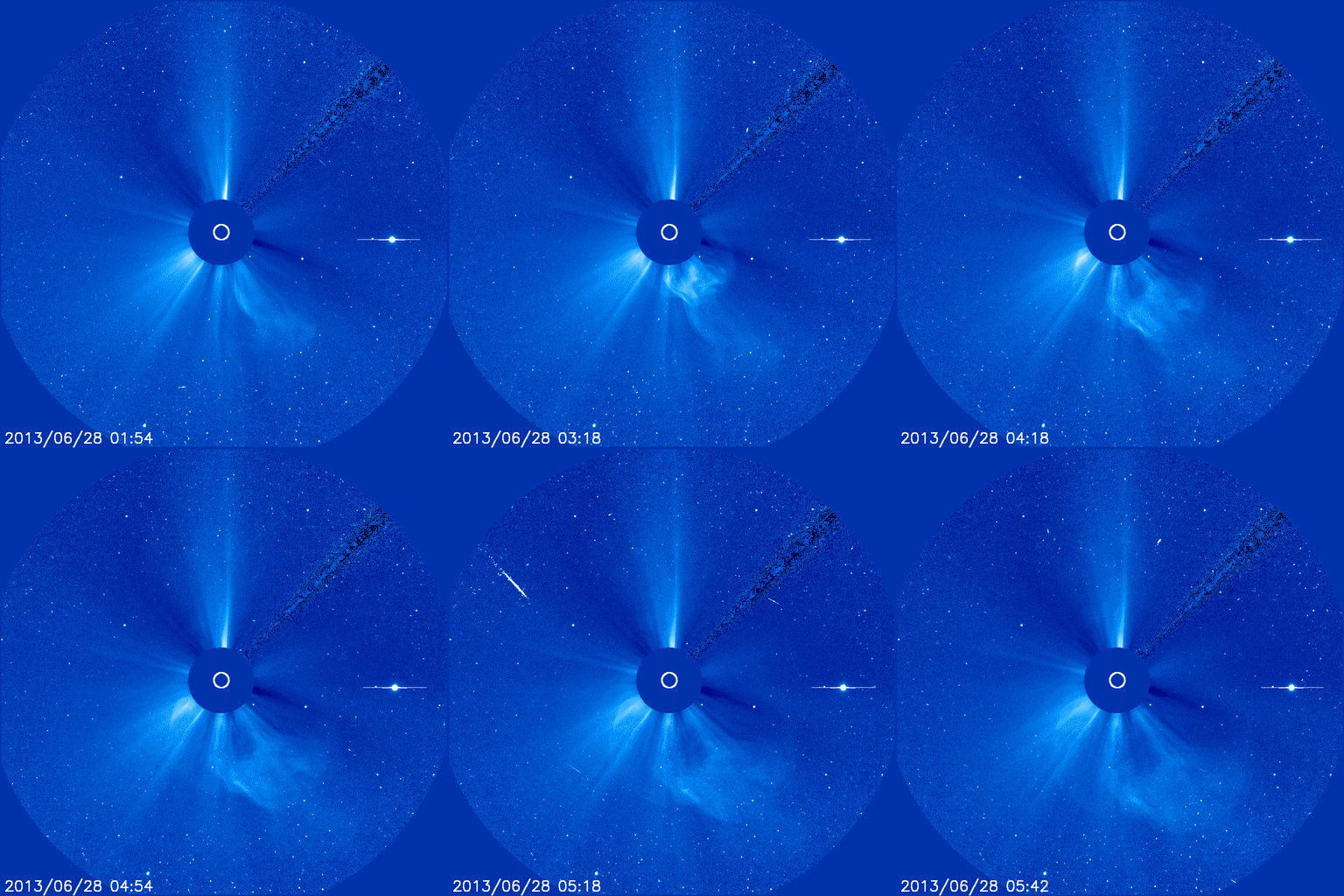
      -Southern hemisphere sunspots AR1777 and AR1778 erupted in quick succession during the early hours of June 28th, producing a pair of C-class solar flares and at least one CME. An initial analysis of coronagraph images suggests that the CME could deliver a glancing blow to Earth's magnetic field over the weekend.

      -The Big Dipper, still high in the northwest, is moving a little lower now and starting to dip around toward the right. Follow the curve of its tail a little more than a Dipper-length left to bright Arcturus high in the southwest.

      Astro Picture of the Day:
      June 28, 2013


      Source:
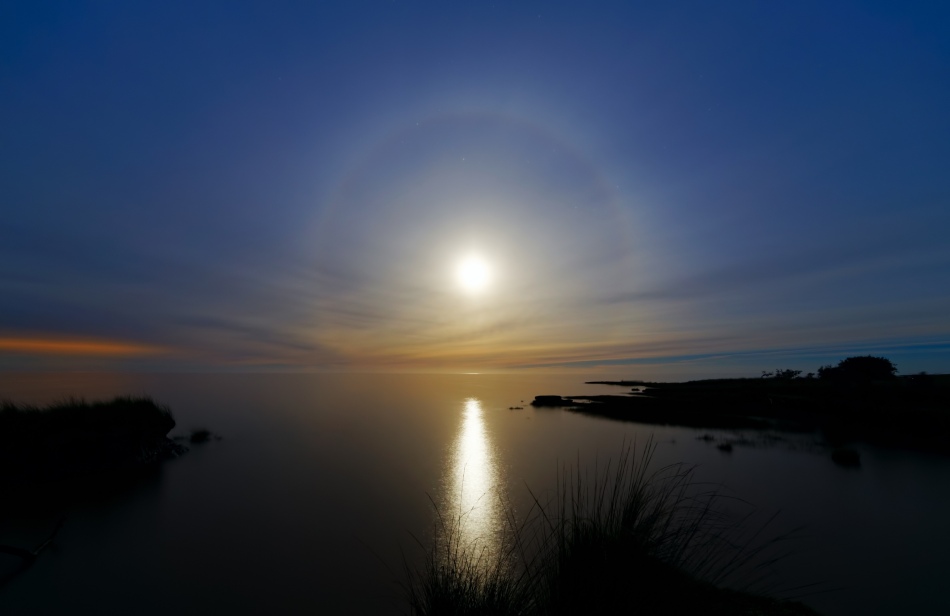
      A Full Perigee Moon rose as the Sun set last Sunday. At its closest to Earth it was, by just a bit, the year's brightest and largest Full Moon also known as a Super Moon. Seen from Punta Piedras, Argentina and the mouth of the Rio de La Plata, near Buenos Aires, the Super Moon's light created this magnificent circular lunar halo. Still, the size of a lunar halo is determined by the geometry of six sided water ice crystals in planet Earth's high, thin clouds. The crystals deflect the rays of moonlight more strongly through a minimum angle of 22 degrees. So this halo has an inner radius of 22 degrees, just like the halos of the less-than-super moons. Even more common than a Super Moon, beautiful 22 degree halos can be spotted at any time of year.
      1st in Kommisar's 2009 SM Tournament
      1st in I Love You`s 2009 New Year`s Tournament
      3rd in EnR's Mashfest '08 tournament
      5th in Phynx's Unofficial FFR Tournament
      9th in D3 of the 2008-2009 4th Official FFR Tournament
      10th in D5 of the 2010 5th Official FFR Tournament
      10th in D6 of the 2011-2012 6th Official FFR Tournament

      FMO AAA Count: 71
      FGO AAA Count: 10

      Bluearrowll = The Canadian player who can not detect awkward patterns. If it's awkward for most people, it's normal for Terry. If the file is difficult but super straight forward, he has issues. If he's AAAing a FGO but then heard that his favorite Hockey team was losing by a point, Hockey > FFR
      PS: Cool AAA's Terry
      - I Love You


      An Alarm Clock's Haiku
      beep beep beep beep beep
      beep beep beep beep beep beep beep
      beep beep beep beep beep
      - ieatyourlvllol

      Comment

      • Bluearrowll
        ⊙▃⊙
        FFR Simfile Author
        • Nov 2007
        • 7376

        #588
        Re: Terry's Astronomy Thread.

        What's in the sky tonight?
        June 29, 2013
        -This is the time of year when, after dark, the dim Little Dipper floats straight upward from Polaris (the end of its handle) — like a helium balloon on a string escaped from some summer evening party.

        -Mercury is lost in the glare of the Sun.

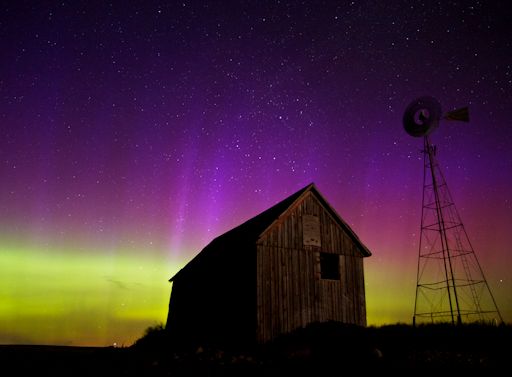
        A strong (Kp=7) geomagnetic storm is in progress on June 28-29 as Earth passes through a region of south-pointing magnetism in the solar wind. The storm has sparked Northern Lights photographed in the USA as far south as Kansas. Christian Begeman sends this picture from a farm outside Hartford, South Dakota:

        "A clear sky allowed me to the Northern Lights dancing in southeast South Dakota around the midnight hour tonight," says Begeman. "It was quite the show."

        High-latitude sky watchers should remain alert for auroras in the hours ahead. Solar wind conditions continue to favor geomagnetic activity.


        Astro Picture of the Day:
        June 29, 2013


        Source:
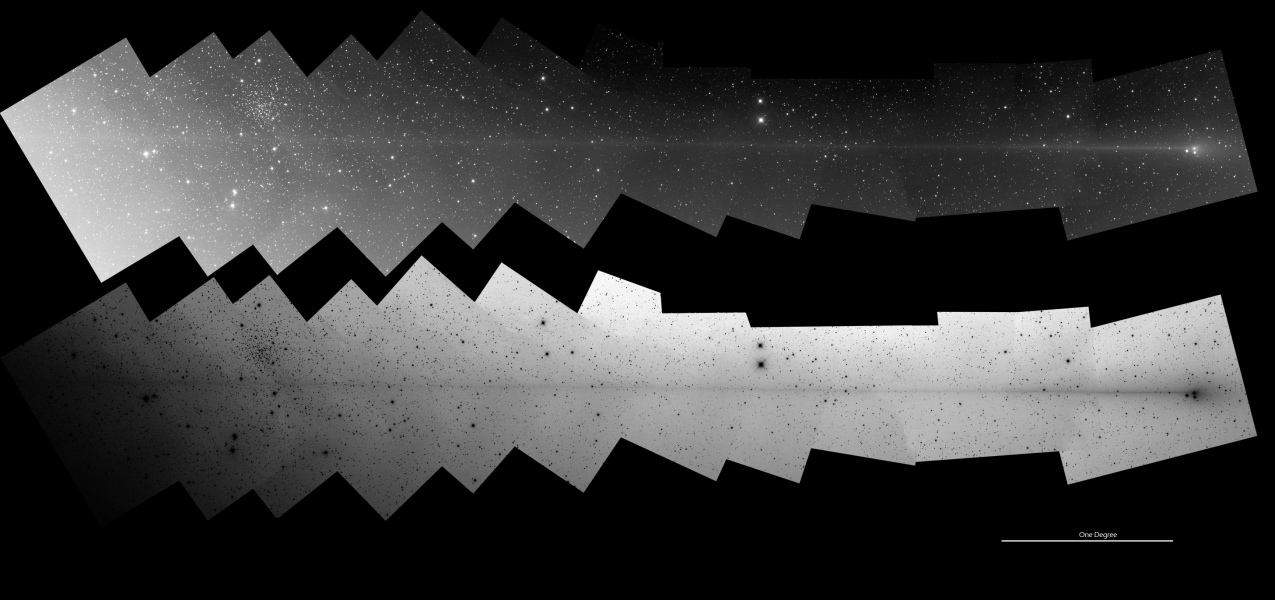
        Once known as Earth's sunset comet, PanSTARRS (C/2011 L4) is up all night now, but only for northern hemisphere skygazers. Telescopes are required to track its progress as it fades and heads for the outer solar system. But because planet Earth passed through the comet's orbital plane in late May, PanSTARRS will also be remembered for its remarkably long anti-tail. That edge-on perspective looking along the broad, fanned-out dust tail as it trailed behind the comet created the appearance of an anti-tail pointing in the sunward direction, back toward the inner solar system. Recorded on the night of May 27, this 13 pane mosaic (shown in positive and negative views) follows PanSTARRS' anti-tail as it stretches over 7 degrees from the comet's coma at the far right. The anti-tail was likely much longer, but gets lost in the evening's bright moonlight encroaching on the left edge of the scene. Background star cluster NGC 188 in Cepheus shows up along the way, near top left.
        1st in Kommisar's 2009 SM Tournament
        1st in I Love You`s 2009 New Year`s Tournament
        3rd in EnR's Mashfest '08 tournament
        5th in Phynx's Unofficial FFR Tournament
        9th in D3 of the 2008-2009 4th Official FFR Tournament
        10th in D5 of the 2010 5th Official FFR Tournament
        10th in D6 of the 2011-2012 6th Official FFR Tournament

        FMO AAA Count: 71
        FGO AAA Count: 10

        Bluearrowll = The Canadian player who can not detect awkward patterns. If it's awkward for most people, it's normal for Terry. If the file is difficult but super straight forward, he has issues. If he's AAAing a FGO but then heard that his favorite Hockey team was losing by a point, Hockey > FFR
        PS: Cool AAA's Terry
        - I Love You


        An Alarm Clock's Haiku
        beep beep beep beep beep
        beep beep beep beep beep beep beep
        beep beep beep beep beep
        - ieatyourlvllol

        Comment

        • Riotpolice
          "Reach For The Stars"
          • Nov 2010
          • 1921

          #589
          Re: Terry's Astronomy Thread.

          Holy shit that first picture, not even kidding, I thought it was photo shopped. That's absolutely beautiful, didn't know those kinds of colors were even possible in real life...
          Originally posted by hi19hi19
          Also why is "summon" in quotation marks as usually that signifies an alternate meaning like for example last night I "visited" your mother but it really means last night I "fucked her in the ass" so exactly what is the subtext of "summon" because I am not sure I am comfortable with the implications

          Originally posted by m0de
          im usually the "nice guy" around these parts.. but this is bad, and you should feel bad. i would rather dip my balls in honey and hover them over a red ant hill than to ever hear such butchered crap.

          Comment

          • Bluearrowll
            ⊙▃⊙
            FFR Simfile Author
            • Nov 2007
            • 7376

            #590
            Re: Terry's Astronomy Thread.

            What's in the sky tonight?
            June 30, 2013
            -Vega is the brightest star high in the east. Right next to Vega lies one of the best-known multiple stars in the sky: 4th-magnitude Epsilon (ε) Lyrae, the Double-Double. It forms one corner of a roughly equilateral triangle with Vega and Zeta (ζ) Lyrae. The triangle is less than 2° on a side. A 4-inch telescope at 100× or more should resolve each of Epsilon's two wide components into a tight pair.
            Zeta Lyrae is also a double star for binoculars; much tougher, but easily split with a telescope.

            -As the current spate of geomagnetic storming subsides, more storms could be in the offing. A coronal mass ejection (CME), pictured below, is expected to deliver a glancing blow to Earth's magnetic field late on June 30th or early on July 31st.

            -The cloud was propelled in our direction during the early hours of June 28th when magnetic filaments around sunspot AR1777 erupted. The explosion registered approximately C4 on the Richter Scale of Solar Flares. Because the CME is not heading squarely toward Earth, there is still a chance that it will miss.

            For understanding the RIchter Scale of Solar Flares: http://www.spaceweather.com/glossary...8s4qc6tuni8p14


            News Posted Today:
            June 29, 2013
            Good-bye to GALEX


            Astro Picture of the Day:
            June 30, 2013


            Source:
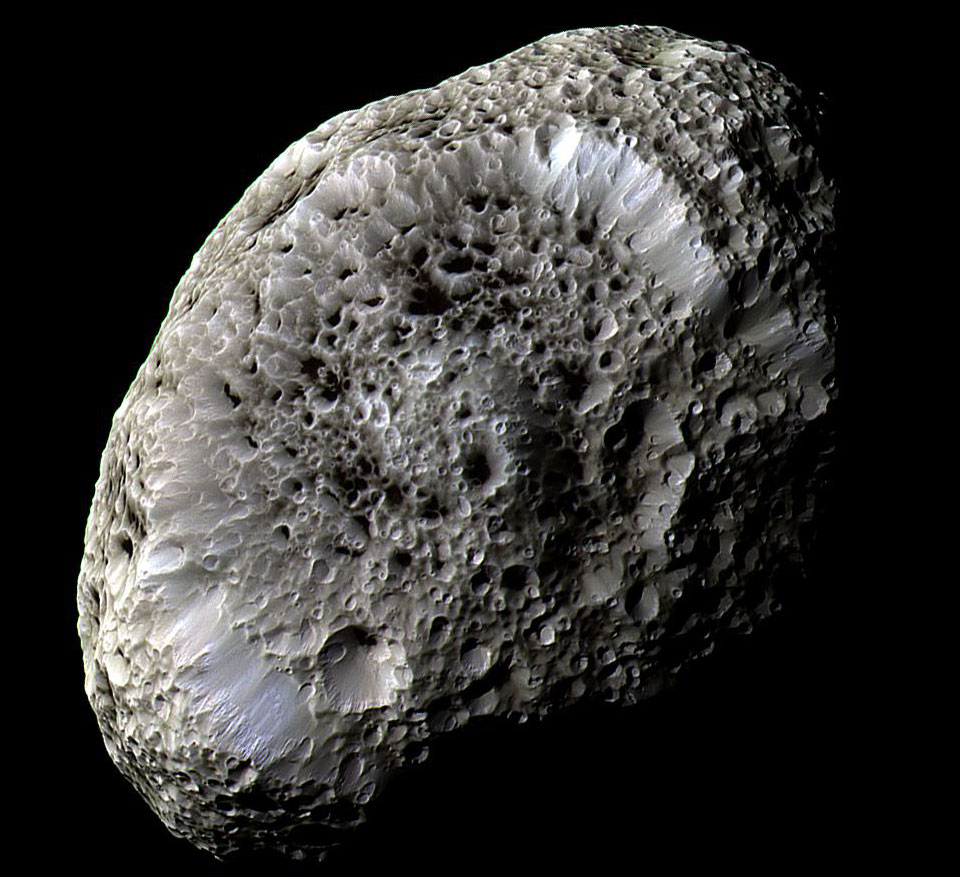
            What lies at the bottom of Hyperion's strange craters? Nobody's sure. To help find out, the robot Cassini spacecraft now orbiting Saturn swooped past the sponge-textured moon in 2005 and 2010 and took images of unprecedented detail. An image from the 2005 pass, shown above in false color, shows a remarkable world strewn with strange craters and a generally odd surface. The slight differences in color likely show differences in surface composition. At the bottom of most craters lies some type of unknown dark material. Inspection of the image shows bright features indicating that the dark material might be only tens of meters thick in some places. Hyperion is about 250 kilometers across, rotates chaotically, and has a density so low that it might house a vast system of caverns inside.
            1st in Kommisar's 2009 SM Tournament
            1st in I Love You`s 2009 New Year`s Tournament
            3rd in EnR's Mashfest '08 tournament
            5th in Phynx's Unofficial FFR Tournament
            9th in D3 of the 2008-2009 4th Official FFR Tournament
            10th in D5 of the 2010 5th Official FFR Tournament
            10th in D6 of the 2011-2012 6th Official FFR Tournament

            FMO AAA Count: 71
            FGO AAA Count: 10

            Bluearrowll = The Canadian player who can not detect awkward patterns. If it's awkward for most people, it's normal for Terry. If the file is difficult but super straight forward, he has issues. If he's AAAing a FGO but then heard that his favorite Hockey team was losing by a point, Hockey > FFR
            PS: Cool AAA's Terry
            - I Love You


            An Alarm Clock's Haiku
            beep beep beep beep beep
            beep beep beep beep beep beep beep
            beep beep beep beep beep
            - ieatyourlvllol

            Comment

            • Bluearrowll
              ⊙▃⊙
              FFR Simfile Author
              • Nov 2007
              • 7376

              #591
              Re: Terry's Astronomy Thread.

              What's in the sky tonight?
              July 1, 2013
              -If you have a dark enough sky, the Milky Way now forms a magnificent arch high across the whole eastern sky after nightfall is complete. It runs all the way from below Cassiopeia low in the north-northeast, up and across Cygnus and the Summer Triangle in the east, and down past the spout of the Sagittarius Teapot in the south-southeast.

              News Posted Today:
              June 30, 2013
              Now Playing: Core Collapse in 3D


              Astro Picture of the Day:
              July 1, 2013


              Source:
              On June 28, Earth passed through a region of south-pointing magnetism in the solar wind. The encounter set off one of the finest geomagnetic storms of the current solar cycle. At its peak on June 29th, the strong (Kp=7) storm filled the sky over Alberta Canasa with bright green auroras:

              "With advance warning from Spaceweather.com, I headed out Friday night to a wind farm near my rural home, to take images of what I hoped would be an all-sky aurora. It did not disappoint!" says photographer Alan Dyer of Drumheller, Alberta. "These images are taken from the base of one of the massive wind machines, seemingly aimed into the aurora blown by the solar wind."

              For a brief time, the auroras spilled across the Canadian border into the USA as south as Iowa, Oregon, Nebraska, and Kansas. In total, observers in more than a dozen US states reported visual or photographic sightings of auroras.
              1st in Kommisar's 2009 SM Tournament
              1st in I Love You`s 2009 New Year`s Tournament
              3rd in EnR's Mashfest '08 tournament
              5th in Phynx's Unofficial FFR Tournament
              9th in D3 of the 2008-2009 4th Official FFR Tournament
              10th in D5 of the 2010 5th Official FFR Tournament
              10th in D6 of the 2011-2012 6th Official FFR Tournament

              FMO AAA Count: 71
              FGO AAA Count: 10

              Bluearrowll = The Canadian player who can not detect awkward patterns. If it's awkward for most people, it's normal for Terry. If the file is difficult but super straight forward, he has issues. If he's AAAing a FGO but then heard that his favorite Hockey team was losing by a point, Hockey > FFR
              PS: Cool AAA's Terry
              - I Love You


              An Alarm Clock's Haiku
              beep beep beep beep beep
              beep beep beep beep beep beep beep
              beep beep beep beep beep
              - ieatyourlvllol

              Comment

              • Bluearrowll
                ⊙▃⊙
                FFR Simfile Author
                • Nov 2007
                • 7376

                #592
                Re: Terry's Astronomy Thread.

                Today is late because FFR appeared to be down this morning - and I was unable to access the site during work.

                What's in the sky tonight?
                July 2, 2013
                -The Big Dipper, high in the northwest after dark, is turning around to "scoop up water" through the nights of summer and early fall.

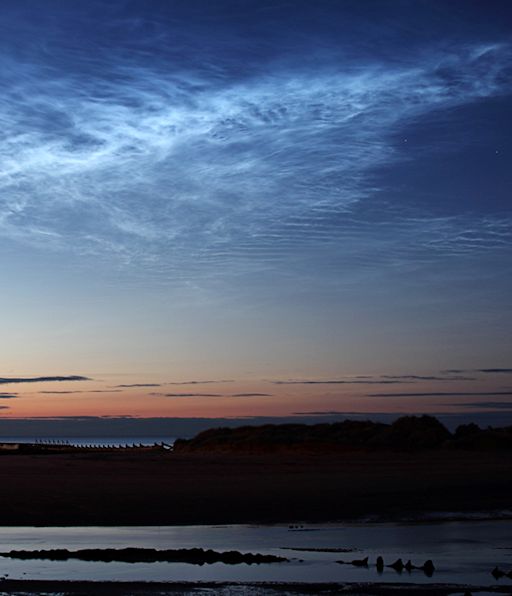
                -The "noctilucent daisy" continues to expand and intensify as summer unfolds. Observers in central-to-northern Europe are reporting vivid, nightly displays of NLCs. Just hours ago, Alan Tough photographed these over Lossiemouth, Moray, Scotland.

                "This was another spectacular display of noctilucent clouds," says Tough. "I arrived in Lossiemouth in time to see the Moon rising and managed to capture its glitter path on the River Lossie."


                Astro Picture of the Day:
                July 2, 2013


                Source:
                What would it look like to go right up to a black hole? One particularly interesting place near a black hole is its photon sphere, where photons can orbit in circles, a sphere 50 percent further out than the event horizon. Were you to look out from the photon sphere of a black hole, half of the sky would appear completely black, half of the sky would appear unusually bright, and the back of your head would appear across the middle. The above computer-animated video depicts this view from the photon sphere. The reason that the lower region, as shown, appears black is because all light paths from this dark region comes up from the black hole - which classically emits no light. The upper half of the sky now appears unusually bright, blueshifted, and shows increasingly many complete sky images increasingly close to the dark-light divide across the middle. That dark-light divide is the photon sphere - your location - and since photons can do circles there, light from the back of your head can circle the black hole and come to your eye. No place on the sky is hidden from you - stars that would normally pass behind the black hole now appear to zip quickly around an Einstein ring, a ring that appears above as a horizontal line about a quarter of the way down from the video top. (Disclosure: Video creator Robert Nemiroff is an editor for APOD.)
                1st in Kommisar's 2009 SM Tournament
                1st in I Love You`s 2009 New Year`s Tournament
                3rd in EnR's Mashfest '08 tournament
                5th in Phynx's Unofficial FFR Tournament
                9th in D3 of the 2008-2009 4th Official FFR Tournament
                10th in D5 of the 2010 5th Official FFR Tournament
                10th in D6 of the 2011-2012 6th Official FFR Tournament

                FMO AAA Count: 71
                FGO AAA Count: 10

                Bluearrowll = The Canadian player who can not detect awkward patterns. If it's awkward for most people, it's normal for Terry. If the file is difficult but super straight forward, he has issues. If he's AAAing a FGO but then heard that his favorite Hockey team was losing by a point, Hockey > FFR
                PS: Cool AAA's Terry
                - I Love You


                An Alarm Clock's Haiku
                beep beep beep beep beep
                beep beep beep beep beep beep beep
                beep beep beep beep beep
                - ieatyourlvllol

                Comment

                • Bluearrowll
                  ⊙▃⊙
                  FFR Simfile Author
                  • Nov 2007
                  • 7376

                  #593
                  Re: Terry's Astronomy Thread.

                  What's in the sky tonight?
                  July 3, 2013
                  -A twilight challenge: As twilight fades, spot Venus low in the west-northwest. As darkness deepens, can you make out stars of the Beehive Cluster within about ½° below it? Good luck — the brightest of them are 6th magnitude, about 10,000 times fainter than Venus!

                  -A much easier challenge: Look ½° above Saturn soon after dark for the 4.2-magnitude star Kappa Virginis.


                  Astro Picture of the Day:
                  July 3, 2013


                  Source:
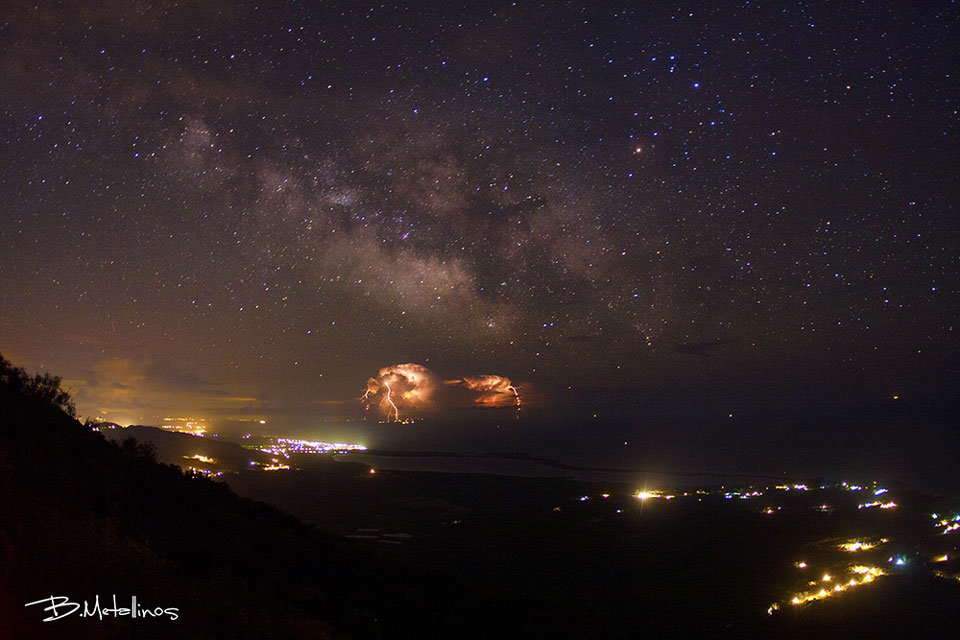
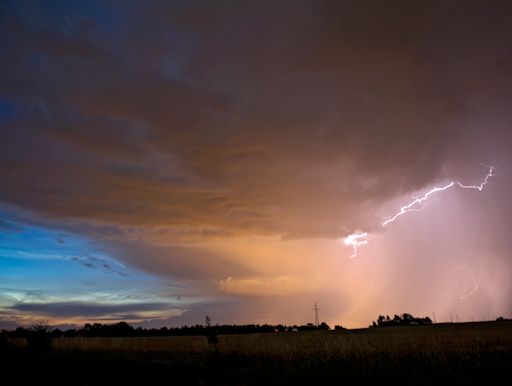
                  It may appear, at first, like the Galaxy is producing the lightning, but really it's the Earth. In the foreground of the above picturesque nighttime landscape is the Greek Island of Corfu, with town lights surrounding Lake Korrision. Visible farther in the distance are lights from the town of Preveza on the Greek mainland. In the more distant sky a thunderstorm is threatening, with two lightning strokes caught together during this 45 second wide-angle exposure taken in mid-May. The lightning branch on the left appears to be striking near Preveza, whereas the lightning strike on the right appears to be striking near Mount Ainos on the Greek Island of Cephalonia. Much farther in the distance, strewn about the sky, are hundreds of stars in the neighborhood of our Sun in the Milky Way Galaxy. Furthest away, arching over the entire panorama, are billions of stars that together compose the central band of our Milky Way.
                  1st in Kommisar's 2009 SM Tournament
                  1st in I Love You`s 2009 New Year`s Tournament
                  3rd in EnR's Mashfest '08 tournament
                  5th in Phynx's Unofficial FFR Tournament
                  9th in D3 of the 2008-2009 4th Official FFR Tournament
                  10th in D5 of the 2010 5th Official FFR Tournament
                  10th in D6 of the 2011-2012 6th Official FFR Tournament

                  FMO AAA Count: 71
                  FGO AAA Count: 10

                  Bluearrowll = The Canadian player who can not detect awkward patterns. If it's awkward for most people, it's normal for Terry. If the file is difficult but super straight forward, he has issues. If he's AAAing a FGO but then heard that his favorite Hockey team was losing by a point, Hockey > FFR
                  PS: Cool AAA's Terry
                  - I Love You


                  An Alarm Clock's Haiku
                  beep beep beep beep beep
                  beep beep beep beep beep beep beep
                  beep beep beep beep beep
                  - ieatyourlvllol

                  Comment

                  • Bluearrowll
                    ⊙▃⊙
                    FFR Simfile Author
                    • Nov 2007
                    • 7376

                    #594
                    Re: Terry's Astronomy Thread.

                    What's in the sky tonight?
                    July 4, 2013
                    -Watching the fireworks tonight? As you're waiting for them to begin, point out to people some sky sights. The two brightest stars of summer, Vega and Arcturus, are high overhead toward the east and southwest, respectively. Far below Arcturus are the planet Saturn and, to its lower right, Spica. Nearly that high in the southeast is the orange-red supergiant Antares, amid fainter stars of upper Scorpius.

                    -The July waning crescent Moon passes landmarks of Taurus. The visibility of faint objects in twilight is exaggerated here; binoculars help. The blue 10° scale is about the width of your fist at arm's length.


                    Astro Picture of the Day:
                    July 4, 2013


                    Source:
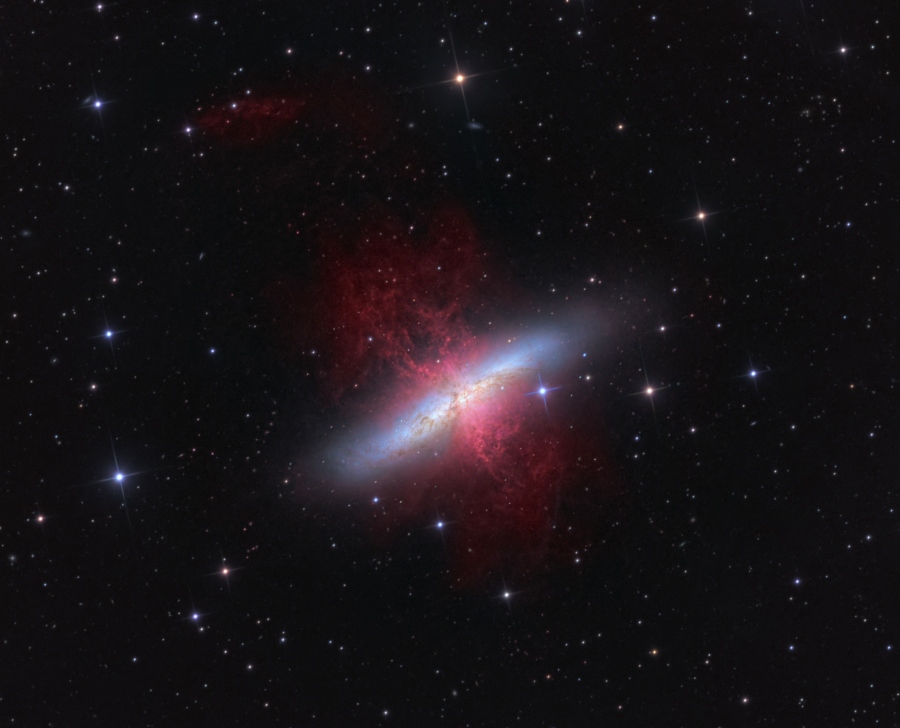
                    Also known as the Cigar Galaxy for its elongated visual appearance, M82 is a starburst galaxy with a superwind. In fact, through ensuing supernova explosions and powerful winds from massive stars, the burst of star formation in M82 is driving a prodigious outflow of material. Evidence for the superwind from the galaxy's central regions is clear in this sharp telescopic snapshot. The composite image highlights emission from long outflow filaments of atomic hydrogen gas in reddish hues. Some of the gas in the superwind, enriched in heavy elements forged in the massive stars, will eventually escape into intergalactic space. Including narrow band image data in the deep exposure has revealed a faint feature dubbed the cap. Perched about 35,000 light-years above the galaxy at the upper left, the cap appears to be galactic halo material ionized by the superwind shock or intense ultraviolet radiation from the young, massive stars in the galaxy's core. Triggered by a close encounter with nearby large galaxy M81, the furious burst of star formation in M82 should last about 100 million years or so. M82 is 12 million light-years distant, near the northern boundary of Ursa Major.
                    1st in Kommisar's 2009 SM Tournament
                    1st in I Love You`s 2009 New Year`s Tournament
                    3rd in EnR's Mashfest '08 tournament
                    5th in Phynx's Unofficial FFR Tournament
                    9th in D3 of the 2008-2009 4th Official FFR Tournament
                    10th in D5 of the 2010 5th Official FFR Tournament
                    10th in D6 of the 2011-2012 6th Official FFR Tournament

                    FMO AAA Count: 71
                    FGO AAA Count: 10

                    Bluearrowll = The Canadian player who can not detect awkward patterns. If it's awkward for most people, it's normal for Terry. If the file is difficult but super straight forward, he has issues. If he's AAAing a FGO but then heard that his favorite Hockey team was losing by a point, Hockey > FFR
                    PS: Cool AAA's Terry
                    - I Love You


                    An Alarm Clock's Haiku
                    beep beep beep beep beep
                    beep beep beep beep beep beep beep
                    beep beep beep beep beep
                    - ieatyourlvllol

                    Comment

                    • Bluearrowll
                      ⊙▃⊙
                      FFR Simfile Author
                      • Nov 2007
                      • 7376

                      #595
                      Re: Terry's Astronomy Thread.

                      What's in the sky tonight?
                      July 5, 2013
                      -During dawn this morning and Saturday morning, look low in the east-northeast for the waning Moon. It guides your way to Mars, Jupiter, Aldebaran, and Beta Tauri, as shown at right. Binoculars will help.

                      -Earth is at aphelion, its farthest from the Sun for the year (just 1 part in 30 farther than at perihelion in January).


                      Astro Picture of the Day:
                      July 5, 2013


                      Source:
                      Some 13,000 light-years away toward the southern constellation Pavo, the globular star cluster NGC 6752 roams the halo of our Milky Way galaxy. Over 10 billion years old, NGC 6752 follows clusters Omega Centauri and 47 Tucanae as the third brightest globular in planet Earth's night sky. It holds over 100 thousand stars in a sphere about 100 light-years in diameter. Telescopic explorations of the NGC 6752 have found that a remarkable fraction of the stars near the cluster's core, are multiple star systems. They also reveal the presence of blue straggle stars, stars which appear to be too young and massive to exist in a cluster whose stars are all expected to be at least twice as old as the Sun. The blue stragglers are thought to be formed by star mergers and collisions in the dense stellar environment at the cluster's core. This sharp color composite also features the cluster's ancient red giant stars in yellowish hues.
                      1st in Kommisar's 2009 SM Tournament
                      1st in I Love You`s 2009 New Year`s Tournament
                      3rd in EnR's Mashfest '08 tournament
                      5th in Phynx's Unofficial FFR Tournament
                      9th in D3 of the 2008-2009 4th Official FFR Tournament
                      10th in D5 of the 2010 5th Official FFR Tournament
                      10th in D6 of the 2011-2012 6th Official FFR Tournament

                      FMO AAA Count: 71
                      FGO AAA Count: 10

                      Bluearrowll = The Canadian player who can not detect awkward patterns. If it's awkward for most people, it's normal for Terry. If the file is difficult but super straight forward, he has issues. If he's AAAing a FGO but then heard that his favorite Hockey team was losing by a point, Hockey > FFR
                      PS: Cool AAA's Terry
                      - I Love You


                      An Alarm Clock's Haiku
                      beep beep beep beep beep
                      beep beep beep beep beep beep beep
                      beep beep beep beep beep
                      - ieatyourlvllol

                      Comment

                      • Bluearrowll
                        ⊙▃⊙
                        FFR Simfile Author
                        • Nov 2007
                        • 7376

                        #596
                        Re: Terry's Astronomy Thread.

                        What's in the sky tonight?
                        July 6, 2013
                        -Two hours after sunset, after darkness is truly complete, the east-northeast horizon bisects the Great Square of Pegasus across two of its opposite corners. By midnight the whole Great Square is up in good view, balancing on its bottom corner.

                        -Observers of noctilucent clouds often describe their appearance as "electric blue." The pale blue colors of the two phenomena are similar, but the resemblance is superficial. Lightning is hot, a genuinely electric discharge that heats the air to 30,000o C or more. The high temperature of the lightning's plasma (ionized air) gives it the same blue color as a hot O-type star. On the other hand, noctilucent clouds are cold, made of ice that crystallizes at the edge of space where the air temperature is -160o C. The tiny ice crystals in noctilucent clouds scatter blue light from the setting sun, which accounts for their lightning-like color. On July 3rd, Nature provided a color-check when a lightning storm erupted in Szubin, Poland, right in front of a noctilucent display. Marek Nikodem photographed the ensemble:


                        Astro Picture of the Day:
                        July 6, 2013


                        Source:
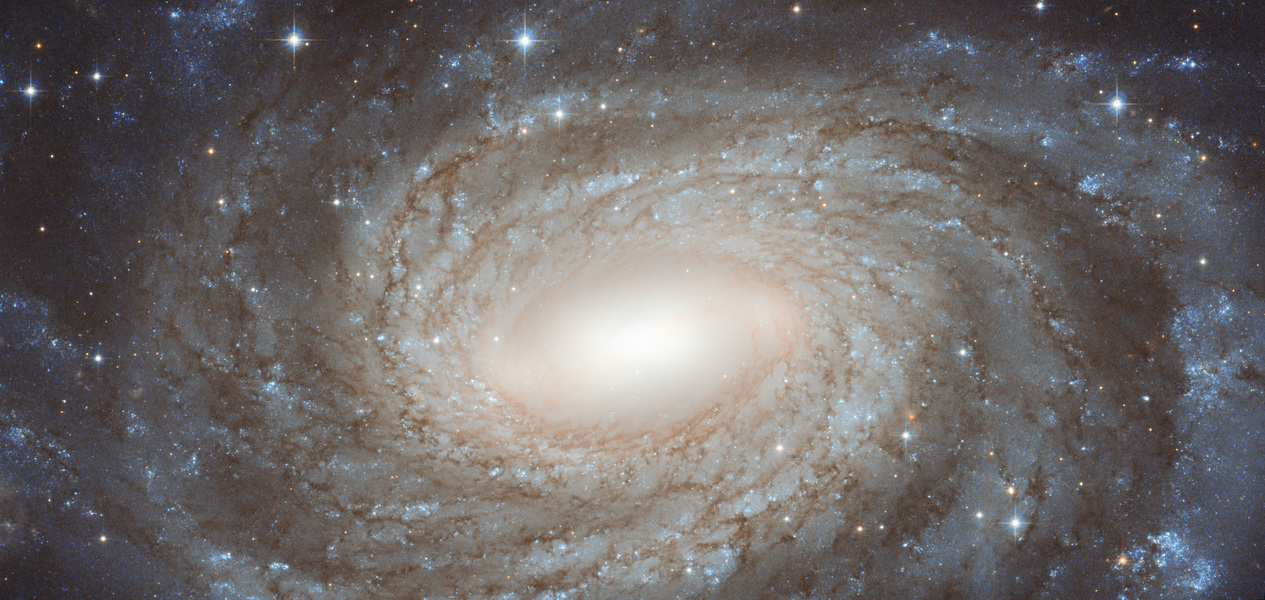
                        The universe is filled with galaxies. But to see them astronomers must look out beyond the stars of our own galaxy, the Milky Way. This colorful Hubble Space Telescopic portrait features spiral galaxy NGC 6384, about 80 million light-years away in the direction of the constellation Ophiuchus. At that distance, NGC 6384 spans an estimated 150,000 light-years, while the Hubble close-up of the galaxy's central region is about 70,000 light-years wide. The sharp image shows details in the distant galaxy's blue star clusters and dust lanes along magnificent spiral arms, and a bright core dominated by yellowish starlight. Still, the individual stars seen in the picture are all in the relatively close foreground, well within our own galaxy. The brighter Milky Way stars show noticeable crosses, or diffraction spikes, caused by the telescope itself.
                        1st in Kommisar's 2009 SM Tournament
                        1st in I Love You`s 2009 New Year`s Tournament
                        3rd in EnR's Mashfest '08 tournament
                        5th in Phynx's Unofficial FFR Tournament
                        9th in D3 of the 2008-2009 4th Official FFR Tournament
                        10th in D5 of the 2010 5th Official FFR Tournament
                        10th in D6 of the 2011-2012 6th Official FFR Tournament

                        FMO AAA Count: 71
                        FGO AAA Count: 10

                        Bluearrowll = The Canadian player who can not detect awkward patterns. If it's awkward for most people, it's normal for Terry. If the file is difficult but super straight forward, he has issues. If he's AAAing a FGO but then heard that his favorite Hockey team was losing by a point, Hockey > FFR
                        PS: Cool AAA's Terry
                        - I Love You


                        An Alarm Clock's Haiku
                        beep beep beep beep beep
                        beep beep beep beep beep beep beep
                        beep beep beep beep beep
                        - ieatyourlvllol

                        Comment

                        • Bluearrowll
                          ⊙▃⊙
                          FFR Simfile Author
                          • Nov 2007
                          • 7376

                          #597
                          Re: Terry's Astronomy Thread.

                          What's in the sky tonight?
                          July 7, 2013
                          -When the stars begin to come out these evenings, the Big Dipper hangs straight down from its handle high in the northwest, while the dim, elusive Little Dipper stands straight up on its handle from Polaris in the north.

                          -When Opportunity left Earth on July 7, 2003, many observers expected the rover to survive no more than a few months on the hostile surface of Mars. Ten years later, Opportunity is still going strong and could be poised to make its biggest discoveries yet at a place named Solander Point.

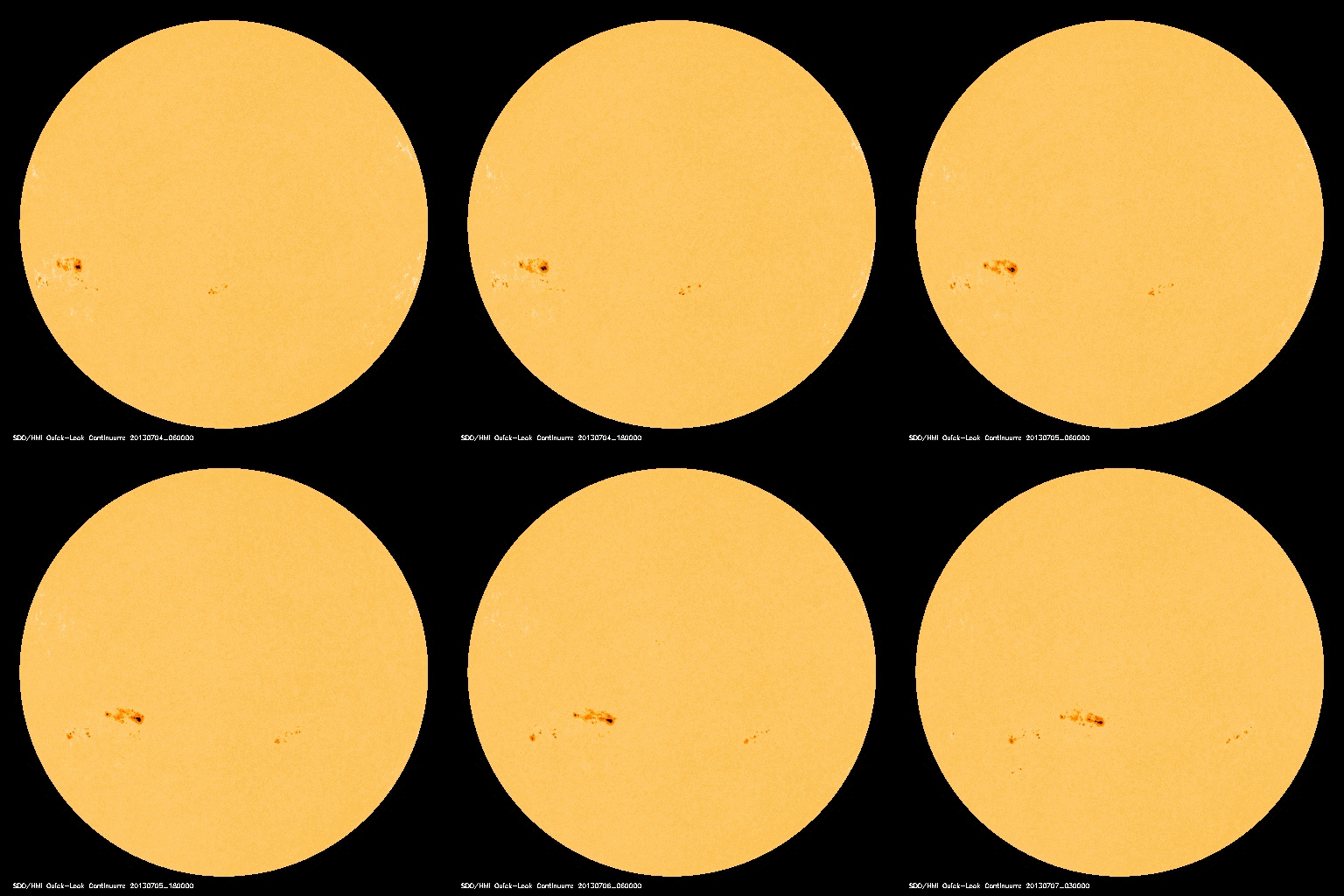
                          -Behemoth sunspot AR1785 is undergoing a metamorphasis, changing shape by the hour as it turns toward Earth. In less than 24 hours, AR1785 has stretched and lengthened by more than 40,000 km. It is now more than 11 times as wide as Earth, which makes the active region an easy target for backyard. This movie from NASA's Solar Dynamics Observatory shows the action on July 6-7:


                          Astro Picture of the Day:
                          July 7, 2013


                          Source:
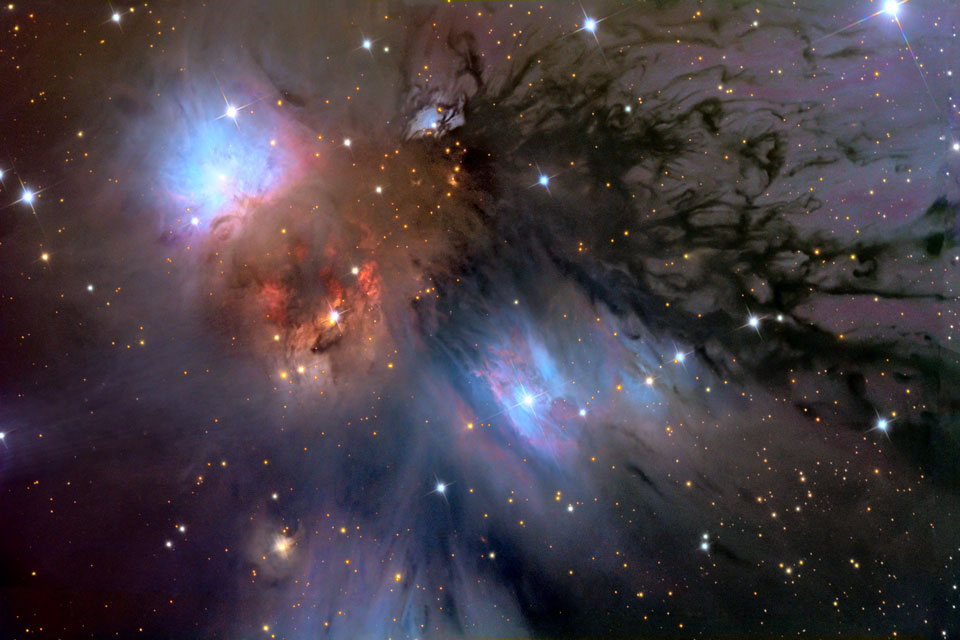
                          In this beautiful celestial still life composed with a cosmic brush, dusty nebula NGC 2170 shines at the upper left. Reflecting the light of nearby hot stars, NGC 2170 is joined by other bluish reflection nebulae, a compact red emission region, and streamers of obscuring dust against a backdrop of stars. Like the common household items still life painters often choose for their subjects, the clouds of gas, dust, and hot stars pictured here are also commonly found in this setting - a massive, star-forming molecular cloud in the constellation of the Unicorn (Monoceros). The giant molecular cloud, Mon R2, is impressively close, estimated to be only 2,400 light-years or so away. At that distance, this canvas would be about 15 light-years across.
                          1st in Kommisar's 2009 SM Tournament
                          1st in I Love You`s 2009 New Year`s Tournament
                          3rd in EnR's Mashfest '08 tournament
                          5th in Phynx's Unofficial FFR Tournament
                          9th in D3 of the 2008-2009 4th Official FFR Tournament
                          10th in D5 of the 2010 5th Official FFR Tournament
                          10th in D6 of the 2011-2012 6th Official FFR Tournament

                          FMO AAA Count: 71
                          FGO AAA Count: 10

                          Bluearrowll = The Canadian player who can not detect awkward patterns. If it's awkward for most people, it's normal for Terry. If the file is difficult but super straight forward, he has issues. If he's AAAing a FGO but then heard that his favorite Hockey team was losing by a point, Hockey > FFR
                          PS: Cool AAA's Terry
                          - I Love You


                          An Alarm Clock's Haiku
                          beep beep beep beep beep
                          beep beep beep beep beep beep beep
                          beep beep beep beep beep
                          - ieatyourlvllol

                          Comment

                          • DarkAngelKanna
                            FFR Veteran
                            • Jul 2008
                            • 51

                            #598
                            Re: Terry's Astronomy Thread.

                            I just wanted to say I love this thread. Beautiful pictures and information.
                            Do you bury me when I am gone? Do you teach me while I am here? Just as soon as I belong, then it's time I disappear.

                            Comment

                            • Bluearrowll
                              ⊙▃⊙
                              FFR Simfile Author
                              • Nov 2007
                              • 7376

                              #599
                              Re: Terry's Astronomy Thread.

                              Thanks for the compliment DarkAngelKanna Glad you enjoy the thread.

                              What's in the sky tonight?
                              July 8, 2013
                              -This is the time of year when, as twilight fades to dark, the two brightest summer stars, Arcturus and Vega, shine equally close to the zenith (depending on where you are). Arcturus is the one toward the southwest; Vega is toward the east.

                              -New Moon (exact at 3:14 a.m. on this date EDT).

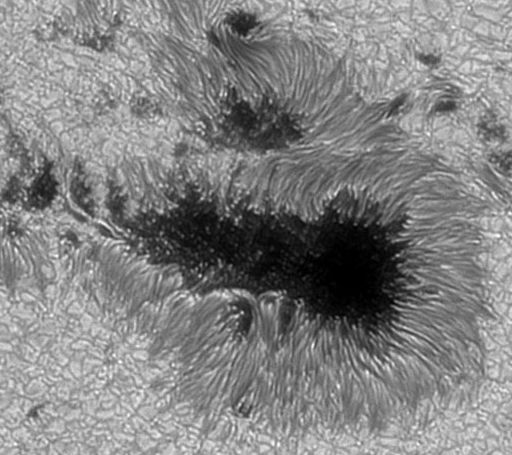
                              Colossal sunspot AR1785 is now directly facing Earth. The active region has a 'beta-gamma-delta' magnetic field that harbors energy for X-class flares, yet so far the sunspot has been mostly quiet. Could it be the calm before the storm? NOAA forecasters estimate a 55% chance of M-flares and a 10% chance of X-flares on July 8th. Solar flare alerts: text, voice.

                              Sprawling more than 11 Earth-diameters from end to end, AR1785 is one of the biggest sunspots of the current solar cycle. Christian Viladrich of Nattages, France, used a filtered 14-inch Celestron telescope to take this picture. All those irregular blobs surrounding the primary dark core are boiling granules of plasma as small as the state of California or Texas.


                              Astro Picture of the Day:
                              July 8, 2013


                              Source:
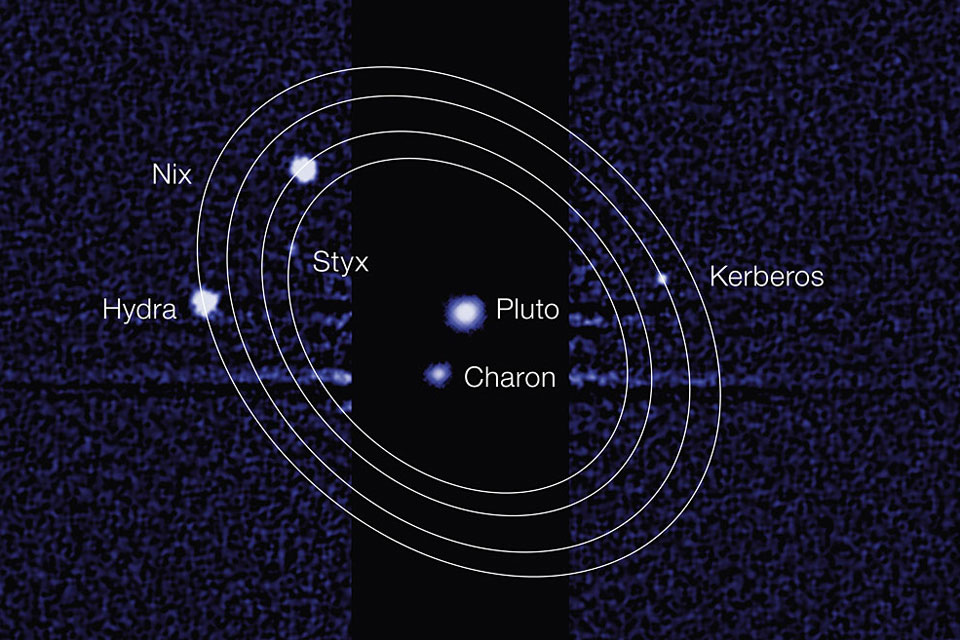
                              Pluto's newly discovered moons now have names. Known previously as P4 and P5, the International Astronomical Union has now given the fourth and fifth discovered moons of Pluto the names Kerberos and Styx. The small moons were discovered in 2011 and 2012 by the Hubble Space Telescope in preparation for the close passing of the New Horizons spacecraft by Pluto in 2015. Keberos is named for the many headed dog in Greek mythology that guards the entrance to the underworld, while Styx is named for the goddess who overlooks the mythological river that runs between the Earth and the underworld. Both monikers are related to the name of Pluto, who rules the mythical nether region. Because their reflectively is unknown, the size of each moon is quite uncertain - but each is crudely estimated to be about 20 kilometers in diameter. The robotic New Horizons spacecraft is on schedule to pass by Pluto in 2015 and provide the first clear images of the dwarf planet and its companions.
                              1st in Kommisar's 2009 SM Tournament
                              1st in I Love You`s 2009 New Year`s Tournament
                              3rd in EnR's Mashfest '08 tournament
                              5th in Phynx's Unofficial FFR Tournament
                              9th in D3 of the 2008-2009 4th Official FFR Tournament
                              10th in D5 of the 2010 5th Official FFR Tournament
                              10th in D6 of the 2011-2012 6th Official FFR Tournament

                              FMO AAA Count: 71
                              FGO AAA Count: 10

                              Bluearrowll = The Canadian player who can not detect awkward patterns. If it's awkward for most people, it's normal for Terry. If the file is difficult but super straight forward, he has issues. If he's AAAing a FGO but then heard that his favorite Hockey team was losing by a point, Hockey > FFR
                              PS: Cool AAA's Terry
                              - I Love You


                              An Alarm Clock's Haiku
                              beep beep beep beep beep
                              beep beep beep beep beep beep beep
                              beep beep beep beep beep
                              - ieatyourlvllol

                              Comment

                              • Bluearrowll
                                ⊙▃⊙
                                FFR Simfile Author
                                • Nov 2007
                                • 7376

                                #600
                                Re: Terry's Astronomy Thread.

                                What's in the sky tonight?
                                July 9, 2013
                                -If you have a dark enough sky, the Milky Way forms a magnificent arch high across the eastern sky after nightfall. It runs all the way from below Cassiopeia in the north-northeast, up and across Cygnus and the Summer Triangle in the east, and down past the spout of the Sagittarius Teapot in the south.

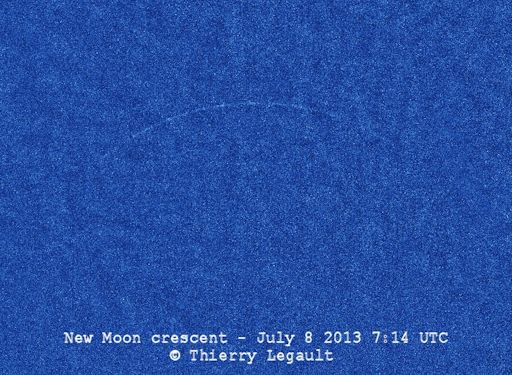
                                -Astrophotographer Thierry Legault is known for his razor-sharp images of spacecraft. Yesterday, for a change of pace, he photographed a razor-sharp crescent.

                                "This image shows the tiny lunar crescent at the precise moment of the New Moon, in full daylight at 7h14min UTC on July 8 2013," says Legault. "It is the youngest possible crescent, the age of the Moon at this instant being exactly zero."

                                "From the shooting site in Elancourt, France, the angular separation between the Moon and the Sun was only 4.4° (nine solar diameters)," he continues. "At this very small separation, the crescent is extremely thin (a few arc seconds at maximum) and, above all, it is drowned in the solar glare, the blue sky being about 400 times brighter than the crescent itself in infrared and probably more than 1000 times brighter in visible light. In order to reduce the glare, the images have been taken at near-infrared wavelengths using a pierced screen placed just in front of the telescope to block direct sunlight."


                                Astro Picture of the Day:
                                July 9, 2013


                                Source:
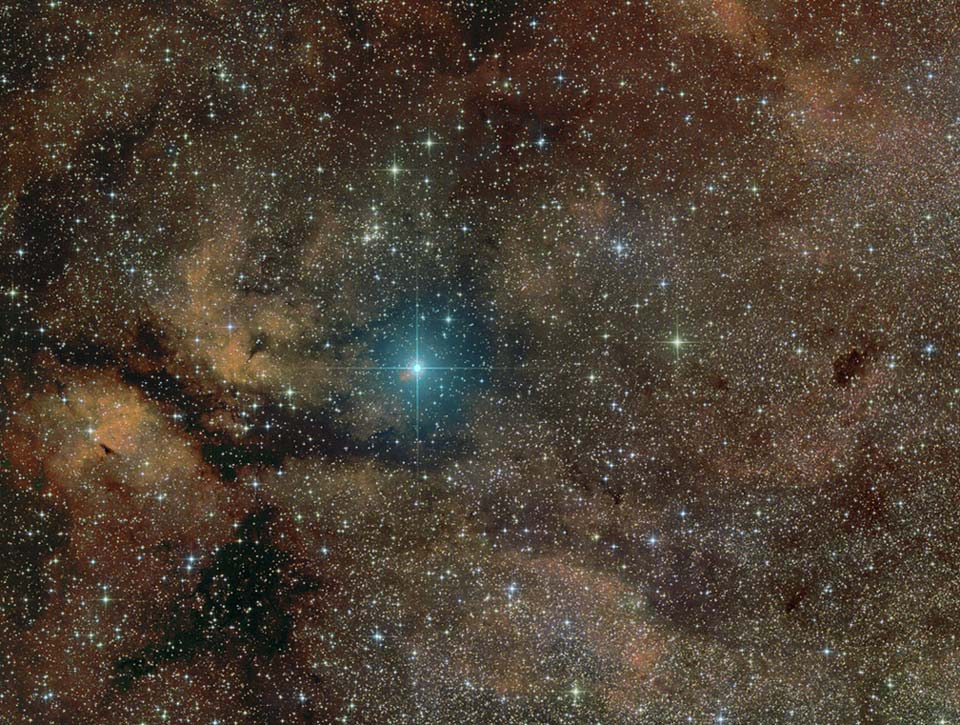
                                Supergiant star Gamma Cygni lies at the center of the Northern Cross, a famous asterism in the constellation of the Swan (Cygnus). Known by the proper name Sadr, the bright star also lies at the center of this gorgeous skyscape, featuring a complex of stars, dust clouds, and glowing nebulae along the plane of our Milky Way galaxy. The field of view spans over 3 degrees (six Full Moons) on the sky and includes emission nebula IC 1318 and open star cluster NGC 6910. Left of Gamma Cygni and shaped like two glowing cosmic wings divided by a long dark dust lane, IC 1318's popular name is understandably the Butterfly Nebula. Above and slightly left of Gamma Cygni, are the young, still tightly grouped stars of NGC 6910. Some distance estimates for Gamma Cygni place it at around 750 light-years while estimates for IC 1318 and NGC 6910 range from 2,000 to 5,000 light-years.
                                1st in Kommisar's 2009 SM Tournament
                                1st in I Love You`s 2009 New Year`s Tournament
                                3rd in EnR's Mashfest '08 tournament
                                5th in Phynx's Unofficial FFR Tournament
                                9th in D3 of the 2008-2009 4th Official FFR Tournament
                                10th in D5 of the 2010 5th Official FFR Tournament
                                10th in D6 of the 2011-2012 6th Official FFR Tournament

                                FMO AAA Count: 71
                                FGO AAA Count: 10

                                Bluearrowll = The Canadian player who can not detect awkward patterns. If it's awkward for most people, it's normal for Terry. If the file is difficult but super straight forward, he has issues. If he's AAAing a FGO but then heard that his favorite Hockey team was losing by a point, Hockey > FFR
                                PS: Cool AAA's Terry
                                - I Love You


                                An Alarm Clock's Haiku
                                beep beep beep beep beep
                                beep beep beep beep beep beep beep
                                beep beep beep beep beep
                                - ieatyourlvllol

                                Comment

                                Working...