

Re: Terry's Astronomy Thread.
What's in the sky tonight?
January 3, 2013
Astro Picture of the Day:
January 3, 2013
 Source:
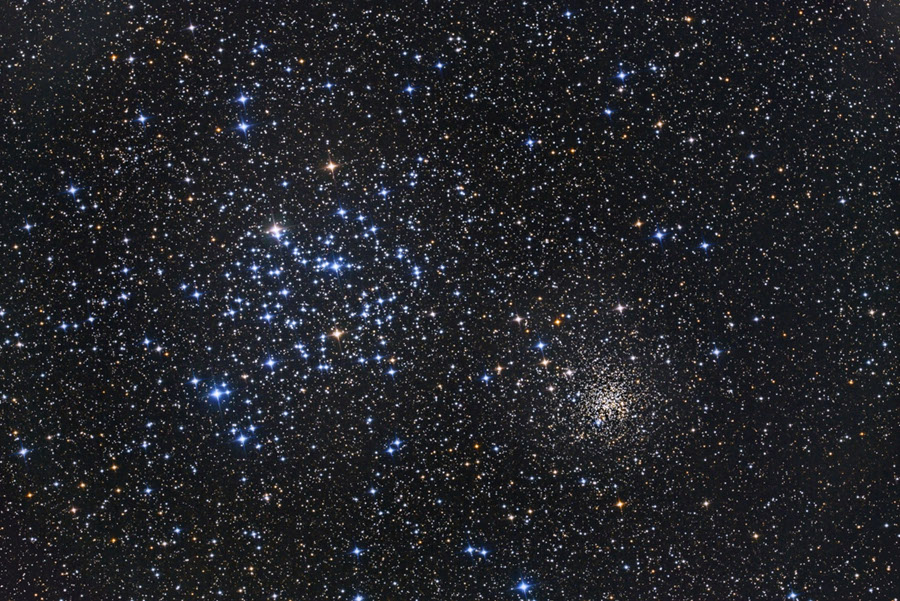
Open clusters of stars can be near or far, young or old, and diffuse or compact. Found near the plane of our Milky Way galaxy, they contain from 100 to 10,000 stars, all of which formed at nearly the same time. Bright blue stars frequently distinguish younger open clusters. M35, on the upper left, is relatively nearby at 2800 light years distant, relatively young at 150 million years old, and relatively diffuse, with about 2500 stars spread out over a volume 30 light years across. An older and more compact open cluster, NGC 2158, is at the lower right. NGC 2158 is four times more distant than M35, over 10 times older, and much more compact with many more stars in roughly the same volume of space. NGC 2158's bright blue stars have self-destructed, leaving cluster light to be dominated by older and yellower stars. Both clusters are seen toward the constellation of Gemini.
What's in the sky tonight?
January 3, 2013
-In this coldest time of the year, the dim Little Dipper hangs straight down from Polaris after dinnertime as if from a nail on the cold north wall of the sky.
-Algol should be at minimum light for a couple hours centered on 7:52 p.m. EST.
-Algol should be at minimum light for a couple hours centered on 7:52 p.m. EST.
Astro Picture of the Day:
January 3, 2013
Open clusters of stars can be near or far, young or old, and diffuse or compact. Found near the plane of our Milky Way galaxy, they contain from 100 to 10,000 stars, all of which formed at nearly the same time. Bright blue stars frequently distinguish younger open clusters. M35, on the upper left, is relatively nearby at 2800 light years distant, relatively young at 150 million years old, and relatively diffuse, with about 2500 stars spread out over a volume 30 light years across. An older and more compact open cluster, NGC 2158, is at the lower right. NGC 2158 is four times more distant than M35, over 10 times older, and much more compact with many more stars in roughly the same volume of space. NGC 2158's bright blue stars have self-destructed, leaving cluster light to be dominated by older and yellower stars. Both clusters are seen toward the constellation of Gemini.










Comment