

Re: Terry's Astronomy Thread.
What's in the sky tonight?
May 6, 2013
Astro Picture of the Day:
May 6, 2013
Source
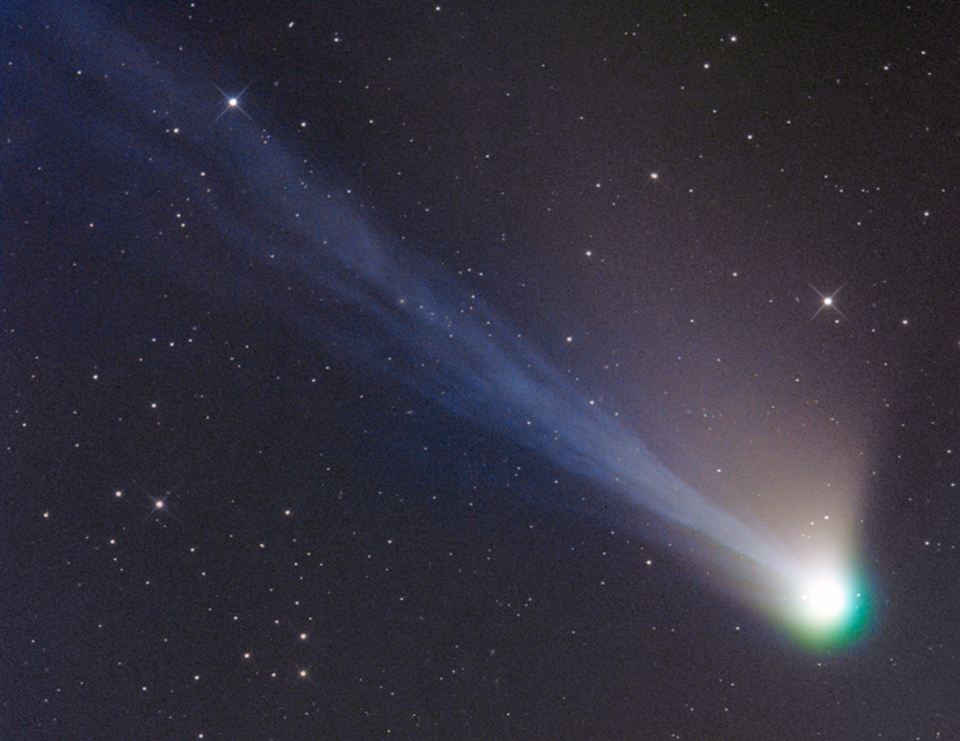
What caused the interestingly intricate tails that Comet Lemmon displayed earlier this year? First of all, just about every comet that nears the Sun displays two tails: a dust tail and an ion tail. Comet Lemmon's dust tail, visible above and around the comet nucleus in off-white, is produced by sun-light reflecting dust shed by the comet's heated nucleus. Flowing and more sculptured, however, is C/2012 F6 (Lemmon)'s blue ion tail, created by the solar wind pushing ions expelled by the nucleus away from the Sun. Also of note is the coma seen surrounding Comet Lemmon's nucleus, tinted green by atomic carbon gas fluorescing in sunlight. The above image was taken from the dark skies of Namibia in mid-April. Comet Lemmon is fading as it now heads back to the outer Solar System.
What's in the sky tonight?
May 6, 2013
-The brightest star high in the southeast after nightfall is Arcturus. Far to its lower right are Spica and, lower, Saturn. To the right of these two, look for the quadrilateral of Corvus, the Crow.
-Jupiter (magnitude –2.0, in Taurus) is the first "star" to come out in the west after sunset, a little lower every day. It descends in the evening and sets around 10 or 11 p.m. Above Jupiter is El Nath (Beta Tauri). Much farther to Jupiter's upper right is bright Capella.
-In a telescope, Jupiter has shrunk to a disappointing 33 arcseconds wide, about as small as it ever gets.
-Jupiter (magnitude –2.0, in Taurus) is the first "star" to come out in the west after sunset, a little lower every day. It descends in the evening and sets around 10 or 11 p.m. Above Jupiter is El Nath (Beta Tauri). Much farther to Jupiter's upper right is bright Capella.
-In a telescope, Jupiter has shrunk to a disappointing 33 arcseconds wide, about as small as it ever gets.
Astro Picture of the Day:
May 6, 2013
What caused the interestingly intricate tails that Comet Lemmon displayed earlier this year? First of all, just about every comet that nears the Sun displays two tails: a dust tail and an ion tail. Comet Lemmon's dust tail, visible above and around the comet nucleus in off-white, is produced by sun-light reflecting dust shed by the comet's heated nucleus. Flowing and more sculptured, however, is C/2012 F6 (Lemmon)'s blue ion tail, created by the solar wind pushing ions expelled by the nucleus away from the Sun. Also of note is the coma seen surrounding Comet Lemmon's nucleus, tinted green by atomic carbon gas fluorescing in sunlight. The above image was taken from the dark skies of Namibia in mid-April. Comet Lemmon is fading as it now heads back to the outer Solar System.














Comment