

Re: Terry's Astronomy Thread.
What's in the sky tonight?
October 15, 2012
Astro Picture of the Day:
October 15, 2012
 Source:
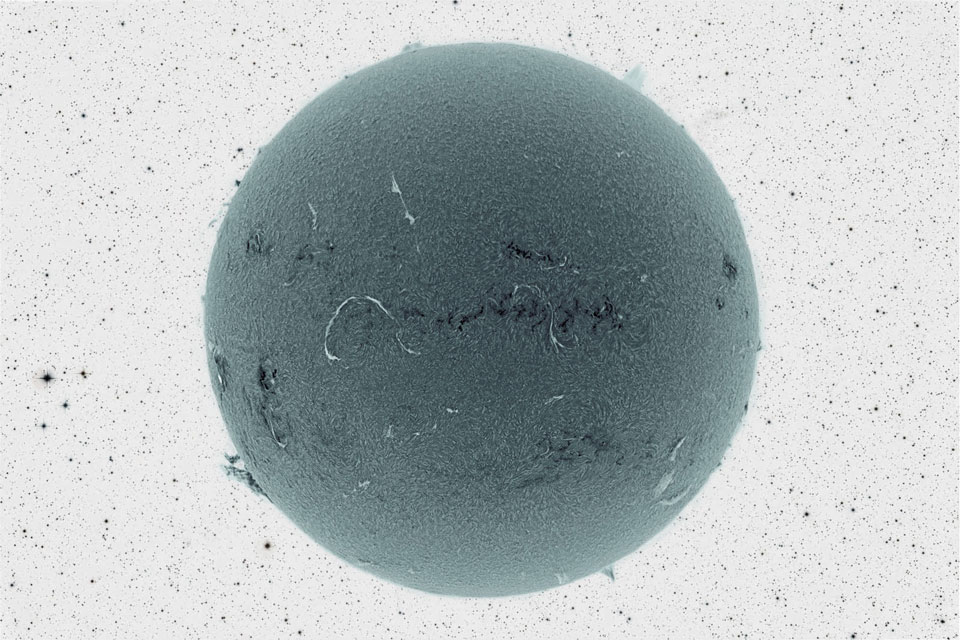
Does this strange dark ball look somehow familiar? If so, that might be because it is our Sun. In the above image, a detailed solar view was captured originally in a very specific color of red light, then rendered in black and white, and then color inverted. Once complete, the resulting image was added to a starfield, then also color inverted. Visible in the above image of the Sun are long light filaments, dark active regions, prominences peaking around the edge, and a moving carpet of hot gas. The surface of our Sun has become a particularly busy place over the past two years because it is now nearing Solar Maximum, the time when its surface magnetic field is wound up the most. Besides an active Sun being so picturesque, the plasma expelled can also become picturesque when it impacts the Earth's magnetosphere and creates auroras.
What's in the sky tonight?
October 15, 2012
-This is the time of year when the W shape of Cassiopeia is tipping nearly vertically in the northeast after dusk. It stands exactly vertically around 9 or 10 p.m., depending on your location. The W's brightest side is on top.
-New Moon (exact at 8:03 a.m. EDT).
-Mercury (magnitude –0.2) is deep in the sunset. Using binoculars, try scanning for it about 30 minutes after sundown very low in the west-southwest. Overall, this will be a poor apparition of Mercury. It stays lying low there for a month, then drops back into the Sun's glare.
-New Moon (exact at 8:03 a.m. EDT).
-Mercury (magnitude –0.2) is deep in the sunset. Using binoculars, try scanning for it about 30 minutes after sundown very low in the west-southwest. Overall, this will be a poor apparition of Mercury. It stays lying low there for a month, then drops back into the Sun's glare.
Astro Picture of the Day:
October 15, 2012
Does this strange dark ball look somehow familiar? If so, that might be because it is our Sun. In the above image, a detailed solar view was captured originally in a very specific color of red light, then rendered in black and white, and then color inverted. Once complete, the resulting image was added to a starfield, then also color inverted. Visible in the above image of the Sun are long light filaments, dark active regions, prominences peaking around the edge, and a moving carpet of hot gas. The surface of our Sun has become a particularly busy place over the past two years because it is now nearing Solar Maximum, the time when its surface magnetic field is wound up the most. Besides an active Sun being so picturesque, the plasma expelled can also become picturesque when it impacts the Earth's magnetosphere and creates auroras.



 - Tosh 2014





Comment