

Re: Terry's Astronomy Thread.
What's in the sky tonight?
February 13, 2013

Astro Picture of the Day:
February 13, 2013
 Source:
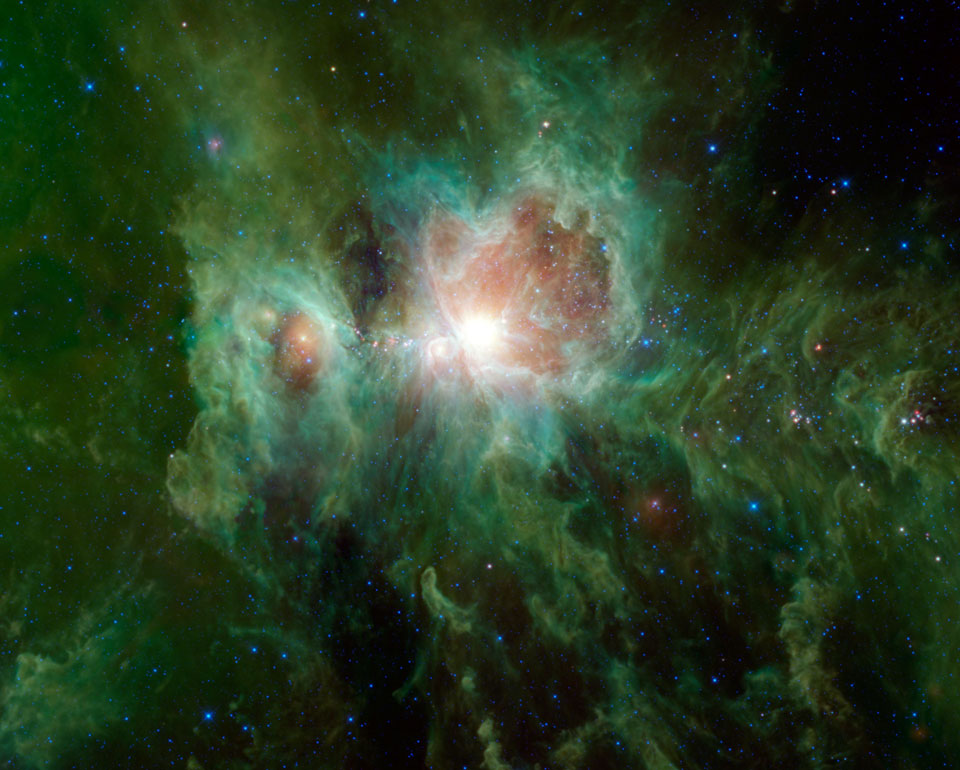
The Great Nebula in Orion is a intriguing place. Visible to the unaided eye, it appears as a small fuzzy patch in the constellation of Orion. But this image, an illusory-color composite of four colors of infrared light taken with the Earth orbiting WISE observatory, shows the Orion Nebula to be a bustling neighborhood or recently formed stars, hot gas, and dark dust. The power behind much of the Orion Nebula (M42) is the stars of the Trapezium star cluster, seen near the center of the above wide field image. The eerie green glow surrounding the bright stars pictured here is their own starlight reflected by intricate dust filaments that cover much of the region. The current Orion Nebula cloud complex, which includes the Horsehead Nebula, will slowly disperse over the next 100,000 years.
What's in the sky tonight?
February 13, 2013
-Look to the right of the Moon soon after dark for Gamma (γ) Pegasi, the leftmost star of the Great Square of Pegasus. The Great Square is standing on one corner.
-Mars (magnitude +1.2) is becoming a real challenge as it sinks lower low into the sunset. Brighter Mercury is your marker for finding it.
-Mars is currently on the far side of the Sun from us, but Mercury is swinging around to the Sun's near side as shown by its growing size and diminishing phase.
-Mars (magnitude +1.2) is becoming a real challenge as it sinks lower low into the sunset. Brighter Mercury is your marker for finding it.
-Mars is currently on the far side of the Sun from us, but Mercury is swinging around to the Sun's near side as shown by its growing size and diminishing phase.
Astro Picture of the Day:
February 13, 2013
The Great Nebula in Orion is a intriguing place. Visible to the unaided eye, it appears as a small fuzzy patch in the constellation of Orion. But this image, an illusory-color composite of four colors of infrared light taken with the Earth orbiting WISE observatory, shows the Orion Nebula to be a bustling neighborhood or recently formed stars, hot gas, and dark dust. The power behind much of the Orion Nebula (M42) is the stars of the Trapezium star cluster, seen near the center of the above wide field image. The eerie green glow surrounding the bright stars pictured here is their own starlight reflected by intricate dust filaments that cover much of the region. The current Orion Nebula cloud complex, which includes the Horsehead Nebula, will slowly disperse over the next 100,000 years.













Comment