

Re: Terry's Astronomy Thread.
What's in the sky tonight?
May 20, 2013
Astro Picture of the Day:
May 20, 2013
Source
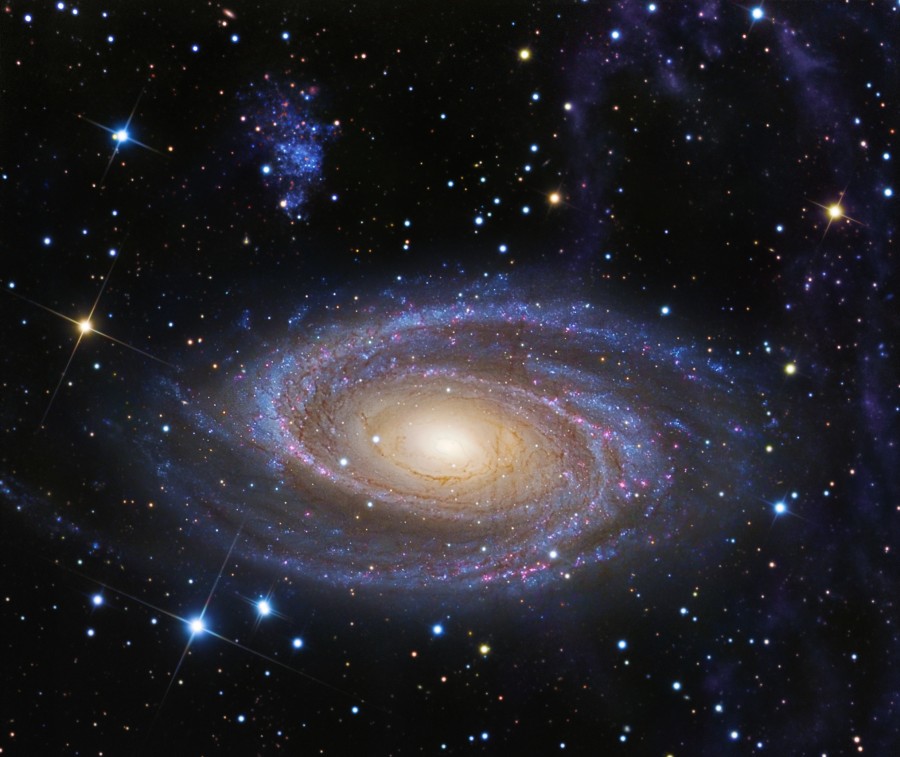
One of the brightest galaxies in planet Earth's sky and similar in size to the Milky Way, big, beautiful spiral M81 lies 11.8 million light-years away in the northern constellation Ursa Major. This deep image of the region reveals details in the bright yellow core, but at the same time follows fainter features along the galaxy's gorgeous blue spiral arms and sweeping dust lanes. It also follows the expansive, arcing feature, known as Arp's loop, that seems to rise from the galaxy's disk at the right. Studied in the 1960s, Arp's loop has been thought to be a tidal tail, material pulled out of M81 by gravitational interaction with its large neighboring galaxy M82. But a recent investigation demonstrates that much of Arp's loop likely lies within our own galaxy. The loop's colors in visible and infrared light match the colors of pervasive clouds of dust, relatively unexplored galactic cirrus only a few hundred light-years above the plane of the Milky Way. Along with the Milky Way's stars, the dust clouds lie in the foreground of this remarkable view. M81's dwarf companion galaxy, Holmberg IX, can be seen just above and left of the large spiral. On the sky, this image spans about 0.5 degrees, about the size of the Full Moon.
What's in the sky tonight?
May 20, 2013
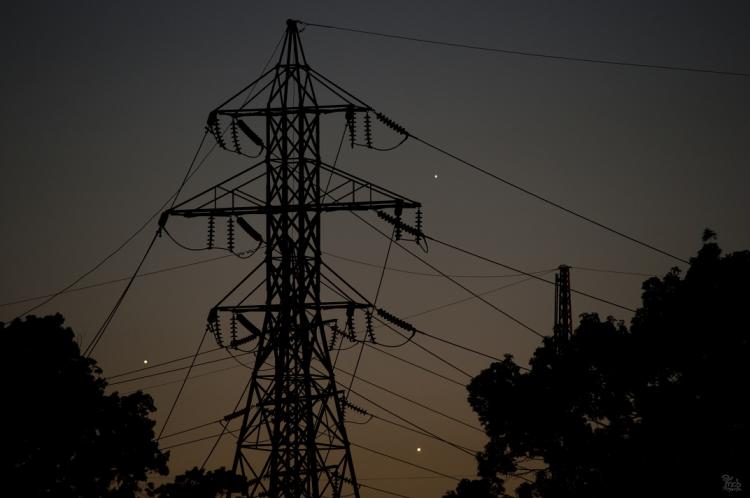
-Low in the afterglow of sunset, Jupiter has drawn to within 8° of Venus, which shines to its lower right. Can you see Mercury yet, 3° to the lower right of Venus?
-These three planets about to swing through a "trio" together, as shown in the video below. They'll appear closest together in a tight little triangle, 2° on a side, next Sunday the 26th.
-These three planets about to swing through a "trio" together, as shown in the video below. They'll appear closest together in a tight little triangle, 2° on a side, next Sunday the 26th.
Astro Picture of the Day:
May 20, 2013
One of the brightest galaxies in planet Earth's sky and similar in size to the Milky Way, big, beautiful spiral M81 lies 11.8 million light-years away in the northern constellation Ursa Major. This deep image of the region reveals details in the bright yellow core, but at the same time follows fainter features along the galaxy's gorgeous blue spiral arms and sweeping dust lanes. It also follows the expansive, arcing feature, known as Arp's loop, that seems to rise from the galaxy's disk at the right. Studied in the 1960s, Arp's loop has been thought to be a tidal tail, material pulled out of M81 by gravitational interaction with its large neighboring galaxy M82. But a recent investigation demonstrates that much of Arp's loop likely lies within our own galaxy. The loop's colors in visible and infrared light match the colors of pervasive clouds of dust, relatively unexplored galactic cirrus only a few hundred light-years above the plane of the Milky Way. Along with the Milky Way's stars, the dust clouds lie in the foreground of this remarkable view. M81's dwarf companion galaxy, Holmberg IX, can be seen just above and left of the large spiral. On the sky, this image spans about 0.5 degrees, about the size of the Full Moon.









Comment