Terry's Astronomy Thread.

Collapse
X
 
  • Time
  • Show
Clear All
new posts
  • Bluearrowll
    ⊙▃⊙
    FFR Simfile Author
    • Nov 2007
    • 7376

    #616
    Re: Terry's Astronomy Thread.

    What's in the sky tonight?
    July 24, 2013
    -The two brightest stars of summer evenings are Arcturus in the west now and Vega nearly overhead. They're 37 and 25 light-years away, respectively.

    -Mars and Jupiter are low in the east-northeast during early dawn. Jupiter is by far the brightest at magnitude –1.9. Binoculars help with finding Mars, magnitude +1.6, right close by. Jupiter and Mars passed just 3/4° from each other on the morning of July 22nd.

    Astro Picture of the Day:
    July 24, 2013
    Source:
    Each panel shows one day. With 360 movie panels, the sky over (almost) an entire year is shown in time lapse format as recorded by a video camera on the roof of the Exploratorium museum in San Francisco, California. The camera recorded an image every 10 seconds from before sunrise to after sunset and from mid-2009 to mid-2010. A time stamp showing the local time of day is provided on the lower right. The videos are arranged chronologically, with July 28 shown on the upper left, and January 1 located about about half way down. Although every day lasts 24 hours, daylight lasts longest in the northern hemisphere in June and the surrounding summer months, a fact which can be seen here as the bottom (and soon top) videos are the first to light up with dawn. The initial darkness in the middle depicts the delayed dawn and fewer daylight hours of winter. In the videos, darkness indicates night, blue depicts clear day, while gray portrays pervasive daytime cloud cover. Many videos show complex patterns of clouds moving across the camera's wide field as that day progresses. As the videos collectively end, sunset and then darkness descend first on the winter days just above the middle, and last on the mid-summer near the bottom.
    1st in Kommisar's 2009 SM Tournament
    1st in I Love You`s 2009 New Year`s Tournament
    3rd in EnR's Mashfest '08 tournament
    5th in Phynx's Unofficial FFR Tournament
    9th in D3 of the 2008-2009 4th Official FFR Tournament
    10th in D5 of the 2010 5th Official FFR Tournament
    10th in D6 of the 2011-2012 6th Official FFR Tournament

    FMO AAA Count: 71
    FGO AAA Count: 10

    Bluearrowll = The Canadian player who can not detect awkward patterns. If it's awkward for most people, it's normal for Terry. If the file is difficult but super straight forward, he has issues. If he's AAAing a FGO but then heard that his favorite Hockey team was losing by a point, Hockey > FFR
    PS: Cool AAA's Terry
    - I Love You


    An Alarm Clock's Haiku
    beep beep beep beep beep
    beep beep beep beep beep beep beep
    beep beep beep beep beep
    - ieatyourlvllol

    Comment

    • Bluearrowll
      ⊙▃⊙
      FFR Simfile Author
      • Nov 2007
      • 7376

      #617
      Re: Terry's Astronomy Thread.

      What's in the sky tonight?
      July 25, 2013
      -The waning gibbous Moon rises due east late this evening. If you have a distant, flat eastern horizon, mark the spot. The Great Square of Pegasus stands on one corner well to the rising Moon's upper left.

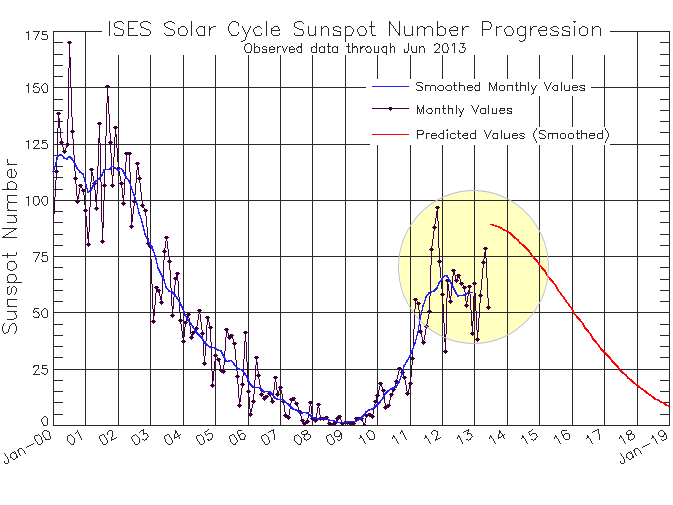
      -Solar Cycle 24 is shaping up to be the weakest solar cycle in more than 50 years. In 2009, a panel of forecasters led by NOAA and NASA predicted a below-average peak. Now that Solar Max has arrived, however, it is even weaker than they expected. It may be premature to declare Solar Cycle 24 underwhelming. Solar physicist Dean Pesnell of the Goddard Space Flight Center thinks Solar Cycle 24 is double peaked - and the second peak is yet to come. Also, weak solar cycles have been known to produce very strong flares. The strongest solar storm in recorded history, the Carrington Event of 1859, occurred during a relatively weak solar cycle like this one.


      Astro Picture of the Day:
      July 25, 2013
      Source:
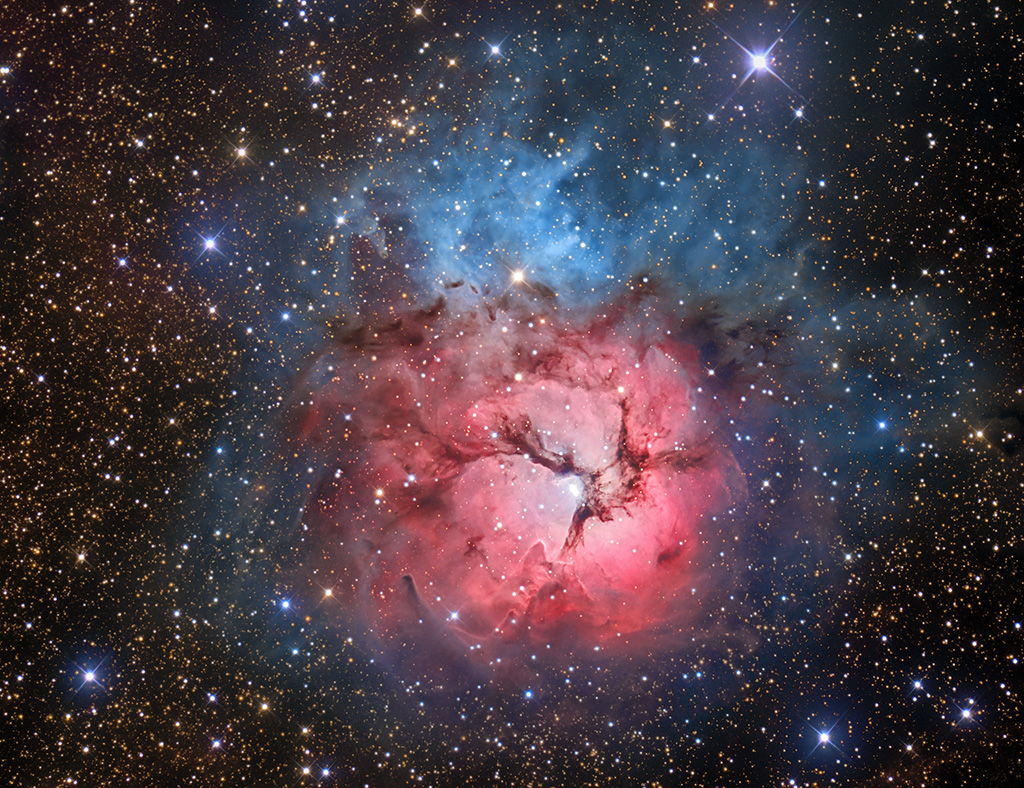
      The beautiful Trifid Nebula is a cosmic study in contrasts. Also known as M20, it lies about 5,000 light-years away toward the nebula rich constellation Sagittarius. A star forming region in the plane of our galaxy, the Trifid illustrates three different types of astronomical nebulae; red emission nebulae dominated by light emitted by hydrogen atoms, blue reflection nebulae produced by dust reflecting starlight, and dark nebulae where dense dust clouds appear in silhouette. The bright red emission region, roughly separated into three parts by obscuring dust lanes, lends the Trifid its popular name. But in this sharp, colorful scene, the red emission is also surrounded by the the telltale blue haze of reflection nebulae. Pillars and jets sculpted by newborn stars, below and left of the emission nebula's center, appear in Hubble Space Telescope close-up images of the region. The Trifid Nebula is about 40 light-years across.
      1st in Kommisar's 2009 SM Tournament
      1st in I Love You`s 2009 New Year`s Tournament
      3rd in EnR's Mashfest '08 tournament
      5th in Phynx's Unofficial FFR Tournament
      9th in D3 of the 2008-2009 4th Official FFR Tournament
      10th in D5 of the 2010 5th Official FFR Tournament
      10th in D6 of the 2011-2012 6th Official FFR Tournament

      FMO AAA Count: 71
      FGO AAA Count: 10

      Bluearrowll = The Canadian player who can not detect awkward patterns. If it's awkward for most people, it's normal for Terry. If the file is difficult but super straight forward, he has issues. If he's AAAing a FGO but then heard that his favorite Hockey team was losing by a point, Hockey > FFR
      PS: Cool AAA's Terry
      - I Love You


      An Alarm Clock's Haiku
      beep beep beep beep beep
      beep beep beep beep beep beep beep
      beep beep beep beep beep
      - ieatyourlvllol

      Comment

      • Bluearrowll
        ⊙▃⊙
        FFR Simfile Author
        • Nov 2007
        • 7376

        #618
        Re: Terry's Astronomy Thread.

        What's in the sky tonight?
        July 26, 2013
        -The Delta Aquariid meteor shower should be in its broad maximum all week. This and other weak, long-lasting July showers with radiants in the southern sky increase the chance that any meteor you see will be flying out of the south.

        -Mercury, Mars, and Jupiter shine low in the east-northeast during dawn. Jupiter is the highest and brightest (magnitude –1.9). Look for faint Mars (magnitude +1.6) a little to Jupiter's lower left. Look below them, and perhaps a bit left, for Mercury, which brightens from magnitude +1 to 0 this week. Best time: about 60 to 40 minutes before your local sunrise. Binoculars may help with the fainter two planets, especially through summer haze.

        Astro Picture of the Day:
        July 26, 2013
        Source:
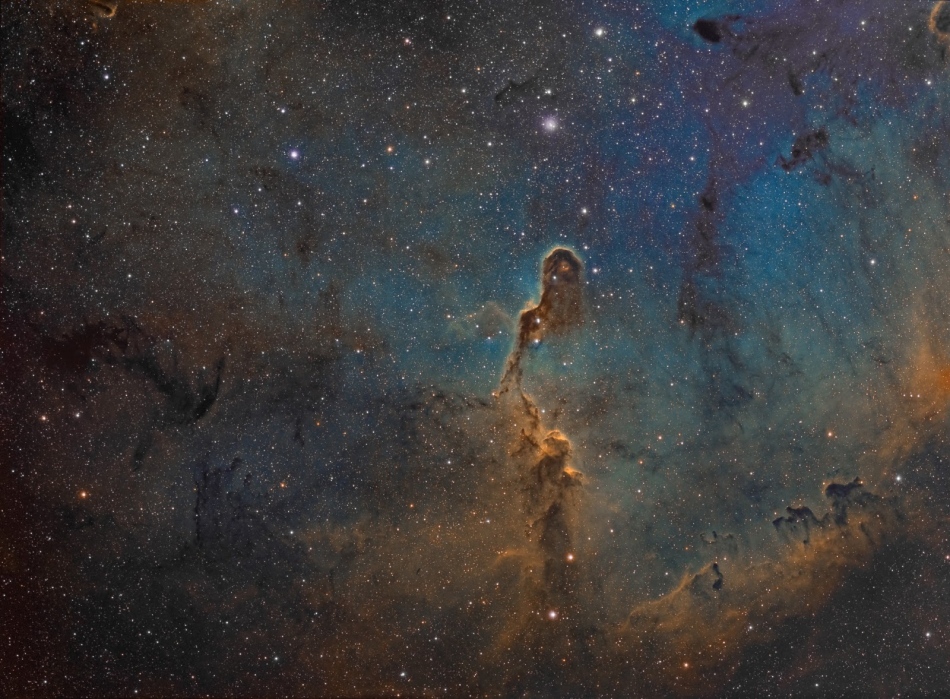
        The Elephant's Trunk Nebula winds through the emission nebula and young star cluster complex IC 1396, in the high and far off constellation of Cepheus. The cosmic elephant's trunk is over 20 light-years long. This composite was recorded through narrow band filters that transmit the light from ionized hydrogen, sulfur, and oxygen atoms in the region. The resulting image highlights the bright swept-back ridges that outline pockets of cool interstellar dust and gas. Such embedded, dark, tendril-shaped clouds contain the raw material for star formation and hide protostars within the obscuring cosmic dust. Nearly 3,000 light-years distant, the relatively faint IC 1396 complex covers a large region on the sky, spanning over 5 degrees. This close-up mosaic covers a 2 degree wide field, about the size of 4 Full Moons.
        1st in Kommisar's 2009 SM Tournament
        1st in I Love You`s 2009 New Year`s Tournament
        3rd in EnR's Mashfest '08 tournament
        5th in Phynx's Unofficial FFR Tournament
        9th in D3 of the 2008-2009 4th Official FFR Tournament
        10th in D5 of the 2010 5th Official FFR Tournament
        10th in D6 of the 2011-2012 6th Official FFR Tournament

        FMO AAA Count: 71
        FGO AAA Count: 10

        Bluearrowll = The Canadian player who can not detect awkward patterns. If it's awkward for most people, it's normal for Terry. If the file is difficult but super straight forward, he has issues. If he's AAAing a FGO but then heard that his favorite Hockey team was losing by a point, Hockey > FFR
        PS: Cool AAA's Terry
        - I Love You


        An Alarm Clock's Haiku
        beep beep beep beep beep
        beep beep beep beep beep beep beep
        beep beep beep beep beep
        - ieatyourlvllol

        Comment

        • Bluearrowll
          ⊙▃⊙
          FFR Simfile Author
          • Nov 2007
          • 7376

          #619
          Re: Terry's Astronomy Thread.

          What's in the sky tonight?
          July 27, 2013
          -During the late hours of July 26th, two filaments of magnetism erupted on the sun. The first to blow was this loop on the sun's southwestern limb. A second filament connecting sunspots AR1800 and AR1805 erupted shortly thereafter. The explosions hurled coronal mass ejections (CMEs) into space. One of them (the one propelled by the filament connecting AR1800 and AR1805) might be heading in the general direction of Earth. An analysis the CME's trajectory is in progress as more imagery becomes available.

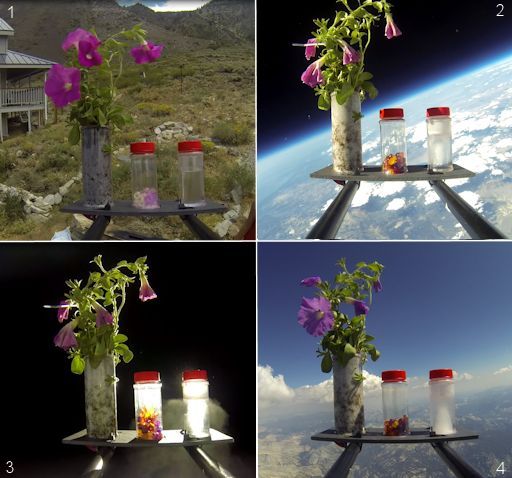
          -The students of Earth to Sky Calculus have recovered the petunias they sent to the stratosphere last Friday. The flowers left Earth July 19th onboard a helium research balloon, ascended to 110,570 feet, then parachuted back to Earth on the same day. The below four screenshots show the following scenarios:

          (1) The flowers were pink and alert when they left Earth. (2) An hour later, in the stratosphere, the flowers appear limp and wilted, but they were not. Actually, the flowers were frozen. The petals were bent downward by onrushing wind during the ascent, and they froze in place as the petunias passed through the tropopause where the temperature was -63 C. (3) You can see that the flowers were frozen stiff because when the balloon exploded, they did not move at all. (4) Finally, as the payload parachuted back to Earth the flowers thawed and turned deep purple.


          Astro Picture of the Day:
          July 27, 2013
          Source:
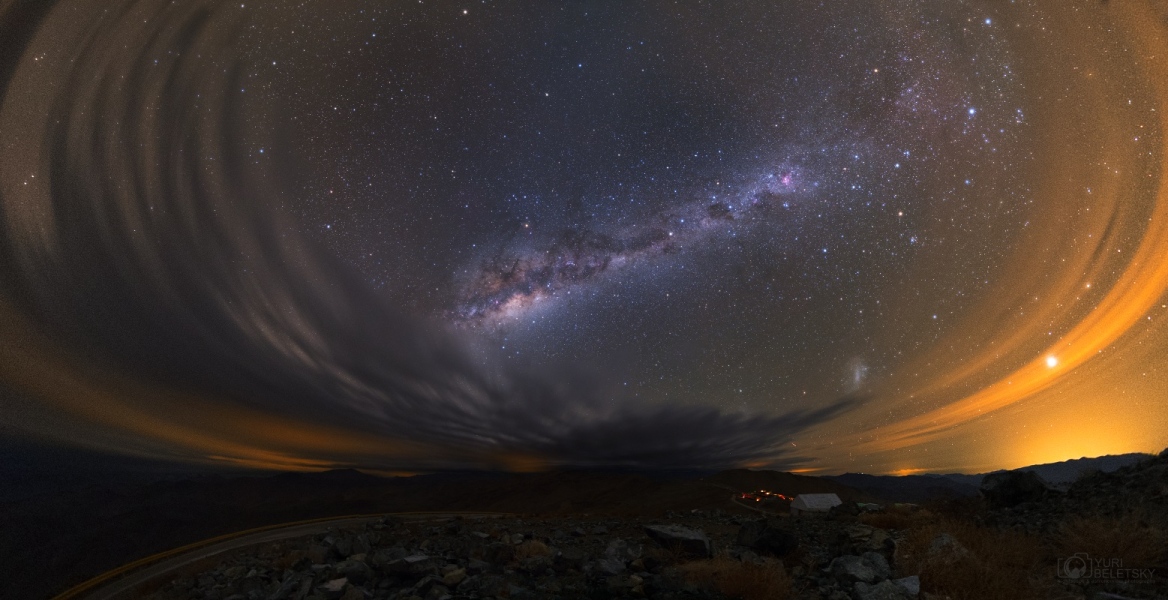
          Storm clouds do sometimes come to Chile's Atacama desert, known as the driest place on Earth. These washed through the night sky just last month during the winter season, captured in this panoramic view. Drifting between are cosmic clouds more welcome by the region's astronomical residents though, including dark dust clouds in silhouette against the crowded starfields and nebulae of the central Milky Way. Below and right of center lies the Large Magellanic Cloud, appropriately named for its appearance in starry southern skies. City lights about 200 kilometers distant still glow along the horizon at the right, while bright star Canopus shines above them in the cloudy sky.
          1st in Kommisar's 2009 SM Tournament
          1st in I Love You`s 2009 New Year`s Tournament
          3rd in EnR's Mashfest '08 tournament
          5th in Phynx's Unofficial FFR Tournament
          9th in D3 of the 2008-2009 4th Official FFR Tournament
          10th in D5 of the 2010 5th Official FFR Tournament
          10th in D6 of the 2011-2012 6th Official FFR Tournament

          FMO AAA Count: 71
          FGO AAA Count: 10

          Bluearrowll = The Canadian player who can not detect awkward patterns. If it's awkward for most people, it's normal for Terry. If the file is difficult but super straight forward, he has issues. If he's AAAing a FGO but then heard that his favorite Hockey team was losing by a point, Hockey > FFR
          PS: Cool AAA's Terry
          - I Love You


          An Alarm Clock's Haiku
          beep beep beep beep beep
          beep beep beep beep beep beep beep
          beep beep beep beep beep
          - ieatyourlvllol

          Comment

          • Bluearrowll
            ⊙▃⊙
            FFR Simfile Author
            • Nov 2007
            • 7376

            #620
            Re: Terry's Astronomy Thread.

            What's in the sky tonight?
            July 28, 2013
            -Starry Scorpius is sometimes called "the Orion of Summer" for its brightness and its prominent red supergiant (Antares in the case of Scorpius, Betelgeuse for Orion). But Scorpius is a lot lower in the sky for those of us at mid-northern latitudes. This means it has only one really good evening month: July. Catch Scorpius due south just after dark now, before it starts to tilt lower toward the southwest.

            -Jupiter is climbing higher above faint Mars low in the dawn. What morning can you first pick up Mercury?

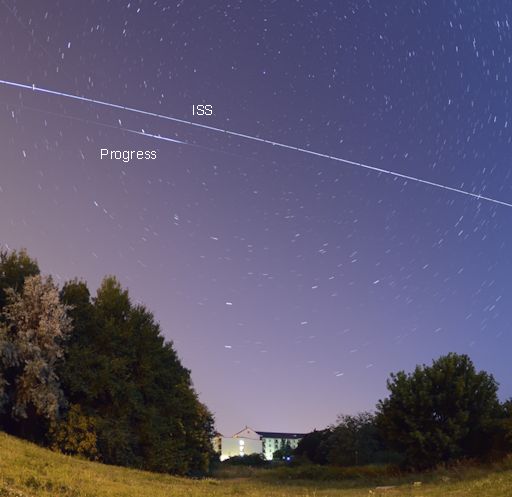
            -On Saturday, July 27th, the Russian Space Agency launched a Progress supply ship to the International Space Station. The Progress quickly caught up with the ISS and docked to the outpost, delivering food, fuel, and the last-minute addition of a repair kit for a U.S. spacesuit that malfunctioned during a spacewalk last week. Shortly before docking, Monika Landy-Gyebnar saw the two spaceships fly over her home in Veszprem, Hungary:

            "The ISS appeared in the NW sky, glowing brightly," says Landy-Gyebnar. "About 10 seconds later I noticed a very faint dot of light following it - the Progress!"

            "At the middle of its route across the sky, the Progress spacecraft produced a very bright flare, even brighter than ISS," she continues. "It was short, but very spectacular. At maximum, the flare's astronomical magntitude was about -5, while the ISS was only -2.5. Other observers from Hungary saw it, too." (The flare was caused by sunlight glinting from a flat surface on the spacecraft.)

            "As the spaceships flew on towards the NE horizon, Progress became less and less bright and soon it faded into the sky background," she concludes. "The ISS remained bright until it set. Then I packed my gear and came home to watch the docking on NASA TV."

            -Spaceweather can tell you when fly bys will happen in your area through here: http://spaceweather.com/flybys/


            Astro Picture of the Day:
            July 28, 2013
            Source:
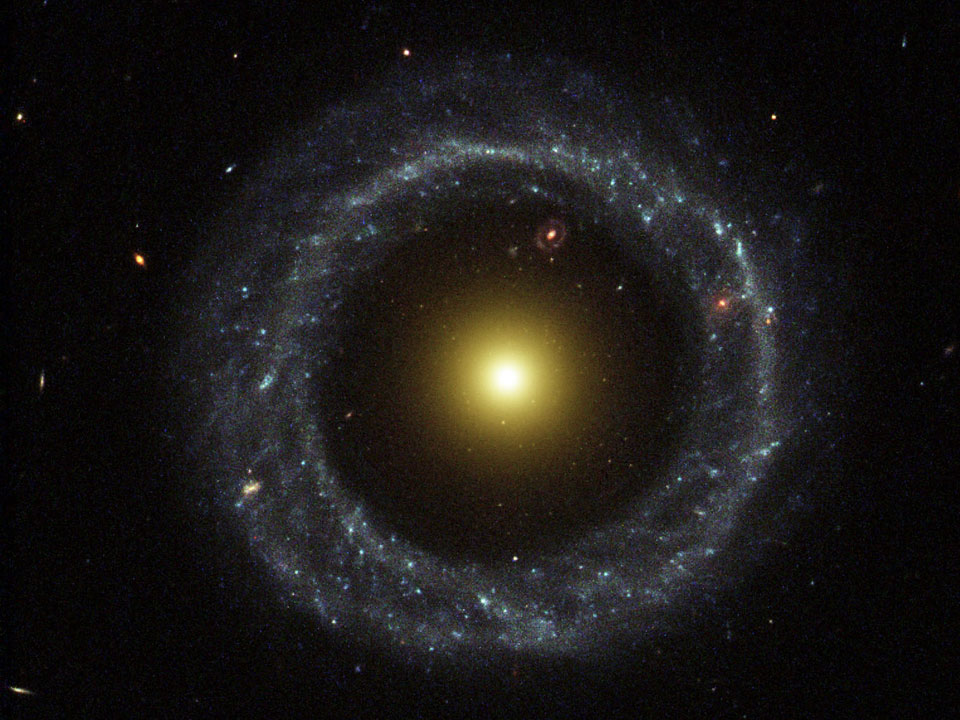
            Is this one galaxy or two? This question came to light in 1950 when astronomer Art Hoag chanced upon this unusual extragalactic object. On the outside is a ring dominated by bright blue stars, while near the center lies a ball of much redder stars that are likely much older. Between the two is a gap that appears almost completely dark. How Hoag's Object formed remains unknown, although similar objects have now been identified and collectively labeled as a form of ring galaxy. Genesis hypotheses include a galaxy collision billions of years ago and the gravitational effect of a central bar that has since vanished. The above photo taken by the Hubble Space Telescope in July 2001 revealed unprecedented details of Hoag's Object. More recent observations in radio waves indicate that Hoag's Object has not accreted a smaller galaxy in the past billion years. Hoag's Object spans about 100,000 light years and lies about 600 million light years away toward the constellation of the Snake (Serpens). Coincidentally, visible in the gap (at about one o'clock) is yet another ring galaxy that likely lies far in the distance.
            1st in Kommisar's 2009 SM Tournament
            1st in I Love You`s 2009 New Year`s Tournament
            3rd in EnR's Mashfest '08 tournament
            5th in Phynx's Unofficial FFR Tournament
            9th in D3 of the 2008-2009 4th Official FFR Tournament
            10th in D5 of the 2010 5th Official FFR Tournament
            10th in D6 of the 2011-2012 6th Official FFR Tournament

            FMO AAA Count: 71
            FGO AAA Count: 10

            Bluearrowll = The Canadian player who can not detect awkward patterns. If it's awkward for most people, it's normal for Terry. If the file is difficult but super straight forward, he has issues. If he's AAAing a FGO but then heard that his favorite Hockey team was losing by a point, Hockey > FFR
            PS: Cool AAA's Terry
            - I Love You


            An Alarm Clock's Haiku
            beep beep beep beep beep
            beep beep beep beep beep beep beep
            beep beep beep beep beep
            - ieatyourlvllol

            Comment

            • Bluearrowll
              ⊙▃⊙
              FFR Simfile Author
              • Nov 2007
              • 7376

              #621
              Re: Terry's Astronomy Thread.

              What's in the sky tonight?
              July 29, 2013
              -Last-quarter Moon (exact at 1:43 p.m. EDT). The Moon rises around midnight tonight, shining below the stars of Aries. As it climbs higher through the morning hours, look well to its lower left for the Pleiades.

              - A pair of CMEs launched into space on July 26th by erupting solar filaments will apparently miss Earth. The odds of a geomagnetic storm this weekend are low.

              Astro Picture of the Day:
              July 29, 2013
              Source:
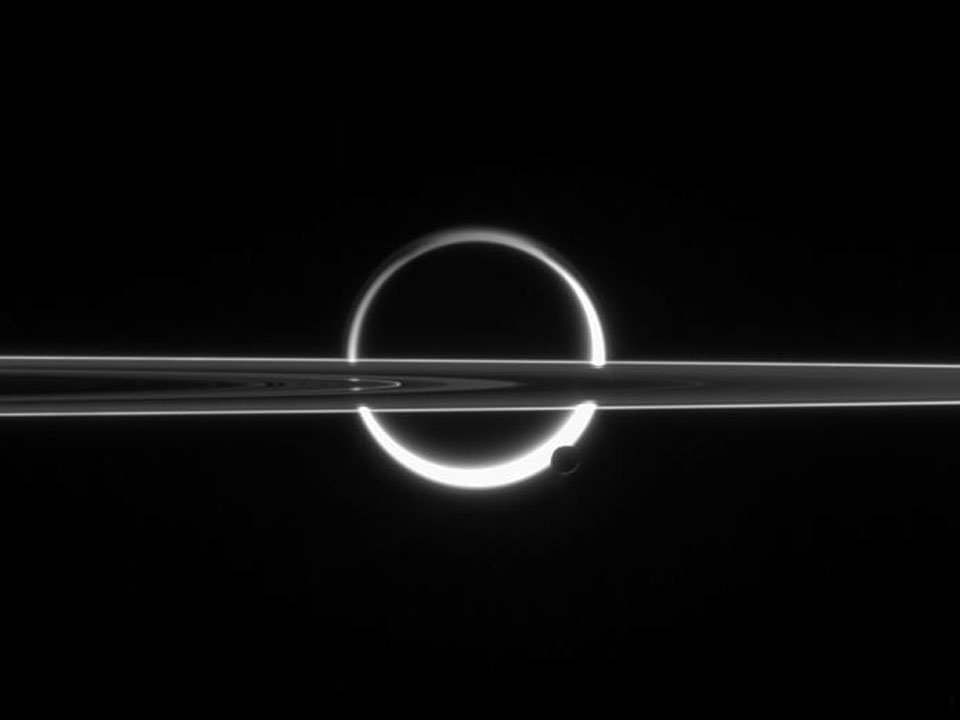
              This is not a solar eclipse. Pictured above is a busy vista of moons and rings taken at Saturn. The large circular object in the center of the image is Titan, the largest moon of Saturn and one of the most intriguing objects in the entire Solar System. The dark spot in the center is the main solid part of the moon. The bright surrounding ring is atmospheric haze above Titan, gas that is scattering sunlight to a camera operating onboard the robotic Cassini spacecraft. Cutting horizontally across the image are the rings of Saturn, seen nearly edge on. At the lower right of Titan is Enceladus, a small moon of Saturn. Since the image was taken pointing nearly at the Sun, the surfaces of Titan and Enceladus appear in silhouette, and the rings of Saturn appear similar to a photographic negative. Now if you look really really closely at Enceladus, you can see a hint of icy jets shooting out toward the bottom of the image. It is these jets that inspired future proposals to land on Enceladus, burrow into the ice, and search for signs of extraterrestrial life.
              1st in Kommisar's 2009 SM Tournament
              1st in I Love You`s 2009 New Year`s Tournament
              3rd in EnR's Mashfest '08 tournament
              5th in Phynx's Unofficial FFR Tournament
              9th in D3 of the 2008-2009 4th Official FFR Tournament
              10th in D5 of the 2010 5th Official FFR Tournament
              10th in D6 of the 2011-2012 6th Official FFR Tournament

              FMO AAA Count: 71
              FGO AAA Count: 10

              Bluearrowll = The Canadian player who can not detect awkward patterns. If it's awkward for most people, it's normal for Terry. If the file is difficult but super straight forward, he has issues. If he's AAAing a FGO but then heard that his favorite Hockey team was losing by a point, Hockey > FFR
              PS: Cool AAA's Terry
              - I Love You


              An Alarm Clock's Haiku
              beep beep beep beep beep
              beep beep beep beep beep beep beep
              beep beep beep beep beep
              - ieatyourlvllol

              Comment

              • Bluearrowll
                ⊙▃⊙
                FFR Simfile Author
                • Nov 2007
                • 7376

                #622
                Re: Terry's Astronomy Thread.

                What's in the sky tonight?
                July 30, 2013
                -Bright Vega shines nearly overhead these evenings, for those of us at mid-northern latitudes. Look southeast for Altair, almost as bright. Above Altair by a finger-width at arm's length is its little orange sidekick Tarazed, 3rd magnitude.

                -Earth is passing through a stream of debris from Comet 96P/Machholz, source of the annual Southern Delta Aquariid meteor shower. The shower's broad peak, centered on July 30th, is expected to produce a meteor every 4 or 5 minutes during the dark hours before local sunrise. Southern hemisphere observers are favored.

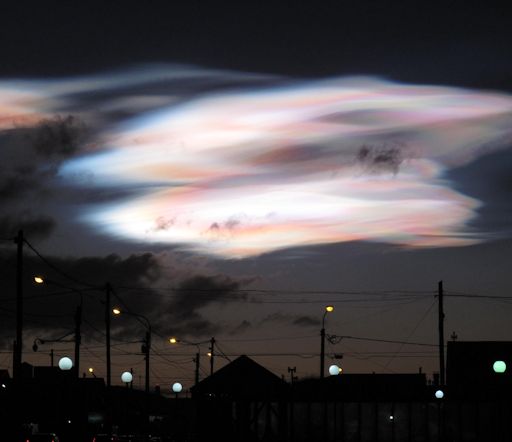
                -On July 24th, about an hour after sunset, Gerardo Connon of Rio Grande city in Tierra del Fuego, Argentina, walked outside and witnessed a rare display of nacreous clouds. The colorful apparition was as bright as the street lights in the city. These clouds, also known as "mother of pearl clouds," form in the stratosphere far above the usual realm of weather. They are seldom seen, but when they are, the reports usually come from high-northern parts of our planet. This apparition over Tierra del Fuego was unusual indeed. Atmospheric optics expert Les Cowley explains the special conditions required to create such a cloud: "Take an unusually cold lower stratosphere (15-25km high), use some gravity waves generated by high winds and storms in the troposphere to stir in some water vapour, and - voilà! You get these clouds made of tiny ice crystals shining after sunset with unforgettably bright iridescent colors."


                News Posted Today:
                July 29, 2013
                Supernova Erupts in M74


                Astro Picture of the Day:
                July 30, 2013
                Source:
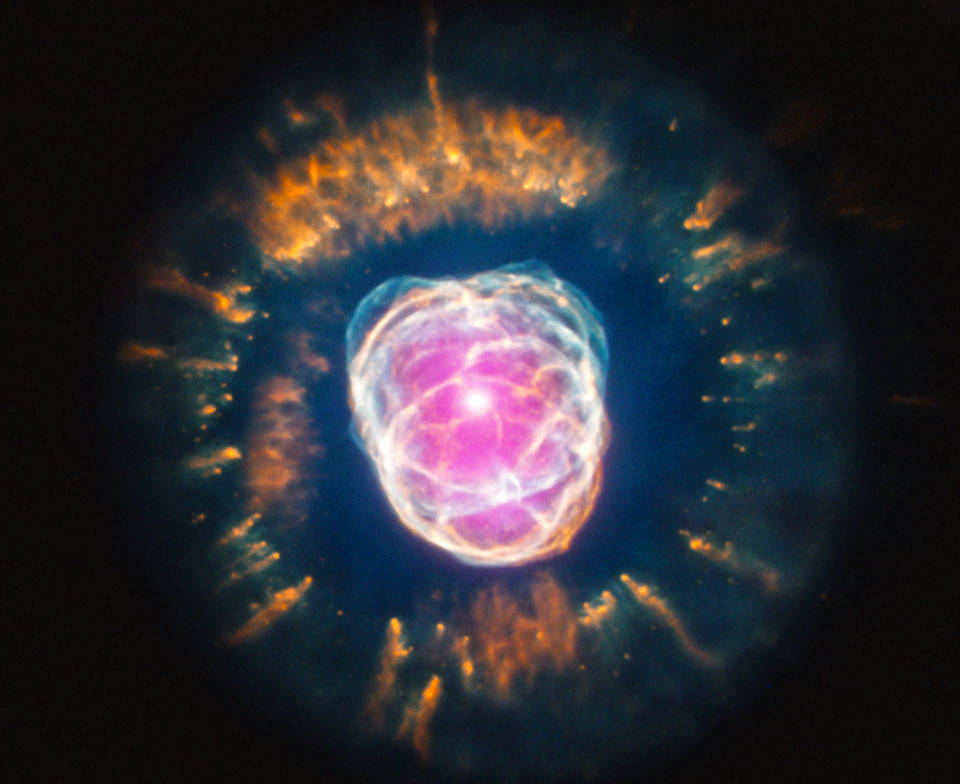
                In 1787, astronomer William Herschel discovered the Eskimo Nebula. From the ground, NGC 2392 resembles a person's head surrounded by a parka hood. In 2000, the Hubble Space Telescope imaged the Eskimo Nebula in visible light, while the nebula was imaged in X-rays by the Chandra X-ray Observatory in 2007. The above combined visible-X ray image, with X-rays emitted by central hot gas and shown in pink, was released last week. From space, the nebula displays gas clouds so complex they are not fully understood. The Eskimo Nebula is clearly a planetary nebula, and the gas seen above composed the outer layers of a Sun-like star only 10,000 years ago. The inner filaments visible above are being ejected by strong wind of particles from the central star. The outer disk contains unusual light-year long orange filaments. The Eskimo Nebula spans about 1/3 of a light year and lies in our Milky Way Galaxy, about 3,000 light years distant, toward the constellation of the Twins (Gemini).
                1st in Kommisar's 2009 SM Tournament
                1st in I Love You`s 2009 New Year`s Tournament
                3rd in EnR's Mashfest '08 tournament
                5th in Phynx's Unofficial FFR Tournament
                9th in D3 of the 2008-2009 4th Official FFR Tournament
                10th in D5 of the 2010 5th Official FFR Tournament
                10th in D6 of the 2011-2012 6th Official FFR Tournament

                FMO AAA Count: 71
                FGO AAA Count: 10

                Bluearrowll = The Canadian player who can not detect awkward patterns. If it's awkward for most people, it's normal for Terry. If the file is difficult but super straight forward, he has issues. If he's AAAing a FGO but then heard that his favorite Hockey team was losing by a point, Hockey > FFR
                PS: Cool AAA's Terry
                - I Love You


                An Alarm Clock's Haiku
                beep beep beep beep beep
                beep beep beep beep beep beep beep
                beep beep beep beep beep
                - ieatyourlvllol

                Comment

                • Bluearrowll
                  ⊙▃⊙
                  FFR Simfile Author
                  • Nov 2007
                  • 7376

                  #623
                  Re: Terry's Astronomy Thread.

                  What's in the sky tonight?
                  July 31, 2013
                  -Find Altair again high in the southeast after dark. To its right, by about a fist and a half at arm's length, is the dim but distinctive little constellation Delphinus, the Dolphin, jumping leftward.

                  -Solar activity remains low. The only action on the Earthside of the sun is a minor crackling of C-class solar flares from departing sunspot AR1800. NOAA forecasters estimate a 10% chance of M-class flares and no more than a 1% chance of X-flares on July 31st.

                  Astro Picture of the Day:
                  July 31, 2013
                  Source:
                  How has the surface temperature of Earth been changing? To help find out, Earth scientists collected temperature records from over 1000 weather stations around the globe since 1880, and combined them with modern satellite data. The above movie dramatizes the result showing 130 years of planet-wide temperature changes relative to the local average temperatures in the mid-1900s. In the above global maps, red means warmer and blue means colder. On average, the display demonstrates that the temperature on Earth has increased by nearly one degree Celsius over the past 130 years, and many of the warmest years on record have occurred only recently. Global climate change is of more than passing interest - it is linked to global weather severity and coastal sea water levels.
                  1st in Kommisar's 2009 SM Tournament
                  1st in I Love You`s 2009 New Year`s Tournament
                  3rd in EnR's Mashfest '08 tournament
                  5th in Phynx's Unofficial FFR Tournament
                  9th in D3 of the 2008-2009 4th Official FFR Tournament
                  10th in D5 of the 2010 5th Official FFR Tournament
                  10th in D6 of the 2011-2012 6th Official FFR Tournament

                  FMO AAA Count: 71
                  FGO AAA Count: 10

                  Bluearrowll = The Canadian player who can not detect awkward patterns. If it's awkward for most people, it's normal for Terry. If the file is difficult but super straight forward, he has issues. If he's AAAing a FGO but then heard that his favorite Hockey team was losing by a point, Hockey > FFR
                  PS: Cool AAA's Terry
                  - I Love You


                  An Alarm Clock's Haiku
                  beep beep beep beep beep
                  beep beep beep beep beep beep beep
                  beep beep beep beep beep
                  - ieatyourlvllol

                  Comment

                  • Bluearrowll
                    ⊙▃⊙
                    FFR Simfile Author
                    • Nov 2007
                    • 7376

                    #624
                    Re: Terry's Astronomy Thread.

                    What's in the sky tonight?
                    August 1, 2013
                    -The asteroid 3 Juno is brightest at opposition this week, glimmering at magnitude 9.0 at the Aquarius-Aquila border.

                    -Mercury, Mars, and Jupiter shine low in the east-northeast during dawn. Jupiter is the highest and brightest (magnitude –1.9). Look for faint Mars (magnitude +1.6) a little to Jupiter's lower left. Look below them, and perhaps a bit left, for Mercury, which brightens from magnitude +1 to 0 this week. Best time: about 60 to 40 minutes before your local sunrise. See the illustrations above. Binoculars may help with the fainter two planets, especially through summer haze.

                    Astro Picture of the Day:
                    August 1, 2013
                    Source:
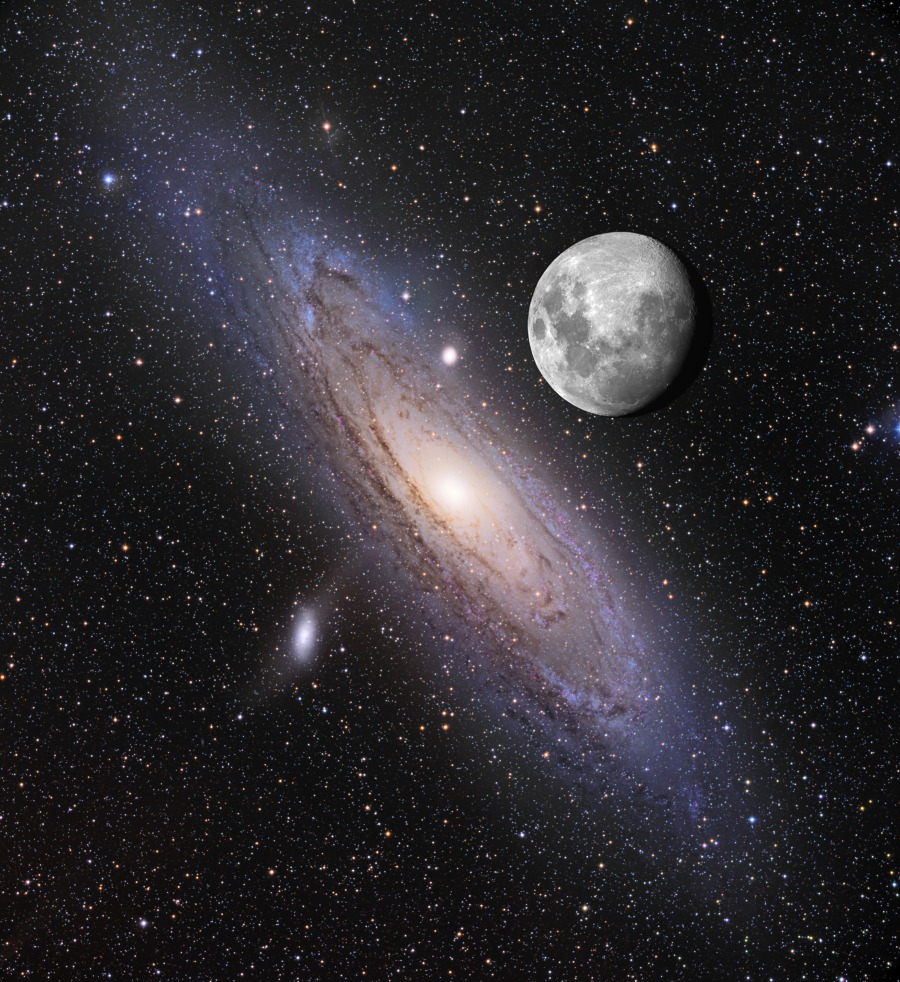
                    The Great Spiral Galaxy in Andromeda (aka M31), a mere 2.5 million light-years distant, is the closest large spiral to our own Milky Way. Andromeda is visible to the unaided eye as a small, faint, fuzzy patch, but because its surface brightness is so low, casual skygazers can't appreciate the galaxy's impressive extent in planet Earth's sky. This entertaining composite image compares the angular size of the nearby galaxy to a brighter, more familiar celestial sight. In it, a deep exposure of Andromeda, tracing beautiful blue star clusters in spiral arms far beyond the bright yellow core, is combined with a typical view of a nearly full Moon. Shown at the same angular scale, the Moon covers about 1/2 degree on the sky, while the galaxy is clearly several times that size. The deep Andromeda exposure also includes two bright satellite galaxies, M32 and M110 (bottom).
                    1st in Kommisar's 2009 SM Tournament
                    1st in I Love You`s 2009 New Year`s Tournament
                    3rd in EnR's Mashfest '08 tournament
                    5th in Phynx's Unofficial FFR Tournament
                    9th in D3 of the 2008-2009 4th Official FFR Tournament
                    10th in D5 of the 2010 5th Official FFR Tournament
                    10th in D6 of the 2011-2012 6th Official FFR Tournament

                    FMO AAA Count: 71
                    FGO AAA Count: 10

                    Bluearrowll = The Canadian player who can not detect awkward patterns. If it's awkward for most people, it's normal for Terry. If the file is difficult but super straight forward, he has issues. If he's AAAing a FGO but then heard that his favorite Hockey team was losing by a point, Hockey > FFR
                    PS: Cool AAA's Terry
                    - I Love You


                    An Alarm Clock's Haiku
                    beep beep beep beep beep
                    beep beep beep beep beep beep beep
                    beep beep beep beep beep
                    - ieatyourlvllol

                    Comment

                    • Bluearrowll
                      ⊙▃⊙
                      FFR Simfile Author
                      • Nov 2007
                      • 7376

                      #625
                      Re: Terry's Astronomy Thread.

                      Just a heads up that until August 12, I'm moving into my living quarters at the Rexall Centre as a 24/7 stand by IT staff for the Rogers Cup tournament beginning in Montreal today, and in Toronto tomorrow. I may or may not be able to get around to these posts at a reasonable time.

                      What's in the sky tonight?
                      August 2, 2013
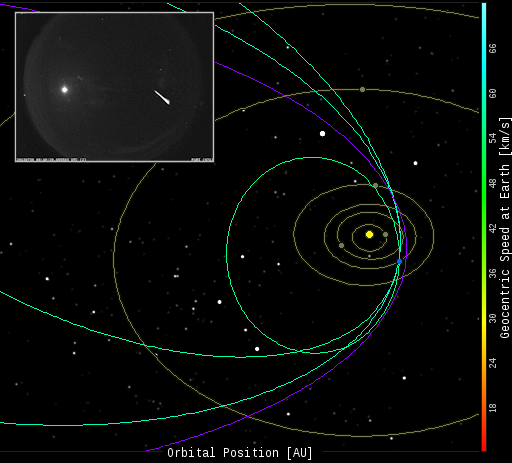
                      -Earth is entering a broad stream of debris from comet 109P/Swift-Tuttle, source of the annual Perseid meteor shower. Although the shower won't peak until August 12-13, when Earth hits the densest part of the stream, the first Perseids are already arriving. "Despite poor weather over our network of meteor cameras, we detected three Perseid fireballs on July 30-31," reports Bill Cooke, head of NASA's Meteoroid Environment Office. In the diagram he made below, the green lines trace the orbits of Perseid meteoroids. All three intersect Earth (the blue dot). The orbit of the parent comet is color-coded purple. An inset shows one of the fireballs shining almost as brightly as the Moon.

                      -The shower is just getting started. Rates should remain low for the next week as Earth penetrates the sparse outskirts of the debris stream, then skyrocket to ~100 meteors per hour as the calendar turns to the second week of August. Stay tuned for more fireballs.

                      -As summer begins to wane, The Big Dipper hangs diagonally on the wall of the northwestern sky during evening. It's about as high as bright Arcturus, shining left of it in the west.

                      -In early dawn Saturday morning (you can set your alarm), the waning crescent Moon hangs to the upper right of Jupiter, Mars, and Mercury low in the east-northeast.


                      Astro Picture of the Day:
                      August 2, 2013
                      Source:
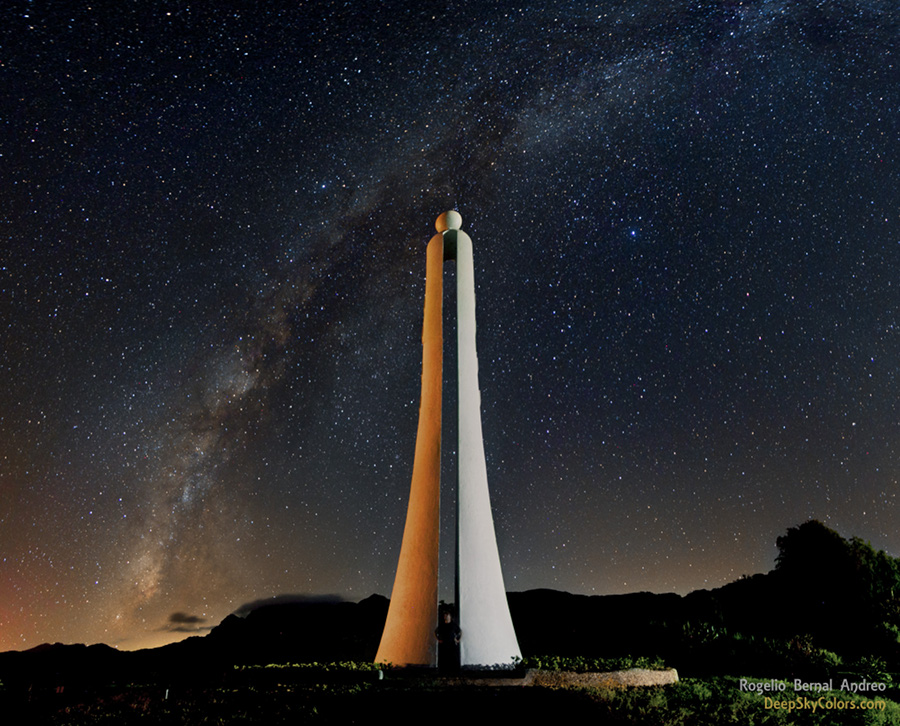
                      This intriguing monument can be found in Taiwan between the cities of Hualian and Taitong. Split into two sides, it straddles a special circle of latitude on planet Earth, near 23.5 degrees north, known as the Tropic of Cancer. Points along the Tropic of Cancer are the northernmost locations where the Sun can pass directly overhead, an event that occurs once a year during the northern hemisphere's summer solstice. The latitude that defines the Tropic of Cancer corresponds to the tilt of planet Earth's rotation axis with respect to its orbital plane. The name refers to the zodiacal constellation Cancer the Crab. Historically the Sun's position was within Cancer during the northern summer solstice, but because of the precession of Earth's axis, that solstice Sun is currently within the boundaries of Taurus. In this starry night scene the otherwise all white structure is colored by city lights, with its orange side just south of the Tropic of Cancer and the white side just north. Of course, there is a southern hemisphere counterpart of the Tropic of Cancer called the Tropic of Capricorn.
                      Last edited by Bluearrowll; 08-3-2013, 10:32 AM.
                      1st in Kommisar's 2009 SM Tournament
                      1st in I Love You`s 2009 New Year`s Tournament
                      3rd in EnR's Mashfest '08 tournament
                      5th in Phynx's Unofficial FFR Tournament
                      9th in D3 of the 2008-2009 4th Official FFR Tournament
                      10th in D5 of the 2010 5th Official FFR Tournament
                      10th in D6 of the 2011-2012 6th Official FFR Tournament

                      FMO AAA Count: 71
                      FGO AAA Count: 10

                      Bluearrowll = The Canadian player who can not detect awkward patterns. If it's awkward for most people, it's normal for Terry. If the file is difficult but super straight forward, he has issues. If he's AAAing a FGO but then heard that his favorite Hockey team was losing by a point, Hockey > FFR
                      PS: Cool AAA's Terry
                      - I Love You


                      An Alarm Clock's Haiku
                      beep beep beep beep beep
                      beep beep beep beep beep beep beep
                      beep beep beep beep beep
                      - ieatyourlvllol

                      Comment

                      • Bluearrowll
                        ⊙▃⊙
                        FFR Simfile Author
                        • Nov 2007
                        • 7376

                        #626
                        Re: Terry's Astronomy Thread.

                        What's in the sky tonight?
                        August 3, 2013
                        -During Sunday dawn an even thinner waning Moon poses to the right of the Jupiter-Mars-Mercury line.

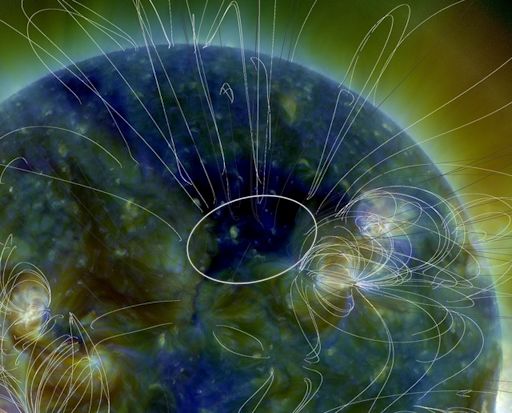
                        -Magnetic fields in the sun's northern hemisphere have opened up, forming a coronal hole. This UV image from NASA's Solar Dynamics Observatory shows the opening as a dark gap in the sun's upper atmosphere.


                        Astro Picture of the Day:
                        August 3, 2013
                        Source:
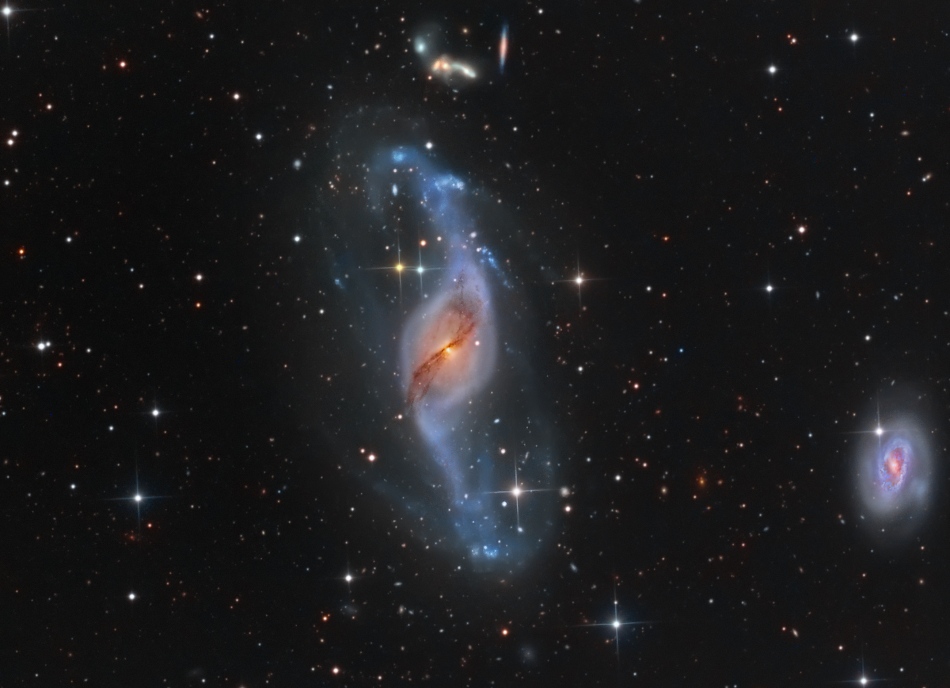
                        A careful look at this colorful cosmic snapshot reveals a surprising number of galaxies both near and far toward the constellation Ursa Major. The most striking is NGC 3718, the warped spiral galaxy near picture center. NGC 3718's spiral arms look twisted and extended, mottled with young blue star clusters. Drawn out dust lanes obscure its yellowish central regions. A mere 150 thousand light-years to the right is another large spiral galaxy, NGC 3729. The two are likely interacting gravitationally, accounting for the peculiar appearance of NGC 3718. While this galaxy pair lies about 52 million light-years away, the remarkable Hickson Group 56 can also be seen clustered above NGC 3718, near the top of the frame. Hickson Group 56 consists of five interacting galaxies and lies over 400 million light-years away. This picture was chosen as the overall winner in the 2013 David Malin Astrophotography Competition.
                        1st in Kommisar's 2009 SM Tournament
                        1st in I Love You`s 2009 New Year`s Tournament
                        3rd in EnR's Mashfest '08 tournament
                        5th in Phynx's Unofficial FFR Tournament
                        9th in D3 of the 2008-2009 4th Official FFR Tournament
                        10th in D5 of the 2010 5th Official FFR Tournament
                        10th in D6 of the 2011-2012 6th Official FFR Tournament

                        FMO AAA Count: 71
                        FGO AAA Count: 10

                        Bluearrowll = The Canadian player who can not detect awkward patterns. If it's awkward for most people, it's normal for Terry. If the file is difficult but super straight forward, he has issues. If he's AAAing a FGO but then heard that his favorite Hockey team was losing by a point, Hockey > FFR
                        PS: Cool AAA's Terry
                        - I Love You


                        An Alarm Clock's Haiku
                        beep beep beep beep beep
                        beep beep beep beep beep beep beep
                        beep beep beep beep beep
                        - ieatyourlvllol

                        Comment

                        • Bluearrowll
                          ⊙▃⊙
                          FFR Simfile Author
                          • Nov 2007
                          • 7376

                          #627
                          Re: Terry's Astronomy Thread.

                          What's in the sky tonight?
                          August 4, 2013
                          -The asteroid 3 Juno is brightest at opposition this week, glimmering at magnitude 9.0 at the Aquarius-Aquila border.

                          -Venus (magnitude –3.9) shines brightly very low in the west in evening twilight. In a telescope Venus is still small (13 arcseconds) and gibbous (81% sunlit).


                          Astro Picture of the Day:
                          August 4, 2013
                          Source:
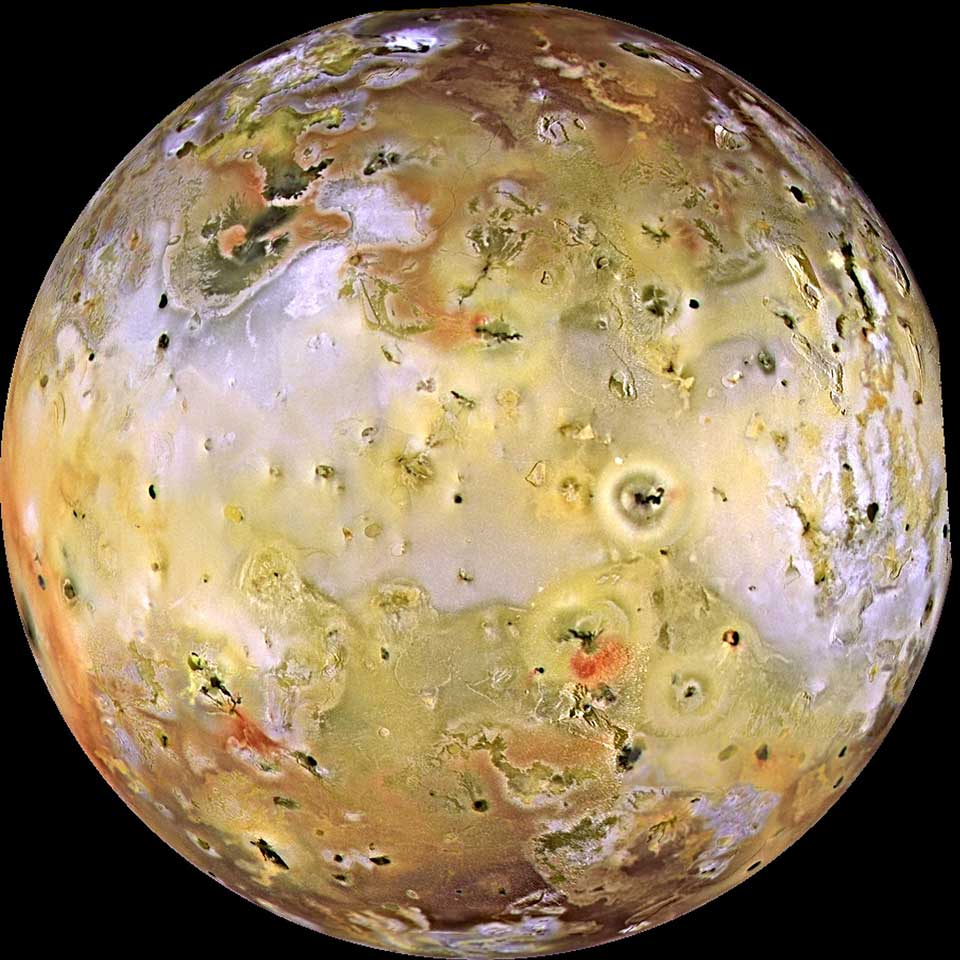
                          Like the downtown area of your favorite city and any self-respecting web site, Io's surface is constantly under construction. This moon of Jupiter holds the distinction of being the Solar System's most volcanically active body - its bizarre looking surface continuously formed and reformed by lava flows. Generated using 1996 data from NASA's Galileo spacecraft, this high resolution composite image is centered on the side of Io that always faces away from Jupiter. It has been enhanced to emphasize Io's surface brightness and color variations, revealing features as small as 1.5 miles across. The notable absence of impact craters suggests that the entire surface is covered with new volcanic deposits much more rapidly than craters are created. What drives this volcanic powerhouse? A likely energy source is the changing gravitational tides caused by Jupiter and the other Galilean moons as Io orbits the massive gas giant planet. Heating Io's interior, the pumping tides would generate the sulfurous volcanic activity.
                          1st in Kommisar's 2009 SM Tournament
                          1st in I Love You`s 2009 New Year`s Tournament
                          3rd in EnR's Mashfest '08 tournament
                          5th in Phynx's Unofficial FFR Tournament
                          9th in D3 of the 2008-2009 4th Official FFR Tournament
                          10th in D5 of the 2010 5th Official FFR Tournament
                          10th in D6 of the 2011-2012 6th Official FFR Tournament

                          FMO AAA Count: 71
                          FGO AAA Count: 10

                          Bluearrowll = The Canadian player who can not detect awkward patterns. If it's awkward for most people, it's normal for Terry. If the file is difficult but super straight forward, he has issues. If he's AAAing a FGO but then heard that his favorite Hockey team was losing by a point, Hockey > FFR
                          PS: Cool AAA's Terry
                          - I Love You


                          An Alarm Clock's Haiku
                          beep beep beep beep beep
                          beep beep beep beep beep beep beep
                          beep beep beep beep beep
                          - ieatyourlvllol

                          Comment

                          • Bluearrowll
                            ⊙▃⊙
                            FFR Simfile Author
                            • Nov 2007
                            • 7376

                            #628
                            Re: Terry's Astronomy Thread.

                            What's in the sky tonight?
                            August 5, 2013
                            -The little constellation Scutum, off the tail of Aquila, is faint to the naked eye but important for its super-rich Milky Way field and its deep-sky objects. How many can you find?

                            -Castor and Pollux are to the left of Mercury, Mars and Jupiter, and Orion is much farther to their right.


                            Astro Picture of the Day:
                            August 5, 2013
                            Source:
                            What it would look like to leave planet Earth? Such an event was recorded visually in great detail by the MESSENGER spacecraft as it swung back past the Earth, eight years ago, on its way in toward the planet Mercury. Earth can be seen rotating in this time-lapse video, as it recedes into the distance. The sunlit half of Earth is so bright that background stars are not visible. The robotic MESSENGER spacecraft is now in orbit around Mercury and has recently concluded the first complete map of the surface. On occasion, MESSENGER has continued to peer back at its home world. MESSENGER is one of the few things created on the Earth that has left and will never return - at the end of its mission MESSENGER will be crashed into Mercury's surface.
                            1st in Kommisar's 2009 SM Tournament
                            1st in I Love You`s 2009 New Year`s Tournament
                            3rd in EnR's Mashfest '08 tournament
                            5th in Phynx's Unofficial FFR Tournament
                            9th in D3 of the 2008-2009 4th Official FFR Tournament
                            10th in D5 of the 2010 5th Official FFR Tournament
                            10th in D6 of the 2011-2012 6th Official FFR Tournament

                            FMO AAA Count: 71
                            FGO AAA Count: 10

                            Bluearrowll = The Canadian player who can not detect awkward patterns. If it's awkward for most people, it's normal for Terry. If the file is difficult but super straight forward, he has issues. If he's AAAing a FGO but then heard that his favorite Hockey team was losing by a point, Hockey > FFR
                            PS: Cool AAA's Terry
                            - I Love You


                            An Alarm Clock's Haiku
                            beep beep beep beep beep
                            beep beep beep beep beep beep beep
                            beep beep beep beep beep
                            - ieatyourlvllol

                            Comment

                            • Bluearrowll
                              ⊙▃⊙
                              FFR Simfile Author
                              • Nov 2007
                              • 7376

                              #629
                              Re: Terry's Astronomy Thread.

                              What's in the sky tonight?
                              August 6, 2013
                              -A binocular challenge: Spot Venus in twilight low in the west and then, using binoculars, see if you can detect the 4.0-magnitude star that it's closely passing. The star is Sigma Leonis, Leo's hind foot, just 0.6° above Venus depending on your time and location.

                              -New Moon (exact at 5:51 p.m. Eastern Daylight Time).

                              -Data from NASA-supported observatories show that the sun's global magnetic field will flip before the end of 2013. The reversal, which signals the arrival of Solar Maximum, will have ripple effects felt throughout the solar system.

                              News Posted Today:
                              August 5, 2013
                              Subaru Sees New Planet Directly


                              Astro Picture of the Day:
                              August 6, 2013
                              Source:
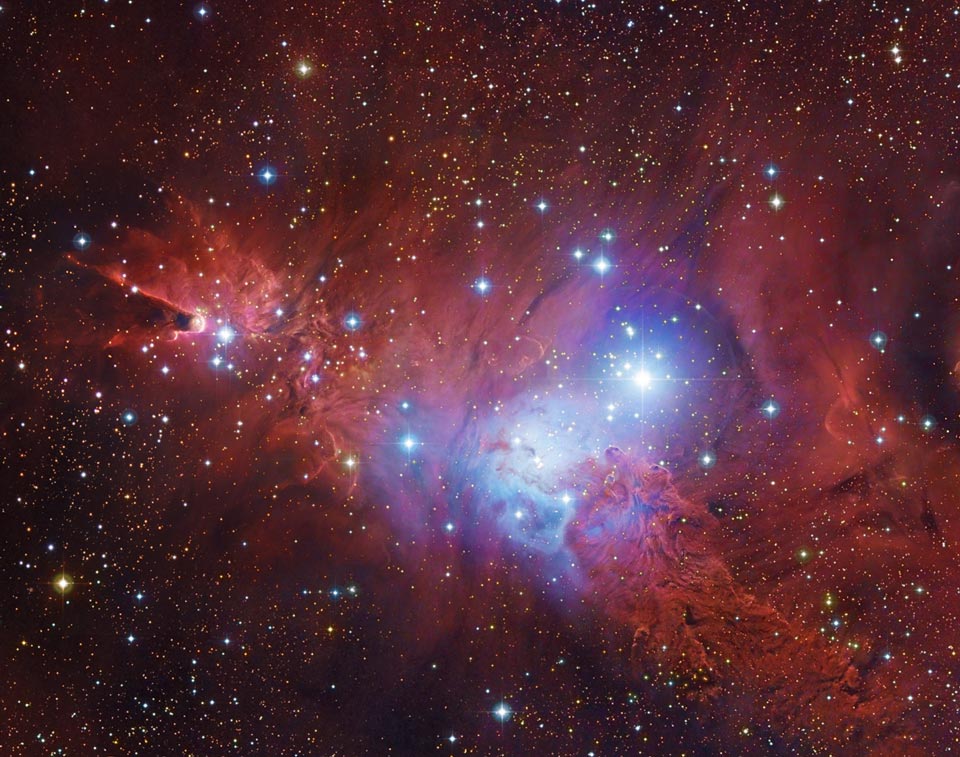
                              Strange shapes and textures can be found in neighborhood of the Cone Nebula. The unusual shapes originate from fine interstellar dust reacting in complex ways with the energetic light and hot gas being expelled by the young stars. The brightest star on the right of the above picture is S Mon, while the region just below it has been nicknamed the Fox Fur Nebula for its color and structure. The blue glow directly surrounding S Mon results from reflection, where neighboring dust reflects light from the bright star. The red glow that encompasses the whole region results not only from dust reflection but also emission from hydrogen gas ionized by starlight. S Mon is part of a young open cluster of stars named NGC 2264, located about 2500 light years away toward the constellation of the Unicorn (Monoceros). Even though it points right at S Mon, details of the origin of the mysterious geometric Cone Nebula, visible on the far left, remain a mystery.
                              1st in Kommisar's 2009 SM Tournament
                              1st in I Love You`s 2009 New Year`s Tournament
                              3rd in EnR's Mashfest '08 tournament
                              5th in Phynx's Unofficial FFR Tournament
                              9th in D3 of the 2008-2009 4th Official FFR Tournament
                              10th in D5 of the 2010 5th Official FFR Tournament
                              10th in D6 of the 2011-2012 6th Official FFR Tournament

                              FMO AAA Count: 71
                              FGO AAA Count: 10

                              Bluearrowll = The Canadian player who can not detect awkward patterns. If it's awkward for most people, it's normal for Terry. If the file is difficult but super straight forward, he has issues. If he's AAAing a FGO but then heard that his favorite Hockey team was losing by a point, Hockey > FFR
                              PS: Cool AAA's Terry
                              - I Love You


                              An Alarm Clock's Haiku
                              beep beep beep beep beep
                              beep beep beep beep beep beep beep
                              beep beep beep beep beep
                              - ieatyourlvllol

                              Comment

                              • Hateandhatred
                                "The Quebec Steparatist."
                                FFR Simfile Author
                                • Feb 2011
                                • 1974

                                #630
                                Re: Terry's Astronomy Thread.

                                I just learned that Hubble v2 will be named after Synthlight


                                roflmao!
                                Forgot where I put my old sig lol

                                Comment

                                Working...