Ok, a new problem. Calculus.
Take a non-zero number N.
The sum (1 + 1 + 1 + .... + 1) has N copies of the integer 1 in it.
Therefore, (1 + 1 + 1 + 1 + ... + 1) (with N ones) = N.
Multiply both sides by N.
Now the left hand side distributes.
(N + N + N + N + N ...) = N^2
Take the derivative with respect to N.
Because the derivative is a linear operator, it too distributes over sums.
Now we have:
(1 + 1 + 1 + 1 + 1 .... ) = 2*N
N = 2N
Because N is non-zero,
1 = 2.
Disprove. There are two reasonable flaws. Find both of them.
Silence isn't always golden, in which case, what is it?
Blue.
Nobody bothered with my last problem. So...
Eight hooks are attached to the corners of a giant cubical wooden box, one hook at each corner. String is stretched between each and every pair of hooks. Rubix walks along the strings, always remaining in contact with one of them and changing directions only at the hooks, not at any other points at which two or more strings are contiguous. Rubix never walks along the same length of string twice, although he may pass another string at an angle. Of the twenty-eight string segments between pairs of hooks, what is the maximum number Rubix may traverse under these conditions?
Eight hooks are attached to the corners of a giant cubical wooden box, one hook at each corner. String is stretched between each and every pair of hooks. Rubix walks along the strings, always remaining in contact with one of them and changing directions only at the hooks, not at any other points at which two or more strings are contiguous. Rubix never walks along the same length of string twice, although he may pass another string at an angle. Of the twenty-eight string segments between pairs of hooks, what is the maximum number Rubix may traverse under these conditions?
Eight hooks are attached to the corners of a giant cubical wooden box, one hook at each corner. String is stretched between each and every pair of hooks. Rubix walks along the strings, always remaining in contact with one of them and changing directions only at the hooks, not at any other points at which two or more strings are contiguous. Rubix never walks along the same length of string twice, although he may pass another string at an angle. Of the twenty-eight string segments between pairs of hooks, what is the maximum number Rubix may traverse under these conditions?
I thought about it and came up with 25... How I see it, you can make three complete loops around all eight hooks (24), so you would have used six paths from each hook. The last line from the start will lead to a hook with all other paths taken. That leaves six hooks with one path left each, so the three paths you can't take each connect two of those six hooks.
I haven't actually tried making three complete loops, but, yeah.
How do you write a single function where the output is dependent on whether the input is odd or even?
If I'm right, an equation to solve this riddle for any natural number of "hooks" could be... if x is the number of "hooks" or points, and g(x) = Σ of n=1 to x for x-n, or the total number of paths between the points, then... When x is even, f(x) = g(x) - (x-2)/2. The "x-2" comes from how you can only walk all the paths from two points, the starting and ending points. Halving the number of points with one path left results in the amount of paths you cannot walk. So, that value subtracted from g(x) will answer the riddle. And when x is odd, f(x) = g(x), all paths can be taken.
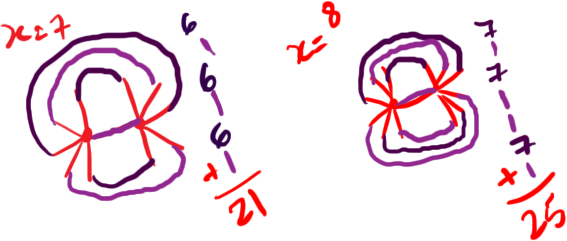
Also, this was my graphical approach:
( Oops, makes more sense if the two ones in a row are at the end.)
The image displays two points with the extended paths. The first point is the starting point, and the other point is just... any point, really. You start with a loop around the other points, the dark purple line. This loop will, of course, count for x-1 paths. You must complete the loop, following one path, the purple lines. The last step will always be connecting the starting and ending points. When x is odd, the last step completes the last loop. When x is even, the last step follows the completion of a loop.
Well it appears ieat found ways to reach 27, but, uh, I still feel like editing a bit more in to my post...
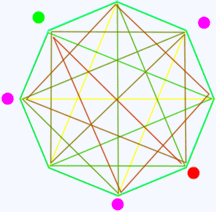
Another diagram in the form of an octagon showing what I thought up. The magenta dots are dots that are represented by the second dot in my diagram above this one. The yellow lines are the three unexplored paths etc.
Assuming I haven't made any errors, I've found several configurations for 27. In each one, for the count to reach 28, there had to be a segment that repeated itself, which violates the restrictions specified by Reach.













Comment