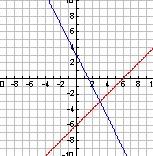
Not sure exactly what you're asking for (both of the functions' equations?), but those are basic linear functions, bro. You should have been able to do that since junior high at least.
ps m is slope, the rise divided by the run, change in y divided by change in x. b is the y intercept, the x value where the line crosses the y axis.
The equation you gave appears to be correct for the blue line. Not sure what relation the red line is supposed to be or what the "solution" to this "equation" is. Isn't the "answer" to a system of functions usually the point of intersection?
How about some problems that are actually trickier to solve:
1. A stick of length one is split into two sticks at a random point that is uniformly distributed -- say X is the shorter stick and Y is the longer one. Find E(X) and Var(X), then find E(Y-X)^2
2. Leonid and Rubix are alternating rolling a pair of dice, stopping either when Leonid rolls the sum of 9 or when Rubix rolls the sum of 6. Assuming that Leonid rolls first, find the probability that Leonid has the final roll.
3. Easier one for ya -- you can buy a lottery ticket for $1. If you win, you get $5 back. You're determined to win twice at any cost. Each ticket has p = .125 of winning. What is the probability you get your second winning ticket on the sixth purchase? What's your expected profit or loss from this lottery in general?
Here's a hard one I doubt anyone here will get -- from one of my homeworks:
You have a system of N components. Each component will function, independently, with probability p. The total system of components will work if at least half of them are functioning. For what value of p is a 5-component system more likely to operate than a 3-component system? How about a (2k+1) component system over a (2k-1) component system?
god damn jigga nones how hard can this be? math doesnt work with my brain and i took algebra ii in like grade 9 or something damn u were born halfbrained







Comment