


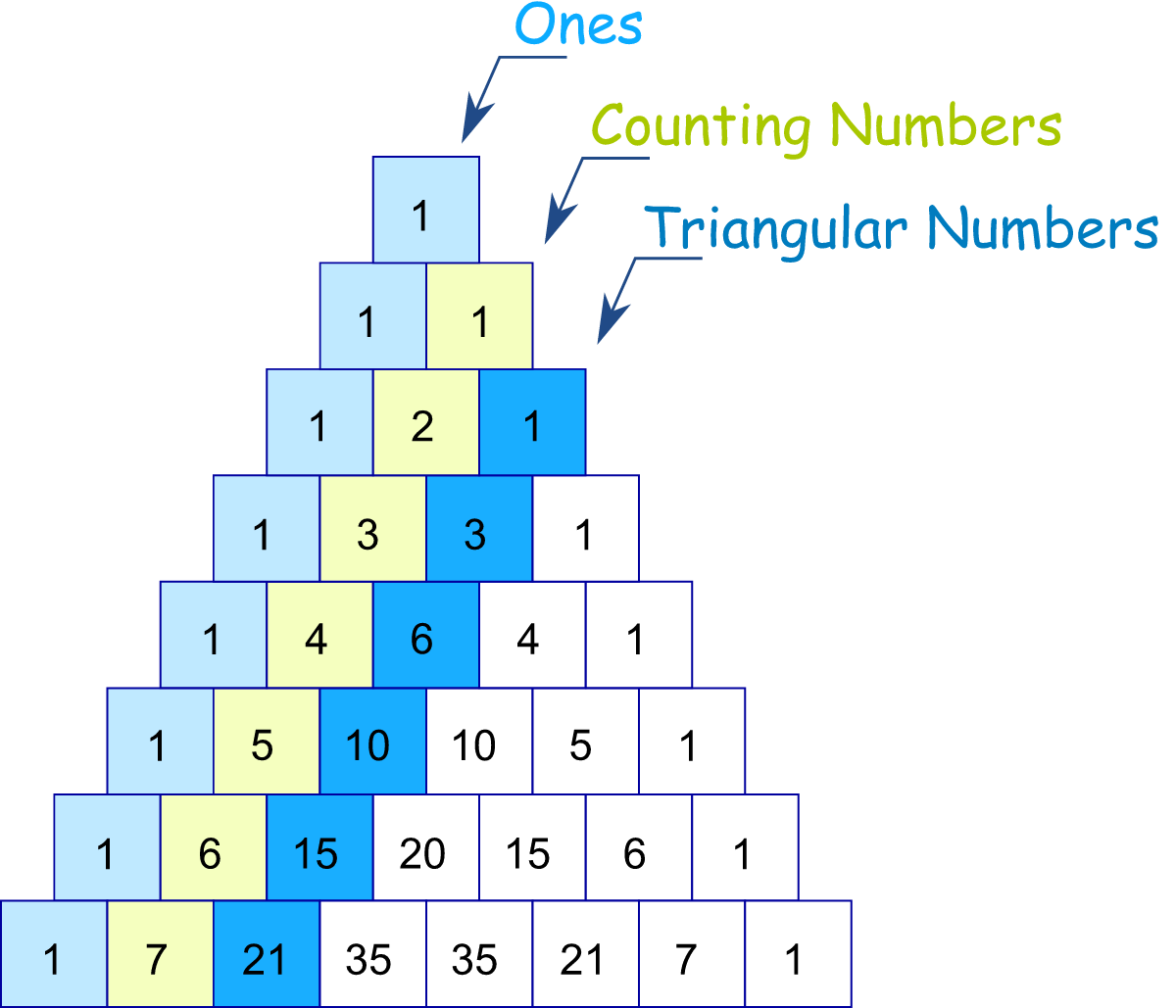
Pascal's triangle is a simple construction with awesome properties - you start with one 1 and, to each of its diagonal down placements, you write the numbe that is the sum of both its parents.

There are infinitely many cool things about Pascal's Triangle. For example:
-Each row's cells represent the number of ways to choose m objects from n. Thus,s the some of all these cells is the total number of ways to choose objects from n - which is 2^n, which follows from the fact that you're doubling the usage of each parent in the next row!
-If you colour Pascal's triangle mod 2, mod 3, mod 4 or mod any number you like, you get fractal self-similar Sierpenski's Triangle like patterns.
-The Fibbonaci numbers are contained in Pascal's triangle, if you sum up the value of shallow diagonals (go downleft then left, downleft then left, downleft then left...). See why?
-The second diagonal is the triangular numbers. The third diagonal is the tetrahedral numbers, and so on
-If you calculate 11^n, you get the number that, in decimal, expands to the values of the cells of that row, e.g. 11^4 = 14641. 11^5 might seem to break the pattern - 161051 - but the tens have just overflowed into the digits next to them!
etc
Now, while I was on two flight trips today I was discussing and going over various mathematical geekery with my brother to pass the time. We went over the permutation function and combination/choose function and moved onto pascal's triangle and pascal's triangle mod various numbers, exploring all the properties and asking him to prove or disprove things. Then I had the idea - pascal's triangle only covers 1/6 of the infinite plane. What's in the other 5/6ths? The answer may surprise you... have a look!



There are infinitely many cool things about Pascal's Triangle. For example:
-Each row's cells represent the number of ways to choose m objects from n. Thus,s the some of all these cells is the total number of ways to choose objects from n - which is 2^n, which follows from the fact that you're doubling the usage of each parent in the next row!
-If you colour Pascal's triangle mod 2, mod 3, mod 4 or mod any number you like, you get fractal self-similar Sierpenski's Triangle like patterns.
-The Fibbonaci numbers are contained in Pascal's triangle, if you sum up the value of shallow diagonals (go downleft then left, downleft then left, downleft then left...). See why?
-The second diagonal is the triangular numbers. The third diagonal is the tetrahedral numbers, and so on
-If you calculate 11^n, you get the number that, in decimal, expands to the values of the cells of that row, e.g. 11^4 = 14641. 11^5 might seem to break the pattern - 161051 - but the tens have just overflowed into the digits next to them!
etc
Now, while I was on two flight trips today I was discussing and going over various mathematical geekery with my brother to pass the time. We went over the permutation function and combination/choose function and moved onto pascal's triangle and pascal's triangle mod various numbers, exploring all the properties and asking him to prove or disprove things. Then I had the idea - pascal's triangle only covers 1/6 of the infinite plane. What's in the other 5/6ths? The answer may surprise you... have a look!







Comment