

Re: Terry's Astronomy Thread.
Daily Suspicious0bserver's Weather Post:
August 31, 2014
What's in the sky tonight?
August 31, 2014

Astro Picture of the Day:
August 31, 2014
Source:
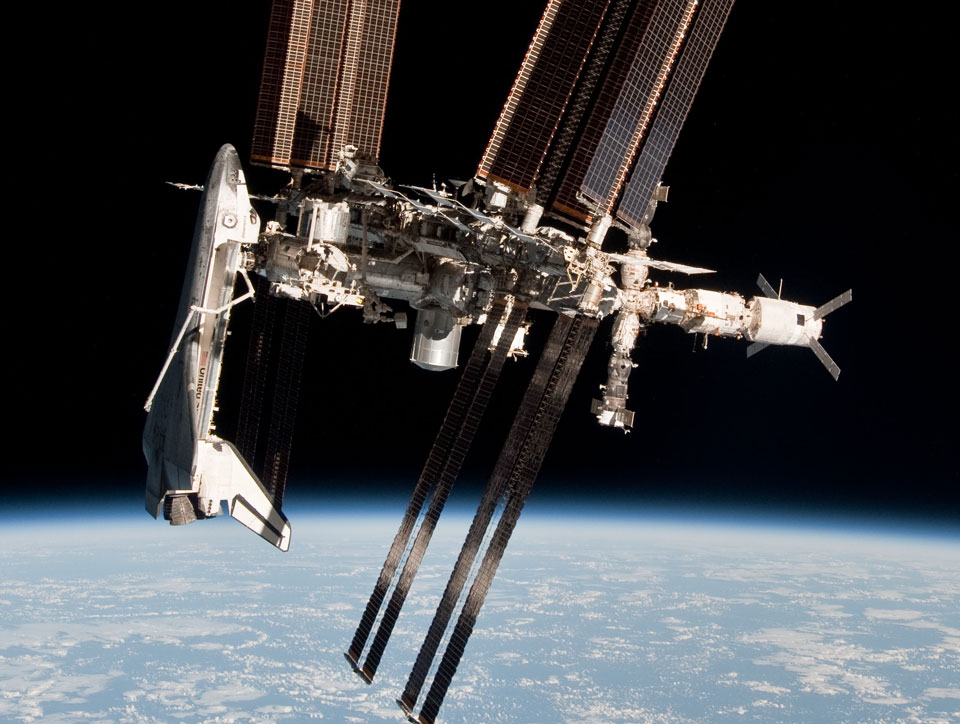
How was this picture taken? Usually, pictures of the shuttle, taken from space, are snapped from the space station. Commonly, pictures of the space station are snapped from the shuttle. How, then, can there be a picture of both the shuttle and the station together, taken from space? The answer is that during the Space Shuttle Endeavour's last trip to the International Space Station in 2011 May, a supply ship departed the station with astronauts that captured a series of rare views. The supply ship was the Russian Soyuz TMA-20 which landed in Kazakhstan later that day. The above spectacular image well captures the relative sizes of the station and docked shuttle. Far below, clouds of Earth are seen above a blue sea.
Daily Suspicious0bserver's Weather Post:
August 31, 2014
What's in the sky tonight?
August 31, 2014
-Spot the Moon at dusk with Saturn to its right and Mars to its lower left (for North America).
-As the stars come out this week, the first you see may be Arcturus shining high in the west. As the sky gets a little darker, look to its right for the Big Dipper scooping down in the northwest.
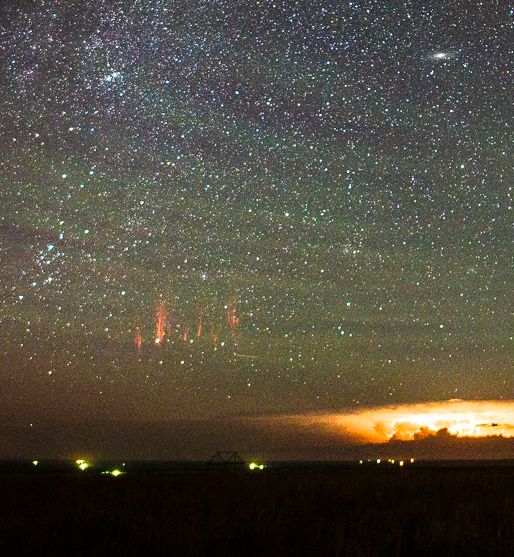
-As northern summer comes to a close, electrical storms are rumbling across the USA. After nightfall, red sprites can be seen dancing across the cloudtops. On Aug. 20th, Tom A. Warner photographed these speciments above New Underwood, South Dakota:
"On the night of Aug 20th, intense storms developed in north central South Dakota," says Warner. "Skies cleared out to the west and offered a chance to capture some sprites from the northern activity."
He saw not only sprites, but also green-glowing gravity waves. The waves are, literally, the ripple effect of a powerful thunderstorm on the mesosphere some 80 km above Earth's surface. From space, these waves look like a giant atmospheric bull's eye. From the ground, they appear to be green ripples in the sky, as shown in Warner's images.
Left to themselves, gravity waves would be invisible to the human eye. We see them, however, because they are colored green by an aurora-like phenomenon called "airglow." Airglow is caused by an assortment of chemical reactions in the upper atmosphere driven mainly by solar ultraviolet radiation. Gravity waves rippling away from the central axis of a thunderstorm cause temperature and density perturbations in the upper atmosphere. Speaking simplistically, those perturbations alter the chemical reaction rates of airglow, leading to more-bright or less-bright bands depending on whether the rates are boosted or diminished, respectively.
Inhabiting the upper reaches of Earth's atmosphere alongside meteors, noctilucent clouds and some auroras, sprites and mesospheric gravity waves are true space weather phenomena. Now is a good time to see them.
-As the stars come out this week, the first you see may be Arcturus shining high in the west. As the sky gets a little darker, look to its right for the Big Dipper scooping down in the northwest.
-As northern summer comes to a close, electrical storms are rumbling across the USA. After nightfall, red sprites can be seen dancing across the cloudtops. On Aug. 20th, Tom A. Warner photographed these speciments above New Underwood, South Dakota:
"On the night of Aug 20th, intense storms developed in north central South Dakota," says Warner. "Skies cleared out to the west and offered a chance to capture some sprites from the northern activity."
He saw not only sprites, but also green-glowing gravity waves. The waves are, literally, the ripple effect of a powerful thunderstorm on the mesosphere some 80 km above Earth's surface. From space, these waves look like a giant atmospheric bull's eye. From the ground, they appear to be green ripples in the sky, as shown in Warner's images.
Left to themselves, gravity waves would be invisible to the human eye. We see them, however, because they are colored green by an aurora-like phenomenon called "airglow." Airglow is caused by an assortment of chemical reactions in the upper atmosphere driven mainly by solar ultraviolet radiation. Gravity waves rippling away from the central axis of a thunderstorm cause temperature and density perturbations in the upper atmosphere. Speaking simplistically, those perturbations alter the chemical reaction rates of airglow, leading to more-bright or less-bright bands depending on whether the rates are boosted or diminished, respectively.
Inhabiting the upper reaches of Earth's atmosphere alongside meteors, noctilucent clouds and some auroras, sprites and mesospheric gravity waves are true space weather phenomena. Now is a good time to see them.
Astro Picture of the Day:
August 31, 2014
How was this picture taken? Usually, pictures of the shuttle, taken from space, are snapped from the space station. Commonly, pictures of the space station are snapped from the shuttle. How, then, can there be a picture of both the shuttle and the station together, taken from space? The answer is that during the Space Shuttle Endeavour's last trip to the International Space Station in 2011 May, a supply ship departed the station with astronauts that captured a series of rare views. The supply ship was the Russian Soyuz TMA-20 which landed in Kazakhstan later that day. The above spectacular image well captures the relative sizes of the station and docked shuttle. Far below, clouds of Earth are seen above a blue sea.



Comment