

Re: Terry's Astronomy Thread.
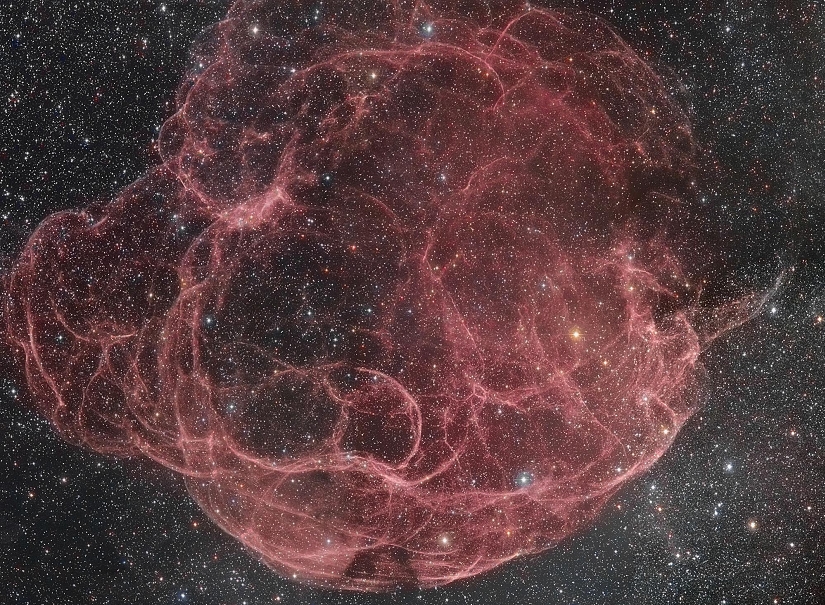
More specifically, the remnants of supernovae since as carbon based life forms, before our ability to create carbon, there was only one way carbon could be created. During a supermassive star's fusion, one of the elements it fuses is carbon (preceded by helium, hydrogen).
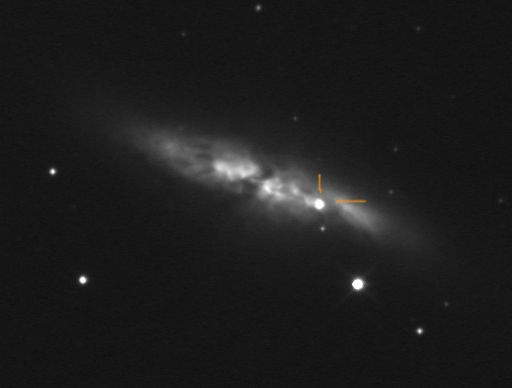
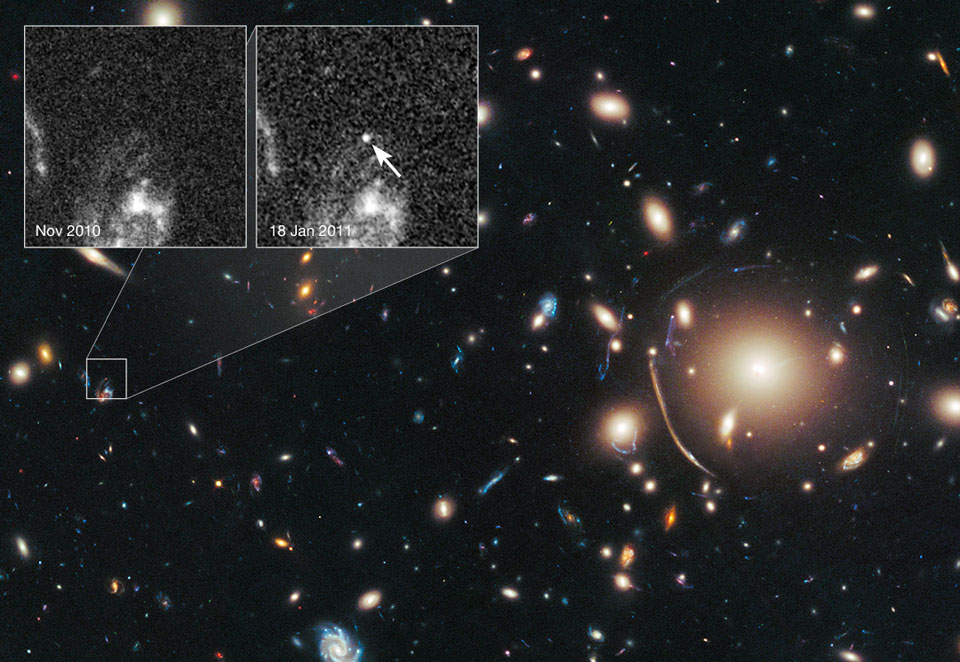
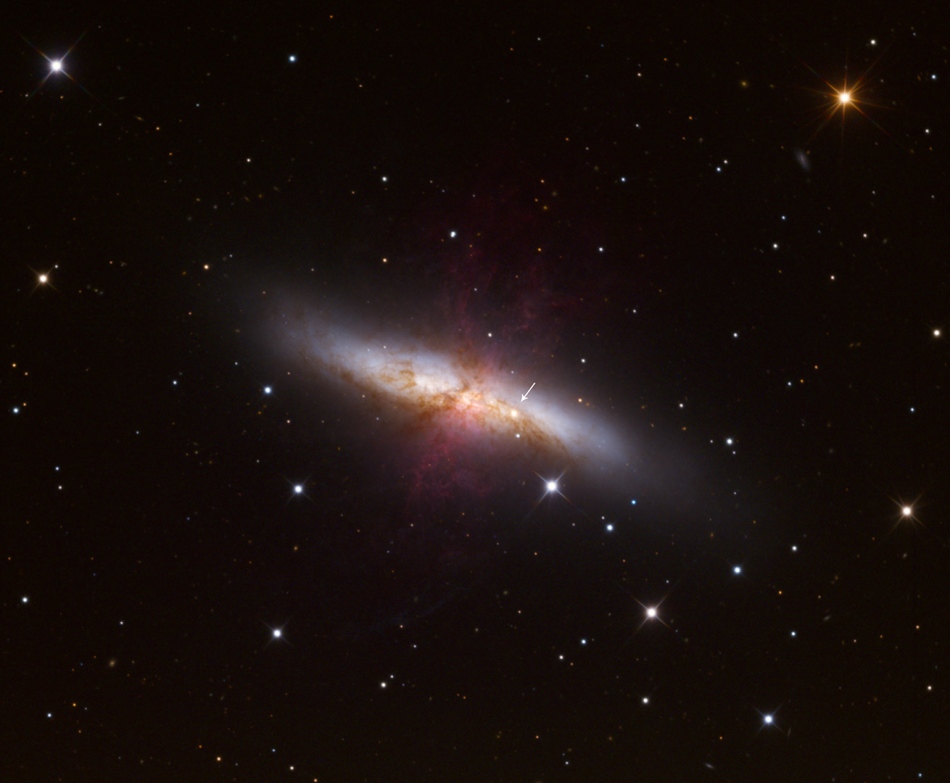
As it runs out of each type of fuel in the order of Hydrogen, Helium, Carbon, Neon, Oxygen, Silicon, it will eventually fuse Silicon into Iron which it cannot fuse. Once this happens, the core collapses and a supernova explosion occurs, expelling all known elements into the far reaches of the explosion. Supernova 1987a shows what a supernova would look like 25 years after it's occurance.
The neat thing is how quickly the time it takes for each type of fuel to run out. For any star that is greater than 25 solar masses:
Hydrogen fusion 7x10^6 years
Helium fusion 7x10^5 years
Carbon fusion 600 years
Neon Fusion 1 year
Oxygen fusion 6 months
Silicon fusion 1 day
Iron Core
Core collapse ¼ second
Core bounce milliseconds
Explosive supernova 10 seconds
---------------------------------------
What's in the sky tonight?
April 26, 2012
Astro Picture of the Day:
April 26, 2012
Source:
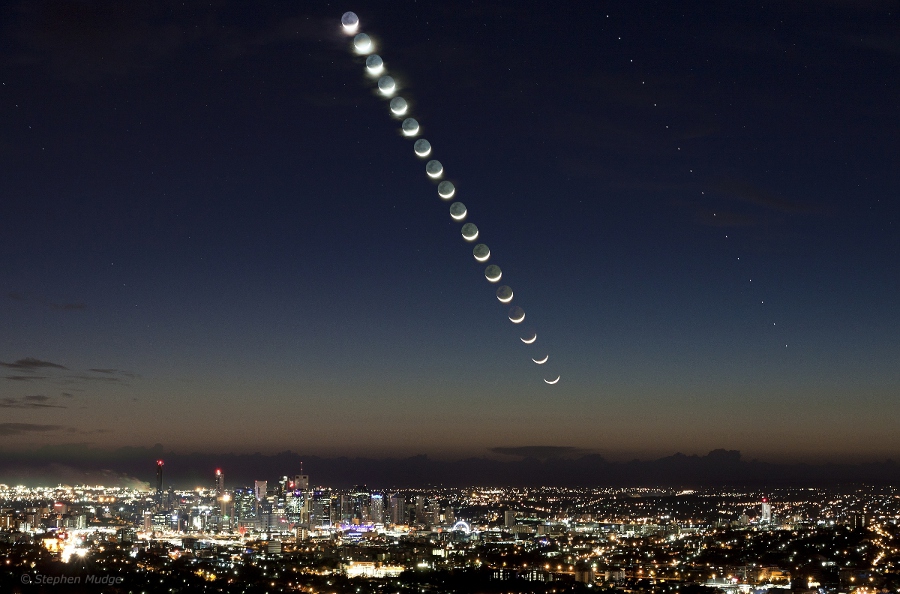
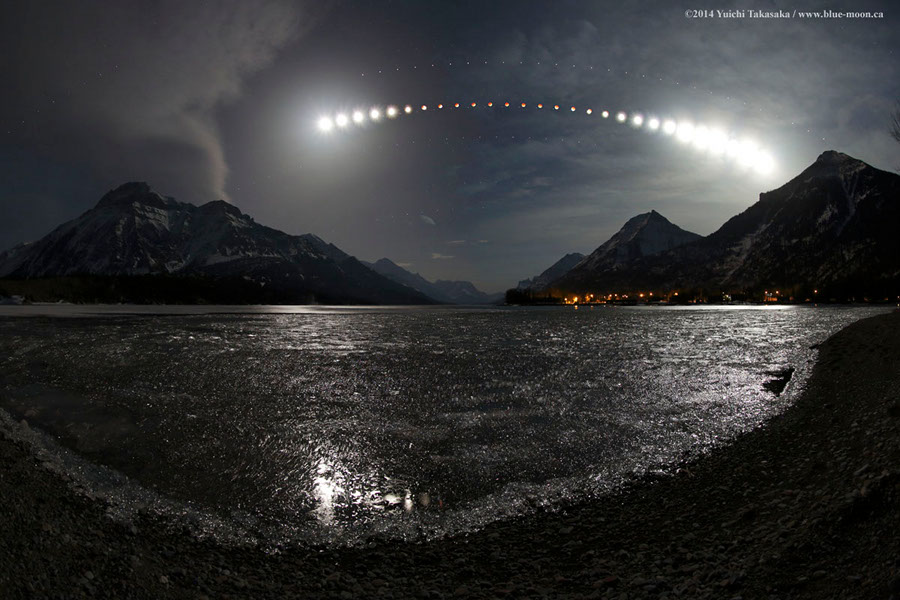
Last week Mercury wandered far to the west of the Sun. As the solar system's innermost planet neared its greatest elongation or greatest angle from the Sun (for this apparition about 27 degrees) it was joined by an old crescent Moon. The conjunction was an engaging sight for early morning risers in the southern hemisphere. There the pair rose together in predawn skies, climbing high above the horizon along a steeply inclined ecliptic plane. This well composed sequence captures the rising Moon and Mercury above the city lights of Brisbane in Queensland, Australia. A stack of digital images, it consists of an exposure made every 3 minutes beginning at 4:15 am local time on April 19. Mercury's track is at the far right, separated from the Moon's path by about 8 degrees.
More specifically, the remnants of supernovae since as carbon based life forms, before our ability to create carbon, there was only one way carbon could be created. During a supermassive star's fusion, one of the elements it fuses is carbon (preceded by helium, hydrogen).
As it runs out of each type of fuel in the order of Hydrogen, Helium, Carbon, Neon, Oxygen, Silicon, it will eventually fuse Silicon into Iron which it cannot fuse. Once this happens, the core collapses and a supernova explosion occurs, expelling all known elements into the far reaches of the explosion. Supernova 1987a shows what a supernova would look like 25 years after it's occurance.
The neat thing is how quickly the time it takes for each type of fuel to run out. For any star that is greater than 25 solar masses:
Hydrogen fusion 7x10^6 years
Helium fusion 7x10^5 years
Carbon fusion 600 years
Neon Fusion 1 year
Oxygen fusion 6 months
Silicon fusion 1 day
Iron Core
Core collapse ¼ second
Core bounce milliseconds
Explosive supernova 10 seconds
---------------------------------------
What's in the sky tonight?
April 26, 2012
-This evening the Moon is in the feet of Gemini, below Pollux and Castor and high above Betelgeuse.
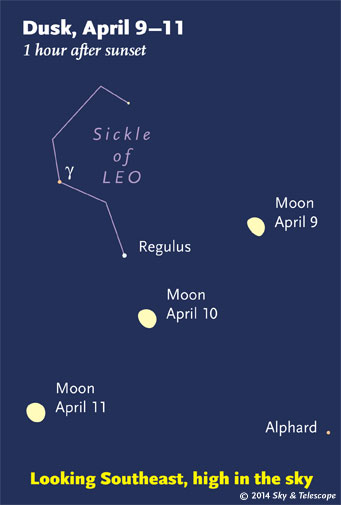
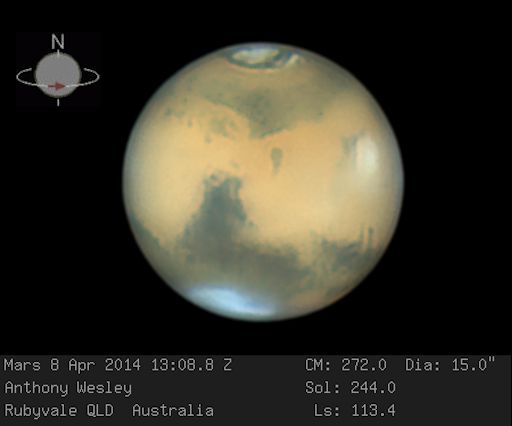
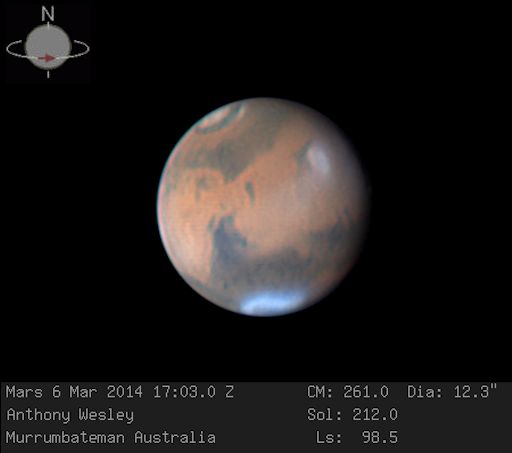
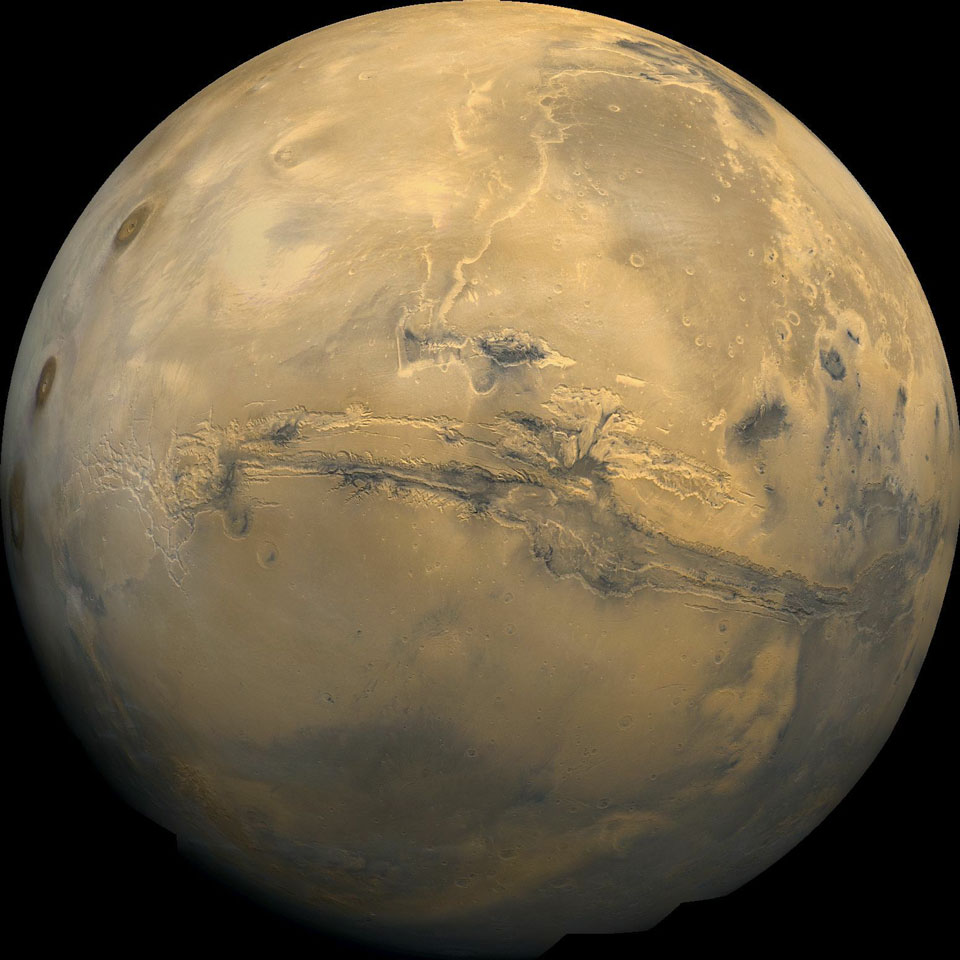
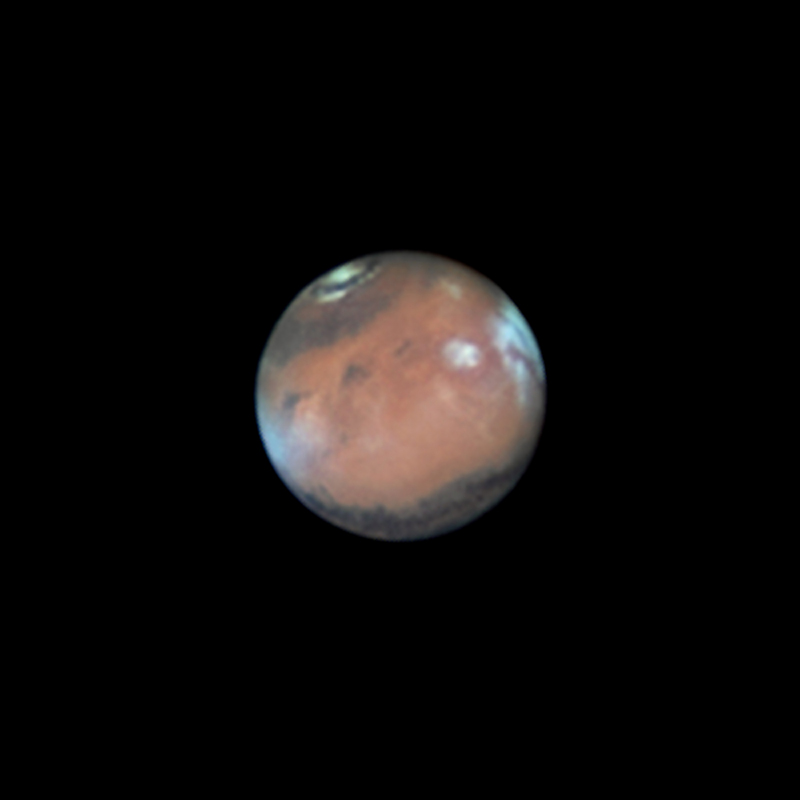
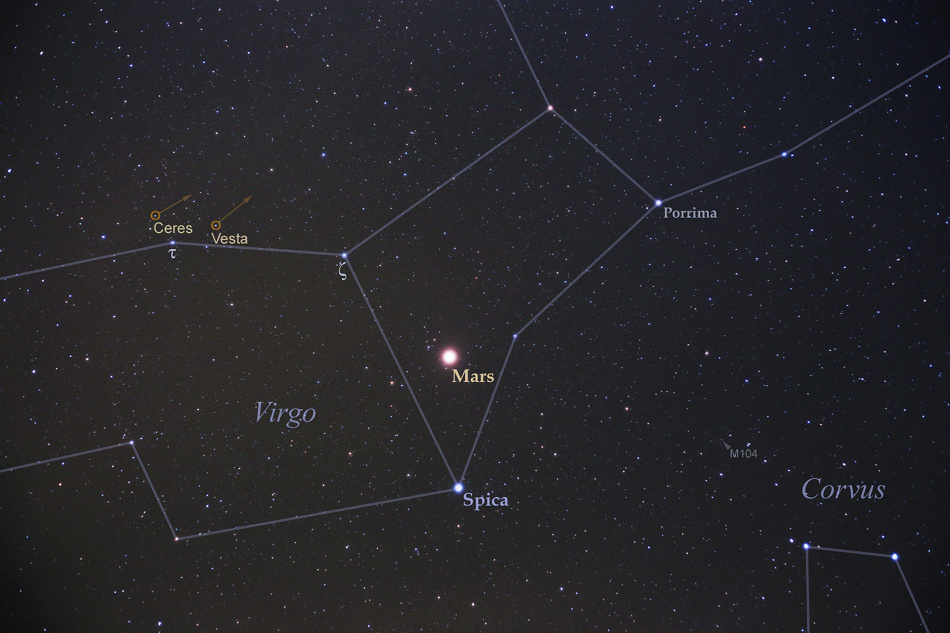
-Mars (magnitude –0.2) shines fire-orange in Leo, high in the south at dusk and southwest later in the evening. Regulus is 5° to Mars's right or lower right. Fainter Gamma Leonis is 8° above them. Mars in a telescope is gibbous and small, 10.5 arcseconds wide, fading and shrinking weekly.
-Mars (magnitude –0.2) shines fire-orange in Leo, high in the south at dusk and southwest later in the evening. Regulus is 5° to Mars's right or lower right. Fainter Gamma Leonis is 8° above them. Mars in a telescope is gibbous and small, 10.5 arcseconds wide, fading and shrinking weekly.
Astro Picture of the Day:
April 26, 2012
Source:
Last week Mercury wandered far to the west of the Sun. As the solar system's innermost planet neared its greatest elongation or greatest angle from the Sun (for this apparition about 27 degrees) it was joined by an old crescent Moon. The conjunction was an engaging sight for early morning risers in the southern hemisphere. There the pair rose together in predawn skies, climbing high above the horizon along a steeply inclined ecliptic plane. This well composed sequence captures the rising Moon and Mercury above the city lights of Brisbane in Queensland, Australia. A stack of digital images, it consists of an exposure made every 3 minutes beginning at 4:15 am local time on April 19. Mercury's track is at the far right, separated from the Moon's path by about 8 degrees.

























































Comment