Terry's Astronomy Thread.

Collapse
X
 
  • Time
  • Show
Clear All
new posts
  • Bluearrowll
    ⊙▃⊙
    FFR Simfile Author
    • Nov 2007
    • 7376

    #961
    Re: Terry's Astronomy Thread.

    Daily Suspicious0bserver's Weather Post:
    June 13, 2014


    What's in the sky tonight?
    June 13, 2014
    -Vega is the brightest star shining in the east after dusk. It's currently the top star of the big Summer Triangle. The brightest star to Vega's lower left is Deneb. Look farther to Vega's lower right for Altair. The Summer Triangle will climb higher in early evening all through the summer, to pose highest overhead at dusk when fall begins.

    -A coronal mass ejection hurled into space by the double X-flare of June 10th could sideswipe Earth's magnetic field today. NOAA forecasters estimate a 50% chance of polar geomagnetic storms in response to the glancing blow.

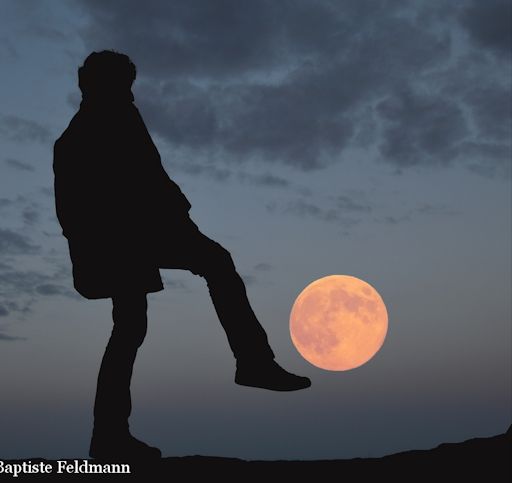
    -For soccer fans, Friday the 13th is a lucky day because the World Cup is underway. The world's biggest sports event began yesterday in Brazil with a game between the host country and Croatia. (Brazil won.) To celebrate the kickoff, Jean-Baptiste Feldmann took this picture of the Moon rising over Nuits-Saint-Georges, France.

    The fact that this month's full Moon falls on Friday the 13th has been widely noted in the media. Such a coincidence is not particularly rare. The last Friday the 13th full Moon occurred on Aug. 13, 2011. The next one will be on Aug. 13, 2049.

    Neither is the coincidence unlucky. Folklore holds that all kinds of wacky things happen under the light of a full Moon. Supposedly, hospital admissions increase, the crime rate ticks upward, and people behave strangely. The idea that the full Moon causes mental disorders was widespread in the Middle Ages. Even the word "lunacy," meaning "insanity," comes from the Latin word for "Moon." The majority of modern studies, however, show no correlation between the phase of the Moon and the incidence of crime, sickness, or human behavior. This is true even on Fridays.

    -Last week NASA's Curiosity rover witnessed something no one has ever seen from the surface of another world: a planetary transit of the sun. As the sun rose over Mars' Gale Crater on June 3rd, Curiosity's two-eyed MastCam tracked the shadowy silhouette of Mercury crossing the solar disk. In addition to showing Mercury, the same MastCam frames show two sunspots approximately the size of Earth.

    This is the first transit of the sun by a planet observed from any planet other than Earth, and also the first imaging of Mercury from Mars. Mercury fills only about one-sixth of one pixel as seen from such a great distance, so the darkening does not have a distinct shape. Nevertheless, it is definitely Mercury as the shadow follows Mercury's expected path based on orbital calculations.

    On Earth, it is possible to observe solar transits of Mercury and Venus, although they are rare. Last seen in June 2012, Venus transits are typically separated by more than a hundred years. The next Mercury transit visible from Earth will be May 9, 2016. Mercury and Venus transits are visible more often from Mars than from Earth, and Mars also offers a vantage point for seeing Earth transits. The next of each type visible from Mars will be Mercury in April 2015, Venus in August 2030 and Earth in November 2084.


    Astro Picture of the Day:
    June 13, 2014
    Source:
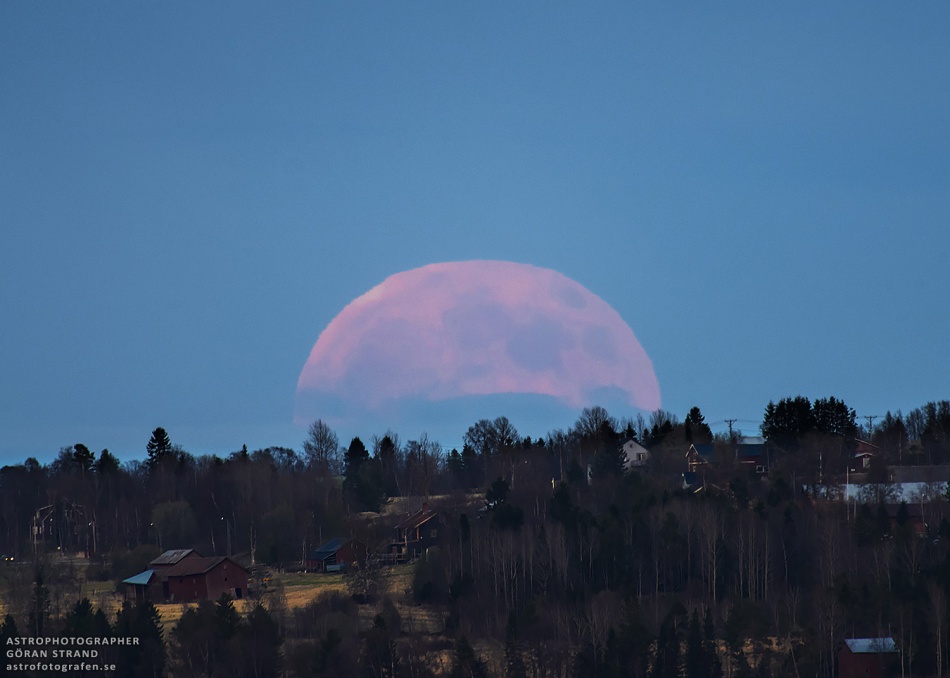
    June's Full Moon (full phase on June 13, 0411 UT) is traditionally known as the Strawberry Moon or Rose Moon. Of course those names might also describe the appearance of this Full Moon, rising last month over the small Swedish village of Marieby. The Moon looks large in the image because the scene was captured with a long focal length lens from a place about 8 kilometers from the foreground houses. But just by eye a Full Moon rising, even on Friday the 13th, will appear to loom impossibly large near the horizon. That effect has long been recognized as the Moon Illusion. Unlike the magnification provided by a telescope or telephoto lens, the cause of the Moon illusion is still poorly understood and not explained by atmospheric optical effects, such as scattering and refraction, that produce the Moon's blushing color and ragged edge also seen in the photograph.
    1st in Kommisar's 2009 SM Tournament
    1st in I Love You`s 2009 New Year`s Tournament
    3rd in EnR's Mashfest '08 tournament
    5th in Phynx's Unofficial FFR Tournament
    9th in D3 of the 2008-2009 4th Official FFR Tournament
    10th in D5 of the 2010 5th Official FFR Tournament
    10th in D6 of the 2011-2012 6th Official FFR Tournament

    FMO AAA Count: 71
    FGO AAA Count: 10

    Bluearrowll = The Canadian player who can not detect awkward patterns. If it's awkward for most people, it's normal for Terry. If the file is difficult but super straight forward, he has issues. If he's AAAing a FGO but then heard that his favorite Hockey team was losing by a point, Hockey > FFR
    PS: Cool AAA's Terry
    - I Love You


    An Alarm Clock's Haiku
    beep beep beep beep beep
    beep beep beep beep beep beep beep
    beep beep beep beep beep
    - ieatyourlvllol

    Comment

    • Bluearrowll
      ⊙▃⊙
      FFR Simfile Author
      • Nov 2007
      • 7376

      #962
      Re: Terry's Astronomy Thread.

      Daily Suspicious0bserver's Weather Post:
      June 14, 2014


      What's in the sky tonight?
      June 14, 2014
      -Mars and Spica arrest your eye in the southwest just after dark this week. Spot brighter Arcturus high above them. Half as far below them is the four-star pattern of Corvus, the Crow.

      -A CME expected to hit Earth's magnetic field on Friday the 13th did not show up. Either it missed or, as NOAA forecasters suspect, the storm cloud is still en route. A glancing blow on June 14th could spark a G1-class geomagnetic storm.

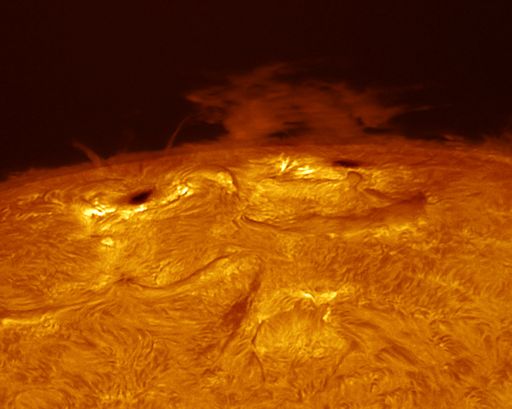
      -Two sunspots that have threatened Earth with flares during the past week will soon be gone. AR2080 and AR2085 are about to disappear over the sun's western limb. "These two amazing sunspot groups are saying goodbye with a splendid array of prominences, filaments and minor flare activity," reports Sergio Castillo who sends this parting shot from his backyard observatory in Corona, CA. Although these sunspots are leaving, they still pose a threat to Earth. Both of them are well-connected to our planet by the sun's spiraling magnetic field. If one of them erupts this weekend--a distinct possibility--energetic particles could be funneled by magnetic forces back toward Earth, causing a solar proton storm.

      Meanwhile, another active sunspot is not leaving: AR2087 is almost directly facing Earth and it has a 'beta-gamma-delta' magnetic field that harbors energy for X-class solar flares. Any eruption from this sunspot would hit Earth head on. NOAA forecasters estimate a 30% chance of X-flares on June 14th.


      Astro Picture of the Day:
      June 14, 2014

      Source:
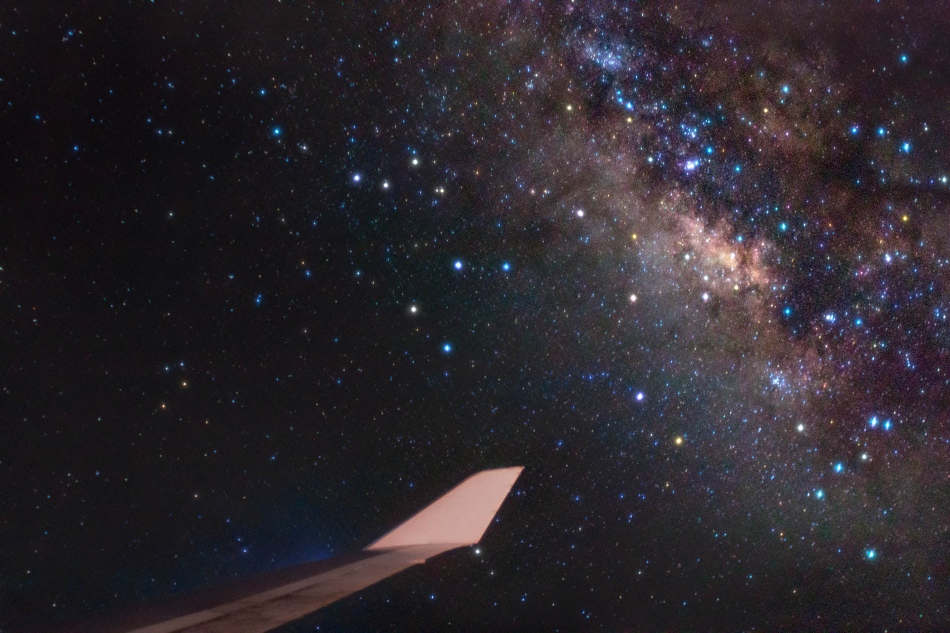
      Bright stars of Sagittarius and the center of our Milky Way Galaxy lie just off the wing of a Boeing 747 in this astronomical travel photo. The stratospheric scene was captured earlier this month during a flight from New York to London, 11,000 meters above the Atlantic Ocean. Of course the sky was clear and dark at that altitude, ideal conditions for astronomical imaging. But there were challenges to overcome while looking out a passenger window of the aircraft moving at nearly 1,000 kilometers per hour (600 mph). Over 90 exposures of 30 seconds or less were attempted with a fast lens and sensitive camera setting, using a small, flexible tripod and a blanket to block reflections of interior lighting. In the end, one 10 second long exposure resulted in this steady and colorful example of airborne astronomy.
      1st in Kommisar's 2009 SM Tournament
      1st in I Love You`s 2009 New Year`s Tournament
      3rd in EnR's Mashfest '08 tournament
      5th in Phynx's Unofficial FFR Tournament
      9th in D3 of the 2008-2009 4th Official FFR Tournament
      10th in D5 of the 2010 5th Official FFR Tournament
      10th in D6 of the 2011-2012 6th Official FFR Tournament

      FMO AAA Count: 71
      FGO AAA Count: 10

      Bluearrowll = The Canadian player who can not detect awkward patterns. If it's awkward for most people, it's normal for Terry. If the file is difficult but super straight forward, he has issues. If he's AAAing a FGO but then heard that his favorite Hockey team was losing by a point, Hockey > FFR
      PS: Cool AAA's Terry
      - I Love You


      An Alarm Clock's Haiku
      beep beep beep beep beep
      beep beep beep beep beep beep beep
      beep beep beep beep beep
      - ieatyourlvllol

      Comment

      • Bluearrowll
        ⊙▃⊙
        FFR Simfile Author
        • Nov 2007
        • 7376

        #963
        Re: Terry's Astronomy Thread.

        Daily Suspicious0bserver's Weather Post:
        June 15, 2014


        What's in the sky tonight?
        June 15, 2014
        -The waning gibbous Moon rises in the east-southeast around 11 p.m. (depending on where you live). Well to its upper left shines Altair, flagged by the little star Tarazed about a finger-width at arm's length above it. Left or lower left of Altair, by about a fist and a half at arm's length, look for the compact constellation Delphinus, the Dolphin.

        -Red dwarfs are by far the most numerous type of star in the Galaxy, accounting for as much as 80% of the stellar population of the Milky Way. Because of this, astronomers looking for potentially habitable worlds have targeted red dwarf stars. A new study, however, shows that harsh space weather might strip the atmosphere of any rocky planet orbiting in a red dwarf's habitable zone, dooming life as we would know it in a majority of the Galaxy's planetary systems. story: http://smithsonianscience.org/2014/0...dwarf-planets/

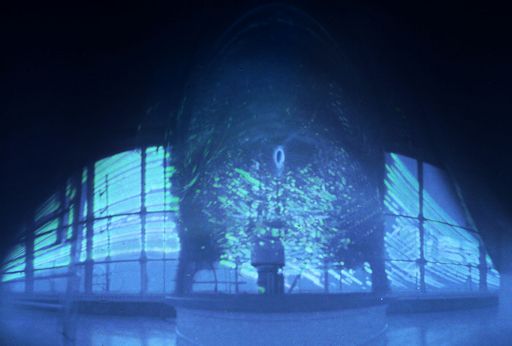
        -The northern summer solstice is just one week away. According to Jan Koeman of Philippus Lansbergen Observatory in Middelburg,the Netherlands, that means "it's time to check your solarcans." A solarcan, a.k.a. solargraph, is a pinhole camera made from a soda or beer can lined with a piece of photographic paper. Using such a simple device, it is possible to take extraordinarily long exposures of the daily sun--in this case, six months long. Yesterday, Koeman opened a solarcan he deployed in December, and this is what he found. Normally, solarcans record the graceful tracks the sun makes across the sky as the seasons unfold--high tracks corresponding to summer, low tracks to winter. In this case, the tracks were interrupted because Koeman deployed his solarcan inside a lighthouse. "I worried that the powerful light from the lighthouse would overwhelm the sun. Luckily our sun is much stronger. However, the fresnel prisms in the lighthouse were chopping up the sunlight."


        Astro Picture of the Day:
        June 15, 2014

        Source:
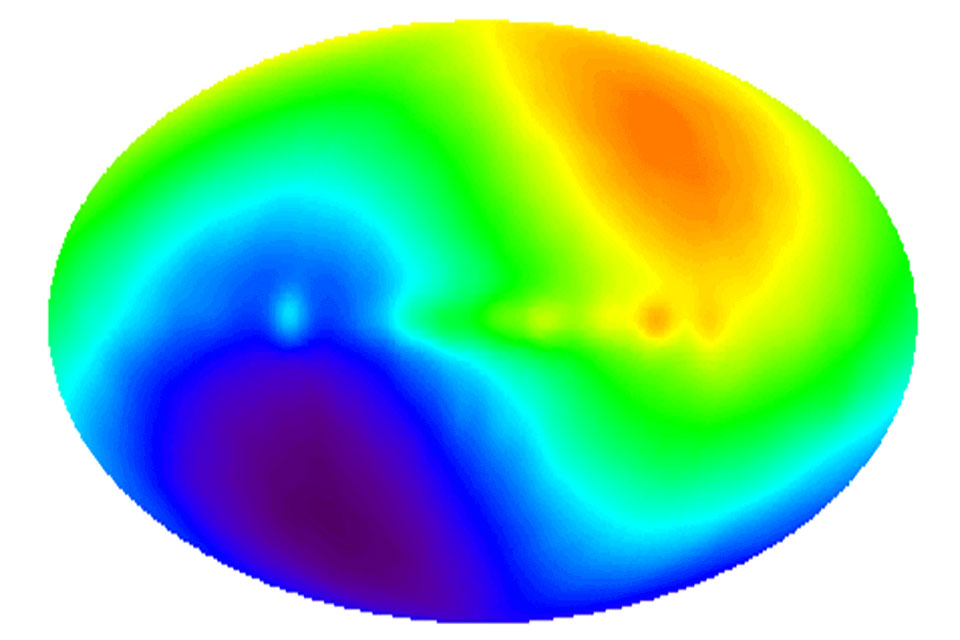
        Our Earth is not at rest. The Earth moves around the Sun. The Sun orbits the center of the Milky Way Galaxy. The Milky Way Galaxy orbits in the Local Group of Galaxies. The Local Group falls toward the Virgo Cluster of Galaxies. But these speeds are less than the speed that all of these objects together move relative to the cosmic microwave background radiation (CMBR). In the above all-sky map from the COBE satellite, radiation in the Earth's direction of motion appears blueshifted and hence hotter, while radiation on the opposite side of the sky is redshifted and colder. The map indicates that the Local Group moves at about 600 kilometers per second relative to this primordial radiation. This high speed was initially unexpected and its magnitude is still unexplained.
        1st in Kommisar's 2009 SM Tournament
        1st in I Love You`s 2009 New Year`s Tournament
        3rd in EnR's Mashfest '08 tournament
        5th in Phynx's Unofficial FFR Tournament
        9th in D3 of the 2008-2009 4th Official FFR Tournament
        10th in D5 of the 2010 5th Official FFR Tournament
        10th in D6 of the 2011-2012 6th Official FFR Tournament

        FMO AAA Count: 71
        FGO AAA Count: 10

        Bluearrowll = The Canadian player who can not detect awkward patterns. If it's awkward for most people, it's normal for Terry. If the file is difficult but super straight forward, he has issues. If he's AAAing a FGO but then heard that his favorite Hockey team was losing by a point, Hockey > FFR
        PS: Cool AAA's Terry
        - I Love You


        An Alarm Clock's Haiku
        beep beep beep beep beep
        beep beep beep beep beep beep beep
        beep beep beep beep beep
        - ieatyourlvllol

        Comment

        • Bluearrowll
          ⊙▃⊙
          FFR Simfile Author
          • Nov 2007
          • 7376

          #964
          Re: Terry's Astronomy Thread.

          Daily Suspicious0bserver's Weather Post:
          June 16, 2014


          What's in the sky tonight?
          June 16, 2014
          -After dark, look below Mars and Spica in the southwest for the four-star pattern of Corvus, the Crow. It's a springtime constellation descending now that spring is nearing its end.

          -NOAA forecasters estimate a 20% to 30% chance of minor geomagnetic storms on June 16-17 in response to a high-speed solar wind stream. Auroras may be difficult to see, however, because of glare from the waning full Moon.

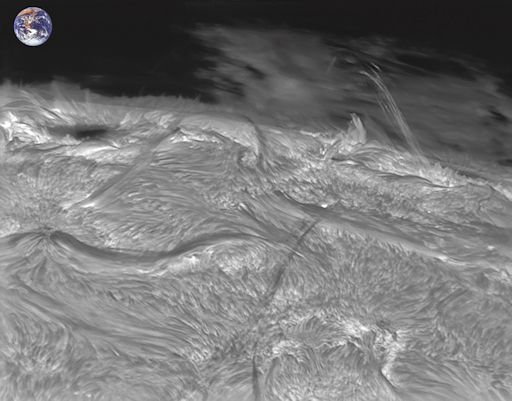
          -With several active sunspots rotating over the sun's western limb, solar activity is quieting. The departure, however, is a riot. J. P. Brahic sends this picture of activity in the exit zone from Uzès, France.

          Brahic took the picture through cirrus clouds using a 9 inch solar telescope, and he inserted an image of Earth for scale. The dark cores of the departing sunspots are about the size of our planet, and the surrounding tangle of magnetic filaments could swallow Earth with room to spare.

          These sunspots are leaving behind at least one region still capable of major flares: AR2087 is almost directly facing Earth and it has a 'beta-gamma' magnetic field that harbors energy for M-class eruptions. Any flares from AR2087 today would hit Earth head on.


          Astro Picture of the Day:
          June 16, 2014

          Source:
          NASA's APOD turns 19 today. APOD's thank yous: The first APOD appeared 19 years ago today. To help celebrate, APOD brings you today an all-sky heatmap of (nearly) 19 years of APOD entries. The brighter a region appears on the above heatmap, the more APODs that occur in that region. Clicking anywhere on the map will bring up a link to all APODs, if any, that appear nearby. We at APOD again thank our readers, NASA, astrophotographers, volunteers who translate APOD daily into over 20 languages, volunteers who run APOD's over 20 mirror sites, volunteers who answer questions and administer APOD's main discussion board, and volunteers who run and update APOD's social media sites and smartphone applications for their continued support.
          1st in Kommisar's 2009 SM Tournament
          1st in I Love You`s 2009 New Year`s Tournament
          3rd in EnR's Mashfest '08 tournament
          5th in Phynx's Unofficial FFR Tournament
          9th in D3 of the 2008-2009 4th Official FFR Tournament
          10th in D5 of the 2010 5th Official FFR Tournament
          10th in D6 of the 2011-2012 6th Official FFR Tournament

          FMO AAA Count: 71
          FGO AAA Count: 10

          Bluearrowll = The Canadian player who can not detect awkward patterns. If it's awkward for most people, it's normal for Terry. If the file is difficult but super straight forward, he has issues. If he's AAAing a FGO but then heard that his favorite Hockey team was losing by a point, Hockey > FFR
          PS: Cool AAA's Terry
          - I Love You


          An Alarm Clock's Haiku
          beep beep beep beep beep
          beep beep beep beep beep beep beep
          beep beep beep beep beep
          - ieatyourlvllol

          Comment

          • Bluearrowll
            ⊙▃⊙
            FFR Simfile Author
            • Nov 2007
            • 7376

            #965
            Re: Terry's Astronomy Thread.

            Daily Suspicious0bserver's Weather Post:
            June 17, 2014


            What's in the sky tonight?
            June 17, 2014
            -Vega is the brightest star high in the east. Barely to its lower left after dark is one of the best-known multiple stars in the sky: 4th-magnitude Epsilon (ε) Lyrae, the Double-Double. It forms one corner of a roughly equilateral triangle with Vega and Zeta (ζ) Lyrae. The triangle is less than 2° on a side, hardly the width of your thumb at arm's length. Binoculars easily resolve Epsilon (not quite resolved in the photo here), and a 4-inch telescope at 100× or more should resolve each of Epsilon's two wide components into a tight pair.

            Zeta Lyrae, the triangle's third star, is also a double star for binoculars, much tougher, but it's easily split with a telescope. Delta Lyrae, the next star down, as a much wider binocular pair; it's resolved in the photo.


            Astro Picture of the Day:
            June 17, 2014

            Source:
            What caused this outburst of V838 Mon? For reasons unknown, star V838 Mon suddenly became one of the brightest stars in the entire Milky Way Galaxy. Then, just a few months later, it faded. A stellar flash like this has never been seen before -- supernovas and novas expel a tremendous amount of matter out into space. Although the V838 Mon flash appeared to expel some material into space, what is seen in the above eight-frame movie, interpolated for smoothness, is actually an outwardly moving light echo of the flash. The actual time-span of the above movie is from 2002, when the flash was first recorded, to 2006. In a light echo, light from the flash is reflected by successively more distant ellipsoids in the complex array of ambient interstellar dust that already surrounded the star. Currently, the leading model for V838's outburst was the orbital decay and subsequent merging of two relatively normal stars. V838 Mon lies about 20,000 light years away toward the constellation of Monoceros, while the largest light echo above spans about six light years in diameter.


            Daily Suspicious0bserver's Weather Post:
            June 18, 2014


            What's in the sky tonight?
            June 18, 2014
            -With Scorpius coming up into good evening view now, keep an eye on the doings of Delta Scorpii. This is the middle star in the row of three marking Scorpius's head. In July 2000 it unexpectedly doubled in brightness. It has remained brighter than normal ever since, with fluctuations, at about magnitude 2.0. Compare it to Beta Scorpii above it, magnitude 2.6, and Antares, 1.1.

            -NASA Cassini spacecraft is swooping over Saturn's moon Titan today, June 18th, for a radar experiment to explore the nature of the moon's mysterious petroleum lakes.

            Astro Picture of the Day:
            June 18, 2014

            Source:
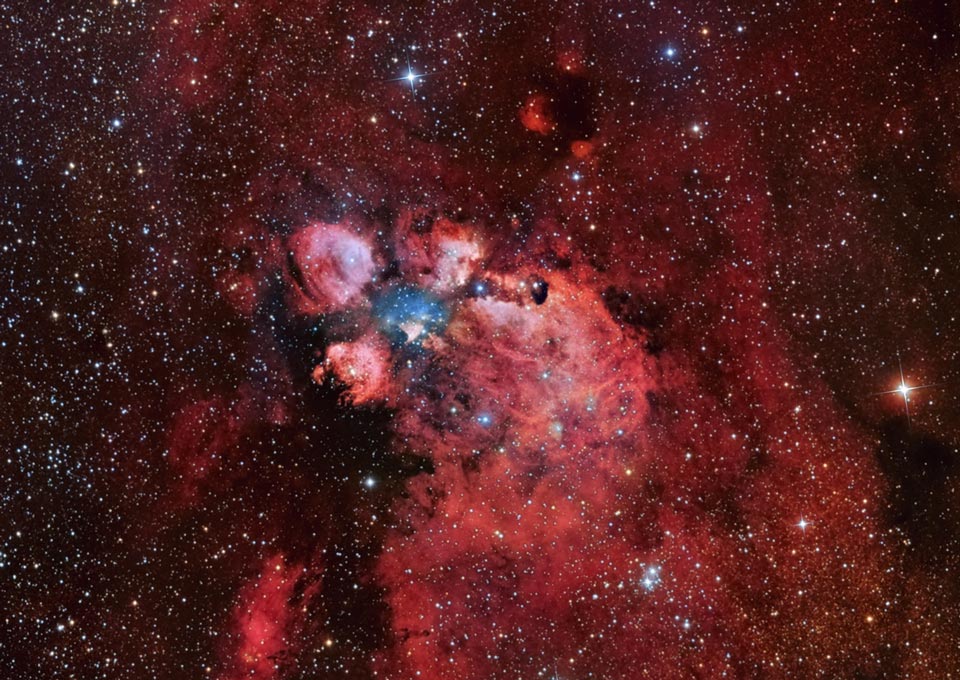
            Nebulas are perhaps as famous for being identified with familiar shapes as perhaps cats are for getting into trouble. Still, no known cat could have created the vast Cat's Paw Nebula visible in Scorpius. At 5,500 light years distant, Cat's Paw is an emission nebula with a red color that originates from an abundance of ionized hydrogen atoms. Alternatively known as the Bear Claw Nebula or NGC 6334, stars nearly ten times the mass of our Sun have been born there in only the past few million years. Pictured above is a deep field image of the Cat's Paw nebula.


            Daily Suspicious0bserver's Weather Post:
            June 19, 2014


            What's in the sky tonight?
            June 19, 2014
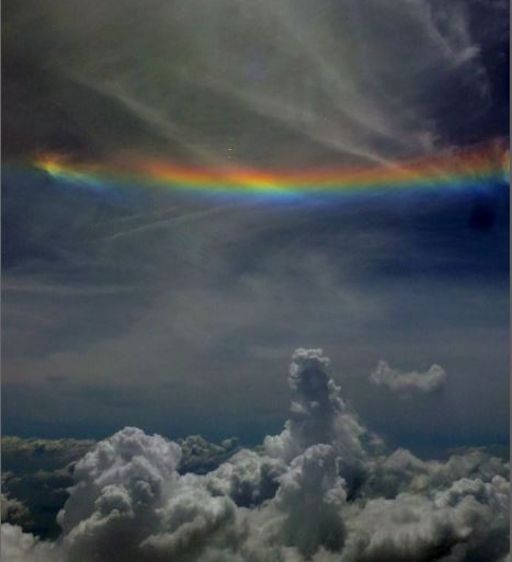
            -Around the northern hemisphere, sky watchers are starting to report a rainbow-colored sun halo that appears almost-exclusively during summer: the circumhorizon arc. "I saw one on June 13th. It was very bright," says Michail Anastasio, who snapped this picture from the cockpit of a plane flying 20,000 feet over Singapore.

            Nicknamed the "fire rainbow" because of its fiery rainbow colors, this apparition in fact has nothing to do with either fire or rainbows. It is caused by sunlight refracting through plate-shaped ice crystals in cirrus clouds. The geometry of the refraction requires that the sun be high in the sky (above 58o), which explains why this is a summertime phenomenon.

            June and July are the best months to see circumhorizon arcs. Look for them circling the horizon sometimes in patches, sometimes not, always brightly decorated with pure and well separated prismatic colors. You'll know it when you see it.


            Astro Picture of the Day:
            June 19, 2014

            Source:
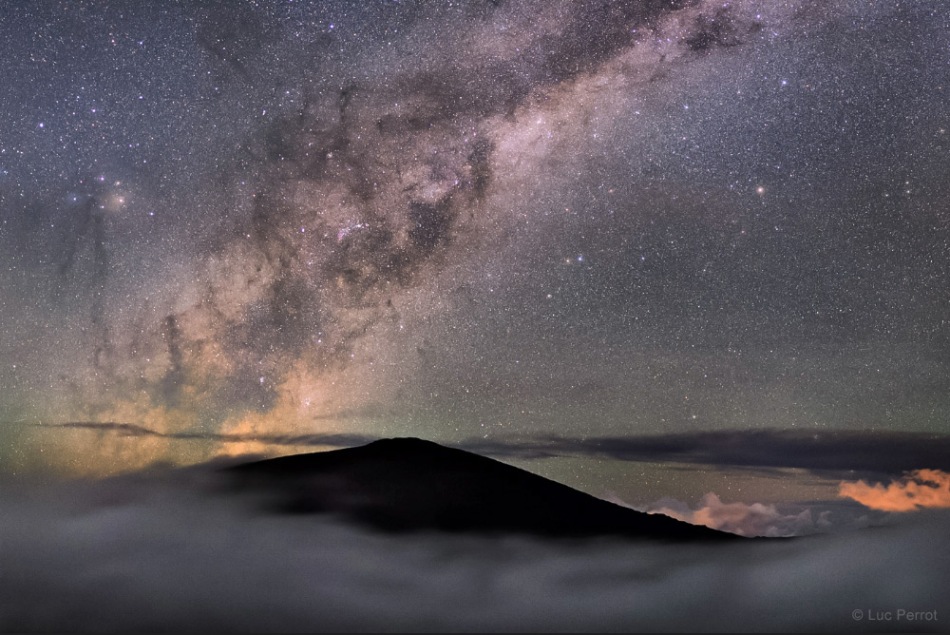
            The central bulge of our Milky Way Galaxy rises above a sea of clouds in this ethereal scene. An echo of the Milky Way's dark dust lanes, the volcanic peak in foreground silhouette is on France's Réunion Island in the southern Indian Ocean. Taken in February, the photograph was voted the winner of the 2014 International Earth and Sky Photo Contest's Beauty of the Night Sky Category. This and other winning and noteable images from the contest were selected from over a thousand entries from 55 countries around planet Earth. Also featured in the contest compilation video (vimeo), the moving images are a testament to the importance and beauty of our world at night.
            Last edited by Bluearrowll; 06-19-2014, 05:16 AM.
            1st in Kommisar's 2009 SM Tournament
            1st in I Love You`s 2009 New Year`s Tournament
            3rd in EnR's Mashfest '08 tournament
            5th in Phynx's Unofficial FFR Tournament
            9th in D3 of the 2008-2009 4th Official FFR Tournament
            10th in D5 of the 2010 5th Official FFR Tournament
            10th in D6 of the 2011-2012 6th Official FFR Tournament

            FMO AAA Count: 71
            FGO AAA Count: 10

            Bluearrowll = The Canadian player who can not detect awkward patterns. If it's awkward for most people, it's normal for Terry. If the file is difficult but super straight forward, he has issues. If he's AAAing a FGO but then heard that his favorite Hockey team was losing by a point, Hockey > FFR
            PS: Cool AAA's Terry
            - I Love You


            An Alarm Clock's Haiku
            beep beep beep beep beep
            beep beep beep beep beep beep beep
            beep beep beep beep beep
            - ieatyourlvllol

            Comment

            • Bluearrowll
              ⊙▃⊙
              FFR Simfile Author
              • Nov 2007
              • 7376

              #966
              Re: Terry's Astronomy Thread.

              Daily Suspicious0bserver's Weather Post:
              June 20, 2014


              What's in the sky tonight?
              June 20, 2014
              -This is the time of year when the two brightest stars of summer, Arcturus and Vega, shine equally high overhead as evening grows late: Arcturus in the southwest, Vega toward the east. Arcturus and Vega are 37 and 25 light-years away, respectively. They represent the two commonest types of naked-eye stars: a yellow-orange K giant and a white A main-sequence star. They're 150 and 50 times more luminous than the Sun — which, combined with their nearness, is why they dominate the evening.

              -The season are changing. On June 21st, the sun will reach its northernmost point in the sky, +23.5 degrees above the celestial equator, marking the onset of summer in the north and winter in the south. Today is the last day of northern spring. Happy solstice!

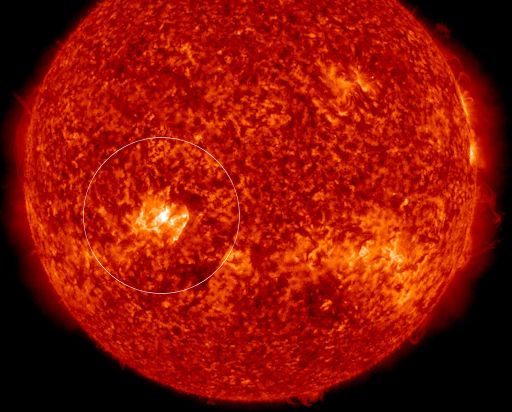
              -A dark magnetic filament on the sun erupted during the late hours of June 19th. While one end of the filament remained connected to sunspot complex AR2093-AR2094, the other end corkscrewed wildly through the sun's atmosphere. Click the link to view the eruption, and keep an eye on the circled region in the preview below.


              The corkscrewing filament hurled much of itself into space. Both of NASA's STEREO probes and the Solar and Heliospheric Observatory recorded a CME emerging from the blast site. A preliminary analysis suggests an expansion velocity near 600 km/s or 1.3 million mph. That may sound fast, but it is merely typical for a CME. The expanding cloud could deliver a glancing blow to Earth's magnetic field in a few days, possibly sparking a minor geomagnetic storm.


              Astro Picture of the Day:
              June 20, 2014

              Source:
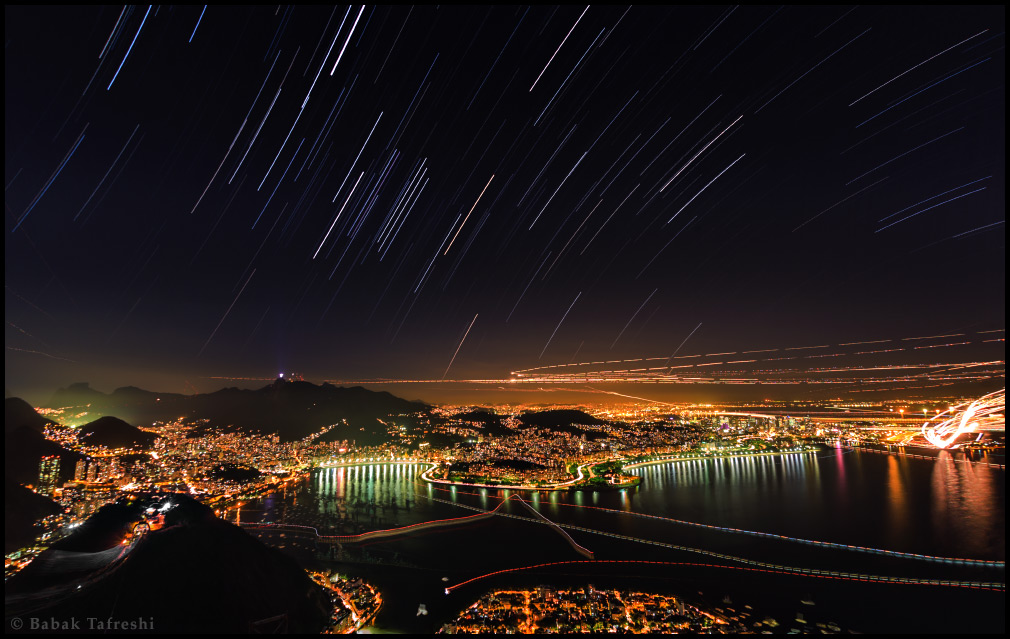
              In this night skyscape setting stars trail above the western horizon over Rio de Janeiro, Brazil, a venue for the 2014 World Cup. Gentle arcs from the bright, colorful stars of Orion are near the center of the frame, while the starfield itself straddles planet Earth's celestial equator during the long exposure. Of course, trails from more local lights seem to create the strident paths through the scene. Air traffic smears an intense glow over an airport at the far right, while helicopters fly above the city and boats cruise near the coast. Striping the waterfront are tantalizing reflections of bright lights along the Copacabana and Ipanema beaches. Near the horizon, the brightest fixed light is the famous Cristo statue overlooking Rio at night.
              1st in Kommisar's 2009 SM Tournament
              1st in I Love You`s 2009 New Year`s Tournament
              3rd in EnR's Mashfest '08 tournament
              5th in Phynx's Unofficial FFR Tournament
              9th in D3 of the 2008-2009 4th Official FFR Tournament
              10th in D5 of the 2010 5th Official FFR Tournament
              10th in D6 of the 2011-2012 6th Official FFR Tournament

              FMO AAA Count: 71
              FGO AAA Count: 10

              Bluearrowll = The Canadian player who can not detect awkward patterns. If it's awkward for most people, it's normal for Terry. If the file is difficult but super straight forward, he has issues. If he's AAAing a FGO but then heard that his favorite Hockey team was losing by a point, Hockey > FFR
              PS: Cool AAA's Terry
              - I Love You


              An Alarm Clock's Haiku
              beep beep beep beep beep
              beep beep beep beep beep beep beep
              beep beep beep beep beep
              - ieatyourlvllol

              Comment

              • Bluearrowll
                ⊙▃⊙
                FFR Simfile Author
                • Nov 2007
                • 7376

                #967
                Re: Terry's Astronomy Thread.

                Daily Suspicious0bserver's Weather Post:
                June 21, 2014


                What's in the sky tonight?
                June 21, 2014
                -If you have a good dark sky, look east as the final glow of twilight fades away. All across the low eastern sky on any clear night now, the starry, mottled band of the Milky Way is looming up. It rises higher through the night and crosses straight overhead around 3 a.m.


                -The June solstice occurs at 6:51 a.m. Eastern Daylight Time. This is when the Sun reaches its northernmost point in the sky for the year and begins its six-month return south. Summer begins in the Northern Hemisphere, where today is the longest day. In the Southern Hemisphere, this is the start of winter and the longest night.


                Astro Picture of the Day:
                June 21, 2014

                Source:
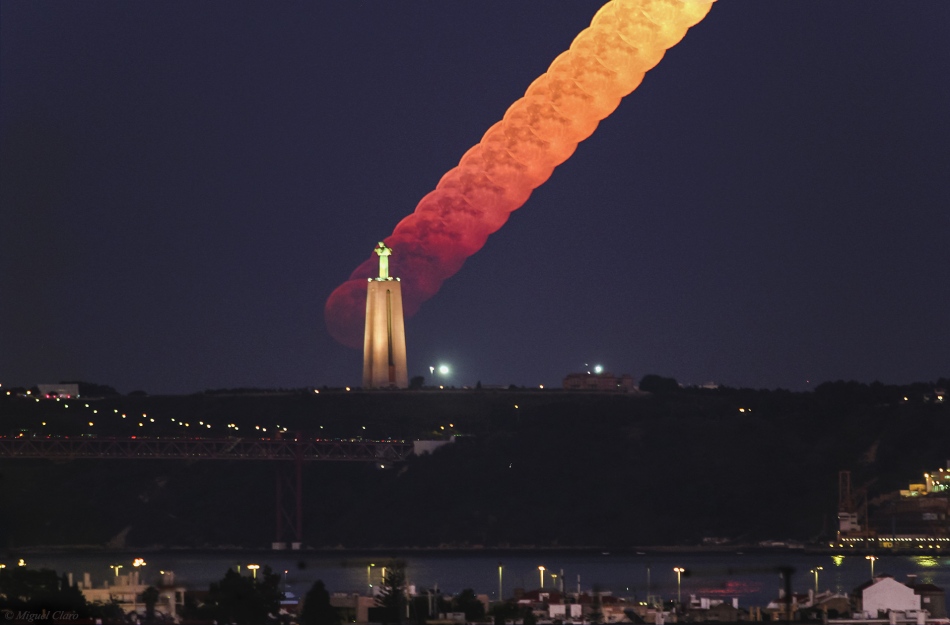
                The Sun set on Friday the 13th as a full Honey Moon rose, captured in this well-planned time-lapse sequence. Lisbon, Portugal's Christ the King monument is in the foreground, about 6 kilometers distant from camera and telephoto lens. During the days surrounding today's solstice (June 21, 10:51 UT) the Sun follows its highest arc through northern hemisphere skies as it travels along the ecliptic plane. At night the ecliptic plane is low, and the Full Moon's path close to the ecliptic was also low, the rising Moon separating more slowly from the distant horizon. Northern moon watchers were likely to experience the mysterious Moon Illusion, the lunar orb appearing impossibly large while near the horizon. But the photo sequence shows the Moon's apparent size did not not change at all. Its light was initially scattered by the long line-of-sight through the atmosphere though, and a deeper reddened color gave way to a paler gold as the Full Moon rose into the night.
                1st in Kommisar's 2009 SM Tournament
                1st in I Love You`s 2009 New Year`s Tournament
                3rd in EnR's Mashfest '08 tournament
                5th in Phynx's Unofficial FFR Tournament
                9th in D3 of the 2008-2009 4th Official FFR Tournament
                10th in D5 of the 2010 5th Official FFR Tournament
                10th in D6 of the 2011-2012 6th Official FFR Tournament

                FMO AAA Count: 71
                FGO AAA Count: 10

                Bluearrowll = The Canadian player who can not detect awkward patterns. If it's awkward for most people, it's normal for Terry. If the file is difficult but super straight forward, he has issues. If he's AAAing a FGO but then heard that his favorite Hockey team was losing by a point, Hockey > FFR
                PS: Cool AAA's Terry
                - I Love You


                An Alarm Clock's Haiku
                beep beep beep beep beep
                beep beep beep beep beep beep beep
                beep beep beep beep beep
                - ieatyourlvllol

                Comment

                • Bluearrowll
                  ⊙▃⊙
                  FFR Simfile Author
                  • Nov 2007
                  • 7376

                  #968
                  Re: Terry's Astronomy Thread.

                  Daily Suspicious0bserver's Weather Post:
                  June 22, 2014


                  What's in the sky tonight?
                  June 22, 2014
                  -What is the oldest thing you've ever seen? The Earth, Sun, Moon, and planets are 4.6 billion years old. The age record for people who occasionally glance at the sky might be Arcturus, about 7 billion years old. But with a pair of binoculars, you can pick up the 7.2-magnitude star HD 140283 in Libra, the constellation that houses Saturn these evenings. This star is in competition for the title of the oldest known, with an age recently measured at about 13 billion years. That means it formed just several hundred million years after the Big Bang.

                  -NOAA forecasters estimate a 35% chance of minor geomagnetic storms today, June 22nd, when a CME is expected hit Earth's magnetic field. High-latitude sky watchers shoud be alert for auroras.

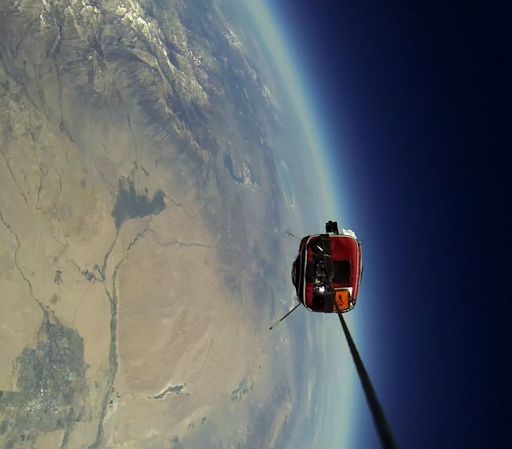
                  -Assisted by the students of Earth to Sky Calculus, spaceweather.com has been launching a series of Space Weather Buoys to measure cosmic radiation in the stratosphere. A buoy consists of an insulated payload (a.k.a. K-Mart lunchbox) bristling with sensors and cameras, carried aloft by a suborbital helium balloon. On the latest flight, June 19th, the payload took a selfie. Below it is flying 95,000 feet above Earth's surface. The "SelfieCam" was designed by high school student Carson Reid.

                  The goal of the ongoing experiment is to determine how radiation levels change during solar and geomagnetic storms, and how those changes affect the ozone layer. During each flight, the buoy gathers a complete radiation profile starting at the launch site in California's Eastern Sierras and extending up to 100,000+ feet. Such data are of interest to aviators, entrepreneurs in the emerging space tourism industry, and researchers of the ozone layer. Selfies are a visual bonus.

                  A complete data set will be released in Oct. 2014 when the student scientists will have collected a full year of radiation measurements, spanning all four seasons and a variety of space weather conditions.


                  Astro Picture of the Day:
                  June 22, 2014

                  Source:
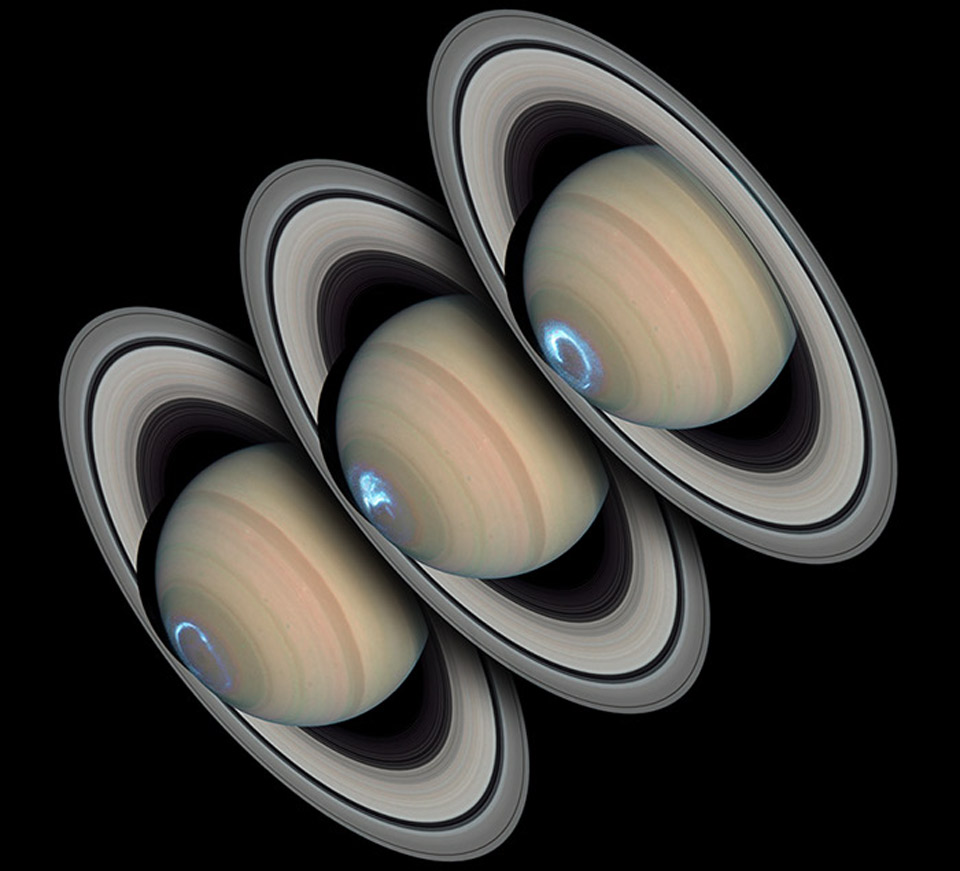
                  Are Saturn's auroras like Earth's? To help answer this question, the Hubble Space Telescope and the Cassini spacecraft monitored Saturn's South Pole simultaneously as Cassini closed in on the gas giant in January 2004. Hubble snapped images in ultraviolet light, while Cassini recorded radio emissions and monitored the solar wind. Like on Earth, Saturn's auroras make total or partial rings around magnetic poles. Unlike on Earth, however, Saturn's auroras persist for days, as opposed to only minutes on Earth. Although surely created by charged particles entering the atmosphere, Saturn's auroras also appear to be more closely modulated by the solar wind than either Earth's or Jupiter's auroras. The above sequence shows three Hubble images of Saturn each taken two days apart.
                  1st in Kommisar's 2009 SM Tournament
                  1st in I Love You`s 2009 New Year`s Tournament
                  3rd in EnR's Mashfest '08 tournament
                  5th in Phynx's Unofficial FFR Tournament
                  9th in D3 of the 2008-2009 4th Official FFR Tournament
                  10th in D5 of the 2010 5th Official FFR Tournament
                  10th in D6 of the 2011-2012 6th Official FFR Tournament

                  FMO AAA Count: 71
                  FGO AAA Count: 10

                  Bluearrowll = The Canadian player who can not detect awkward patterns. If it's awkward for most people, it's normal for Terry. If the file is difficult but super straight forward, he has issues. If he's AAAing a FGO but then heard that his favorite Hockey team was losing by a point, Hockey > FFR
                  PS: Cool AAA's Terry
                  - I Love You


                  An Alarm Clock's Haiku
                  beep beep beep beep beep
                  beep beep beep beep beep beep beep
                  beep beep beep beep beep
                  - ieatyourlvllol

                  Comment

                  • Bluearrowll
                    ⊙▃⊙
                    FFR Simfile Author
                    • Nov 2007
                    • 7376

                    #969
                    Re: Terry's Astronomy Thread.

                    Daily Suspicious0bserver's Weather Post:
                    June 23, 2014


                    What's in the sky tonight?
                    June 23, 2014
                    -Can you still see Jupiter in the sunset? Look low in the west-northwest about 45 minutes after sundown. If the air is clear it shouldn't be hard. Jupiter is heading away into conjunction with the Sun.

                    -Moon and Venus at Dawn Tuesday. The waning crescent Moon forms a beautiful close pair with Venus in Tuesday's dawn, as seen from the Americas. Look low in the east, as shown at the top of this page. Look early enough, and you can see the Pleiades to their upper right. From other longitudes around the world, the Moon and Venus appear farther apart at the local time of dawn.

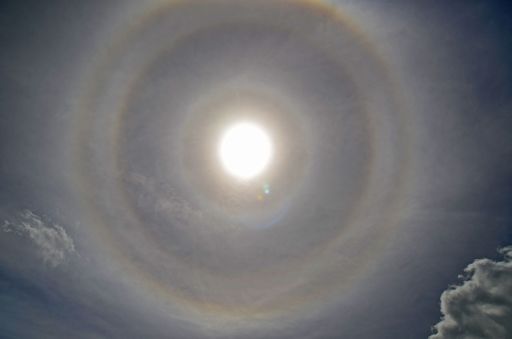
                    -Regular sky watchers are accustomed to seeing rings of light around the sun. Called "ice halos," they form when sunlight shines through ice crystals in high clouds. Usually these rings appear one at a time. On June 21st, Jun Lao of Mason, Ohio, saw three at once. "It was about 4 p.m. EDT in the greater Cincinnati area when I imaged what I first thought was a regular halo, but was surprised to see three concentric halos!" says Lao. "The sky had a light cloud layer, and I suspect these multiple halos were caused by pyramidal ice crystals."

                    Indeed, they were. Ordinary sun halos are produced by crystals shaped like pencils and flat plates. On rare occasions, however, the sky fills with pyramidal crystals. They look like two pyramids glued together, base-to-base. The pyramid-tips are sometimes truncated, and sometimes the two pyramids are separated by an intervening prism section, creating 18 different variations with up to 20 sides. Such a complicated crystalline form can produce multiple halos during the same display.

                    These multiple halos are sometimes called "odd-radius halos." However, as atmospheric optics expert Les Cowley points out, "Odd radius halos are perhaps not so 'odd' or rare as usually thought. Make a point of routinely searching for them."


                    Astro Picture of the Day:
                    June 23, 2014

                    Source:
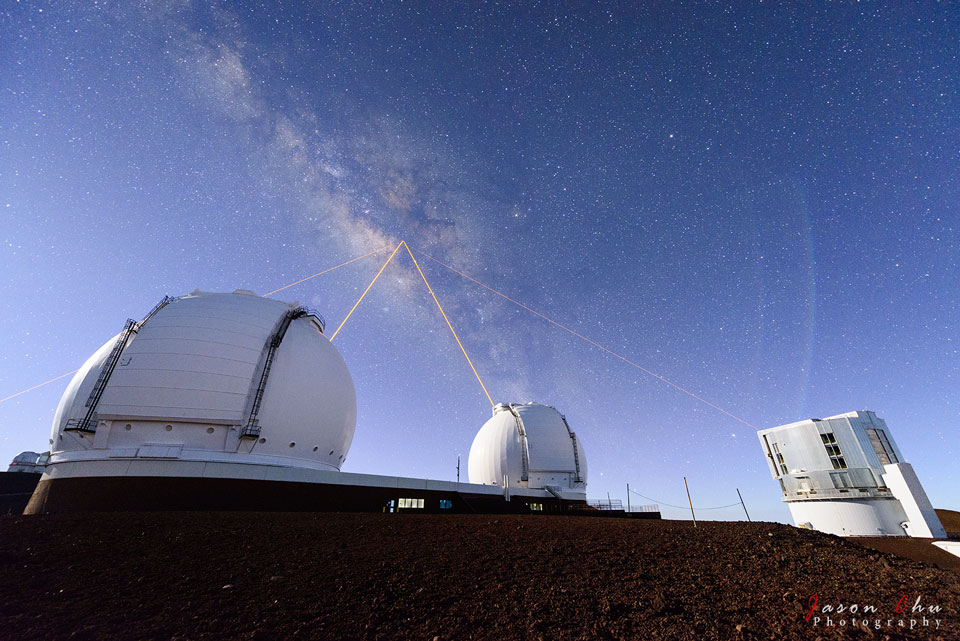
                    Are lasers from giant telescopes being used to attack the Galactic center? No. Lasers shot from telescopes are now commonly used to help increase the accuracy of astronomical observations. In some sky locations, Earth atmosphere-induced fluctuations in starlight can indicate how the air mass over a telescope is changing, but many times no bright star exists in the direction where atmospheric information is needed. In these cases, astronomers create an artificial star where they need it -- with a laser. Subsequent observations of the artificial laser guide star can reveal information so detailed about the blurring effects of the Earth's atmosphere that much of this blurring can be removed by rapidly flexing the mirror. Such adaptive optic techniques allow high-resolution ground-based observations of real stars, planets, and nebulae. Pictured above, four telescopes on Mauna Kea, Hawaii, USA are being used simultaneously to study the center of our Galaxy and so all use a laser to create an artificial star nearby.
                    1st in Kommisar's 2009 SM Tournament
                    1st in I Love You`s 2009 New Year`s Tournament
                    3rd in EnR's Mashfest '08 tournament
                    5th in Phynx's Unofficial FFR Tournament
                    9th in D3 of the 2008-2009 4th Official FFR Tournament
                    10th in D5 of the 2010 5th Official FFR Tournament
                    10th in D6 of the 2011-2012 6th Official FFR Tournament

                    FMO AAA Count: 71
                    FGO AAA Count: 10

                    Bluearrowll = The Canadian player who can not detect awkward patterns. If it's awkward for most people, it's normal for Terry. If the file is difficult but super straight forward, he has issues. If he's AAAing a FGO but then heard that his favorite Hockey team was losing by a point, Hockey > FFR
                    PS: Cool AAA's Terry
                    - I Love You


                    An Alarm Clock's Haiku
                    beep beep beep beep beep
                    beep beep beep beep beep beep beep
                    beep beep beep beep beep
                    - ieatyourlvllol

                    Comment

                    • Bluearrowll
                      ⊙▃⊙
                      FFR Simfile Author
                      • Nov 2007
                      • 7376

                      #970
                      Re: Terry's Astronomy Thread.

                      Daily Suspicious0bserver's Weather Post:
                      June 24, 2014


                      What's in the sky tonight?
                      June 24, 2014
                      -Mars and Spica shine in the southwest after dusk, with Arcturus high above them. Watch Mars move closer to Spica day by day. They'll pass each other on July 13th, just 1.3° apart.

                      -Arriving about a day later than expected, a CME hit Earth's magnetic field on June 23rd at 2300 UT. The impact did not spark a geomagnetic storm. A second CME following close behind could, however, push the geomagnetic field over the threshold into storm conditions. A glancing blow is expected during the early hours of June 24th.

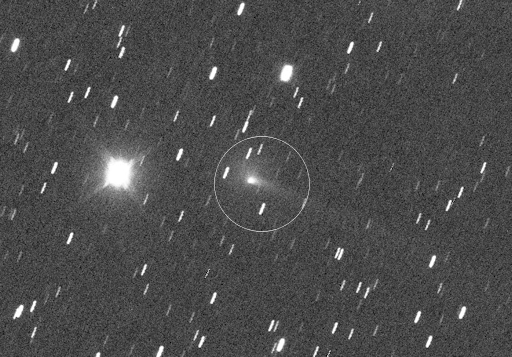
                      -If you've never heard of a "damocloid", don't feel bad; even many professional astronomers don't know what they are. However, there are at least 50 of them moving through the Solar System. Named after protoptype object 5335 Damocles, a damocloid is an asteroid that follows a comet-like orbit. In fact, many damacloids turn out to be comets when, without warning, they suddenly sprout a tail. The latest to make this transformation is damacloid 2013 UQ4. Michael Jäger photographed it on June 23rd from his backyard observatory in Stixendorf, Austria. Discovered in the fall of 2013 by Catalina Sky Survey, 2013 UQ4 at first appeared to be a dark asteroid. On May 7, 2014, however, astronomers noticed a fuzzy atmosphere surrounding object's formerly-inert core. Barely two months later, it has sprouted a tail and is undeniably a comet. 2013 UQ4 swung by the sun in early June, a warm encounter that boosted the activity of its apparently icy nucleus. 2013 UQ4 is expected to brighten to binocular visibility (7th magnitude) by July 10th when it flies by Earth approximately 29 million miles (0.3 AU) away.


                      Astro Picture of the Day:
                      June 24, 2014

                      Source:
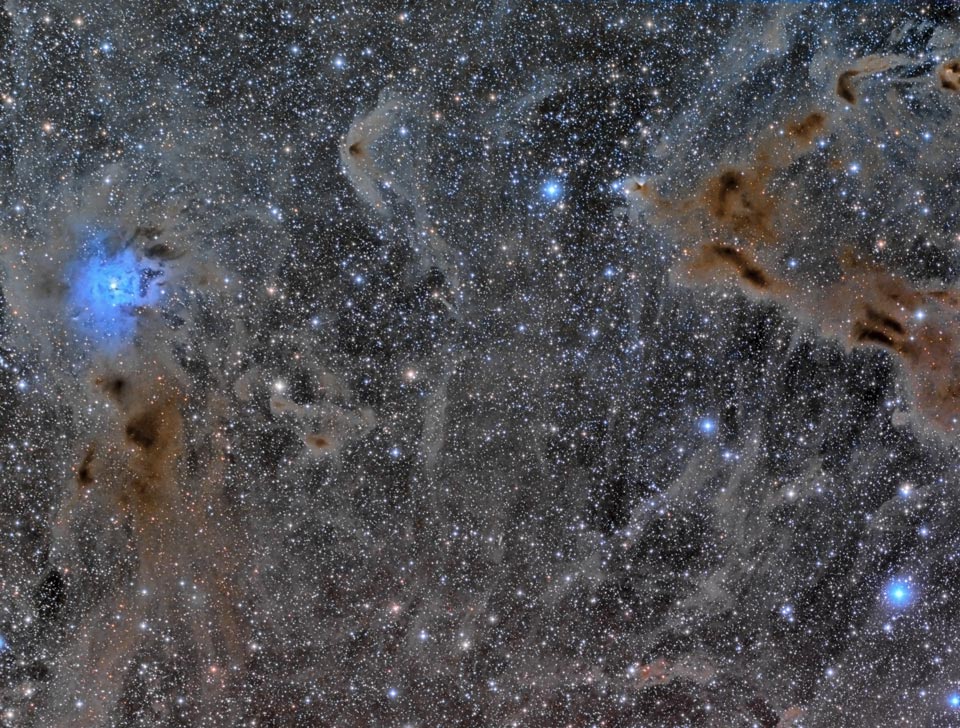
                      What flowers in this field of dark star dust? The Iris Nebula. The striking blue color of the Iris Nebula is created by light from the bright star SAO 19158 reflecting off of a dense patch of normally dark dust. Not only is the star itself mostly blue, but blue light from the star is preferentially reflected by the dust -- the same affect that makes Earth's sky blue. The brown tint of the pervasive dust comes partly from photoluminescence -- dust converting ultraviolet radiation to red light. Cataloged as NGC 7023, the Iris Nebula is studied frequently because of the unusual prevalence there of Polycyclic Aromatic Hydrocarbons (PAHs), complex molecules that are also released on Earth during the incomplete combustion of wood fires. The bright blue portion of the Iris Nebula spans about six light years. The Iris Nebula, pictured above, lies about 1300 light years distant and can be found with a small telescope toward the constellation of Cepheus.
                      1st in Kommisar's 2009 SM Tournament
                      1st in I Love You`s 2009 New Year`s Tournament
                      3rd in EnR's Mashfest '08 tournament
                      5th in Phynx's Unofficial FFR Tournament
                      9th in D3 of the 2008-2009 4th Official FFR Tournament
                      10th in D5 of the 2010 5th Official FFR Tournament
                      10th in D6 of the 2011-2012 6th Official FFR Tournament

                      FMO AAA Count: 71
                      FGO AAA Count: 10

                      Bluearrowll = The Canadian player who can not detect awkward patterns. If it's awkward for most people, it's normal for Terry. If the file is difficult but super straight forward, he has issues. If he's AAAing a FGO but then heard that his favorite Hockey team was losing by a point, Hockey > FFR
                      PS: Cool AAA's Terry
                      - I Love You


                      An Alarm Clock's Haiku
                      beep beep beep beep beep
                      beep beep beep beep beep beep beep
                      beep beep beep beep beep
                      - ieatyourlvllol

                      Comment

                      • Bluearrowll
                        ⊙▃⊙
                        FFR Simfile Author
                        • Nov 2007
                        • 7376

                        #971
                        Re: Terry's Astronomy Thread.

                        Daily Suspicious0bserver's Weather Post:
                        June 25, 2014


                        What's in the sky tonight?
                        June 25, 2014
                        -With Scorpius now in fine evening view, keep an eye on the doings of Delta Scorpii. This is the middle star in the row of three marking Scorpius's head. In July 2000 it unexpectedly doubled in brightness. It has remained brighter than normal ever since, with fluctuations, at about magnitude 2.0. Compare it to Beta Scorpii above it, magnitude 2.6, and Antares, 1.1.

                        -With only three small sunspot groups dotting the solar disk, and not one of them flaring, solar activity is low. NOAA forecasters estimate a scant 1% chance of M-flares on June 25th.

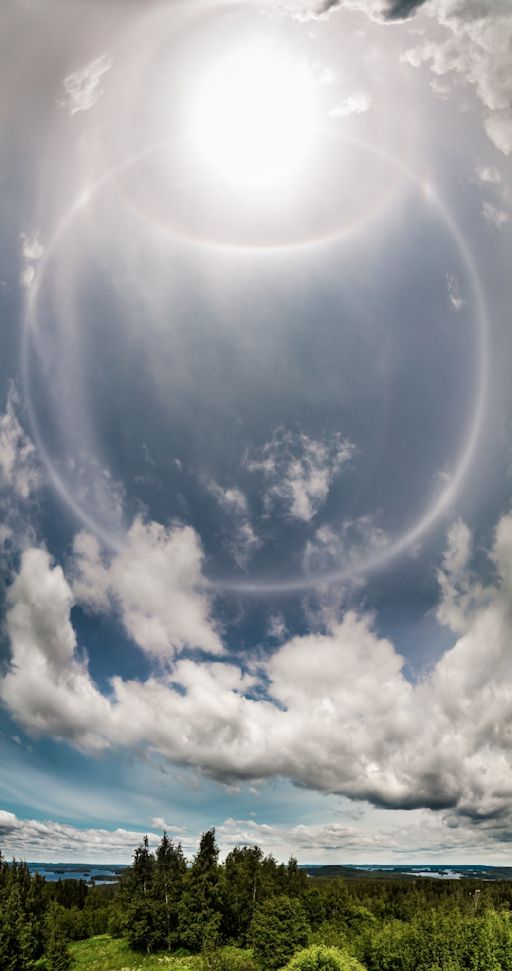
                        -Looking at the sun can be a wincing, painful experience. Yesterday in Finland it was a rare delight. "On June 24th, multiple arcs and rings of light appeared around the sun," reports Ville Miettinen of Kuopio. "What a spectacular view!" He dashed inside and grabbed his camera to record the amazing vista." They lingered in the sky for three whole hours," he says, "only disappearing when thick clouds intervened."

                        These luminous forms are called ice halos, because they caused by sunlight shining through icy crystals in cirrus clouds. Usually their forms are rather simple, like a solitary pillar or an uncomplicated ring. In this case, however, a complex assortment of halos criss-crossed the sky. In Miettinen's photo, we see a complete parhelic circle, a circumscribed halo, a supralateral arc, a 22-degree halo, and a pair of sundogs.

                        Vesa Vauhkonen of Rautalampi, Finland, saw even more forms. "These were very, very impressive halos--some of them quite rare," he says.

                        The variety of halos they witnessed was caused by a corresponding variety of ice crystals with rare gem-like perfection and unusually precise crystal-to-crystal alignment. What are the odds? No one knows but, apparently, they're higher in Finland.


                        News Posted Today:
                        June 24, 2014
                        Shadow of a Supervoid


                        Astro Picture of the Day:
                        June 25, 2014

                        Source:
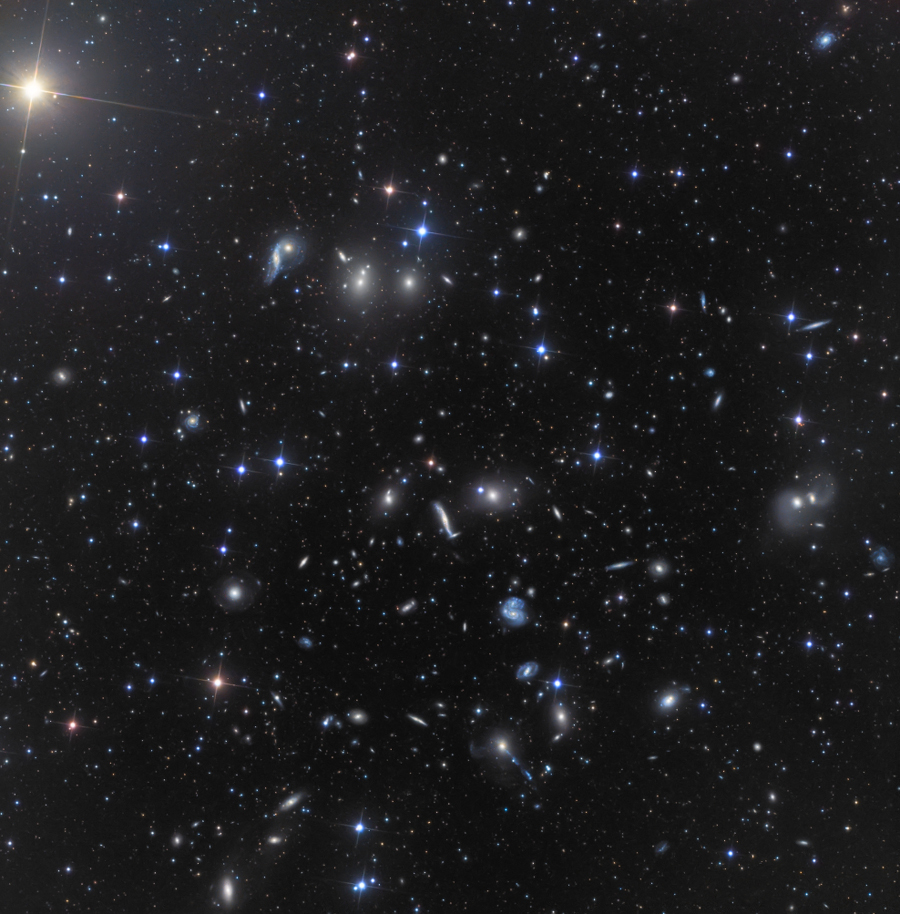
                        These are galaxies of the Hercules Cluster, an archipelago of island universes a mere 500 million light-years away. Also known as Abell 2151, this cluster is loaded with gas and dust rich, star-forming spiral galaxies but has relatively few elliptical galaxies, which lack gas and dust and the associated newborn stars. The colors in this remarkably deep composite image clearly show the star forming galaxies with a blue tint and galaxies with older stellar populations with a yellowish cast. The sharp picture spans about 3/4 degree across the cluster center, corresponding to over 6 million light-years at the cluster's estimated distance. Diffraction spikes around brighter foreground stars in our own Milky Way galaxy are produced by the imaging telescope's mirror support vanes. In the cosmic vista many galaxies seem to be colliding or merging while others seem distorted - clear evidence that cluster galaxies commonly interact. In fact, the Hercules Cluster itself may be seen as the result of ongoing mergers of smaller galaxy clusters and is thought to be similar to young galaxy clusters in the much more distant, early Universe.
                        1st in Kommisar's 2009 SM Tournament
                        1st in I Love You`s 2009 New Year`s Tournament
                        3rd in EnR's Mashfest '08 tournament
                        5th in Phynx's Unofficial FFR Tournament
                        9th in D3 of the 2008-2009 4th Official FFR Tournament
                        10th in D5 of the 2010 5th Official FFR Tournament
                        10th in D6 of the 2011-2012 6th Official FFR Tournament

                        FMO AAA Count: 71
                        FGO AAA Count: 10

                        Bluearrowll = The Canadian player who can not detect awkward patterns. If it's awkward for most people, it's normal for Terry. If the file is difficult but super straight forward, he has issues. If he's AAAing a FGO but then heard that his favorite Hockey team was losing by a point, Hockey > FFR
                        PS: Cool AAA's Terry
                        - I Love You


                        An Alarm Clock's Haiku
                        beep beep beep beep beep
                        beep beep beep beep beep beep beep
                        beep beep beep beep beep
                        - ieatyourlvllol

                        Comment

                        • Bluearrowll
                          ⊙▃⊙
                          FFR Simfile Author
                          • Nov 2007
                          • 7376

                          #972
                          Re: Terry's Astronomy Thread.

                          Daily Suspicious0bserver's Weather Post:
                          June 26, 2014


                          What's in the sky tonight?
                          June 26, 2014
                          -If you have a really good dark sky, look east as the final glow of twilight fades away. All across the low eastern sky, the intricate, mottled band of the Milky Way is on the rise. It rises higher through the night and crosses straight overhead around 2 or 3 a.m.

                          -The solstice sun has been very quiet. For more than five days there have been no significant flares, and the quiet appears set to continue. NOAA forecasters put the daily odds of an M- or X-class flare at no more than 1%.

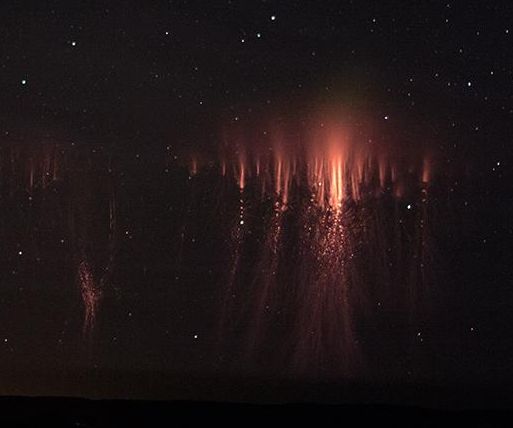
                          -With the arrival of summer, thunderstorm activity is underway across the USA. We all know what comes out of the bottom of thunderstorms: lightning. Lesser known is what comes out of the top: sprites. "Lately there has been a bumper crop of sprites," reports Thomas Ashcraft, a longtime observer of the phenomenon. "Here is one of the largest' 'jellyfish' sprites I have captured in the last four years." The cluster shot up from western Oklahoma on June 23, so large that it was visible from Ashcraft's observatory in New Mexico 289 miles away. "According to my measurements, it was 40 miles tall and 46 miles wide. This sprite would dwarf Mt. Everest!" he exclaims. Ashcraft's video: http://vimeo.com/99060196

                          Also in New Mexico, Jan Curtis saw a cluster of red sprites just one night later, June 24. "I've always wanted to capture these elusive atmospheric phenomena and last night I was finally successful."

                          Although sprites have been seen for at least a century, most scientists did not believe they existed until after 1989 when sprites were photographed by cameras onboard the space shuttle. Now "sprite chasers" regularly photograph the upward bolts from their own homes.

                          Ashcraft explains how he does it: "My method for photographing sprites is fairly simple. First I check for strong thunderstorms within 500 miles using regional radar maps accessible on the Internet. There must be a locally clear sky to image above the distant storm clouds. Then I aim my cameras out over the direction of the thunderstorms (which will be hot red or purple on the radar maps) and shoot continuous DSLR exposures. I usually shoot continuous 2 second exposures but if there is no moon then I will shoot up to 4 second exposures. Then I run through all the photographs and if I am lucky some sprites will be there. It might take hundreds to usually thousands of exposures so be prepared for many shutter clicks. I use a modified near infrared DLSR but any DLSR will capture sprites. Note that it does require persistence and a little bit of luck."

                          Inhabiting the upper reaches of Earth's atmosphere alongside meteors, noctilucent clouds and some auroras, sprites are a true space weather phenomenon. Now is a good time to see them.


                          Astro Picture of the Day:
                          June 26, 2014

                          Source:
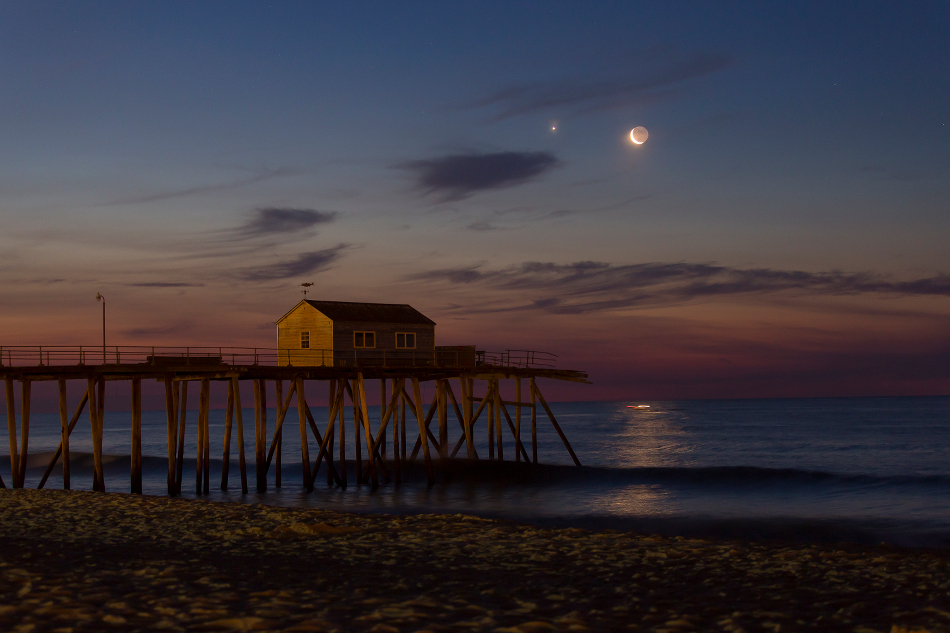
                          Early morning risers were treated to a beautiful conjunction of Venus and waning Crescent Moon on June 24, captured in this seaside photo near Belmar, New Jersey, USA, planet Earth. The serene celestial pairing is seen above the Atlantic Ocean horizon as the eastern sky grows brighter with dawn's early light. Wispy, scattered clouds appear in silhouette. But the exposure also reveals the night side of the lunar orb in the arms of the sunlit crescent. That shadowed part of the Moon, with hints of the smooth, dark lunar seas or maria, is illuminated by Earthshine, sunlight reflected from planet Earth itself.
                          1st in Kommisar's 2009 SM Tournament
                          1st in I Love You`s 2009 New Year`s Tournament
                          3rd in EnR's Mashfest '08 tournament
                          5th in Phynx's Unofficial FFR Tournament
                          9th in D3 of the 2008-2009 4th Official FFR Tournament
                          10th in D5 of the 2010 5th Official FFR Tournament
                          10th in D6 of the 2011-2012 6th Official FFR Tournament

                          FMO AAA Count: 71
                          FGO AAA Count: 10

                          Bluearrowll = The Canadian player who can not detect awkward patterns. If it's awkward for most people, it's normal for Terry. If the file is difficult but super straight forward, he has issues. If he's AAAing a FGO but then heard that his favorite Hockey team was losing by a point, Hockey > FFR
                          PS: Cool AAA's Terry
                          - I Love You


                          An Alarm Clock's Haiku
                          beep beep beep beep beep
                          beep beep beep beep beep beep beep
                          beep beep beep beep beep
                          - ieatyourlvllol

                          Comment

                          • Bluearrowll
                            ⊙▃⊙
                            FFR Simfile Author
                            • Nov 2007
                            • 7376

                            #973
                            Re: Terry's Astronomy Thread.

                            Daily Suspicious0bserver's Weather Post:
                            June 27, 2014


                            What's in the sky tonight?
                            June 27, 2014
                            -This is the time of year when, at the end of dusk, the dim Little Dipper (Ursa Minor) floats straight upward from Polaris (the end of its handle) — like a helium balloon on a string, escaped from some summer evening party. Look due north.

                            -Through light pollution, all you may see of the Little Dipper are Polaris at one end and Kochab, the lip of the Little Dipper's bowl, above it at the other.

                            -NASA's twin STEREO probes, which can see the farside of the sun and make 3D models of incoming CMEs, have revolutionized space weather forecasting. We might have to do without them for a while. Later this year, the twin probes will pass directly behind the sun. Originally, mission planners expected a brief eclipse. Instead, operations could be curtailed for more than a year. The reason has to do with STEREO's high gain antenna feed. Ironically, when the antenna points too close to the sun, it overheats. As the probes pass behind the sun, they can't point their antennas at Earth without heat-sensitive components becoming dangerously hot. This engineering problem was not anticipated when STEREO was launched in 2006. On the bright side, it might be possible to avert a complete blackout using the antenna's sidelobes. Tests in July will evaluate this possibility.

                            Astro Picture of the Day:
                            June 27, 2014

                            Source:
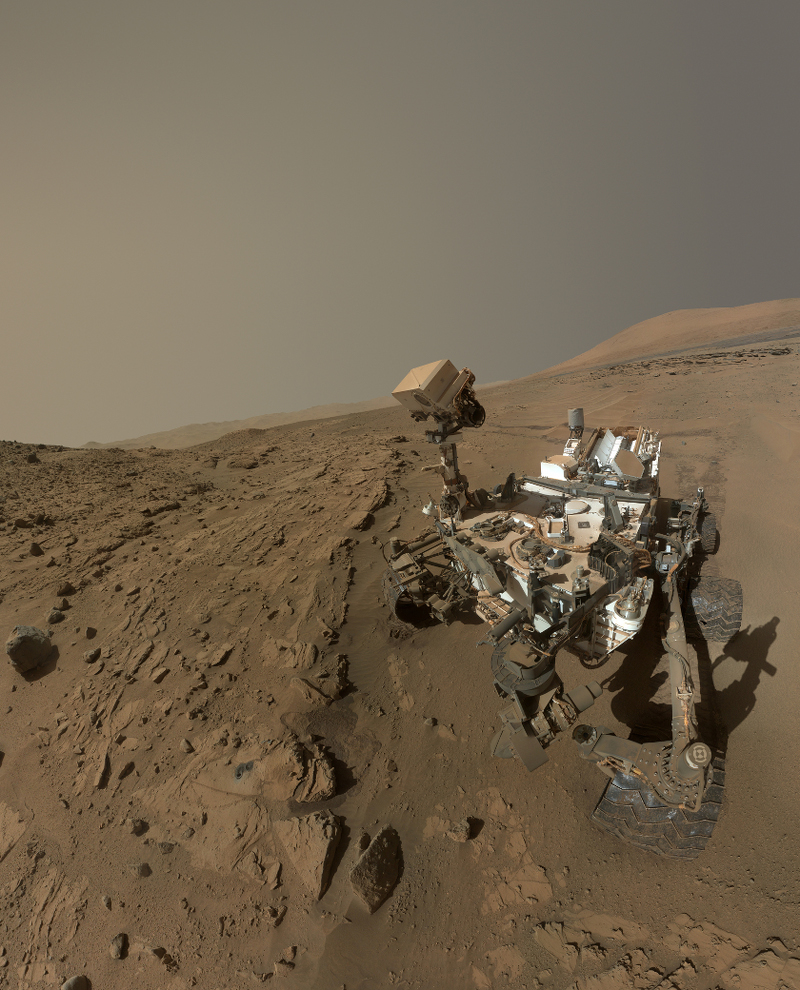
                            June 24th marked the first full Martian year of the Curiosity Rover's exploration of the surface of the Red Planet. That's 687 Earth days or 669 sols since its landing on August 5, 2012. To celebrate, consider this self-portrait of the car-sized robot posing next to a rocky outcrop dubbed Windjana, its recent drilling and sampling site. The mosaicked selfie was constructed with frames taken this April and May using the rover's Mars Hand Lens Imager (MAHLI), intended for close-up work and mounted at the end of the rover's robotic arm. The MAHLI frames used exclude sections that show the arm itself and so MAHLI and the robotic arm are not seen. Famous for panoramic views, the rover's Mastcam is visible though, on top of the tall mast staring toward the left and down at the drill hole.
                            1st in Kommisar's 2009 SM Tournament
                            1st in I Love You`s 2009 New Year`s Tournament
                            3rd in EnR's Mashfest '08 tournament
                            5th in Phynx's Unofficial FFR Tournament
                            9th in D3 of the 2008-2009 4th Official FFR Tournament
                            10th in D5 of the 2010 5th Official FFR Tournament
                            10th in D6 of the 2011-2012 6th Official FFR Tournament

                            FMO AAA Count: 71
                            FGO AAA Count: 10

                            Bluearrowll = The Canadian player who can not detect awkward patterns. If it's awkward for most people, it's normal for Terry. If the file is difficult but super straight forward, he has issues. If he's AAAing a FGO but then heard that his favorite Hockey team was losing by a point, Hockey > FFR
                            PS: Cool AAA's Terry
                            - I Love You


                            An Alarm Clock's Haiku
                            beep beep beep beep beep
                            beep beep beep beep beep beep beep
                            beep beep beep beep beep
                            - ieatyourlvllol

                            Comment

                            • Bluearrowll
                              ⊙▃⊙
                              FFR Simfile Author
                              • Nov 2007
                              • 7376

                              #974
                              Re: Terry's Astronomy Thread.

                              Daily Suspicious0bserver's Weather Post:
                              June 28, 2014


                              What's in the sky tonight?
                              June 28, 2014
                              -Can you see the big Coma Berenices star cluster from where you live? Does your light pollution really hide it, or do you just not know exactly where to look? It's 2/5 of the way from Denebola (Leo's tail) to the end of the Big Dipper's handle (Ursa Major's tail). Its brightest members form an inverted Y. The cluster is about 5° wide overall — a big, dim glow in at least a moderately dark sky. It nearly fills a binocular view.

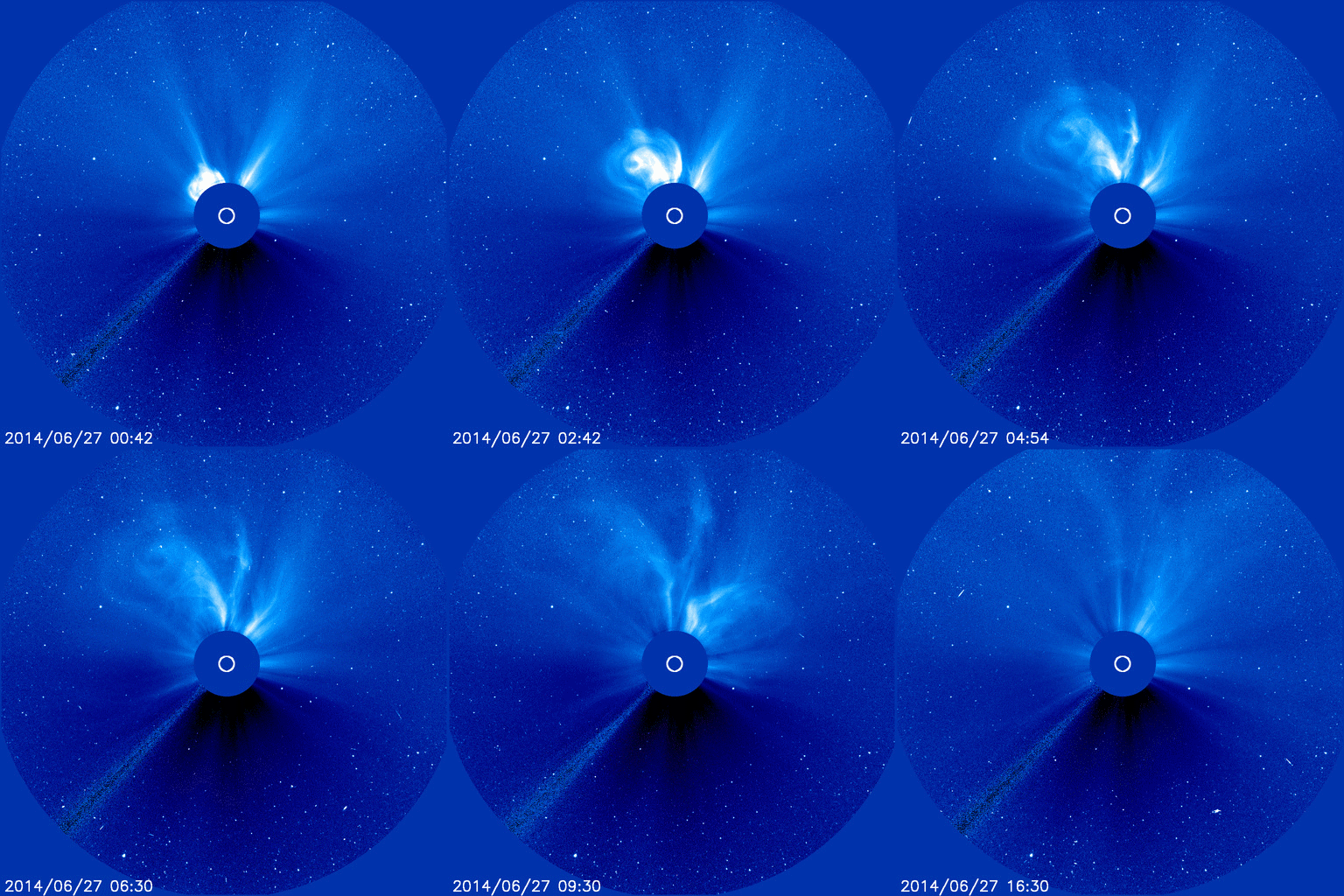
                              -During the early hours of June 27th, a series of bright CMEs billowed over the sun's northern limb. The Solar and Heliospheric Observatory (SOHO) recorded the blasts. NASA's STEREO probes saw the eruptions that gave birth to these clouds; the blast sites were on the farside of the sun. During STEREO's year-long brownout, pinpointing farside eruptions won't always be possible. Data trickling out of the STEREO's antenna's sidelobes simply cannot provide the kind of uninterrupted coverage required to catch every flare.

                              The situation could worsen if, during STEREO's absence, something happens to SOHO. Launched in 1995, the Solar and Heliospheric Observatory is an old spacecraft operating far beyond its design lifetime. A mishap for SOHO could leave us without any operating space-based coronagraphs until STEREO comes back online in late 2015. Such a scenario would make it impossible to detect and track emerging CMEs. Imagine a whole year of space weather forecasting based on supposition and guesswork! This possibility highlights the need for a next generation of spacecraft to monitor the sun.


                              Astro Picture of the Day:
                              June 28, 2014

                              Source:
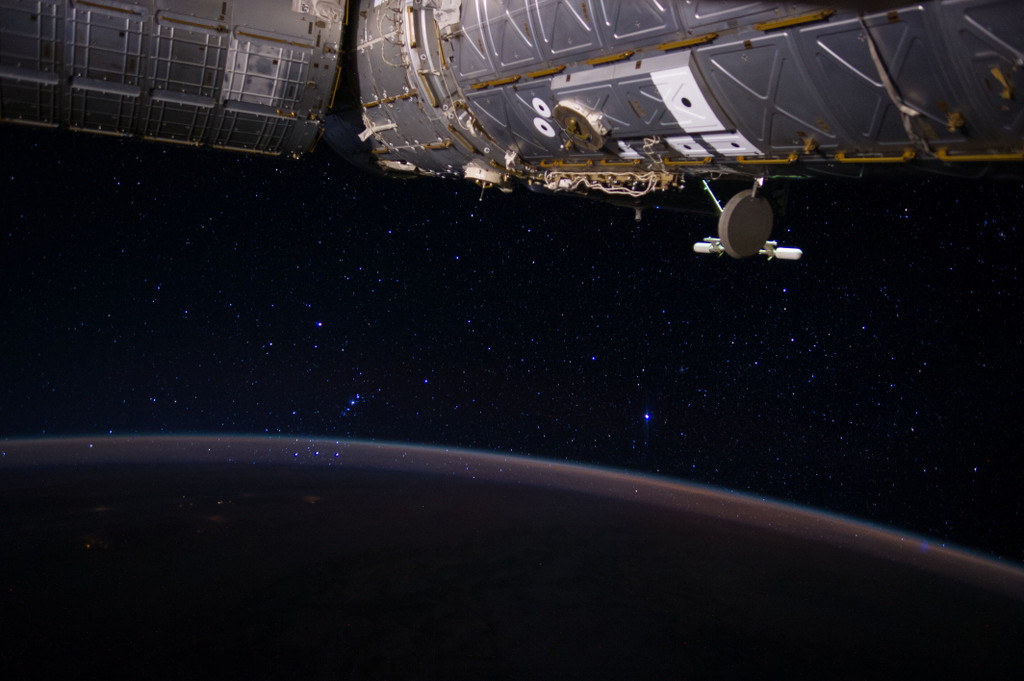
                              Orion's belt runs just along the horizon, seen through Earth's atmosphere and rising in this starry snapshot from low Earth orbit on board the International Space Station. The belt stars, Alnitak, Alnilam, and Mintaka run right to left and Orion's sword, home to the great Orion Nebula, hangs above his belt, an orientation unfamiliar to denizens of the planet's northern hemisphere. That puts bright star Rigel, at the foot of Orion, still higher above Orion's belt. Of course the brightest celestial beacon in the frame is Sirius, alpha star of the constellation Canis Major. The station's Destiny Laboratory module is in the foreground at the top right.
                              1st in Kommisar's 2009 SM Tournament
                              1st in I Love You`s 2009 New Year`s Tournament
                              3rd in EnR's Mashfest '08 tournament
                              5th in Phynx's Unofficial FFR Tournament
                              9th in D3 of the 2008-2009 4th Official FFR Tournament
                              10th in D5 of the 2010 5th Official FFR Tournament
                              10th in D6 of the 2011-2012 6th Official FFR Tournament

                              FMO AAA Count: 71
                              FGO AAA Count: 10

                              Bluearrowll = The Canadian player who can not detect awkward patterns. If it's awkward for most people, it's normal for Terry. If the file is difficult but super straight forward, he has issues. If he's AAAing a FGO but then heard that his favorite Hockey team was losing by a point, Hockey > FFR
                              PS: Cool AAA's Terry
                              - I Love You


                              An Alarm Clock's Haiku
                              beep beep beep beep beep
                              beep beep beep beep beep beep beep
                              beep beep beep beep beep
                              - ieatyourlvllol

                              Comment

                              • Bluearrowll
                                ⊙▃⊙
                                FFR Simfile Author
                                • Nov 2007
                                • 7376

                                #975
                                Re: Terry's Astronomy Thread.

                                Daily Suspicious0bserver's Weather Post:
                                June 29, 2014


                                What's in the sky tonight?
                                June 29, 2014
                                -Shortly after sunset, look for the thin waxing crescent Moon very low in the west-northwest, then look for Jupiter well to its right, as shown here.

                                -Yesterday, NASA's "flying saucer"--a device designed to deliver heavy payloads to Mars--made its first test flight over Hawaii. "The vehicle worked beautifully, and we met all of our flight objectives," reports project manager Mark Adler of the Jet Propulsion Laboratory. Flight videos and a full report were issued at a news conference on June 29th. Videos can be found here: http://www.nasa.gov/jpl/ldsd/telecon2014/
                                Report: http://www.nasa.gov/jpl/ldsd/test-fl...sful-20140629/


                                Astro Picture of the Day:
                                June 29, 2014

                                Source:
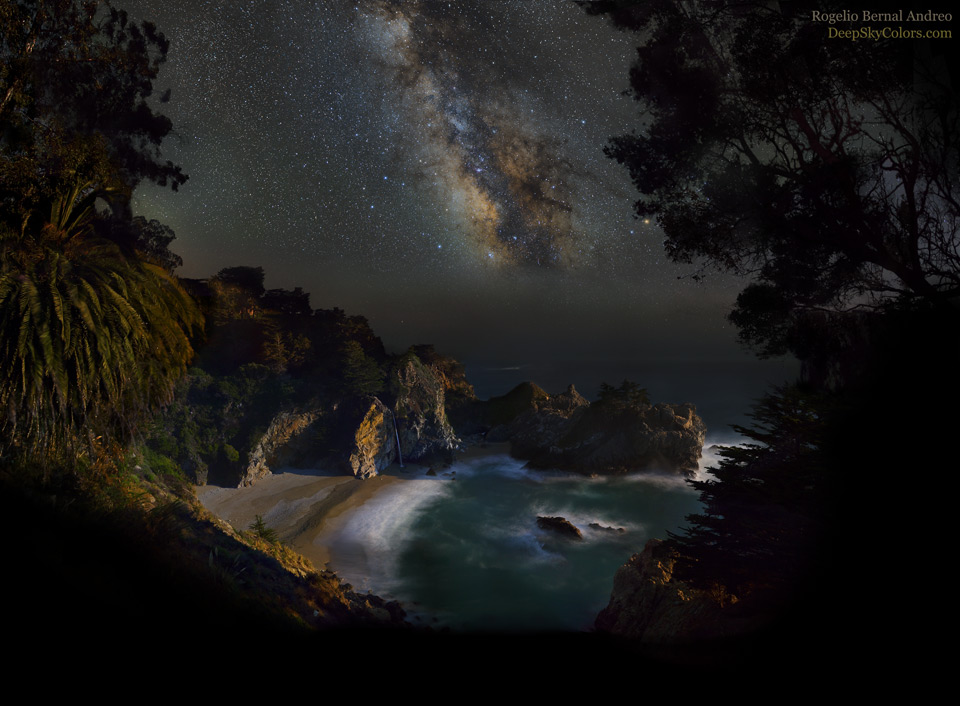
                                To see a vista like this takes patience, hiking, and a camera. Patience was needed in searching out just the right place and waiting for just the right time. A short hike was needed to reach this rugged perch above a secluded cove in Julia Pfeiffer Burns State Park in California, USA. And a camera was needed for the long exposure required to bring out the faint light from stars and nebulae in the background Milky Way galaxy. Moonlight illuminated the hidden beach and inlet behind nearby trees in the above composite image taken last month. Usually obscured McWay Falls is visible just below the image center, while the Pacific Ocean is in view to its right.


                                Daily Suspicious0bserver's Weather Post:
                                June 30, 2014


                                What's in the sky tonight?
                                June 30, 2014
                                -Now the thickening crescent Moon is higher and easier to see in twilight, with Jupiter farther to its lower right and stars of Leo above it, as shown here.

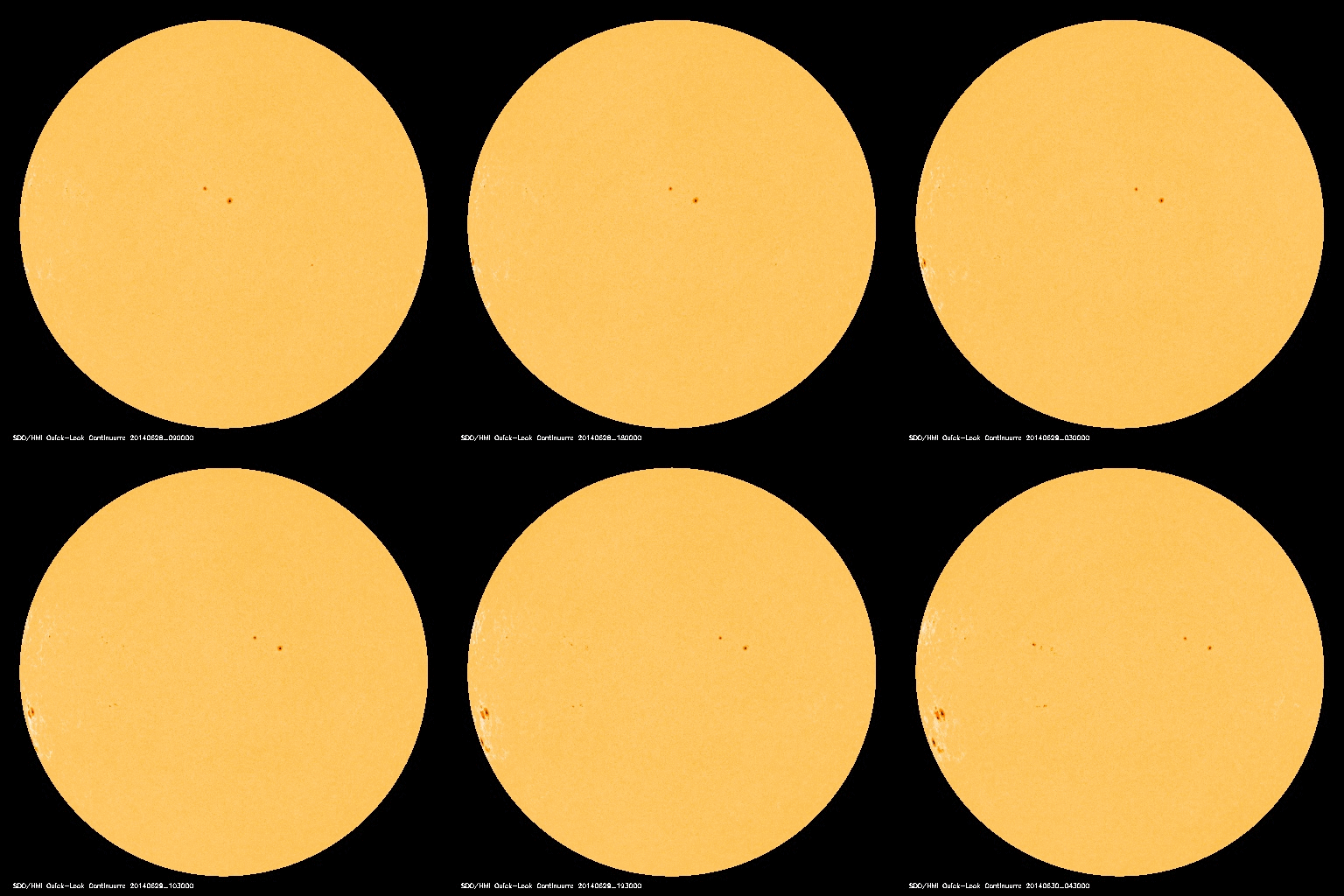
                                -A pair of new sunspots is emerging over the sun's eastern limb--and they appear to be bigs ones. NASA's Solar Dynamics Observatory recorded their arrival during the early hours of June 29th.

                                The sun has been mostly quiet for the past two weeks, and these sunspots could break the quiet. Already they are crackling with C-class solar flares. As the active regions turn toward Earth, we will be able to examine their magnetic fields and evaluate the posssibilitty that they harbor energy for stronger eruptions.


                                Astro Picture of the Day:
                                June 30, 2014

                                Source:
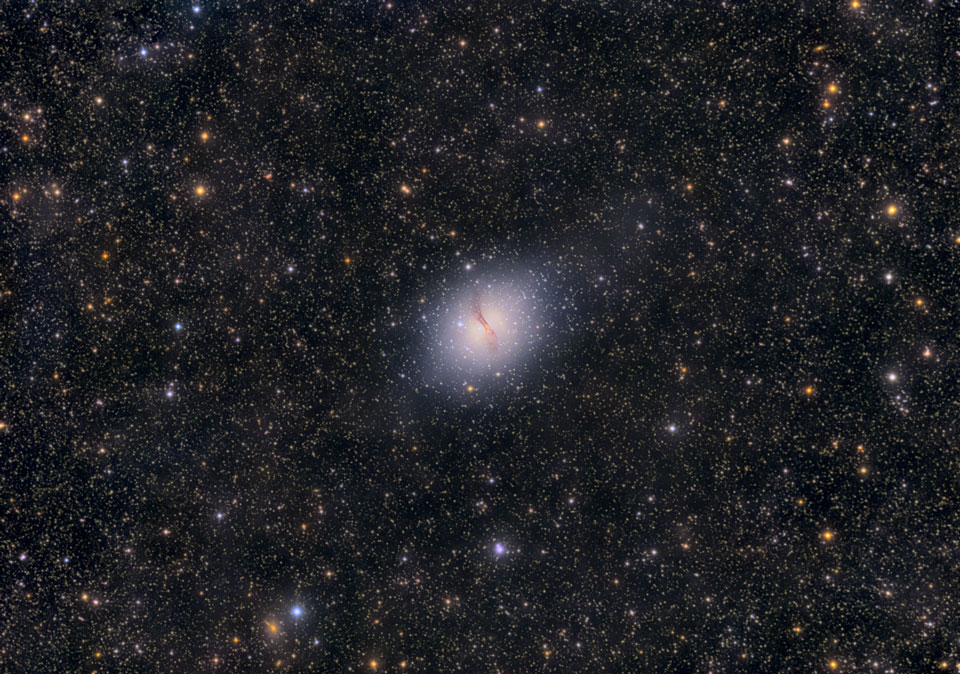
                                What's happened to the center of this galaxy? Unusual and dramatic dust lanes run across the center of elliptical galaxy Centaurus A. These dust lanes are so thick they almost completely obscure the galaxy's center in visible light. This is particularly unusual as Cen A's red stars and round shape are characteristic of a giant elliptical galaxy, a galaxy type usually low in dark dust. Cen A, also known as NGC 5128, is also unusual compared to an average elliptical galaxy because it contains a higher proportion of young blue stars and is a very strong source of radio emission. Evidence indicates that Cen A is likely the result of the collision of two normal galaxies. During the collision, many young stars were formed, but details of the creation of Cen A's unusual dust belts are still being researched. Cen A lies only 13 million light years away, making it the closest active galaxy. Cen A, pictured above, spans 60,000 light years and can be seen with binoculars toward the constellation of Centaurus.
                                1st in Kommisar's 2009 SM Tournament
                                1st in I Love You`s 2009 New Year`s Tournament
                                3rd in EnR's Mashfest '08 tournament
                                5th in Phynx's Unofficial FFR Tournament
                                9th in D3 of the 2008-2009 4th Official FFR Tournament
                                10th in D5 of the 2010 5th Official FFR Tournament
                                10th in D6 of the 2011-2012 6th Official FFR Tournament

                                FMO AAA Count: 71
                                FGO AAA Count: 10

                                Bluearrowll = The Canadian player who can not detect awkward patterns. If it's awkward for most people, it's normal for Terry. If the file is difficult but super straight forward, he has issues. If he's AAAing a FGO but then heard that his favorite Hockey team was losing by a point, Hockey > FFR
                                PS: Cool AAA's Terry
                                - I Love You


                                An Alarm Clock's Haiku
                                beep beep beep beep beep
                                beep beep beep beep beep beep beep
                                beep beep beep beep beep
                                - ieatyourlvllol

                                Comment

                                Working...