Terry's Astronomy Thread.

Collapse
X
 
  • Time
  • Show
Clear All
new posts
  • Bluearrowll
    ⊙▃⊙
    FFR Simfile Author
    • Nov 2007
    • 7376

    #946
    Re: Terry's Astronomy Thread.

    Main post updated.

    Daily Suspicious0bserver's Weather Post:
    May 26, 2014


    What's in the sky tonight?
    May 26, 2014
    -Arcturus shines high in the southeast these nights. Vega shines much lower in the northeast. Look a third of the way from Arcturus to Vega for dim little Corona Borealis, the Northern Crown, with its one modestly bright star, Alphecca or Gemma. Two thirds of the way from Arcturus to Vega glimmers the dim Keystone of Hercules. Continue on down past Vega, and you hit Cygnus.

    Astro Picture of the Day:
    May 26, 2014

    Source:
    It is the most expensive and complex ground-based astronomy project ever -- what will it see tonight? The Atacama Large Millimeter Array (ALMA) project consists of 66 dishes, many the size of a small house, situated in the high altitude Atacama Desert in Northern Chile. Together, ALMA observes the skies in high-frequency radio light, a band usually used only for local communication due to considerable absorption by humid air. The thin atmosphere and low humidity above ALMA, however, enable it to see deep into our universe in new and unique ways that allow, for example, explorations of the early universe for chemicals involved in star formation, and observing local star systems for signs of disks that form planets. The above time-lapse video shows the course of four ALMA antennas over one night. The Moon sets early in the video, while three dishes repoint in unison. Background stars continually rotate up, the central band of our Milky Way Galaxy pivots around and eventually exits off to the right, while halfway through the Small and Large Magellanic Clouds -- satellite galaxies near our Milky Way -- rise up from below the horizon. Car headlights momentarily illuminate the dishes, while an occasional Earth-orbiting satellite crosses overhead. Daylight ends the video but not ALMA observations -- which typically run both all night and all day.
    1st in Kommisar's 2009 SM Tournament
    1st in I Love You`s 2009 New Year`s Tournament
    3rd in EnR's Mashfest '08 tournament
    5th in Phynx's Unofficial FFR Tournament
    9th in D3 of the 2008-2009 4th Official FFR Tournament
    10th in D5 of the 2010 5th Official FFR Tournament
    10th in D6 of the 2011-2012 6th Official FFR Tournament

    FMO AAA Count: 71
    FGO AAA Count: 10

    Bluearrowll = The Canadian player who can not detect awkward patterns. If it's awkward for most people, it's normal for Terry. If the file is difficult but super straight forward, he has issues. If he's AAAing a FGO but then heard that his favorite Hockey team was losing by a point, Hockey > FFR
    PS: Cool AAA's Terry
    - I Love You


    An Alarm Clock's Haiku
    beep beep beep beep beep
    beep beep beep beep beep beep beep
    beep beep beep beep beep
    - ieatyourlvllol

    Comment

    • Bluearrowll
      ⊙▃⊙
      FFR Simfile Author
      • Nov 2007
      • 7376

      #947
      Re: Terry's Astronomy Thread.

      Daily Suspicious0bserver's Weather Post:
      May 27, 2014


      What's in the sky tonight?
      May 27, 2014
      -Comet 209P/LINEAR, the source of last Saturday morning's meteors, is closest to Earth for the next five days. It was only 13th magnitude as of May 22nd, but if you want to try for it with a large telescope, finder charts can be found here: http://www.skyandtelescope.com/astro...buzzing-earth/ It's south of Leo, crossing Sextans and Crater.

      -Solar activity is low. However, departing sunspot AR2065 has a 'beta-gamma' magnetic field that harbors energy for M-class solar flares. If such an explosion does occur, it would be well-connected to Earth. The sun's spiralling magnetic field leads from the sun's western limb, where AR2065 is located, almost directly back to our planet.

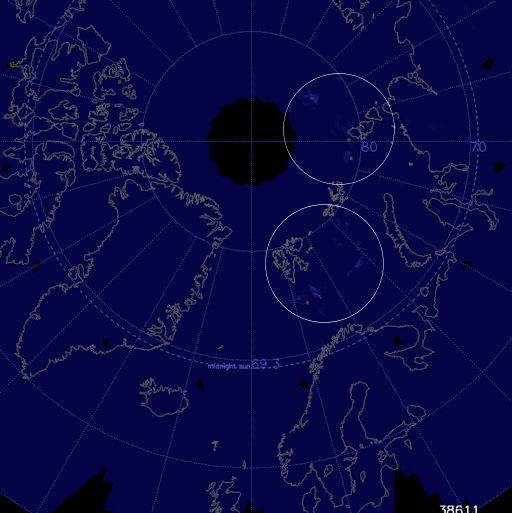
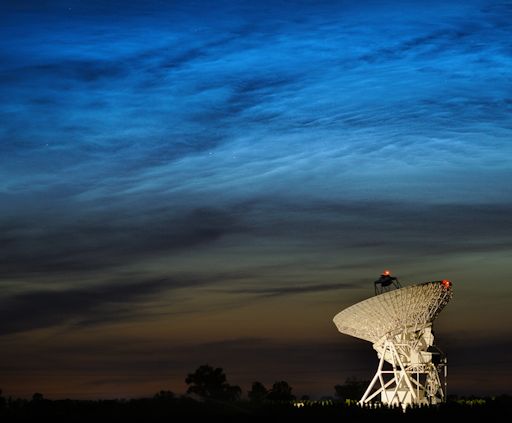
      -Data from NASA's AIM spacecraft have shown that noctilucent clouds (NLCs) are like a great "geophysical light bulb." They turn on every year in late spring, reaching almost full intensity over a period of no more than 5 to 10 days. News flash: The switch has been flipped. "The first NLCs of the northern hemisphere season appeared on May 24th," reports Cora Randall, AIM science team member at the University of Colorado. Pale-blue and wispy, they are circled in this image of the Arctic Circle taken by AIM's CIPS instrument just three days ago.

      Last year, for reasons that are not fully understood, noctilucent clouds appeared earlier than usual. In 2014, however, "we are having a fairly normal start," says Randall. "Since AIM was launched in 2007, we have seen start dates typically ranging from May 15th to May 27th, with four seasons (like this one) getting underway between May 24th and May 27th."

      If this season follows the pattern of earlier seasons, the small wispy patches pictured above will grow into a magnificent ring of electric-blue clouds in 5 to 10 days--that is, by the first week of June. Then the geophysical light bulb will be fully aglow. Stay tuned for sightings.

      Observing tips: NLCs favor high latitudes, but they are not confined there. In recent years the clouds have been sighted as far south as Colorado and Virginia. Look west 30 to 60 minutes after sunset when the Sun has dipped 6o to 16o below the horizon. If you see luminous blue-white tendrils spreading across the sky, you may have spotted a noctilucent cloud.


      Astro Picture of the Day:
      May 27, 2014

      Source:
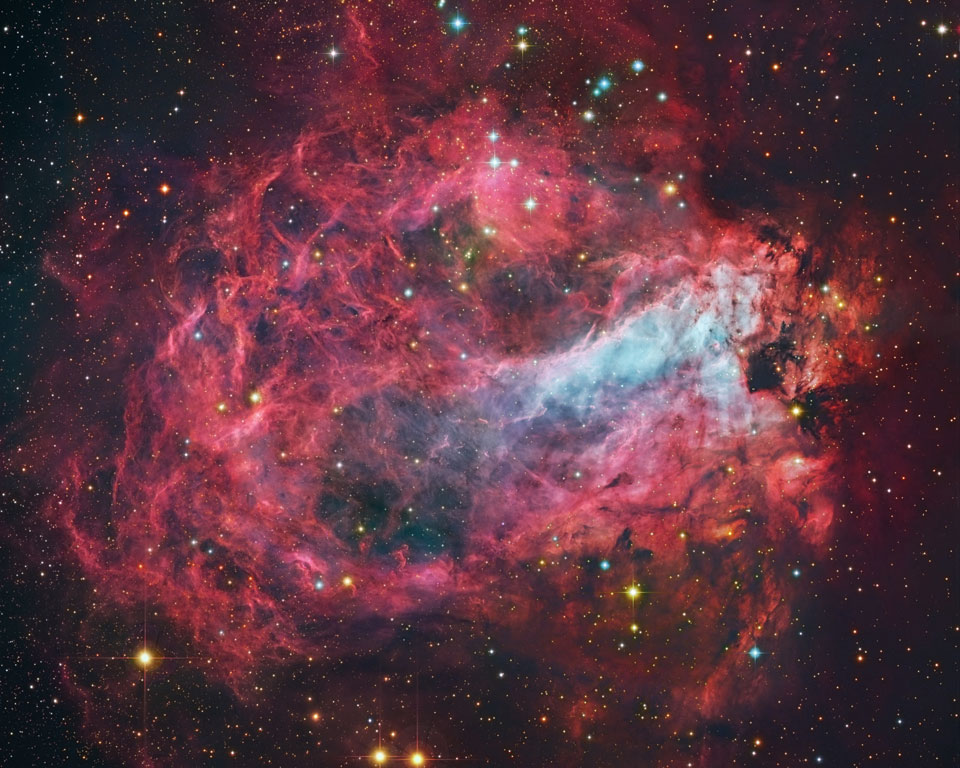
      What's happening at the center of this nebula? Sculpted by stellar winds and radiation, the star factory known as Messier 17 lies some 5,500 light-years away in the nebula-rich constellation Sagittarius. At that distance, this degree wide field of view spans almost 100 light-years. The sharp, composite, color image utilizing data from space and ground based telescopes, follows faint details of the region's gas and dust clouds against a backdrop of central Milky Way stars. Stellar winds and energetic light from hot, massive stars formed from M17's stock of cosmic gas and dust have slowly carved away at the remaining interstellar material producing the cavernous appearance and undulating shapes. M17 is also known as the Omega Nebula or the Swan Nebula.
      1st in Kommisar's 2009 SM Tournament
      1st in I Love You`s 2009 New Year`s Tournament
      3rd in EnR's Mashfest '08 tournament
      5th in Phynx's Unofficial FFR Tournament
      9th in D3 of the 2008-2009 4th Official FFR Tournament
      10th in D5 of the 2010 5th Official FFR Tournament
      10th in D6 of the 2011-2012 6th Official FFR Tournament

      FMO AAA Count: 71
      FGO AAA Count: 10

      Bluearrowll = The Canadian player who can not detect awkward patterns. If it's awkward for most people, it's normal for Terry. If the file is difficult but super straight forward, he has issues. If he's AAAing a FGO but then heard that his favorite Hockey team was losing by a point, Hockey > FFR
      PS: Cool AAA's Terry
      - I Love You


      An Alarm Clock's Haiku
      beep beep beep beep beep
      beep beep beep beep beep beep beep
      beep beep beep beep beep
      - ieatyourlvllol

      Comment

      • Bluearrowll
        ⊙▃⊙
        FFR Simfile Author
        • Nov 2007
        • 7376

        #948
        Re: Terry's Astronomy Thread.

        Daily Suspicious0bserver's Weather Post:
        May 28, 2014


        What's in the sky tonight?
        May 28, 2014
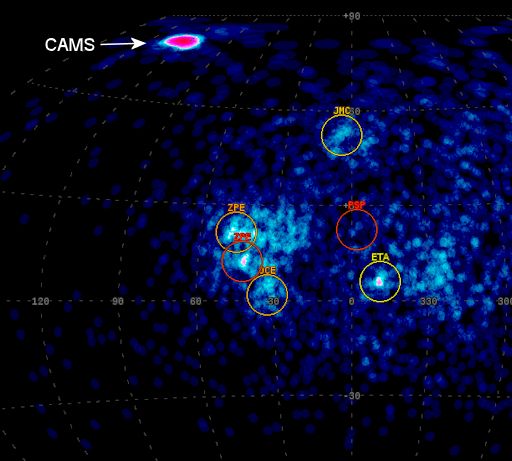
        -On May 24th, many sky watchers were disappointed when the Camelopardalid meteor shower produced a measley 5 to 10 shooting stars per hour. At least 10 times that number had been expected. In fact, they were there, just invisible to the human eye. "The shower was quite strong as seen by radar, but almost exclusively in underdense echoes - that is, it was rich in faint meteors (i.e., 6th to 7th magnitude)," reports Peter Brown of the University of Western Ontario. This all-sky radar map obtained during the shower's peak by the Canadian Meteor Orbit Radar clearly shows a Camelopardalid 'hot spot' near the north celestial pole.

        "CMOR detected about one hundred orbits from the stream, making this comparable to the 2011 Draconids in terms of strength as seen by the radar," says Brown. "[Compared to other minor showers active on May 24th], the May Camelopardalids were at the top of the list -- relatively speaking a major outburst."

        Clearly, the debris stream of parent comet 209P/LINEAR did not contain as many large particles as forecasters anticipated. This gave the advantage to the radar. Even so, some beautiful Camelopardalids were seen by the naked eye.

        -New Moon today (exact at 2:40pm EDT).


        Astro Picture of the Day:
        May 28, 2014

        Source:
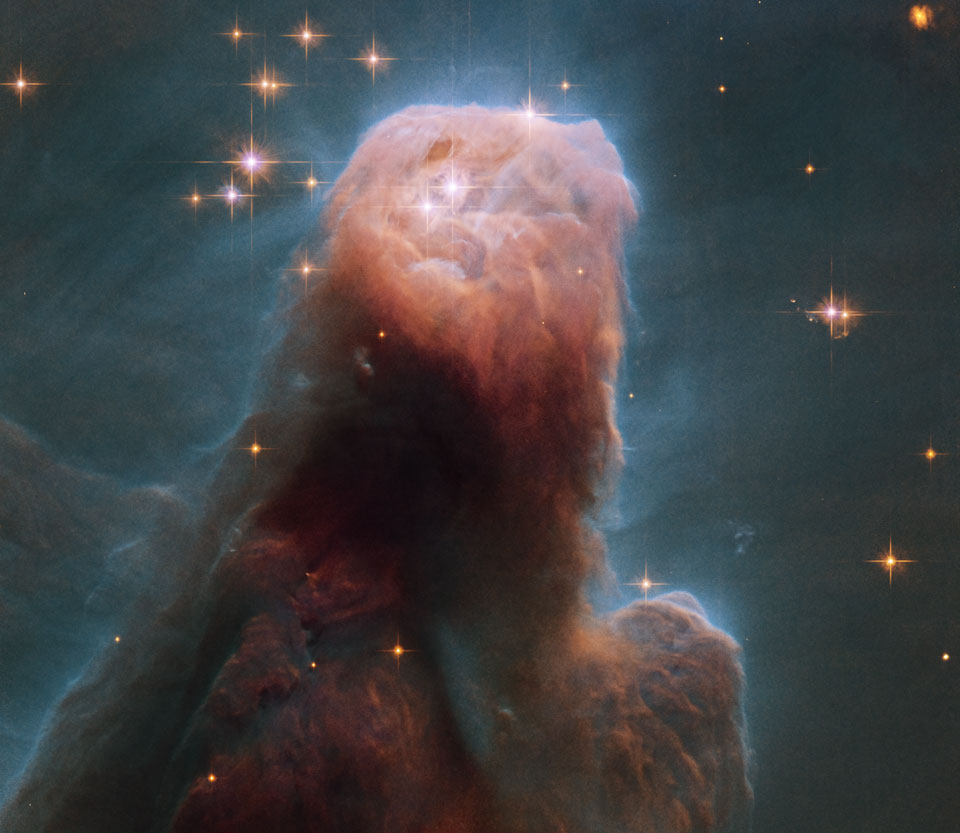
        Stars are forming in the gigantic dust pillar called the Cone Nebula. Cones, pillars, and majestic flowing shapes abound in stellar nurseries where natal clouds of gas and dust are buffeted by energetic winds from newborn stars. The Cone Nebula, a well-known example, lies within the bright galactic star-forming region NGC 2264. The Cone was captured in unprecedented detail in this close-up composite of several observations from the Earth-orbiting Hubble Space Telescope. While the Cone Nebula, about 2,500 light-years away in Monoceros, is around 7 light-years long, the region pictured here surrounding the cone's blunted head is a mere 2.5 light-years across. In our neck of the galaxy that distance is just over half way from the Sun to its nearest stellar neighbor, the Alpha Centauri star system. The massive star NGC 2264 IRS, seen by Hubble's infrared camera in 1997, is the likely source of the wind sculpting the Cone Nebula and lies off the top of the image. The Cone Nebula's reddish veil is produced by glowing hydrogen gas.
        1st in Kommisar's 2009 SM Tournament
        1st in I Love You`s 2009 New Year`s Tournament
        3rd in EnR's Mashfest '08 tournament
        5th in Phynx's Unofficial FFR Tournament
        9th in D3 of the 2008-2009 4th Official FFR Tournament
        10th in D5 of the 2010 5th Official FFR Tournament
        10th in D6 of the 2011-2012 6th Official FFR Tournament

        FMO AAA Count: 71
        FGO AAA Count: 10

        Bluearrowll = The Canadian player who can not detect awkward patterns. If it's awkward for most people, it's normal for Terry. If the file is difficult but super straight forward, he has issues. If he's AAAing a FGO but then heard that his favorite Hockey team was losing by a point, Hockey > FFR
        PS: Cool AAA's Terry
        - I Love You


        An Alarm Clock's Haiku
        beep beep beep beep beep
        beep beep beep beep beep beep beep
        beep beep beep beep beep
        - ieatyourlvllol

        Comment

        • Reincarnate
          x'); DROP TABLE FFR;--
          • Nov 2010
          • 6332

          #949
          Re: Terry's Astronomy Thread.

          reminds me of pillars of creation or w/e

          Comment

          • Bluearrowll
            ⊙▃⊙
            FFR Simfile Author
            • Nov 2007
            • 7376

            #950
            Re: Terry's Astronomy Thread.

            Daily Suspicious0bserver's Weather Post:
            May 29, 2014


            What's in the sky tonight?
            May 29, 2014
            -As twilight turns to darkness, Mars shines brightly fire-colored in the south. Look below it for the four-star pattern of Corvus, the Crow.

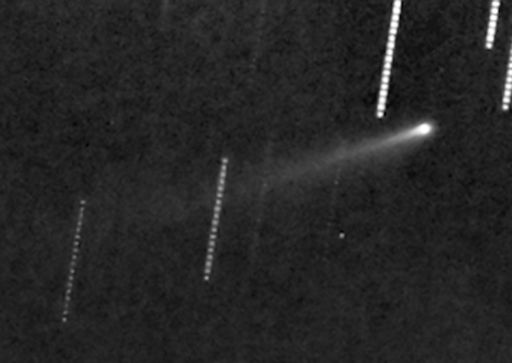
            -Today, Comet 209P/LINEAR is passing remarkably close to Earth. At a distance of only 5 million miles (0.0554 AU), it is making the 9th closest comet flyby in recorded history. Such an encounter should be good news for sky watchers. Just one problem: the comet is not only remarkably close, but also remarkably dim. Observing from Australia, Nirmal Paul needed a half-meter telescope to take this picture of the comet approaching on May 28th.

            Despite its proximity to Earth, the comet is shining like a 10th or 11th magnitude star--that is, about 100 times too dim to see with the unaided eye. The comet is not very active and it currently produces very little dust. This will come as no surprise to anyone who watched the May Camelopardalid meteor shower on May 24th. Caused by dust from Comet 209P/LINEAR, the shower was a visual dud.


            News Posted Today:
            May 28, 2014
            New, Intriguing Double Martian Crater


            Astro Picture of the Day:
            May 29, 2014

            Source:
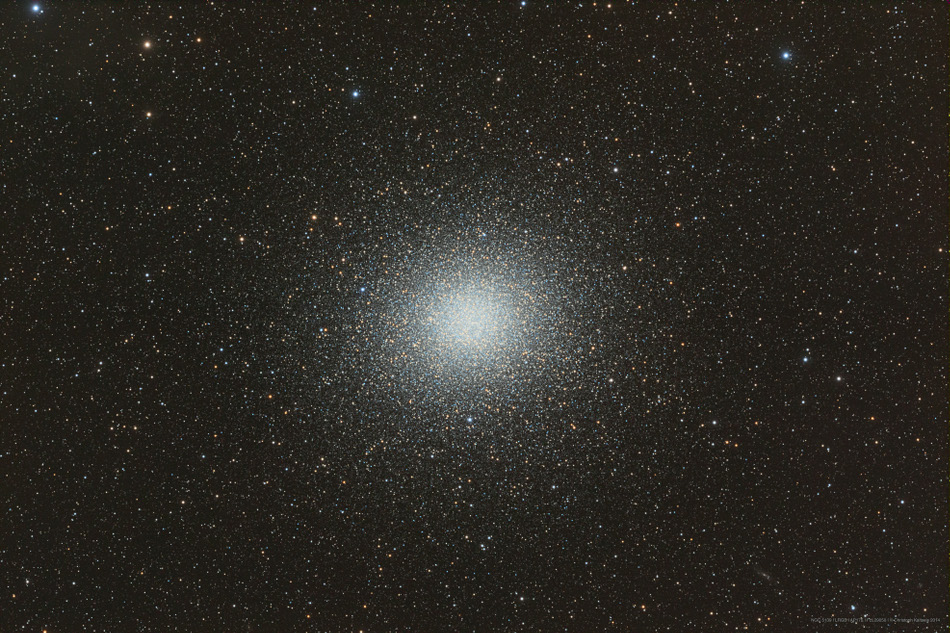
            Globular star cluster Omega Centauri, also known as NGC 5139, is some 15,000 light-years away. The cluster is packed with about 10 million stars much older than the Sun within a volume about 150 light-years in diameter, the largest and brightest of 200 or so known globular clusters that roam the halo of our Milky Way galaxy. Though most star clusters consist of stars with the same age and composition, the enigmatic Omega Cen exhibits the presence of different stellar populations with a spread of ages and chemical abundances. In fact, Omega Cen may be the remnant core of a small galaxy merging with the Milky Way. This astronomically sharp color image of the classic globular cluster was recorded in March under Chilean skies from Hacienda Los Andes.
            1st in Kommisar's 2009 SM Tournament
            1st in I Love You`s 2009 New Year`s Tournament
            3rd in EnR's Mashfest '08 tournament
            5th in Phynx's Unofficial FFR Tournament
            9th in D3 of the 2008-2009 4th Official FFR Tournament
            10th in D5 of the 2010 5th Official FFR Tournament
            10th in D6 of the 2011-2012 6th Official FFR Tournament

            FMO AAA Count: 71
            FGO AAA Count: 10

            Bluearrowll = The Canadian player who can not detect awkward patterns. If it's awkward for most people, it's normal for Terry. If the file is difficult but super straight forward, he has issues. If he's AAAing a FGO but then heard that his favorite Hockey team was losing by a point, Hockey > FFR
            PS: Cool AAA's Terry
            - I Love You


            An Alarm Clock's Haiku
            beep beep beep beep beep
            beep beep beep beep beep beep beep
            beep beep beep beep beep
            - ieatyourlvllol

            Comment

            • Bluearrowll
              ⊙▃⊙
              FFR Simfile Author
              • Nov 2007
              • 7376

              #951
              Re: Terry's Astronomy Thread.

              Starting at 6:00pm, I will not be in the city, with no access to internet until Sunday night. Making a trip approximately 120km north to plant a food forest and learn of optimal plants to grow off each other for my own garden at home.

              Daily Suspicious0bserver's Weather Post:
              May 30, 2014


              What's in the sky tonight?
              May 30, 2014
              -When the sun goes down tonight, step outside and look west. A beautifully-slender crescent Moon is shining through the twilight not far below the planet Jupiter. It's a nice way to end the day.
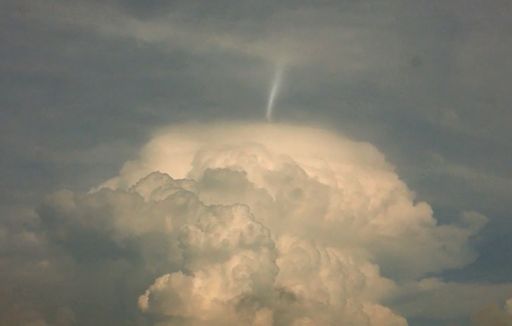
              -For years, researchers have been studying red sprites and blue jets--strange forms of lightning that come out of the tops of clouds. On May 27th, a new form appeared. Pilot Cherdphong Visarathanonth was in the cockpit of an A320 at the airport in Bangkok, Thailand, when he saw a white tornado-like beam dancing atop this cumulonimbus cloud. "We could see the same phenomenon through both windshields even after the aircraft has pushing back in a different direction," says Visarathanonth. "I made a 4 minute video in which we can see the phenomenon quickly moving and disappearing from time to time."

              Brian Whittaker, another pilot with extensive sky watching experience, says, "I have seen Blue Jets and Sprites, but this is something totally different. Good luck figuring out what it is." The video is found below.

              One possible scenario could be found in this APOD link: http://apod.nasa.gov/apod/ap111108.html

              The description is as follows: What's happening above those clouds? In the past few years, videos have appeared on the web detailing an unusual but little known phenomenon: rapid light changes over clouds. Upon inspection and contemplation, a leading hypothesis for its cause has now emerged. In sum, this hypothesis holds that a lightning discharge in a thundercloud can temporarily change the electric field above the cloud where charged ice crystals were reflecting sunlight. The new electric field quickly re-orients the geometric crystals to a new orientation that reflects sunlight differently. In other words, a lightning discharge can cause a sundog to jump. Soon, the old electric field may be restored, causing the ice crystals to return to their original orientation. To help this curious phenomenon become better studied, sky enthusiasts with similar jumping or dancing sundog videos are encouraged to share them.


              Astro Picture of the Day:
              May 30, 2014

              Source:
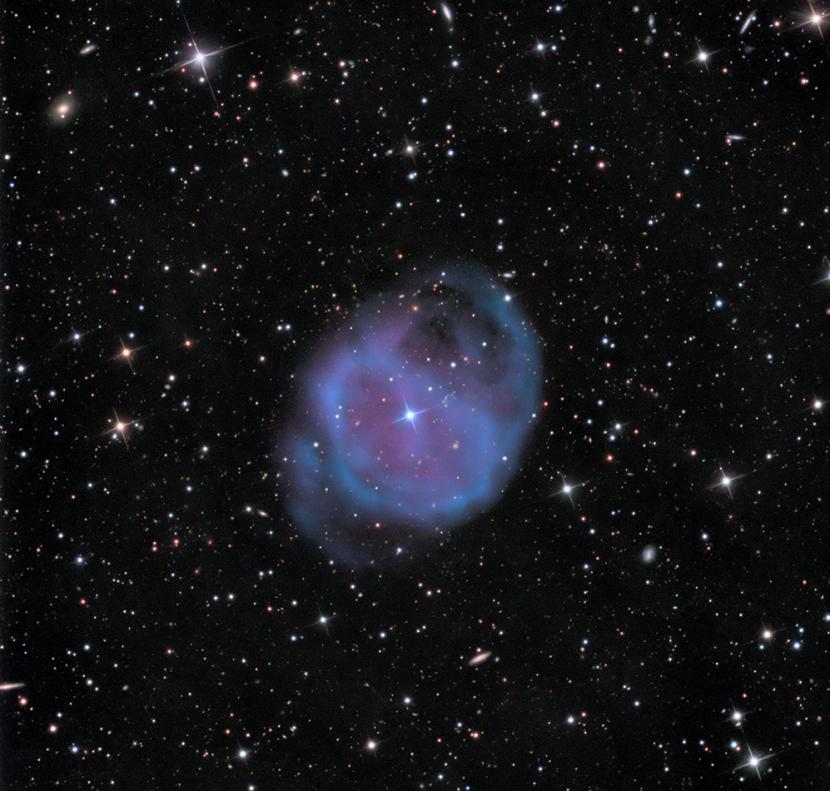
              The gorgeous, gaseous shroud of a dying sunlike star, planetary nebula Abell 36 lies a mere 800 light-years away in the constellation of Virgo. At that distance it spans over 1.5 light-years in this sharp telescopic view. Shrugging off its outer layers, the nebula's central star is contracting and becoming hotter, evolving towards a final white dwarf phase. In fact, in Abell 36, the central star is estimated to have a surface temperature of over 73,000 K, compared to the Sun's present 6,000 K temperature. As a result, the intensely hot star is much brighter in ultraviolet light, compared to its visual appearance here. The invisible ultraviolet light ionizes hydrogen and oxygen atoms in the nebula and ultimately powers the beautiful visible light glow.
              1st in Kommisar's 2009 SM Tournament
              1st in I Love You`s 2009 New Year`s Tournament
              3rd in EnR's Mashfest '08 tournament
              5th in Phynx's Unofficial FFR Tournament
              9th in D3 of the 2008-2009 4th Official FFR Tournament
              10th in D5 of the 2010 5th Official FFR Tournament
              10th in D6 of the 2011-2012 6th Official FFR Tournament

              FMO AAA Count: 71
              FGO AAA Count: 10

              Bluearrowll = The Canadian player who can not detect awkward patterns. If it's awkward for most people, it's normal for Terry. If the file is difficult but super straight forward, he has issues. If he's AAAing a FGO but then heard that his favorite Hockey team was losing by a point, Hockey > FFR
              PS: Cool AAA's Terry
              - I Love You


              An Alarm Clock's Haiku
              beep beep beep beep beep
              beep beep beep beep beep beep beep
              beep beep beep beep beep
              - ieatyourlvllol

              Comment

              • Bluearrowll
                ⊙▃⊙
                FFR Simfile Author
                • Nov 2007
                • 7376

                #952
                Re: Terry's Astronomy Thread.

                Daily Suspicious0bserver's Weather Post:
                June 3, 2014


                What's in the sky tonight?
                June 3, 2014
                -Look above the Moon early this evening for Regulus and Gamma (γ) Leonis, slightly fainter. They're the two brightest stars of the Sickle of Leo.

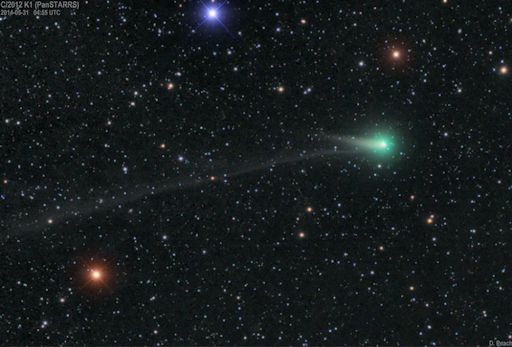
                -On August 27, 2014, Comet C/2012 K1 PanSTARRS will buzz Earth's orbit only 0.05 AU away. Unfortunately for sky watchers, Earth won't be there. Our planet will be on the other side of the sun during PanSTARRS's close approach. A better time to photograph the comet is now. UK astronomer Damian Peach took this picture from his backyard observatory in Selsey, West Sussex, on May 31st. His picture highlights the comet's vivid green atmosphere or "coma". The verdant hue is a sign of diatomic carbon and cyanogen, two gases that grow green when illuminated by sunligght in the near-vacuum of space.
                "The comet's long ion tail is still rather faint," notes Peach. To pull it out of the starry background required a 30 minute exposure with his 4-inch telecope.

                PanSTARRS K1 is currently moving through Ursa Major, shining about as brightly as an 8th magnitude star. This makes it an easy target for mid-sized backyard telescopes, albeit invisible to the naked eye. Amateur astronomers who wish to image the comet can find orbital elements and an ephemeris here.

                If Earth and the comet were on the same side of the sun in August, the view would be spectacular. Disappointment will be mitigated, only a little, by images from the Solar and Heliospheric Observatory. SOHO's C3 coronagraph will track the comet as it passes behind the sun (from our point of view) from August 2nd until August 16th.


                Astro Picture of the Day:
                June 3, 2014

                Source:
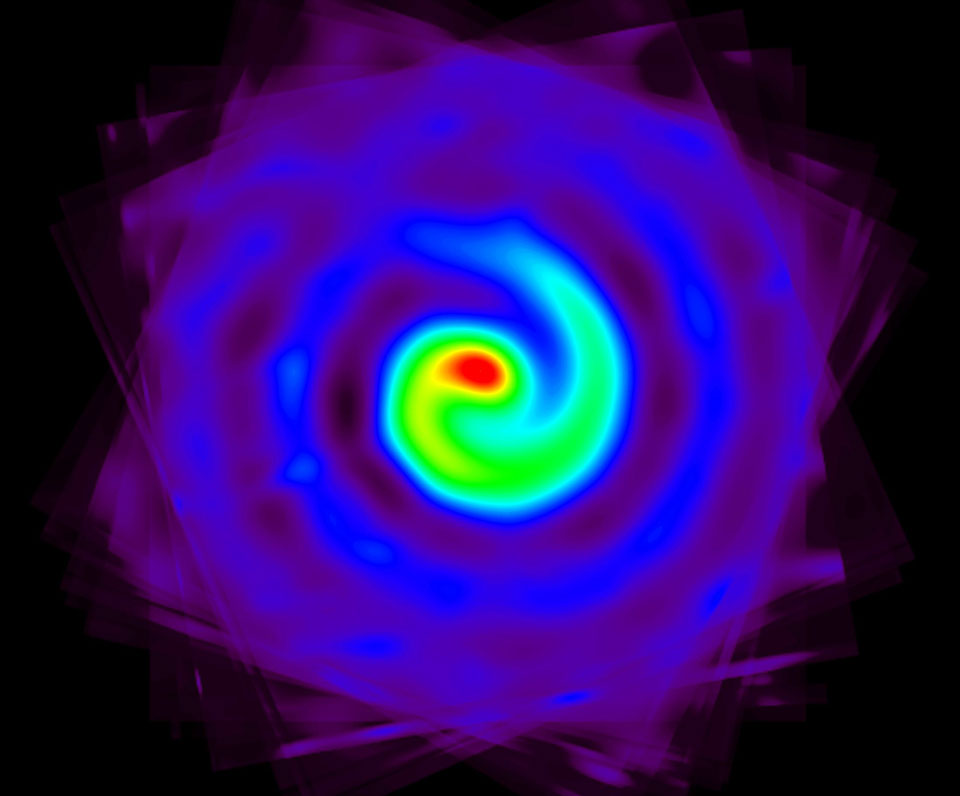
                Might this giant pinwheel one-day destroy us? Probably not, but investigation of the unusual star system Wolf-Rayet 104 has turned up an unexpected threat. The unusual pinwheel pattern has been found to be created by energetic winds of gas and dust that are expelled and intertwine as two massive stars orbit each other. One system component is a Wolf-Rayet star, a tumultuous orb in the last stage of evolution before it explodes in a supernova -- and event possible anytime in the next million years. Research into the spiral pattern of the emitted dust, however, indicates the we are looking nearly straight down the spin axis of the system -- possibly the same axis along which a powerful jet would emerge were the supernova accompanied by a gamma-ray burst. Now the WR 104 supernova itself will likely be an impressive but harmless spectacle. Conversely, were Earth really near the center of the powerful GRB beam, even the explosion's 8,000 light year distance might not be far enough to protect us. Currently, neither WR 104 nor GRB beams are understood well enough to know the real level of danger.
                1st in Kommisar's 2009 SM Tournament
                1st in I Love You`s 2009 New Year`s Tournament
                3rd in EnR's Mashfest '08 tournament
                5th in Phynx's Unofficial FFR Tournament
                9th in D3 of the 2008-2009 4th Official FFR Tournament
                10th in D5 of the 2010 5th Official FFR Tournament
                10th in D6 of the 2011-2012 6th Official FFR Tournament

                FMO AAA Count: 71
                FGO AAA Count: 10

                Bluearrowll = The Canadian player who can not detect awkward patterns. If it's awkward for most people, it's normal for Terry. If the file is difficult but super straight forward, he has issues. If he's AAAing a FGO but then heard that his favorite Hockey team was losing by a point, Hockey > FFR
                PS: Cool AAA's Terry
                - I Love You


                An Alarm Clock's Haiku
                beep beep beep beep beep
                beep beep beep beep beep beep beep
                beep beep beep beep beep
                - ieatyourlvllol

                Comment

                • macchabee
                  FFR Player
                  • Mar 2014
                  • 28

                  #953
                  Re: Terry's Astronomy Thread.

                  Incredible thread, I'm very grateful! Excellent findings.

                  Comment

                  • Bluearrowll
                    ⊙▃⊙
                    FFR Simfile Author
                    • Nov 2007
                    • 7376

                    #954
                    Re: Terry's Astronomy Thread.

                    Thanks for the compliment macchabee!

                    I'm not sure why but twice this week my posts haven't registered on this forum and I haven't noticed until after I left for work. Let's try this again..

                    Daily Suspicious0bserver's Weather Post:
                    May 31, 2014


                    What's in the sky tonight?
                    May 31, 2014
                    -The Moon, Jupiter, and Pollux above them form a nearly straight line in twilight as seen from North America, as shown here.

                    -The crescent Moon and Jupiter are converging for a sunset sky show. When the sun goes down tonight, step outside and look for them beaming through the western twilight. The two bright bodies are less than 10o apart--very pretty.


                    Astro Picture of the Day:
                    May 31, 2014

                    Source:
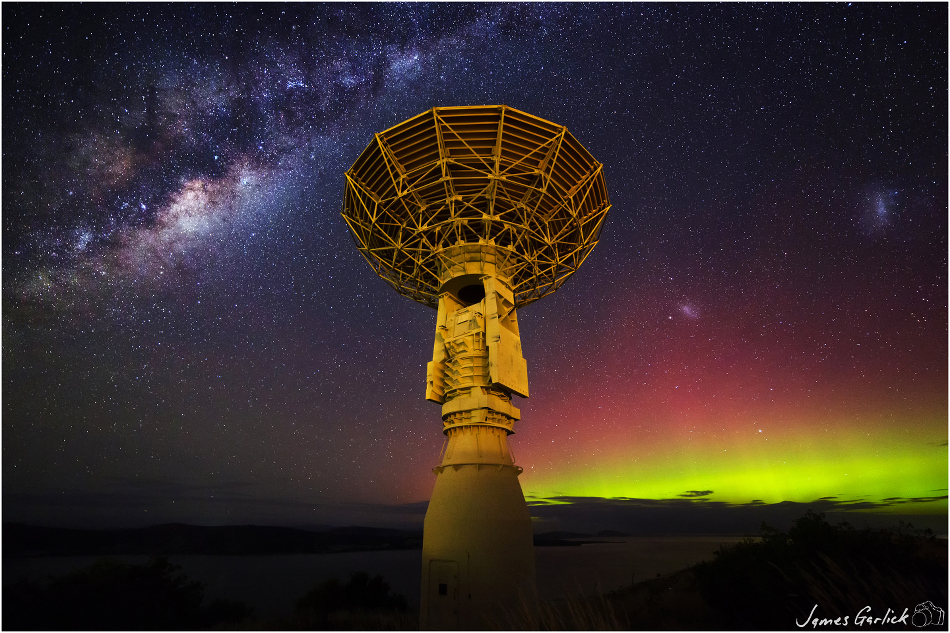
                    This clear night skyscape captures the colorful glow of aurora australis, the southern lights, just outside the port city of Hobart, Tasmania, Australia, planet Earth. As if staring into the dreamlike scene, the Tasmanian Earth Resources Satellite Station poses in the center, illuminated by nearby city lights. Used to receive data from spacebased Earth observing instruments, including NASA's MODIS and SeaWiFS, the station was decommissioned in 2011 and dismantled only recently, shortly after the picture was taken on April 30. Still shining in southern skies though, the central bulge of our Milky Way galaxy and two bright satellite galaxies the Large and Small Magellanic Clouds appear in the frame. The Small Magellanic Cloud shines through the fainter red auroral band.


                    Daily Suspicious0bserver's Weather Post:
                    June 1, 2014


                    What's in the sky tonight?
                    June 1, 2014
                    -At nightfall, Mars shines yellow-orange in the south. Look 4° (two or three finger-widths at arm's length) above it for 3rd-magnitude Porrima (Gamma Virginis). This is a famous, fast-changing close double star for telescopes. This year its two components, equal in brightness, are 2.2 arcseconds apart. A decade ago they were unresolvable.

                    -For the third night in a row, there's something extra in the sunset: Jupiter and the crescent Moon. Separated by less than 10o, the two bright bodies pop out of the twilight as soon as the sun goes down. Take a look!

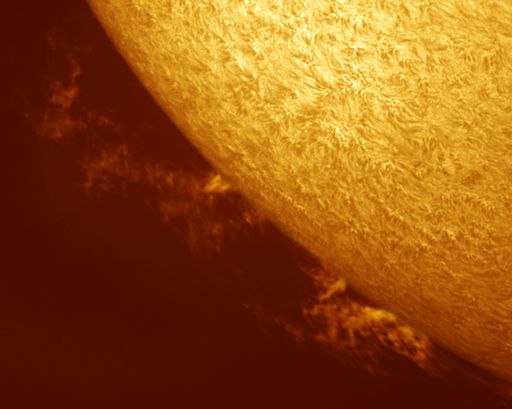
                    -With no sunspots actively flaring, the face of the sun is quiet. The edge of the sun is another matter. Amateur astronomers around the world are monitoring a bushy filament of plasma seething over the sun's southeastern limb. Sergio Castillo sends this picture from his backyard observatory in Inglewood, California. "This gigantic prominence spreading its plasma material and gases on the limb makes an excellent target for imaging," says Castillo.

                    The hot gas in this prominence is held aloft by solar magnetic fields. If those fields become unstable the structure could collapse, causing an explosion when it hits the stellar surface below. This kind of explosion, which occurs without the aid of a sunspot, is called a "Hyder flare."


                    Astro Picture of the Day:
                    June 1, 2014

                    Source:
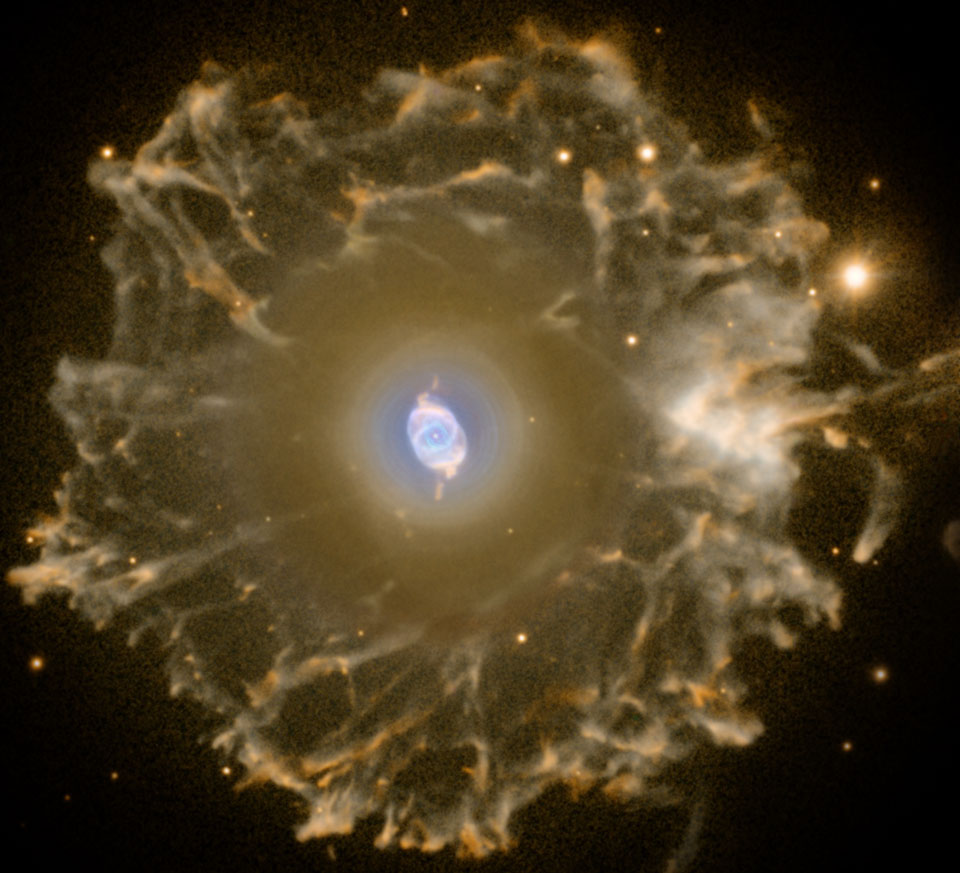
                    The Cat's Eye Nebula (NGC 6543) is one of the best known planetary nebulae in the sky. Its haunting symmetries are seen in the very central region of this stunning false-color picture, processed to reveal the enormous but extremely faint halo of gaseous material, over three light-years across, which surrounds the brighter, familiar planetary nebula. Made with data from the Nordic Optical Telescope in the Canary Islands, the composite picture shows extended emission from the nebula. Planetary nebulae have long been appreciated as a final phase in the life of a sun-like star. Only much more recently however, have some planetaries been found to have halos like this one, likely formed of material shrugged off during earlier active episodes in the star's evolution. While the planetary nebula phase is thought to last for around 10,000 years, astronomers estimate the age of the outer filamentary portions of this halo to be 50,000 to 90,000 years.


                    Daily Suspicious0bserver's Weather Post:
                    June 2, 2014


                    What's in the sky tonight?
                    June 2, 2014
                    -With summer not far off, can you still catch Procyon low in the twilight? It's lower left of Jupiter and, this evening, below or perhaps lower right of the Moon (depending on your latitude). How much later into the season can you follow it? The first day that a star becomes completely invisible in the afterglow of sunset is called its heliacal setting.

                    -On August 27, 2014, Comet C/2012 K1 PanSTARRS will buzz Earth's orbit only 0.05 AU away. Unfortunately for sky watchers, Earth won't be there. Our planet will be on the other side of the sun during PanSTARRS's close approach. A better time to photograph the comet is now. UK astronomer Damian Peach took this picture from his backyard observatory in Selsey, West Sussex, on May 31st. His picture highlights the comet's vivid green atmosphere or "coma". The verdant hue is a sign of diatomic carbon and cyanogen, two gases that grow green when illuminated by sunligght in the near-vacuum of space.

                    "The comet's long ion tail is still rather faint," notes Peach. To pull it out of the starry background required a 30 minute exposure with his 4-inch telecope.

                    PanSTARRS K1 is currently moving through Ursa Major, shining about as brightly as an 8th magnitude star. This makes it an easy target for mid-sized backyard telescopes, albeit invisible to the naked eye. Amateur astronomers who wish to image the comet can find orbital elements and an ephemeris here.

                    If Earth and the comet were on the same side of the sun in August, the view would be spectacular. Disappointment will be mitigated, only a little, by images from the Solar and Heliospheric Observatory. SOHO's C3 coronagraph will track the comet as it passes behind the sun (from our point of view) from August 2nd until August 16th.


                    Astro Picture of the Day:
                    June 2, 2014

                    Source:
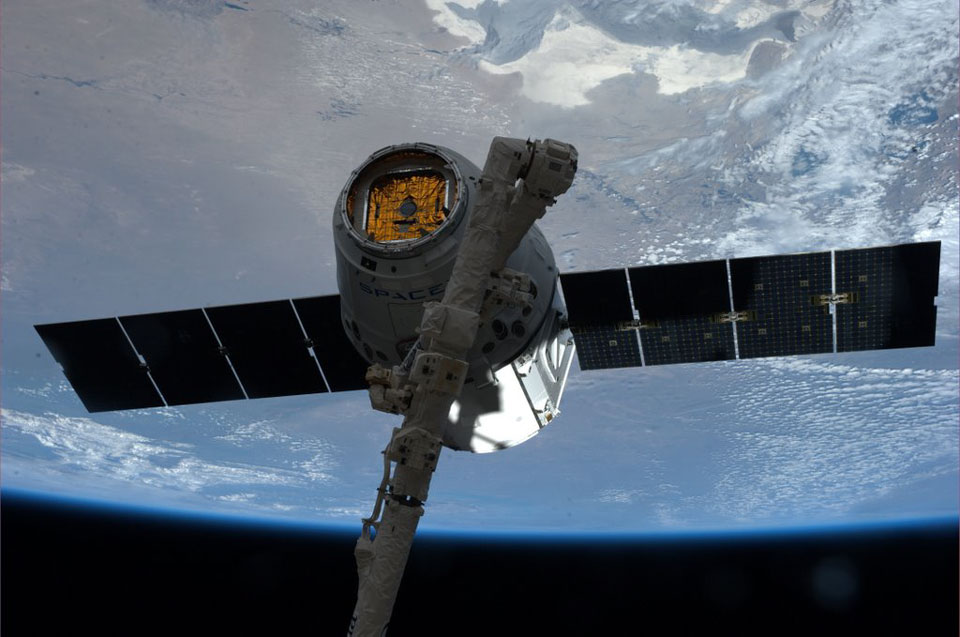
                    The space station has caught a dragon. Specifically, in mid-April, the International Space Station captured the unmanned SpaceX Dragon capsule sent to resupply the orbiting outpost. Pictured above, the station's Canadarm2 had just grabbed the commercial spaceship. The Dragon capsule was filled with over 5000 lbs (2260 kilos) of supplies and experiments to be used by the current band of six ISS astronauts who compose Expedition 39, as well as the six astronauts who compose Expedition 40. After docking with the ISS, the Dragon capsule was unloaded and eventually released, splashing down in the Pacific Ocean on May 18. The current Expedition 40 crew, now complete, will apply themselves to many tasks including the deployment of the Napor-mini RSA experiment which will use phased array radar and a small optical telescope to monitor possible emergency situations on the Earth below.

                    Daily Suspicious0bserver's Weather Post:
                    June 4, 2014


                    What's in the sky tonight?
                    June 4, 2014
                    -As the stars come out, Regulus and the Sickle of Leo are now upper right of the Moon.

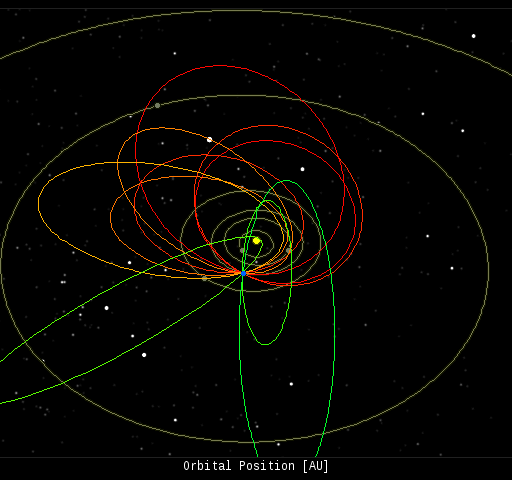
                    -Every night, a network of NASA all-sky cameras scans the skies above the United States for meteoritic fireballs. Automated software maintained by NASA's Meteoroid Environment Office calculates their orbits, velocity, penetration depth in Earth's atmosphere and many other characteristics. On Jun. 3, 2014, the network reported 33 fireballs. (33 sporadics)


                    Astro Picture of the Day:
                    June 4, 2014

                    Source:
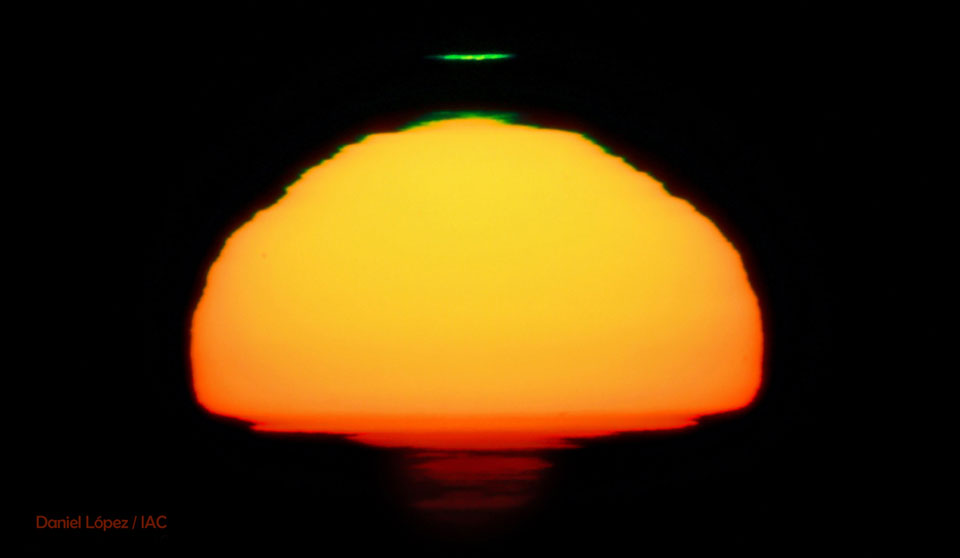
                    Many think it is just a myth. Others think it is true but its cause isn't known. Adventurers pride themselves on having seen it. It's a green flash from the Sun. The truth is the green flash does exist and its cause is well understood. Just as the setting Sun disappears completely from view, a last glimmer appears startlingly green. The effect is typically visible only from locations with a low, distant horizon, and lasts just a few seconds. A green flash is also visible for a rising Sun, but takes better timing to spot. A dramatic green flash, as well as an even more rare red flash, was caught in the above photograph recently observed during a sunset visible from the Observatorio del Roque de Los Muchachos in the Canary Islands, Spain. The Sun itself does not turn partly green or red -- the effect is caused by layers of the Earth's atmosphere acting like a prism.


                    Daily Suspicious0bserver's Weather Post:
                    June 5, 2014


                    What's in the sky tonight?
                    June 5, 2014
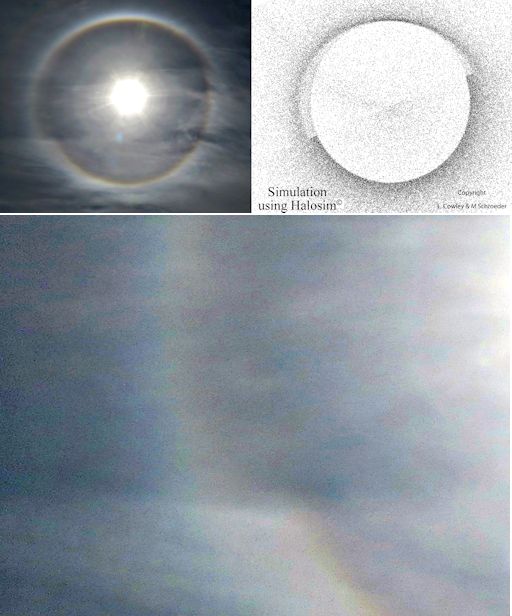
                    -It is well known that ice crystals in high clouds can catch the light of the sun, bending its rays to produce beautiful circular halos in the sky. Last month, Alan Clark of Calgary, Alberta, saw such a halo, but it was strangely broken. "I saw this unusual halo on May 17th," says Clark. "It appears that a sharp transition between clouds of significantly different ice crystal types crossed in front of the Sun, [producing jagged edges around the circle]."

                    To investigate this possibility, Clark simulated the display using the HaloSim program written by atmospheric optics experts Les Cowley and Michael Shroeder. The results are shown in the upper right, above. "I used different crystal types in the upper and lower parts of this halo," explains Clark. "In the simulation, one cloud consisted of 30% of horizontal hexagonal columnar crystals and 70% hexagonal flat-plate crystals with a wide dispersion of angles of their faces to the horizontal. The other cloud contained hexagonal columnar crystals with their axes distributed randomly."

                    The computer-generated halo was a good match to what Clark saw. "I agree entirely with Alan's interpretation," notes Les Cowley. "It is a very unusual observation indeed. The upper halo is a fragment of a circumscribed halo generated by the horizontal column crystals. The lower halo is a fragment of the familiar 22-degree halo from randomly oriented crystals."


                    Astro Picture of the Day:
                    June 5, 2014

                    Source:
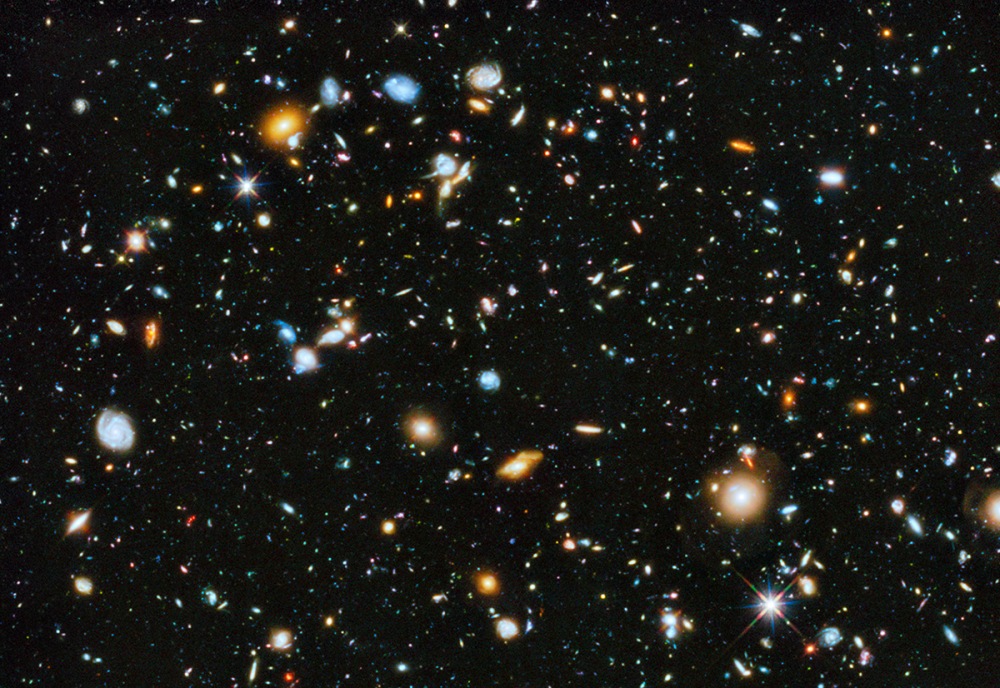
                    Galaxies like colorful pieces of candy fill the Hubble Ultra Deep Field 2014. The dimmest galaxies are more than 10 billion times fainter than stars visible to the unaided eye and represent the Universe in the extreme past, a few 100 million years after the Big Bang. The image itself was made with the significant addition of ultraviolet data to the Hubble Ultra Deep Field, an update of Hubble's famous most distant gaze toward the southern constellation of Fornax. It now covers the entire range of wavelengths available to Hubble's cameras, from ultraviolet through visible to near-infrared. Ultraviolet data adds the crucial capability of studying star formation in the Hubble Ultra Deep Field galaxies between 5 and 10 billion light-years distant.
                    1st in Kommisar's 2009 SM Tournament
                    1st in I Love You`s 2009 New Year`s Tournament
                    3rd in EnR's Mashfest '08 tournament
                    5th in Phynx's Unofficial FFR Tournament
                    9th in D3 of the 2008-2009 4th Official FFR Tournament
                    10th in D5 of the 2010 5th Official FFR Tournament
                    10th in D6 of the 2011-2012 6th Official FFR Tournament

                    FMO AAA Count: 71
                    FGO AAA Count: 10

                    Bluearrowll = The Canadian player who can not detect awkward patterns. If it's awkward for most people, it's normal for Terry. If the file is difficult but super straight forward, he has issues. If he's AAAing a FGO but then heard that his favorite Hockey team was losing by a point, Hockey > FFR
                    PS: Cool AAA's Terry
                    - I Love You


                    An Alarm Clock's Haiku
                    beep beep beep beep beep
                    beep beep beep beep beep beep beep
                    beep beep beep beep beep
                    - ieatyourlvllol

                    Comment

                    • Bluearrowll
                      ⊙▃⊙
                      FFR Simfile Author
                      • Nov 2007
                      • 7376

                      #955
                      Re: Terry's Astronomy Thread.

                      Daily Suspicious0bserver's Weather Post:
                      June 6, 2014


                      What's in the sky tonight?
                      June 6, 2014
                      -Look left of the Moon this evening for Mars, then Spica. With June under way, the Big Dipper is swinging around after dark to hang down by its handle high in the northwest. The middle star of its handle is Mizar, with tiny little Alcor right next to it. On which side of Mizar should you look for Alcor? As always, on the side toward Vega! Which is now shining in the east-northeast.

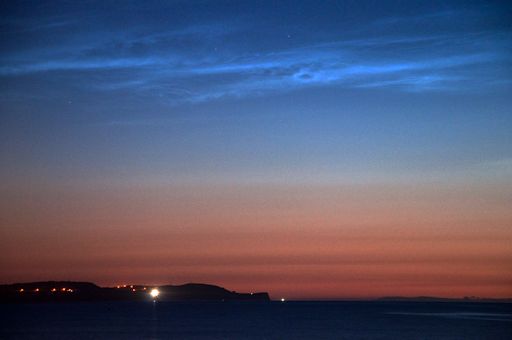
                      -NASA's AIM spacecraft saw the first wispy noctilucent clouds (NLCs) of the 2014 summer season on May 24th. Since then NLCs have begun to intensify around the Arctic Circle and descend to lower latitudes. This morning, June 6th, Noel Blaney spotted a bank of the electric-blue clouds over Bangor, Northern Ireland.

                      "I witnessed this nice early-season noctilucent cloud display over Belfast Lough at 2am," says Blaney. "These are my first proper images of NLCs!"

                      A few hours later, Lance Taylor saw more NLCs over Edmonton, Alberta. "This was my first sighting of the season - and I have been watching for them for the past two weeks now," he says.

                      Seeded by meteor smoke and boosted by the climate-change gas methane, noctilucent clouds have been spreading beyond the Arctic. In recent years, they have been sighted as far south as Colorado and Utah. Observing tips: Look west 30 to 60 minutes after sunset when the Sun has dipped 6o to 16o below the horizon. If you see luminous blue-white tendrils spreading across the sky, you may have spotted a noctilucent cloud.


                      Astro Picture of the Day:
                      June 6, 2014

                      Source:
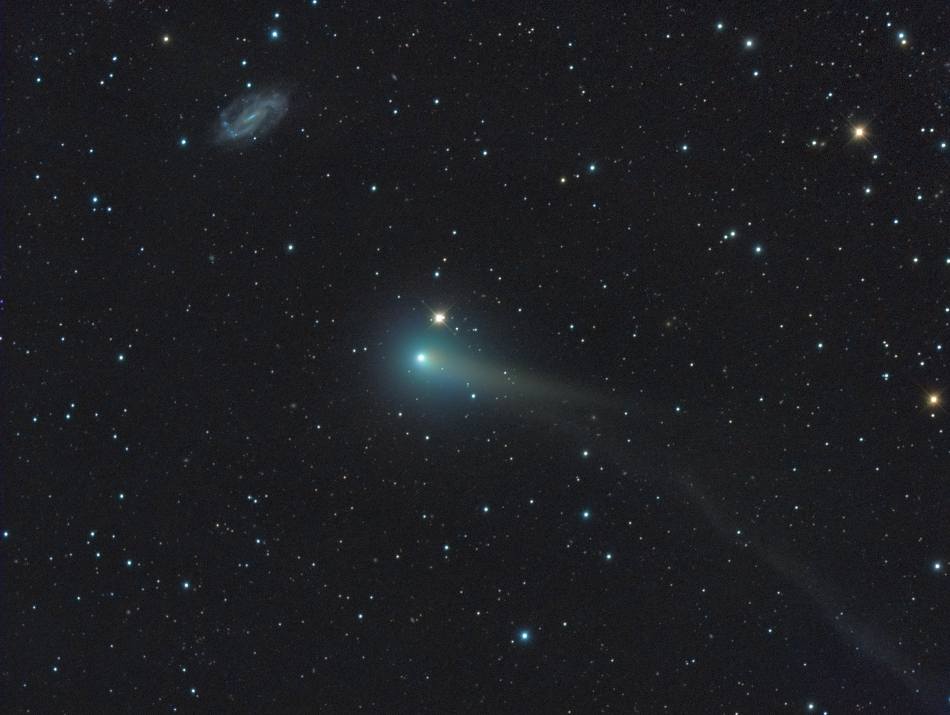
                      Sweeping slowly through northern skies, the comet PanSTARRS C/2012 K1 posed for this telescopic portrait on June 2nd in the constellation Ursa Major. Now in the inner solar system, the icy body from the Oort cloud sports two tails, a lighter broad dust tail and crooked ion tail extending below and right. The comet's condensed greenish coma makes a nice contrast with the spiky yellowish background star above. NGC 3319 appears at the upper left of the frame that spans almost twice the apparent diameter of the full Moon. The spiral galaxy is about 47 million light-years away, far beyond the stars in our own Milky Way. In comparison, the comet was a mere 14 light-minutes from our fair planet. This comet PanSTARRS will slowly grow brighter in the coming months remaining a good target for telescopic comet watchers and reaching perihelion, its closest approach to the Sun, while just beyond Earth's orbit in late August.
                      1st in Kommisar's 2009 SM Tournament
                      1st in I Love You`s 2009 New Year`s Tournament
                      3rd in EnR's Mashfest '08 tournament
                      5th in Phynx's Unofficial FFR Tournament
                      9th in D3 of the 2008-2009 4th Official FFR Tournament
                      10th in D5 of the 2010 5th Official FFR Tournament
                      10th in D6 of the 2011-2012 6th Official FFR Tournament

                      FMO AAA Count: 71
                      FGO AAA Count: 10

                      Bluearrowll = The Canadian player who can not detect awkward patterns. If it's awkward for most people, it's normal for Terry. If the file is difficult but super straight forward, he has issues. If he's AAAing a FGO but then heard that his favorite Hockey team was losing by a point, Hockey > FFR
                      PS: Cool AAA's Terry
                      - I Love You


                      An Alarm Clock's Haiku
                      beep beep beep beep beep
                      beep beep beep beep beep beep beep
                      beep beep beep beep beep
                      - ieatyourlvllol

                      Comment

                      • Bluearrowll
                        ⊙▃⊙
                        FFR Simfile Author
                        • Nov 2007
                        • 7376

                        #956
                        Re: Terry's Astronomy Thread.

                        Daily Suspicious0bserver's Weather Post:
                        June 7, 2014


                        What's in the sky tonight?
                        June 7, 2014
                        -The waxing gibbous Moon shines near Mars this evening. Look just above Mars for fainter Gamma (γ) Virginis (Porrima). Spica shines farther to their their left.

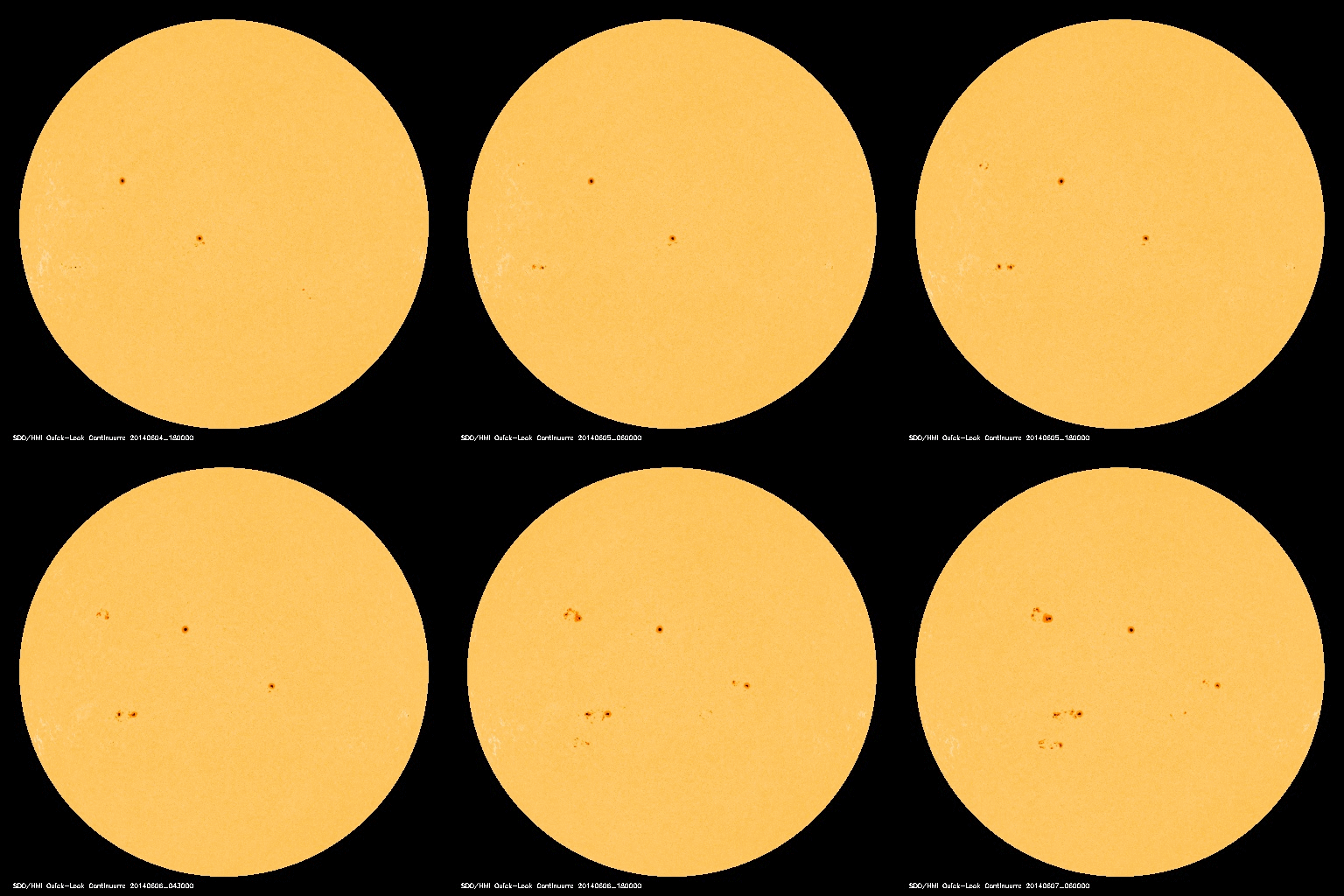
                        -NOAA forecasters have boosted the odds of an M-class flare on June 7th to 35%. To see why, pay close attention to the image below.

                        During the past 48 hours, three large sunspot groups have materialized. Nearly invisible on June 5th, now the active regions are peppered with dark cores larger than Earth. All three regions have unstable magnetic fields that pose a threat for significant eruptions.

                        The greatest threat comes from sunspot AR2080. Its 'beta-gamma-delta' magnetic field harbors energy not only for medium M-class flares, but also for powerful X-flares. Because AR2080 is centrally located on the solar disk, any flares this weekend will likely be Earth-directed.


                        Astro Picture of the Day:
                        June 7, 2014

                        Source:
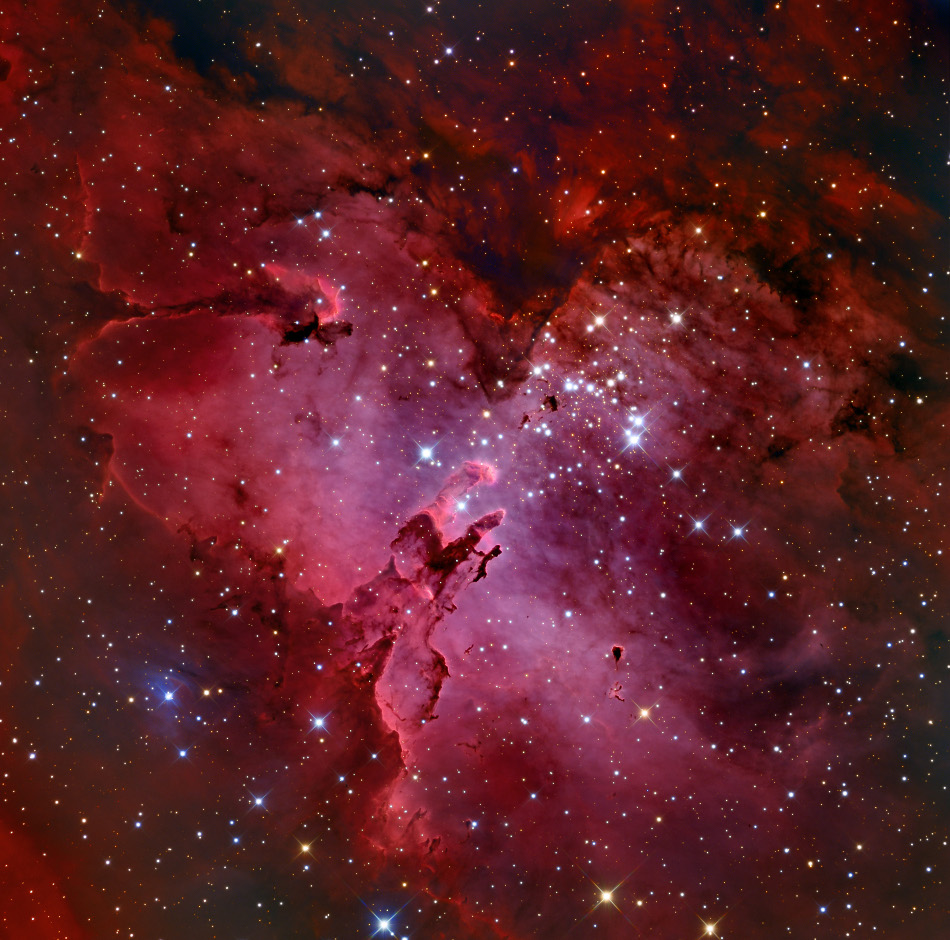
                        A star cluster around 2 million years young, M16 is surrounded by natal clouds of dust and glowing gas also known as The Eagle Nebula. This beautifully detailed image of the region includes cosmic sculptures made famous in Hubble Space Telescope close-ups of the starforming complex. Described as elephant trunks or Pillars of Creation, dense, dusty columns rising near the center are light-years in length but are gravitationally contracting to form stars. Energetic radiation from the cluster stars erodes material near the tips, eventually exposing the embedded new stars. Extending from the left edge of the frame is another dusty starforming column known as the Fairy of Eagle Nebula. M16 and the Eagle Nebula lie about 7,000 light-years away, an easy target for binoculars or small telescopes in a nebula rich part of the sky toward the split constellation Serpens Cauda (the tail of the snake).
                        1st in Kommisar's 2009 SM Tournament
                        1st in I Love You`s 2009 New Year`s Tournament
                        3rd in EnR's Mashfest '08 tournament
                        5th in Phynx's Unofficial FFR Tournament
                        9th in D3 of the 2008-2009 4th Official FFR Tournament
                        10th in D5 of the 2010 5th Official FFR Tournament
                        10th in D6 of the 2011-2012 6th Official FFR Tournament

                        FMO AAA Count: 71
                        FGO AAA Count: 10

                        Bluearrowll = The Canadian player who can not detect awkward patterns. If it's awkward for most people, it's normal for Terry. If the file is difficult but super straight forward, he has issues. If he's AAAing a FGO but then heard that his favorite Hockey team was losing by a point, Hockey > FFR
                        PS: Cool AAA's Terry
                        - I Love You


                        An Alarm Clock's Haiku
                        beep beep beep beep beep
                        beep beep beep beep beep beep beep
                        beep beep beep beep beep
                        - ieatyourlvllol

                        Comment

                        • Bluearrowll
                          ⊙▃⊙
                          FFR Simfile Author
                          • Nov 2007
                          • 7376

                          #957
                          Re: Terry's Astronomy Thread.

                          Daily Suspicious0bserver's Weather Post:
                          June 8, 2014


                          What's in the sky tonight?
                          June 8, 2014
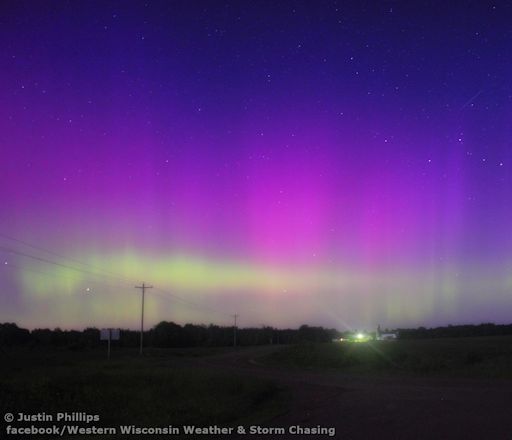
                          -High-latitude sky watchers should be alert for auroras as Earth passes through the wake of a CME that struck on June 7th. The initial impact of the CME was weak, but as June 7th turned into June 8th a G2-class geomagnetic storm developed. At its peak, the storm sparked Northern Lights in the USA as far south as Wisconsin. "There was a quick burst of northern lights in New Auburn WI tonight," says photographer Justin Phillips. "For 10 minutes the pinks were just incredible. What a way to end the aurora drought!"

                          -NOAA forecasters say CME effects could persist until June 9th with a 25% chance of continued geomagnetic storms.


                          Astro Picture of the Day:
                          June 8, 2014

                          Source:
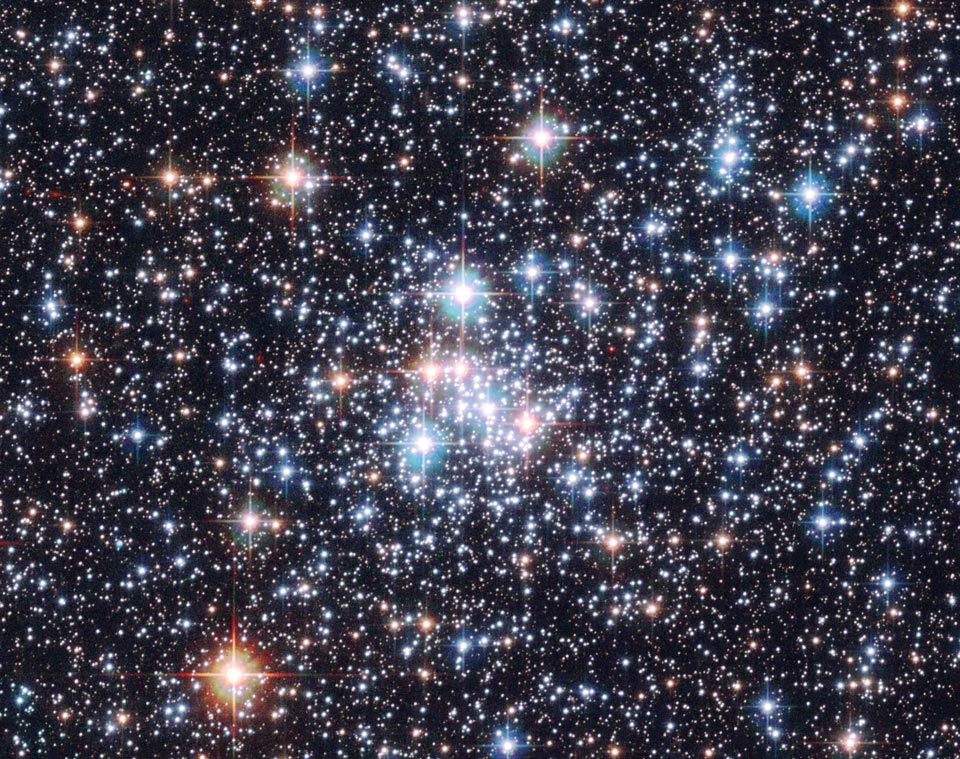
                          Jewels don't shine this bright -- only stars do. Like gems in a jewel box, though, the stars of open cluster NGC 290 glitter in a beautiful display of brightness and color. The photogenic cluster, pictured above, was captured recently by the orbiting Hubble Space Telescope. Open clusters of stars are younger, contain few stars, and contain a much higher fraction of blue stars than do globular clusters of stars. NGC 290 lies about 200,000 light-years distant in a neighboring galaxy called the Small Cloud of Magellan (SMC). The open cluster contains hundreds of stars and spans about 65 light years across. NGC 290 and other open clusters are good laboratories for studying how stars of different masses evolve, since all the open cluster's stars were born at about the same time.
                          1st in Kommisar's 2009 SM Tournament
                          1st in I Love You`s 2009 New Year`s Tournament
                          3rd in EnR's Mashfest '08 tournament
                          5th in Phynx's Unofficial FFR Tournament
                          9th in D3 of the 2008-2009 4th Official FFR Tournament
                          10th in D5 of the 2010 5th Official FFR Tournament
                          10th in D6 of the 2011-2012 6th Official FFR Tournament

                          FMO AAA Count: 71
                          FGO AAA Count: 10

                          Bluearrowll = The Canadian player who can not detect awkward patterns. If it's awkward for most people, it's normal for Terry. If the file is difficult but super straight forward, he has issues. If he's AAAing a FGO but then heard that his favorite Hockey team was losing by a point, Hockey > FFR
                          PS: Cool AAA's Terry
                          - I Love You


                          An Alarm Clock's Haiku
                          beep beep beep beep beep
                          beep beep beep beep beep beep beep
                          beep beep beep beep beep
                          - ieatyourlvllol

                          Comment

                          • Bluearrowll
                            ⊙▃⊙
                            FFR Simfile Author
                            • Nov 2007
                            • 7376

                            #958
                            Re: Terry's Astronomy Thread.

                            Daily Suspicious0bserver's Weather Post:
                            June 9, 2014


                            What's in the sky tonight?
                            June 9, 2014
                            -The Moon is part of a four-object lineup tonight: with Saturn to its left and Spica and Mars to its right.

                            -With summer not far off, can you still catch Procyon very low in the twilight? You may need binoculars. It's 17° lower left of Jupiter. For how many more days can you follow it? The first day that a star becomes completely invisible in the afterglow of sunset is called its heliacal setting.

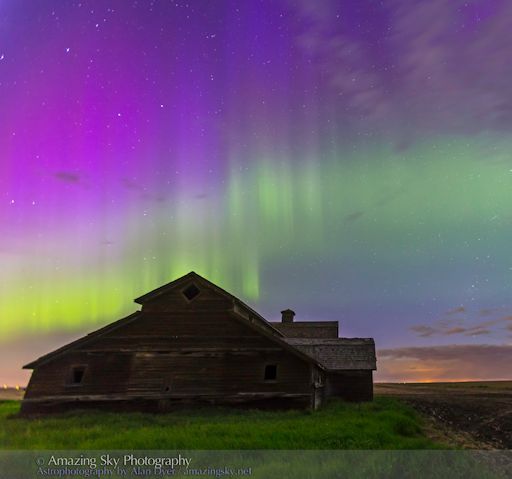
                            -Over the weekend, the sky above Canada and many northern-tier US states turned purple. It was the aurora borealis, sparked by a CME impact during the late hours of June 7th. "Wonderful purple and blue auroras spanned the sky, peaking between 2 and 2:30 a.m. MDT on June 8th," reports Alan Dyer, who captured the colors outside an old barn in Alberta, Canada. In auroras, purple is a sign of nitrogen. While oxygen atoms produce the green glow in Dyer's image, the purple comes from molecular nitrogen ions at very high altitudes. For some reason, high-altitude nitrogen was unusually excited during this G2-class geomagnetic storm, and many people witnessed its telltale hue.

                            More purple could be in the offing. A solar wind stream following in the wake of the CME has kept Earth's magnetic field unsettled two full days after the CME's impact. Solar wind speeds are now greater than 500 km/s, prompting NOAA forecasters to boost the odds of a polar geomagnetic storm on June 9th to 50%.


                            Astro Picture of the Day:
                            June 9, 2014

                            Source:
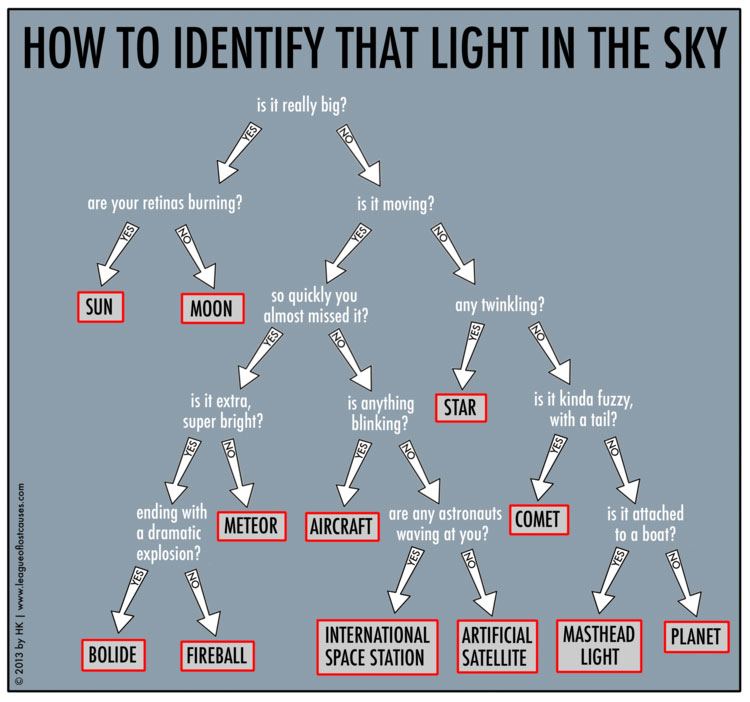
                            What is that light in the sky? Perhaps one of humanity's more common questions, an answer may result from a few quick observations. For example -- is it moving or blinking? If so, and if you live near a city, the answer is typically an airplane, since planes are so numerous and so few stars and satellites are bright enough to be seen over the din of artificial city lights. If not, and if you live far from a city, that bright light is likely a planet such as Venus or Mars -- the former of which is constrained to appear near the horizon just before dawn or after dusk. Sometimes the low apparent motion of a distant airplane near the horizon makes it hard to tell from a bright planet, but even this can usually be discerned by the plane's motion over a few minutes. Still unsure? The above chart gives a sometimes-humorous but mostly-accurate assessment.


                            Daily Suspicious0bserver's Weather Post:
                            June 10, 2014


                            What's in the sky tonight?
                            June 10, 2014
                            -Last night, June 9th, a spectacular display of noctilucent clouds (NLCs) swept across central Europe. "I have waited three years to take a picture like this," says Piotr Majewski who witnessed the apparition at the Torun Centre for Astronomy in Poland.

                            "Noctilucent cloud season has officially begun here in Poland," says Marek Nikodem. "I saw the same display from the town of Szubin, and it was spectacular." Nikodem is a long-time photographer of noctilucent clouds. Last night he framed a nest of storks backlit by electric blue.

                            Noctilucent clouds are a summertime phenomenon. NASA's AIM spacecraft spotted the first NLCs of the 2014 season on May 24th, and they have been intensifying ever since. Long ago, NLCs were confined to the Arctic, but in recent years they have been sighted as far south as Colorado and Utah. Some researchers think the increasing visibility is a sign of climate change. Whatever the cause, sky watchers should be alert for NLCs as northern summer unfolds.

                            Observing tips: Look west 30 to 60 minutes after sunset when the Sun has dipped 6o to 16o below the horizon. If you see luminous blue-white tendrils spreading across the sky, you may have spotted a noctilucent cloud.

                            -Now the waxing gibbous Moon is lower left of Saturn at nightfall. Look farther to the Moon's lower left for Antares and the other stars of upper Scorpius, as shown here.

                            For southernmost Africa, the Moon occults (covers) Saturn around 19 hours Universal Time.


                            Astro Picture of the Day:
                            June 10, 2014


                            Source:
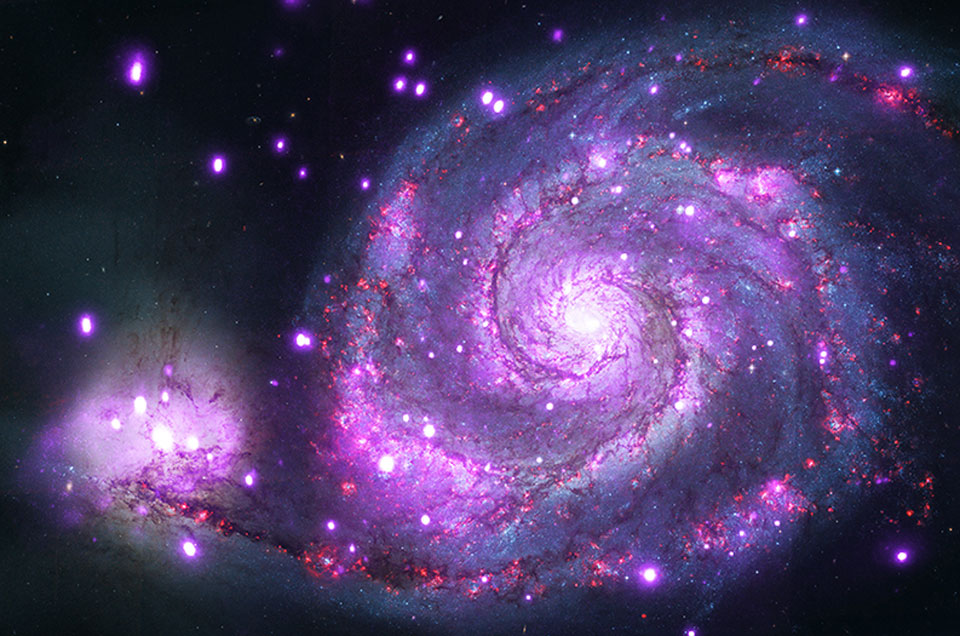
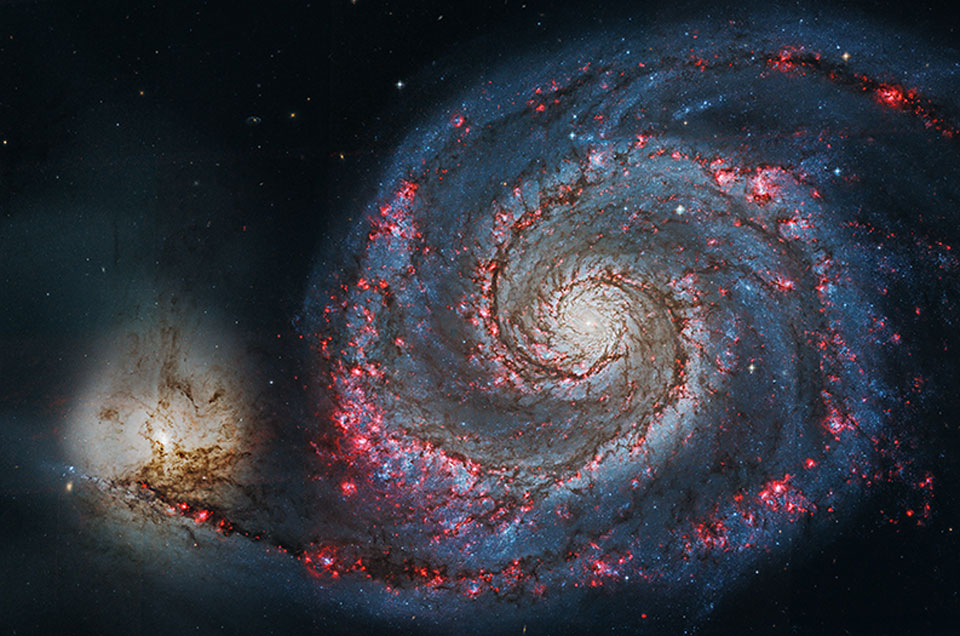
                            What if we X-rayed an entire spiral galaxy? This was done (again) recently by NASA's Chandra X-ray Observatory for the nearby interacting galaxies known as the Whirlpool (M51). Hundreds of glittering x-ray stars are present in the above Chandra image of the spiral and its neighbor. The image is a conglomerate of X-ray light from Chandra and visible light from the Hubble Space Telescope. The number of luminous x-ray sources, likely neutron star and black hole binary systems within the confines of M51, is unusually high for normal spiral or elliptical galaxies and suggests this cosmic whirlpool has experienced intense bursts of massive star formation. The bright cores of both galaxies, NGC 5194 and NGC 5195 (right and left respectively), also exhibit high-energy activity. In this false-color image where X-rays are depicted in purple, diffuse X-ray emission typically results from multi-million degree gas heated by supernova explosions.
                            1st in Kommisar's 2009 SM Tournament
                            1st in I Love You`s 2009 New Year`s Tournament
                            3rd in EnR's Mashfest '08 tournament
                            5th in Phynx's Unofficial FFR Tournament
                            9th in D3 of the 2008-2009 4th Official FFR Tournament
                            10th in D5 of the 2010 5th Official FFR Tournament
                            10th in D6 of the 2011-2012 6th Official FFR Tournament

                            FMO AAA Count: 71
                            FGO AAA Count: 10

                            Bluearrowll = The Canadian player who can not detect awkward patterns. If it's awkward for most people, it's normal for Terry. If the file is difficult but super straight forward, he has issues. If he's AAAing a FGO but then heard that his favorite Hockey team was losing by a point, Hockey > FFR
                            PS: Cool AAA's Terry
                            - I Love You


                            An Alarm Clock's Haiku
                            beep beep beep beep beep
                            beep beep beep beep beep beep beep
                            beep beep beep beep beep
                            - ieatyourlvllol

                            Comment

                            • Bluearrowll
                              ⊙▃⊙
                              FFR Simfile Author
                              • Nov 2007
                              • 7376

                              #959
                              Re: Terry's Astronomy Thread.

                              Daily Suspicious0bserver's Weather Post:
                              June 11, 2014


                              What's in the sky tonight?
                              June 11, 2014
                              -Now it's Antares's turn to shine near the Moon. As evening grows late, it swings straight below the Moon (for North America).

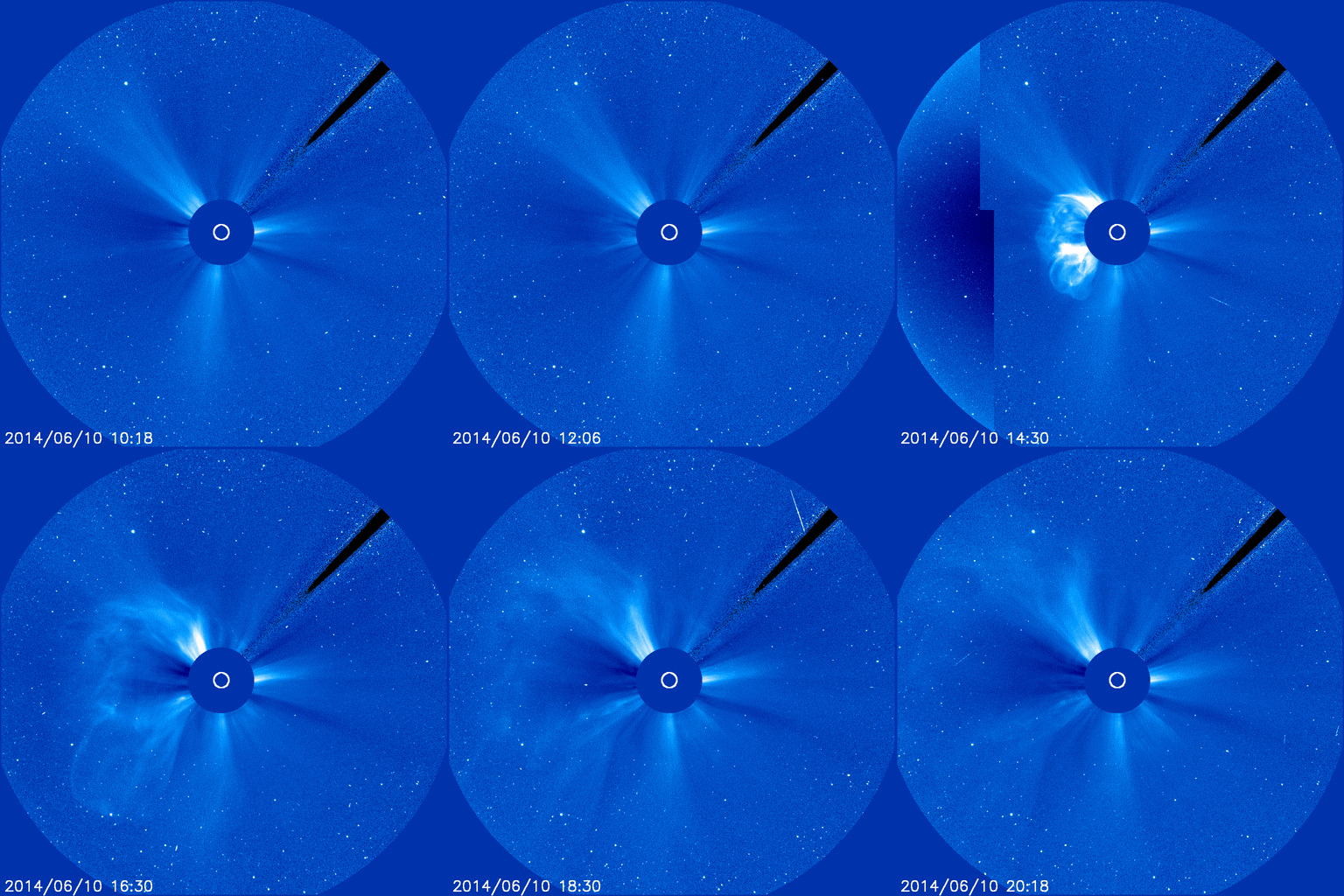
                              -Yesterday's double X-flare may have produced a geoeffective CME after all. At first it appeared that Earth was outside the line of fire, but a closer look at the CME reveals an Earth-directed component. Click to view a movie of the explosion from the Solar and Heliospheric Observatory:

                              The movie shows a faint CME associated with the first X-flare emerging around 1200 UT. A second, brighter CME from the second X-flare quickly overtakes it, forming a "cannibal CME." Computer models run yesterday by NOAA analysts suggest the merged storm cloud will reach Earth mid-day on June 13th. The glancing blow could spark polar geomagnetic storms.

                              Meanwhile, more X-flares are in the offing. At least two sunspots (AR2080 and AR2087) have unstable 'delta-class' magnetic fields that could erupt at any moment. The source of yesterday's X-flares, AR2087, is particularly potent, and it is turning toward Earth. NOAA forecasters estimate a 60% chance of M-flares and a 30% chance of X-flares on June 11th.


                              Astro Picture of the Day:
                              June 11, 2014

                              Source:
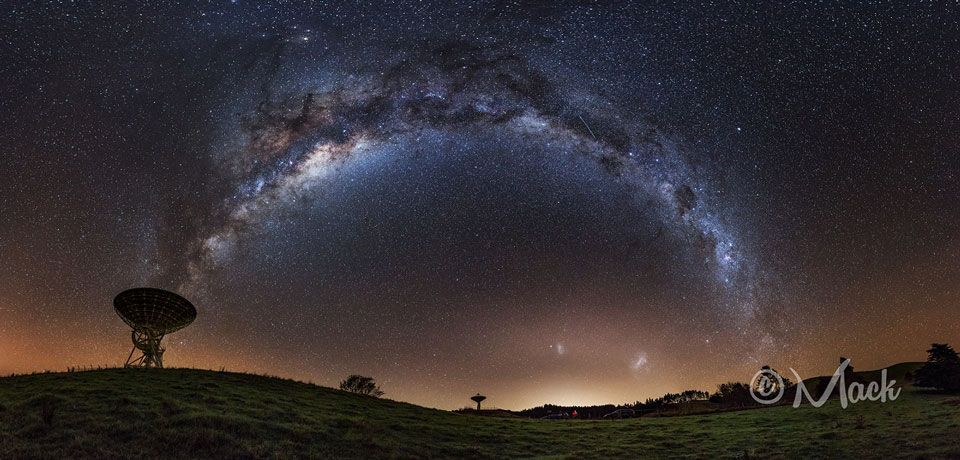
                              No, radio dishes cannot broadcast galaxies. Although they can detect them, the above image features a photogenic superposition during a dark night in New Zealand about two weeks ago. As pictured above, the central part of our Milky Way Galaxy is seen rising to the east on the image left and arching high overhead. Beneath the Galactic arc and just above the horizon are the two brightest satellite galaxies of our Milky Way, with the Small Magellanic Cloud to the left and the Large Magellanic Cloud on the right. The radio dish is the Warkworth Satellite Station located just north of Auckland.
                              1st in Kommisar's 2009 SM Tournament
                              1st in I Love You`s 2009 New Year`s Tournament
                              3rd in EnR's Mashfest '08 tournament
                              5th in Phynx's Unofficial FFR Tournament
                              9th in D3 of the 2008-2009 4th Official FFR Tournament
                              10th in D5 of the 2010 5th Official FFR Tournament
                              10th in D6 of the 2011-2012 6th Official FFR Tournament

                              FMO AAA Count: 71
                              FGO AAA Count: 10

                              Bluearrowll = The Canadian player who can not detect awkward patterns. If it's awkward for most people, it's normal for Terry. If the file is difficult but super straight forward, he has issues. If he's AAAing a FGO but then heard that his favorite Hockey team was losing by a point, Hockey > FFR
                              PS: Cool AAA's Terry
                              - I Love You


                              An Alarm Clock's Haiku
                              beep beep beep beep beep
                              beep beep beep beep beep beep beep
                              beep beep beep beep beep
                              - ieatyourlvllol

                              Comment

                              • Bluearrowll
                                ⊙▃⊙
                                FFR Simfile Author
                                • Nov 2007
                                • 7376

                                #960
                                Re: Terry's Astronomy Thread.

                                Daily Suspicious0bserver's Weather Post:
                                June 12, 2014


                                What's in the sky tonight?
                                June 12, 2014
                                -Solar activity remains high. Active sunspot AR2087 unleashed another X-flare on June 11th (X1.0), following two X-flares (X2.1 and X1.5) on June 10th. The latest blast was intense but short-lived, and it is not expected to have significant Earth-effects.

                                -Full Moon (exact at 12:11 a.m. June 13th EDT). The Moon shines in the dim legs of the constellation Ophiuchus. Look for Antares well to its right.

                                Astro Picture of the Day:
                                June 12, 2014

                                Source:
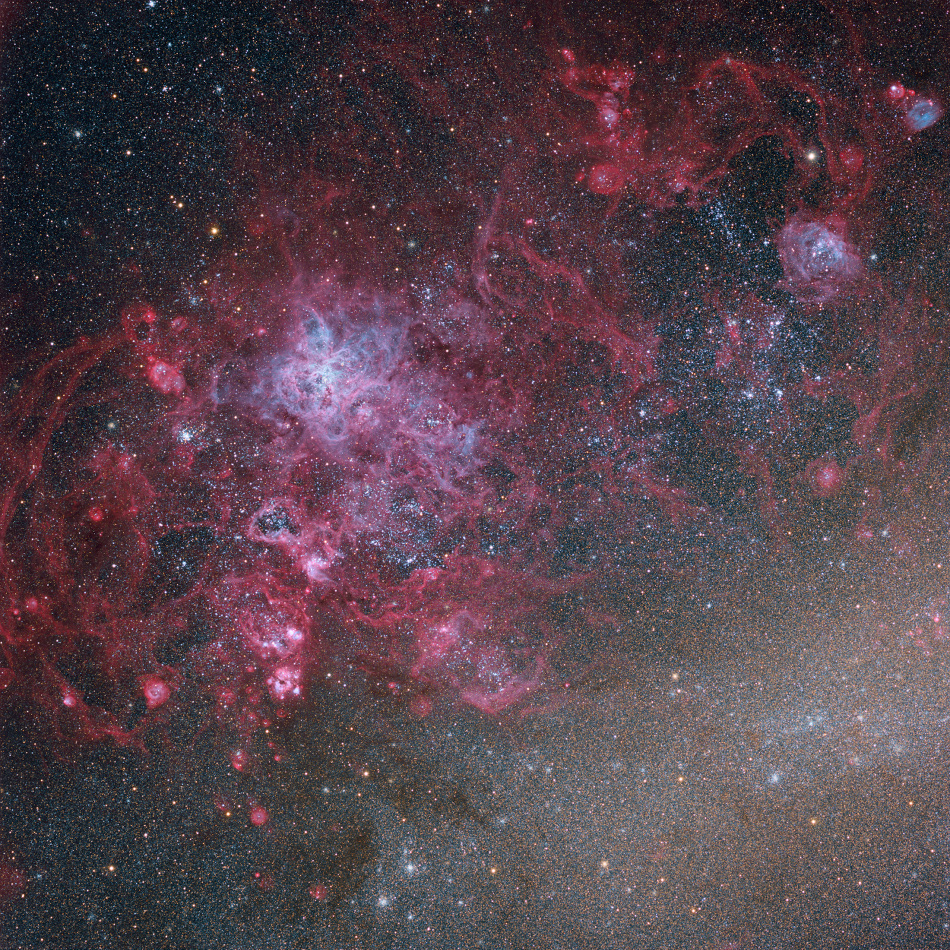
                                The Tarantula Nebula is more than 1,000 light-years in diameter, a giant star forming region within our neighboring galaxy the Large Magellanic Cloud (LMC). That cosmic arachnid lies toward the upper left in this deep and colorful telescopic view made through broad-band and narrow-band filters. The image spans nearly 2 degrees (4 full moons) on the sky and covers a part of the LMC over 8,000 light-years across. Within the Tarantula (NGC 2070), intense radiation, stellar winds and supernova shocks from the central young cluster of massive stars, cataloged as R136, energize the nebular glow and shape the spidery filaments. Around the Tarantula are other violent star-forming regions with young star clusters, filaments, and bubble-shaped clouds In fact, the frame includes the site of the closest supernova in modern times, SN 1987A, just above center. The rich field of view is located in the southern constellation Dorado.
                                1st in Kommisar's 2009 SM Tournament
                                1st in I Love You`s 2009 New Year`s Tournament
                                3rd in EnR's Mashfest '08 tournament
                                5th in Phynx's Unofficial FFR Tournament
                                9th in D3 of the 2008-2009 4th Official FFR Tournament
                                10th in D5 of the 2010 5th Official FFR Tournament
                                10th in D6 of the 2011-2012 6th Official FFR Tournament

                                FMO AAA Count: 71
                                FGO AAA Count: 10

                                Bluearrowll = The Canadian player who can not detect awkward patterns. If it's awkward for most people, it's normal for Terry. If the file is difficult but super straight forward, he has issues. If he's AAAing a FGO but then heard that his favorite Hockey team was losing by a point, Hockey > FFR
                                PS: Cool AAA's Terry
                                - I Love You


                                An Alarm Clock's Haiku
                                beep beep beep beep beep
                                beep beep beep beep beep beep beep
                                beep beep beep beep beep
                                - ieatyourlvllol

                                Comment

                                Working...