

Re: Terry's Astronomy Thread.
Daily Suspicious0bserver's Weather Post:
April 1, 2014
What's in the sky tonight?
April 1, 2014
Astro Picture of the Day:
April 1, 2014

Source:
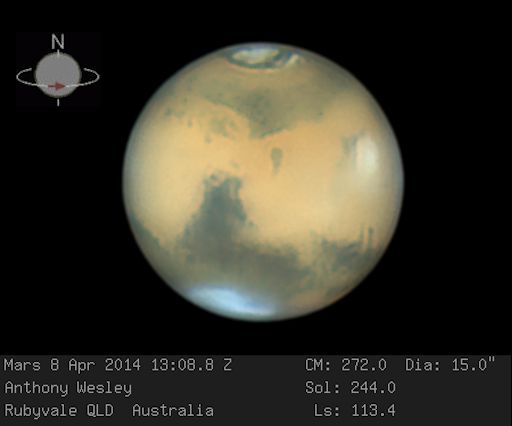
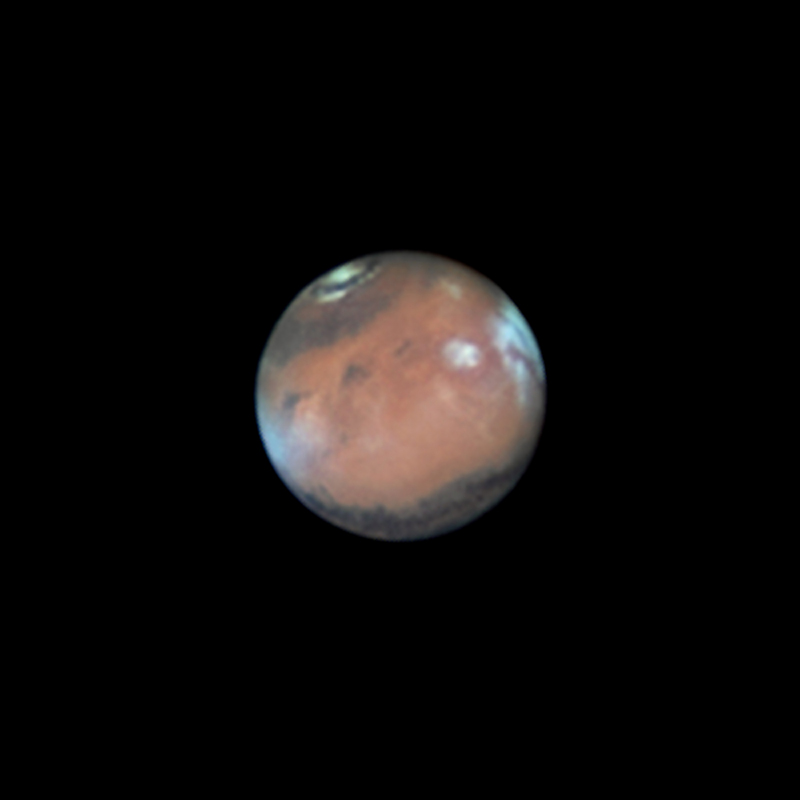
In the next 60 seconds you will be 300 km closer to the planet Mars. As April begins, Earth and Mars are converging at 5 km/s or 300 km/min for a close approach two weeks from now. This matrix of images, taken by Puerto Rican photographer Efrain Morales Rivera, shows how the Red Planet has grown in the eyepiece of his 12-inch telescope over the past month. Even the smallest of Rivera's images shows the martian North Polar Cap, orographic clouds over volcanoes near the equator, and a bright blue cloud filling Hellas Basin in the south. Only an experienced astrophotographer can produce this kind of Hubblesque detail using backyard optics. Novice observers looking through the eyepiece of a small telescope can still see a lot, however, including the rusty-red disk of Mars and bright smudges corresponding to the polar cap and Hellas Basin. Closest approach, Earth to Mars, occurs on April 14th at a distance of 92 million kilometers. Mark your calendar and get ready to see Mars at its best.
Daily Suspicious0bserver's Weather Post:
April 2, 2014
What's in the sky tonight?
April 2, 2014

Astro Picture of the Day:
April 2, 2014
Source:
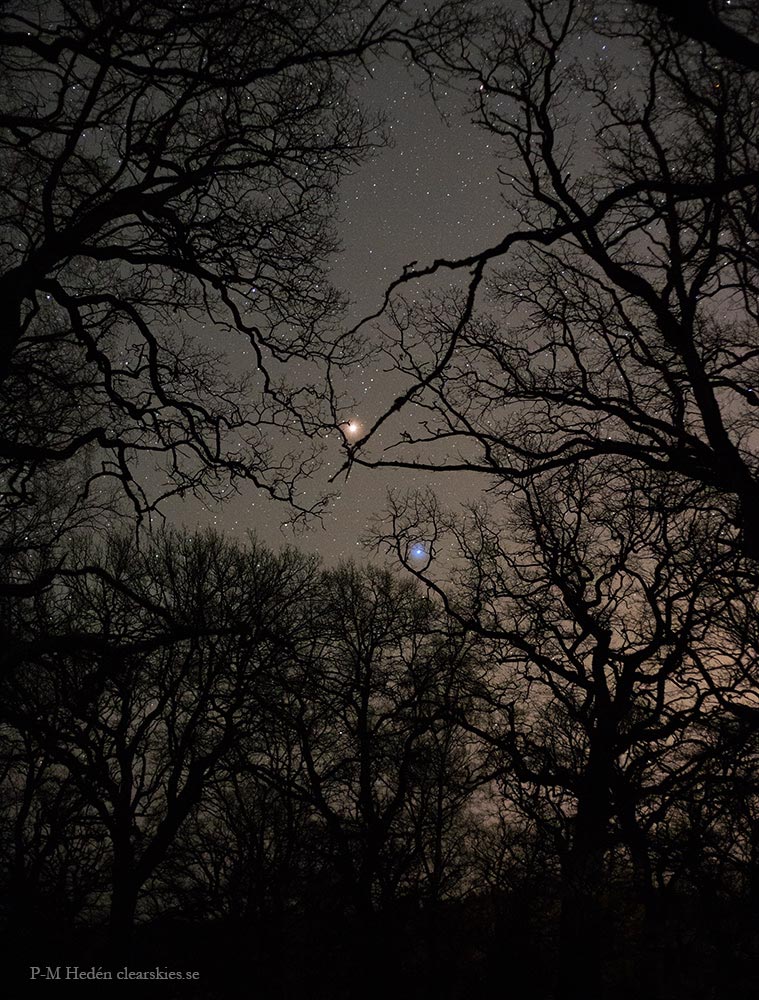
A bright pair of sky objects will be visible together during the next few months. Mars will shine brightly in its familiar rusty hue as it reaches its brightest of 2014 next week. The reason that Mars appears so bright is that Earth and Mars are close to each other in their long orbits around the Sun. Spica, on the other hand, shines constantly as one of the brightest blue stars in the night sky. Pronounced "spy-kah", the blue-hued star has been visible throughout human history and the sounds that identify it today date back to ancient times. Pictured above, the planet and the star were photographed rising together toward the southeast after sunset last week through old oak trees in Sweden.
Daily Suspicious0bserver's Weather Post:
April 1, 2014
What's in the sky tonight?
April 1, 2014
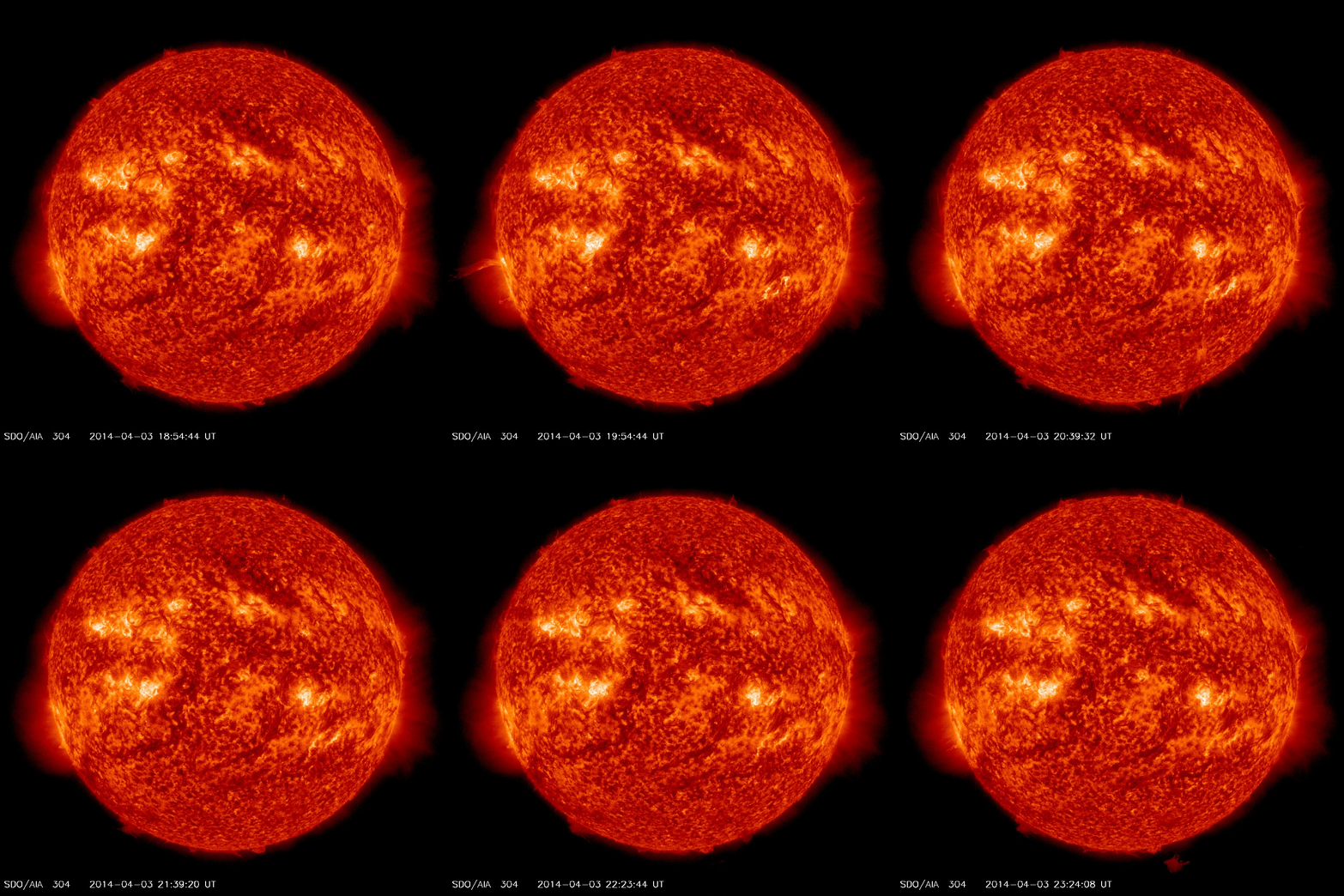
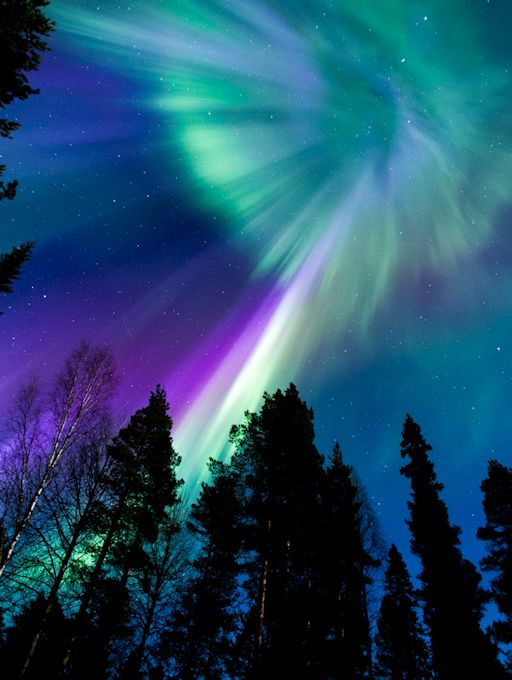
-The first of three or more CMEs en route to Earth are expected to arrive late in the day on April 1st. None of the incoming clouds is squarely Earth-directed. The series of glanciing blows, however, will rattle Earth's magnetic field and possibly spark auroras. NOAA forecasters estimate a 60% chance of polar geomagnetic storms on April 2nd.
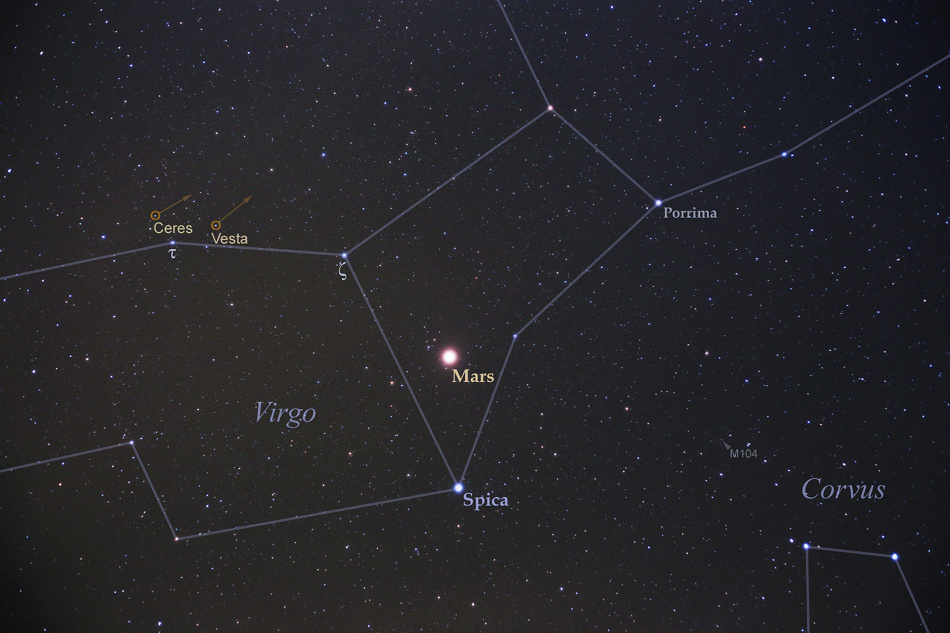
-The biggest and brightest asteroids, 1 Ceres and 4 Vesta respectively, are only about 2° apart in eastern Virgo, some 12° northeast of Mars. They've brightened to magnitudes 7.1 and 5.9, respectively. They'll be at opposition in mid-April.
-The biggest and brightest asteroids, 1 Ceres and 4 Vesta respectively, are only about 2° apart in eastern Virgo, some 12° northeast of Mars. They've brightened to magnitudes 7.1 and 5.9, respectively. They'll be at opposition in mid-April.
Astro Picture of the Day:
April 1, 2014
In the next 60 seconds you will be 300 km closer to the planet Mars. As April begins, Earth and Mars are converging at 5 km/s or 300 km/min for a close approach two weeks from now. This matrix of images, taken by Puerto Rican photographer Efrain Morales Rivera, shows how the Red Planet has grown in the eyepiece of his 12-inch telescope over the past month. Even the smallest of Rivera's images shows the martian North Polar Cap, orographic clouds over volcanoes near the equator, and a bright blue cloud filling Hellas Basin in the south. Only an experienced astrophotographer can produce this kind of Hubblesque detail using backyard optics. Novice observers looking through the eyepiece of a small telescope can still see a lot, however, including the rusty-red disk of Mars and bright smudges corresponding to the polar cap and Hellas Basin. Closest approach, Earth to Mars, occurs on April 14th at a distance of 92 million kilometers. Mark your calendar and get ready to see Mars at its best.
Daily Suspicious0bserver's Weather Post:
April 2, 2014
What's in the sky tonight?
April 2, 2014
-Arriving a little later than expected, at least three CMEs are still en route to Earth. NOAA forecasters expect glancing blows to commence on April 2nd with a 60% chance of polar geomagnetic storms when the impacts begin. High-latitude sky watchers should be alert for auroras.
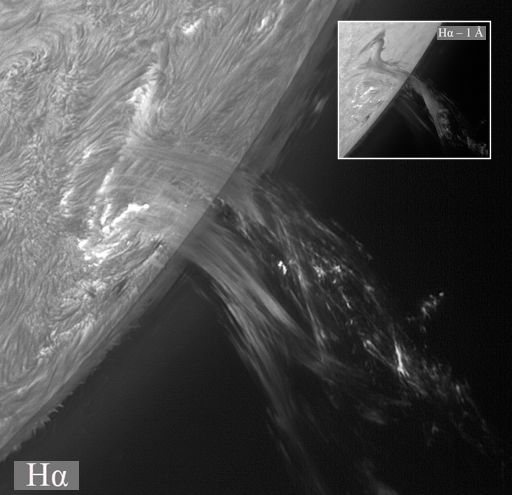
-In the night sky, there are thousands of stars visible to the unaided eye, and thousands of times more stars in range of backyard optics. Not a single one of those faraway balls of fire, however, looks any bigger than a pinprick. For a better view of a star, you need some daylight. This star is the sun. Francois Rouviere of Mougins, France, took the picture on March 31st using no more than a 7-inch refracting telescope and an "H-alpha" filter tuned to the red glow of solar hydrogen.
"I caught this impressive explosion at the sun's western limb near sunspot AR2014," says Rouviere. "The inset, which is at a wavelength 1 Å shorter than H-alpha, shows fast moving material blue-shifted by the Doppler effect."
Got a solar telescope? NOAA forecasters estimate a 40% chance of M-class flares and a 5% chance of X-flares on April 2nd. Train those optics on the daylight sky.
-The crescent Moon shines below the Pleiades, Aldebaran, and the V-shaped Hyades, as shown below.
-In the night sky, there are thousands of stars visible to the unaided eye, and thousands of times more stars in range of backyard optics. Not a single one of those faraway balls of fire, however, looks any bigger than a pinprick. For a better view of a star, you need some daylight. This star is the sun. Francois Rouviere of Mougins, France, took the picture on March 31st using no more than a 7-inch refracting telescope and an "H-alpha" filter tuned to the red glow of solar hydrogen.
"I caught this impressive explosion at the sun's western limb near sunspot AR2014," says Rouviere. "The inset, which is at a wavelength 1 Å shorter than H-alpha, shows fast moving material blue-shifted by the Doppler effect."
Got a solar telescope? NOAA forecasters estimate a 40% chance of M-class flares and a 5% chance of X-flares on April 2nd. Train those optics on the daylight sky.
-The crescent Moon shines below the Pleiades, Aldebaran, and the V-shaped Hyades, as shown below.
Astro Picture of the Day:
April 2, 2014
A bright pair of sky objects will be visible together during the next few months. Mars will shine brightly in its familiar rusty hue as it reaches its brightest of 2014 next week. The reason that Mars appears so bright is that Earth and Mars are close to each other in their long orbits around the Sun. Spica, on the other hand, shines constantly as one of the brightest blue stars in the night sky. Pronounced "spy-kah", the blue-hued star has been visible throughout human history and the sounds that identify it today date back to ancient times. Pictured above, the planet and the star were photographed rising together toward the southeast after sunset last week through old oak trees in Sweden.










Comment