Terry's Astronomy Thread.

Collapse
X
 
  • Time
  • Show
Clear All
new posts
  • Bluearrowll
    ⊙▃⊙
    FFR Simfile Author
    • Nov 2007
    • 7376

    #871
    Re: Terry's Astronomy Thread.

    Daily Suspicious0bserver's Weather Post:
    March 17, 2014


    What's in the sky tonight?
    March 17, 2014
    -Once the Moon is well up in the southeast late this evening, look below it to spot bright Mars and fainter Spica. By dawn on the 18th they're off in the west-southwest.

    -NOAA forecasters estimate a 15% chance of polar geomagnetic storms on March 17th. That means the odds of green skies on St. Patrick's Day are low.

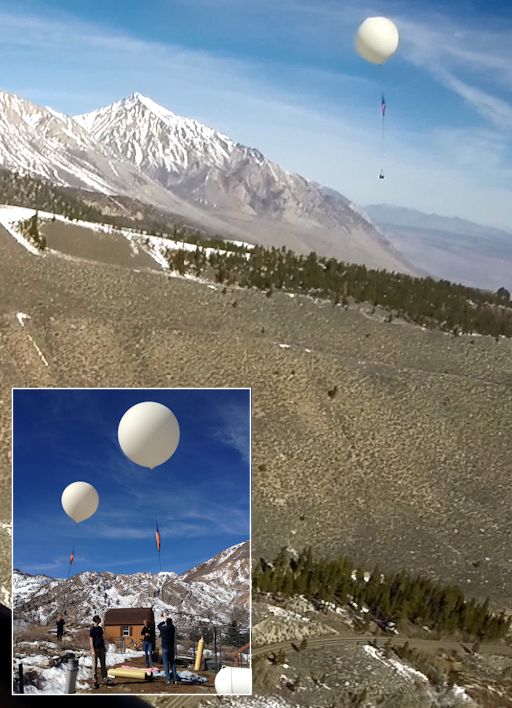
    -Yesterday, the students of Earth to Sky Calculus launched a pair of research balloons into the stratosphere. One of the balloons carried an experimental Space Weather payload designed for rapid deployment during unexpected solar storms. Here it is, photographed in flight by the campanion balloon.

    One balloon photographing another is a rare and possibly unique occurance in the growing field of high-altitude ballooning. Congratulations to the students for breaking new ground in the air.

    There was no solar storm yesterday. The test flight of the Rapid Response Space Weather Payload prepares the team for another day when a strong flare or geomagnetic storm takes forecasters by surprise. This fast-turnaround payload can be displatched on a moment's notice to probe the stratosphere while the storm is underway. It includes a high-energy radiation sensor, a cryogenic thermometer, a GPS altimeter and other devices. Stay tuned for more data and images from the flight.


    Astro Picture of the Day:
    March 17, 2014
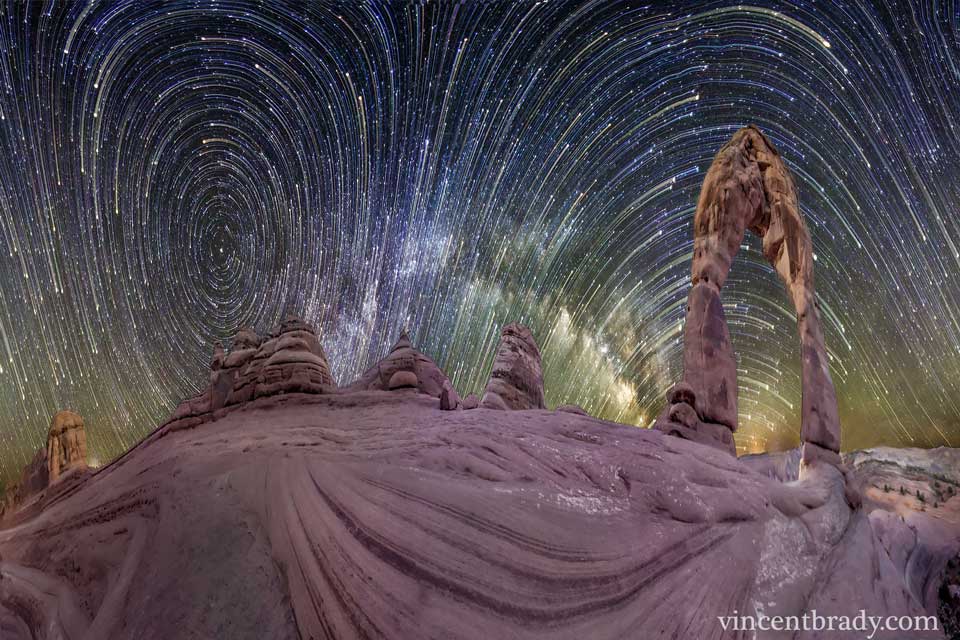
    Source:
    What's happened to the sky? A time warp, of sorts, and a digital space warp too. The time warp occurs because this image captured in a single frame a two and a half hour exposure of the night sky. As a result, prominent star trails are visible. The space warp occurs because the picture is actually a full 360 degree panorama, horizontally compressed to fit your browser. As the Earth rotated, stars appeared to circle both the North Celestial Pole, on the left, and the South Celestial Pole, just below the horizon on the right. The above panorama over Arches National Park in Utah, USA, was captured two weeks ago during early morning hours. While the eye-catching texture of ancient layered sandstone covers the image foreground, twenty-meter tall Delicate Arch is visible on the far right, and the distant arch of our Milky Way Galaxy is visible near the image center.
    1st in Kommisar's 2009 SM Tournament
    1st in I Love You`s 2009 New Year`s Tournament
    3rd in EnR's Mashfest '08 tournament
    5th in Phynx's Unofficial FFR Tournament
    9th in D3 of the 2008-2009 4th Official FFR Tournament
    10th in D5 of the 2010 5th Official FFR Tournament
    10th in D6 of the 2011-2012 6th Official FFR Tournament

    FMO AAA Count: 71
    FGO AAA Count: 10

    Bluearrowll = The Canadian player who can not detect awkward patterns. If it's awkward for most people, it's normal for Terry. If the file is difficult but super straight forward, he has issues. If he's AAAing a FGO but then heard that his favorite Hockey team was losing by a point, Hockey > FFR
    PS: Cool AAA's Terry
    - I Love You


    An Alarm Clock's Haiku
    beep beep beep beep beep
    beep beep beep beep beep beep beep
    beep beep beep beep beep
    - ieatyourlvllol

    Comment

    • Bluearrowll
      ⊙▃⊙
      FFR Simfile Author
      • Nov 2007
      • 7376

      #872
      Re: Terry's Astronomy Thread.

      Daily Suspicious0bserver's Weather Post:
      March 18, 2014


      What's in the sky tonight?
      March 18, 2014
      -The Moon, Mars, and Spica form a striking triangle after they rise in the east late tonight and on into dawn on the morning of the 19th.

      -Tomorrow, For skywatchers in the New York City region and certain areas northward, the faint asteroid 163 Erigone (eh-RIG-uh-nee) will black out 1st-magnitude Regulus for up to 14 seconds a little after 2 a.m. EDT Thursday morning. This is the best asteroid occultation ever predicted to cross such a heavily populated area.

      -Despite a relatively high sunspot number, solar activity is low. None of the half-a-dozen sunspot groups on the solar disk is actively flaring. NOAA forecasters estimate a 35% chance of M-class flares and a 5% chance of X-flares on March 18th.


      News Posted Today:
      March 17, 2014
      First Direct Evidence of Big Bang Inflation


      Astro Picture of the Day:
      March 18, 2014

      Source:
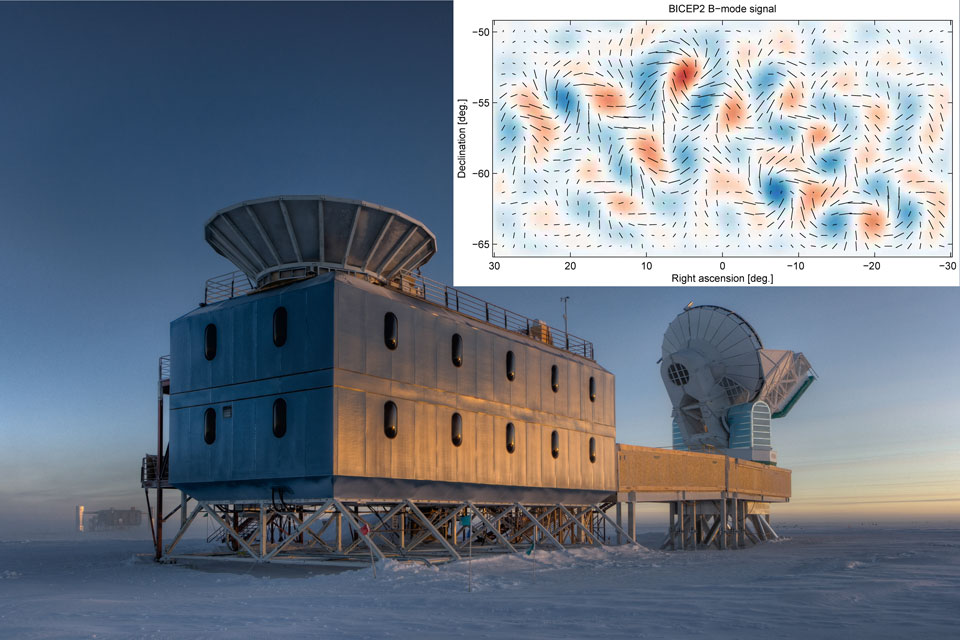
      Did the universe undergo an early epoch of extremely rapid expansion? Such an inflationary epoch has been postulated to explain several puzzling cosmic attributes such as why our universe looks similar in opposite directions. Yesterday, results were released showing an expected signal of unexpected strength, bolstering a prediction of inflation that specific patterns of polarization should exist in cosmic microwave background radiation -- light emitted 13.8 billion years ago as the universe first became transparent. Called B-mode polarizations, these early swirling patterns can be directly attributed to squeeze and stretch effects that gravitational radiation has on photon-emitting electrons. The surprising results were discovered in data from the Background Imaging of Cosmic Extragalactic Polarization 2 (BICEP2) microwave observatory near the South Pole. BICEP2 is the building-mounted dish pictured above on the left. Note how the black polarization vectors appear to swirl around the colored temperature peaks on the inset microwave sky map. Although statistically compelling, the conclusions will likely remain controversial while confirmation attempts are made with independent observations.
      1st in Kommisar's 2009 SM Tournament
      1st in I Love You`s 2009 New Year`s Tournament
      3rd in EnR's Mashfest '08 tournament
      5th in Phynx's Unofficial FFR Tournament
      9th in D3 of the 2008-2009 4th Official FFR Tournament
      10th in D5 of the 2010 5th Official FFR Tournament
      10th in D6 of the 2011-2012 6th Official FFR Tournament

      FMO AAA Count: 71
      FGO AAA Count: 10

      Bluearrowll = The Canadian player who can not detect awkward patterns. If it's awkward for most people, it's normal for Terry. If the file is difficult but super straight forward, he has issues. If he's AAAing a FGO but then heard that his favorite Hockey team was losing by a point, Hockey > FFR
      PS: Cool AAA's Terry
      - I Love You


      An Alarm Clock's Haiku
      beep beep beep beep beep
      beep beep beep beep beep beep beep
      beep beep beep beep beep
      - ieatyourlvllol

      Comment

      • Bluearrowll
        ⊙▃⊙
        FFR Simfile Author
        • Nov 2007
        • 7376

        #873
        Re: Terry's Astronomy Thread.

        Daily Suspicious0bserver's Weather Post:
        March 19, 2014


        What's in the sky tonight?
        March 19, 2014
        -Asteroid to occult Regulus. For skywatchers in the New York City region and certain areas northward, the faint asteroid 163 Erigone (eh-RIG-uh-nee) will black out 1st-magnitude Regulus for up to 14 seconds a little after 2 a.m. EDT Thursday morning. This is the best asteroid occultation ever predicted to cross such a heavily populated area.
        And, anywhere from the Carolinas to Nova Scotia to Manitoba, it's also worth watching to see if Regulus might be occulted by a yet-unknown satellite of Erigone!

        The International Occultation Timing Association is working up a big public observing campaign.


        This effort is being spearheaded by the International Occultation Timing Association (IOTA). Its website for the public telling all about the event and how to participate is occultations.org/Regulus2014.

        The goal is to see (1) whether the star disappears as seen from your location, and (2) for how long — especially if you can time the event to high precision. Read full details and instructions at the website.

        From this data, astronomers hope to obtain a very precise profile of Erigone's size and shape, something that cannot be done any other way short of sending a spacecraft there. This has been done for many asteroids in the past that have occulted fainter stars.

        -Two past successes. The double asteroid Antiope and big, roundish Interamnia blotted out faint background stars on July 19, 2011, and March 23, 2003, respectively. In each case, dozens of observers scattered across hundreds of miles set up equipment to time the star's disappearance and reappearance. Each yellow line represents one observer watching the star. Accurate timings of when the star vanished and returned (breaks in the yellow line) could be properly fitted with each other to yield the asteroid's actual silhouette. Or for Antiope, two silhouettes! The map of the occultation is shown below.


        Astro Picture of the Day:
        March 19, 2014

        Source:
        When does the line between day and night become vertical? Tomorrow. Tomorrow is an equinox on planet Earth, a time of year when day and night are most nearly equal. At an equinox, the Earth's terminator -- the dividing line between day and night -- becomes vertical and connects the north and south poles. The above time-lapse video demonstrates this by displaying an entire year on planet Earth in twelve seconds. From geosynchronous orbit, the Meteosat satellite recorded these infrared images of the Earth every day at the same local time. The video started at the September 2010 equinox with the terminator line being vertical. As the Earth revolved around the Sun, the terminator was seen to tilt in a way that provides less daily sunlight to the northern hemisphere, causing winter in the north. As the year progressed, the March 2011 equinox arrived halfway through the video, followed by the terminator tilting the other way, causing winter in the southern hemisphere -- and summer in the north. The captured year ends again with the September equinox, concluding another of billions of trips the Earth has taken -- and will take -- around the Sun.
        1st in Kommisar's 2009 SM Tournament
        1st in I Love You`s 2009 New Year`s Tournament
        3rd in EnR's Mashfest '08 tournament
        5th in Phynx's Unofficial FFR Tournament
        9th in D3 of the 2008-2009 4th Official FFR Tournament
        10th in D5 of the 2010 5th Official FFR Tournament
        10th in D6 of the 2011-2012 6th Official FFR Tournament

        FMO AAA Count: 71
        FGO AAA Count: 10

        Bluearrowll = The Canadian player who can not detect awkward patterns. If it's awkward for most people, it's normal for Terry. If the file is difficult but super straight forward, he has issues. If he's AAAing a FGO but then heard that his favorite Hockey team was losing by a point, Hockey > FFR
        PS: Cool AAA's Terry
        - I Love You


        An Alarm Clock's Haiku
        beep beep beep beep beep
        beep beep beep beep beep beep beep
        beep beep beep beep beep
        - ieatyourlvllol

        Comment

        • Bluearrowll
          ⊙▃⊙
          FFR Simfile Author
          • Nov 2007
          • 7376

          #874
          Re: Terry's Astronomy Thread.

          Daily Suspicious0bserver's Weather Post:
          March 20, 2014


          What's in the sky tonight?
          March 20, 2014
          -Spring begins in the Northern Hemisphere, and fall in the Southern Hemisphere, at the equinox: 12:57 p.m. Eastern Daylight Time (16:57 UT). This is when the Sun crosses the equator heading north for the year.
          The waning gibbous Moon rises around 11 or midnight tonight with Saturn shining near it. They reach their highest station in the south before the beginning of dawn. Although they look paired, Saturn is 3,600 times farther away in the background.

          -The heliophysics communitty is buzzing today in response to an article in Nature Communications, which describes an intense solar storm that narrowly missed Earth almost two years ago. On July 23, 2012, a CME rocketed away from the sun at 2000 km/s, almost four times faster than a typical eruption. The storm tore through Earth orbit, but fortunately Earth wasn't there. Instead it hit the STEREO-A spacecraft, which experienced the most intense solar proton storm since 1976. Researchers have been analyzing the data ever since, and they have concluded that the storm was akin to the Carrington Event of 1859.

          "Had it hit Earth, it probably would have been like the big one in 1859," says Janet Luhmann of UC Berkeley, a co-author of the paper. "The effect today [on] our modern technologies would have been tremendous."

          The Carrington Event was a series of powerful CMEs that hit Earth head-on, sparking Northern Lights as far south as Tahiti. Intense geomagnetic storms caused global telegraph lines to spark, setting fire to some telegraph offices and disabling the 'Victorian Internet." A similar storm today would have a catastrophic effect on modern power grids and telecommunication networks. According to a study by the National Academy of Sciences, the total economic impact could exceed $2 trillion or 20 times greater than the costs of a Hurricane Katrina. Multi-ton transformers fried by such a storm could take years to repair.

          The paper in Nature Communications describes what gave the July 2012 storm Carrington-like potency. For one thing, the CME was actually two CMEs separated by only 10 to 15 minutes. Plus the CMEs traveled through a region of space that had been cleared out by another CME four days earlier. As a result, they were not decelerated as much as usual by their transit through the interplanetary medium.

          The storm clouds crossed Earth's orbit in a place where Earth itself would be about 1 week later, so it was a relatively narrow escape. The whole episode highlights the perils of space weather. Many observers have noted that the current solar cycle is weak, perhaps the weakest in 100 years. Now we see that even a weak solar cycle can produce a very strong storm. Earth is not safe from these kind of events, so it's time to be prepared.

          The original research reported here may be found in Nature Communications: "Observations of an extreme storm in interplanetary space caused by successive coronal mass ejections" by Ying D. Liu et al., published on March, 18, 2014. http://www.nature.com/ncomms/2014/14...comms4481.html

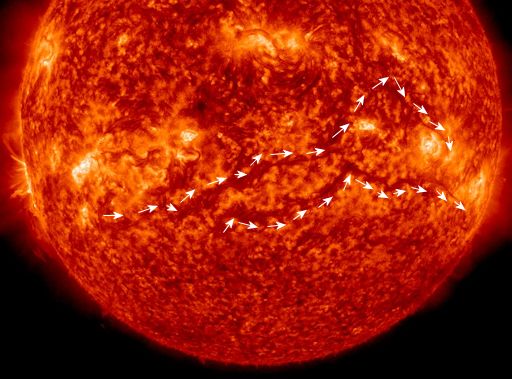
          -The biggest structures on the sun today are not sunspots. Dwarfing all of the ordinary active regions, a pair of dark magnetic filaments are stretching across the almost-entire circumference of the sun's southern hemisphere. NASA's Solar Dynamics Observatory took this picture mid-day on March 19th.

          Containing masses of relatively cool plasma held suspended above the solar surface by magnetic forces, the sinuous structures are each more than 600,000 km long. If you put one end on Earth, the other would stretch far beyond the orbit of the Moon. Their dimensions make them easy targets for backyard solar telescopes.

          Sometimes, magetic filaments such as these become unstable and collapse. This can lead to a Hyder flare--a type of explosion that does not require sunspots. Hyder flares this week would likely be Earth directed as the filaments are both facing our planet.


          Astro Picture of the Day:
          March 20, 2014

          Source:
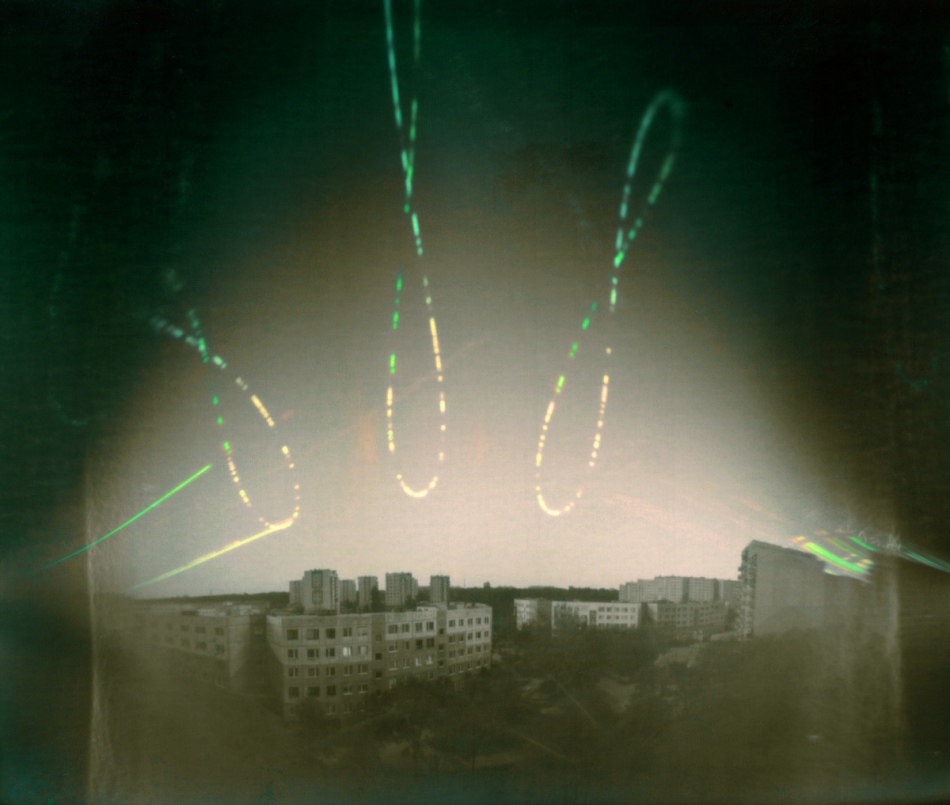
          Today is the equinox. The Sun crosses the celestial equator heading north at 16:57 UT, marking the northern hemisphere's first day of spring. To celebrate, consider this remarkable image following the Sun's yearly trek through planet Earth's sky, the first analemmas exposed every day through the technique of solargraphy. In fact, three analemma curves were captured using a cylindrical pinhole camera by daily making three, separate, one minute long exposures for a year, from March 1, 2013 to March 1, 2014, on a single piece of black and white photographic paper. The well-planned daily exposures began at 10:30, 12:00, and 13:30, CET from a balcony looking south from the Kozanów district in Wrocław, Poland. That year's two equinoxes on March 20 and September 22 correspond to the mid-points, not the cross-over points, along the figure-8 shaped curves. Apparent gaps in the curves are due to cloudy days. Two solid lines at the lower left were both caused by a timer switch failure that left the pinhole shutter open.
          1st in Kommisar's 2009 SM Tournament
          1st in I Love You`s 2009 New Year`s Tournament
          3rd in EnR's Mashfest '08 tournament
          5th in Phynx's Unofficial FFR Tournament
          9th in D3 of the 2008-2009 4th Official FFR Tournament
          10th in D5 of the 2010 5th Official FFR Tournament
          10th in D6 of the 2011-2012 6th Official FFR Tournament

          FMO AAA Count: 71
          FGO AAA Count: 10

          Bluearrowll = The Canadian player who can not detect awkward patterns. If it's awkward for most people, it's normal for Terry. If the file is difficult but super straight forward, he has issues. If he's AAAing a FGO but then heard that his favorite Hockey team was losing by a point, Hockey > FFR
          PS: Cool AAA's Terry
          - I Love You


          An Alarm Clock's Haiku
          beep beep beep beep beep
          beep beep beep beep beep beep beep
          beep beep beep beep beep
          - ieatyourlvllol

          Comment

          • Bluearrowll
            ⊙▃⊙
            FFR Simfile Author
            • Nov 2007
            • 7376

            #875
            Re: Terry's Astronomy Thread.

            Daily Suspicious0bserver's Weather Post:
            March 21, 2014


            What's in the sky tonight?
            March 21, 2014
            -This year's huge "Winter Diamond" — bright Jupiter on top, bright Sirius on the bottom, and Procyon and Betelgeuse forming the left and right corners — persists well into spring. It stands straight up in the south around dusk, then tips westward as the evening advances.

            -China's lunar rover, the "Jade Rabbit", is awake and communicating with Earth. The rover had recently hunkered down to survive its third night on the Moon. Mission controllers weren't sure the Jade Rabbit could survive as darkness fell for two weeks and temperatures plunged as low as -170 C. But survive it did, although the rover can no longer move. Stuck in place, Jade Rabbit continues to gather data about its surroundings in Sinus Iridum (the Bay of Rainbows). The mission was designed to last only 3 months, so every byte that comes back now is a bonus.

            Astro Picture of the Day:
            March 21, 2014

            Source:
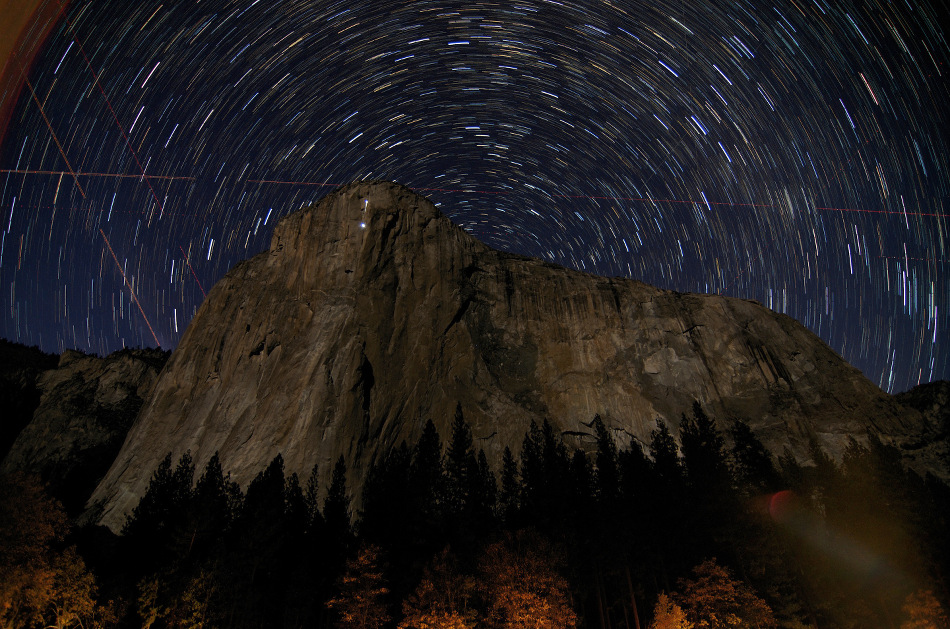
            Towering 3,000 feet from base to summit, the famous granite face of El Capitan in Earth's Yosemite National Park just hides the planet's north celestial pole in this skyscape. Of course, the north celestial pole is at the center of all the star trails. Their short arcs reflecting the planet's daily rotation on its axis are traced in a digital stack of 36 sequential exposures. Linear trails of passing airplane navigation lights and a flare from car lights along the road below are also captured in the sequential stack. But the punctuated trail of light seen against the sheer El Capitan itself follows a climbing team on the night of November 8, 2013. The team is ascending toward the summit along The Nose, a historic rock climbing route.
            1st in Kommisar's 2009 SM Tournament
            1st in I Love You`s 2009 New Year`s Tournament
            3rd in EnR's Mashfest '08 tournament
            5th in Phynx's Unofficial FFR Tournament
            9th in D3 of the 2008-2009 4th Official FFR Tournament
            10th in D5 of the 2010 5th Official FFR Tournament
            10th in D6 of the 2011-2012 6th Official FFR Tournament

            FMO AAA Count: 71
            FGO AAA Count: 10

            Bluearrowll = The Canadian player who can not detect awkward patterns. If it's awkward for most people, it's normal for Terry. If the file is difficult but super straight forward, he has issues. If he's AAAing a FGO but then heard that his favorite Hockey team was losing by a point, Hockey > FFR
            PS: Cool AAA's Terry
            - I Love You


            An Alarm Clock's Haiku
            beep beep beep beep beep
            beep beep beep beep beep beep beep
            beep beep beep beep beep
            - ieatyourlvllol

            Comment

            • Snowcrafta
              V's beta-male entourage
              • May 2005
              • 2873

              #876
              Re: Terry's Astronomy Thread.

              Sticky this again, tia

              Comment

              • Bluearrowll
                ⊙▃⊙
                FFR Simfile Author
                • Nov 2007
                • 7376

                #877
                Re: Terry's Astronomy Thread.

                Daily Suspicious0bserver's Weather Post:
                March 22, 2014


                What's in the sky tonight?
                March 22, 2014
                -When the stars come out this week, the Big Dipper is standing on its handle in the northeast. As evening grows late, the Dipper climbs higher and starts tipping to the left.

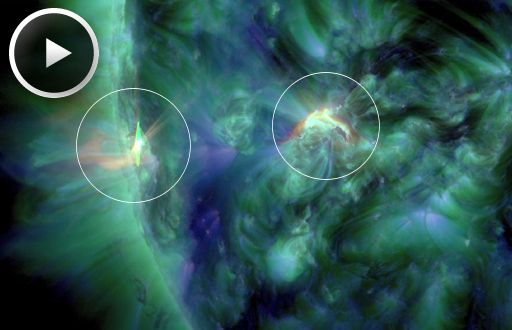
                -Long ago researchers thought solar flares were isolated events. Magnetic fields above a single sunspot became unstable and exploded--end of story. The Solar Dynamics Observatory's global view of the sun has shown, however, that widely-separated sunspots can explode in tandem. That's what happened on March 20th when AR2010 and AR2014 combined for a double flare. Transparent arcs of magnetism stretching across the 400,000 km divide between the two sunspots allow them to communicate magnetohydrodynamically, so instabilities in one can affect the other. This appears to be a textbook example of a 'sympathetic flare.' The most famous example occurred on August 1, 2010. SDO watched as instabilities jumped vast distances from one sunspot to another, setting off a chain reaction that engulfed more than half the sun. Compared to that global eruption, today's double flare was puny--or as puny as two explosions more powerful than a billion nuclear bombs can be. Welcome to the sun.


                Astro Picture of the Day:
                March 22, 2014

                Source:
                Deep shadows create dramatic contrasts between light and dark in this high-resolution close-up of the martian surface. Recorded on January 24 by the HiRISE camera onboard the Mars Reconnaissance Orbiter, the scene spans about 1.5 kilometers across a sand dune field in a southern highlands crater. Captured when the Sun was just 5 degrees above the local horizon, only the dune crests are caught in full sunlight. With the long, cold winter approaching the red planet's southern hemisphere, bright ridges of seasonal frost line the martian dunes.
                1st in Kommisar's 2009 SM Tournament
                1st in I Love You`s 2009 New Year`s Tournament
                3rd in EnR's Mashfest '08 tournament
                5th in Phynx's Unofficial FFR Tournament
                9th in D3 of the 2008-2009 4th Official FFR Tournament
                10th in D5 of the 2010 5th Official FFR Tournament
                10th in D6 of the 2011-2012 6th Official FFR Tournament

                FMO AAA Count: 71
                FGO AAA Count: 10

                Bluearrowll = The Canadian player who can not detect awkward patterns. If it's awkward for most people, it's normal for Terry. If the file is difficult but super straight forward, he has issues. If he's AAAing a FGO but then heard that his favorite Hockey team was losing by a point, Hockey > FFR
                PS: Cool AAA's Terry
                - I Love You


                An Alarm Clock's Haiku
                beep beep beep beep beep
                beep beep beep beep beep beep beep
                beep beep beep beep beep
                - ieatyourlvllol

                Comment

                • Bluearrowll
                  ⊙▃⊙
                  FFR Simfile Author
                  • Nov 2007
                  • 7376

                  #878
                  Re: Terry's Astronomy Thread.

                  Daily Suspicious0bserver's Weather Post:
                  March 23, 2014


                  What's in the sky tonight?
                  March 23, 2014
                  -Double shadow transit on Jupiter: Ganymede and Io are both casting their tiny black shadows onto the giant planet from 10:08 to 10:32 p.m. EDT (9:08 to 9:32 p.m. CDT).

                  -Last quarter Moon (exact at 9:46 p.m. EDT). The Moon, in northern Sagittarius, rises around 2 or 3 a.m. Monday morning. By dawn Monday look for Antares very far to the Moon's right, Altair about equally far to the Moon's upper left, and bright Venus about equally far to its lower left.

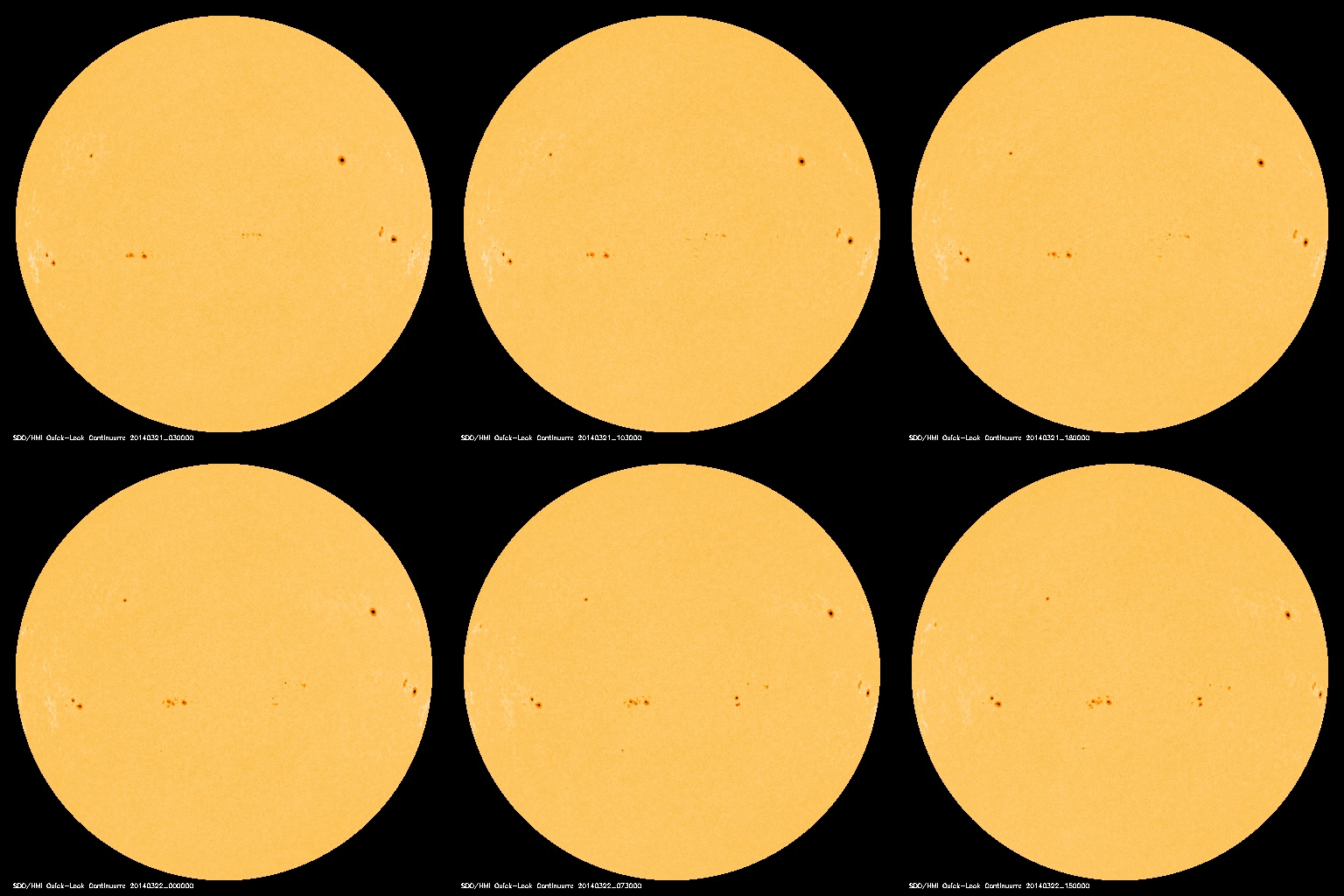
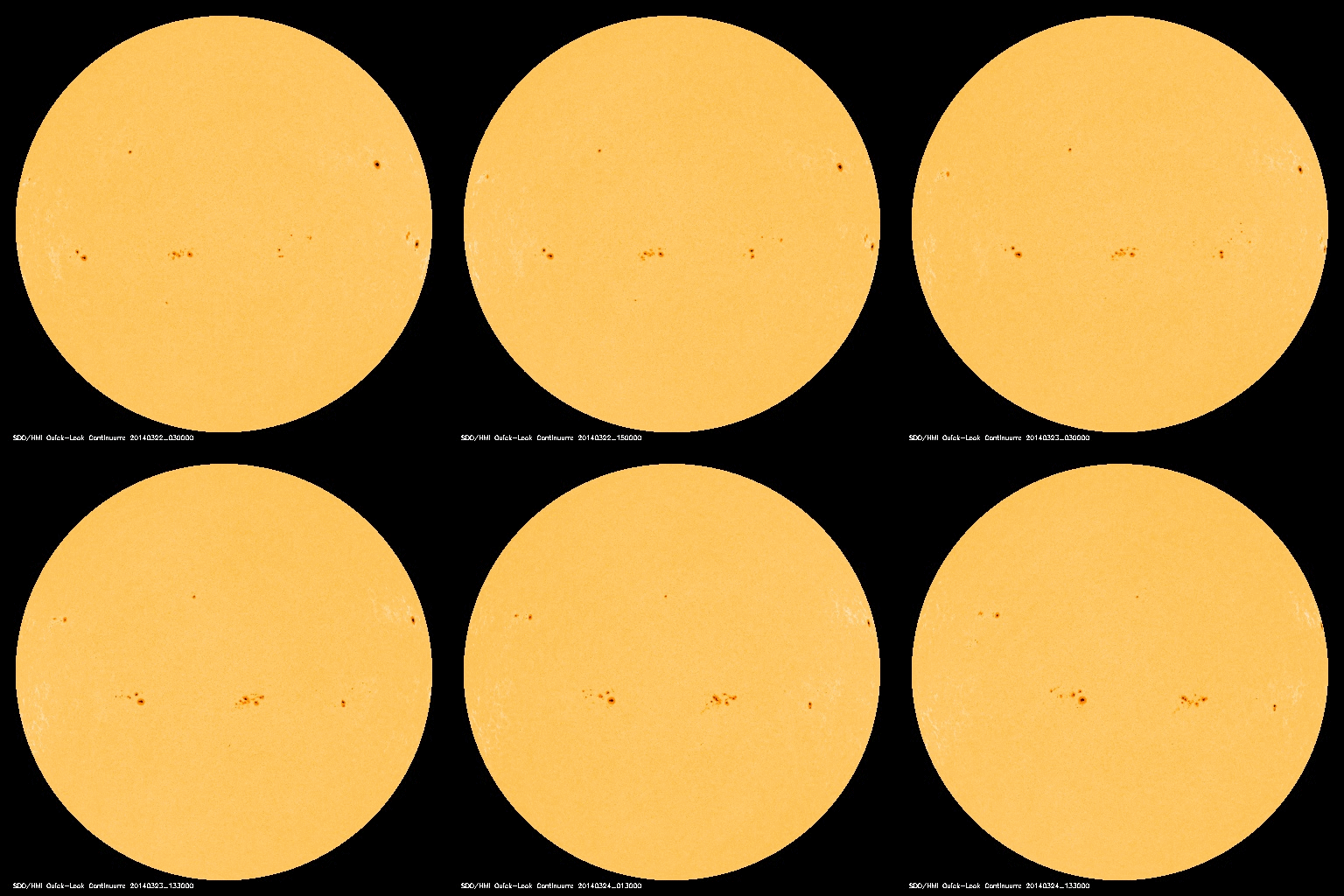
                  -A long line of sunspots is stretching across the sun's southern hemisphere, and at least two of them (AR2010 and AR2014) have 'beta-gamma' magnetic fields that harbor energy for M-class solar flares. NASA's Solar Dynamics Observatory photographed the "sunspot train" in motion on March 22nd.

                  -Most of these sunspots are facing Earth, so if any of them erupts the blast would likely be geoeffective. NOAA forecasters estimate a 45% chance of M-class flares and a 5% chance of X-flares this weekend.


                  Astro Picture of the Day:
                  March 23, 2014

                  Source:
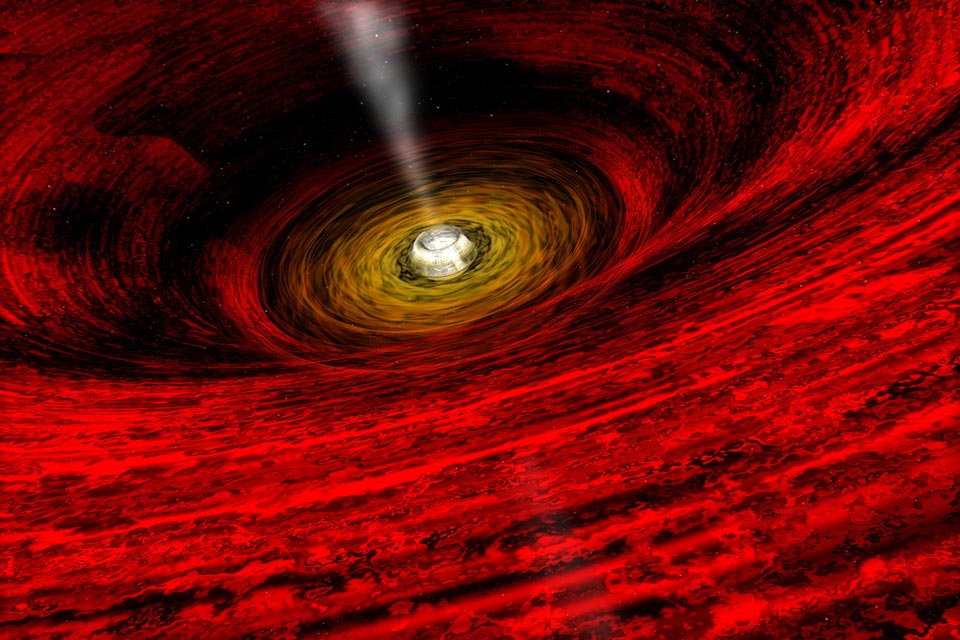
                  In the center of a swirling whirlpool of hot gas is likely a beast that has never been seen directly: a black hole. Studies of the bright light emitted by the swirling gas frequently indicate not only that a black hole is present, but also likely attributes. The gas surrounding GRO J1655-40, for example, has been found to display an unusual flickering at a rate of 450 times a second. Given a previous mass estimate for the central object of seven times the mass of our Sun, the rate of the fast flickering can be explained by a black hole that is rotating very rapidly. What physical mechanisms actually cause the flickering -- and a slower quasi-periodic oscillation (QPO) -- in accretion disks surrounding black holes and neutron stars remains a topic of much research.
                  1st in Kommisar's 2009 SM Tournament
                  1st in I Love You`s 2009 New Year`s Tournament
                  3rd in EnR's Mashfest '08 tournament
                  5th in Phynx's Unofficial FFR Tournament
                  9th in D3 of the 2008-2009 4th Official FFR Tournament
                  10th in D5 of the 2010 5th Official FFR Tournament
                  10th in D6 of the 2011-2012 6th Official FFR Tournament

                  FMO AAA Count: 71
                  FGO AAA Count: 10

                  Bluearrowll = The Canadian player who can not detect awkward patterns. If it's awkward for most people, it's normal for Terry. If the file is difficult but super straight forward, he has issues. If he's AAAing a FGO but then heard that his favorite Hockey team was losing by a point, Hockey > FFR
                  PS: Cool AAA's Terry
                  - I Love You


                  An Alarm Clock's Haiku
                  beep beep beep beep beep
                  beep beep beep beep beep beep beep
                  beep beep beep beep beep
                  - ieatyourlvllol

                  Comment

                  • Bluearrowll
                    ⊙▃⊙
                    FFR Simfile Author
                    • Nov 2007
                    • 7376

                    #879
                    Re: Terry's Astronomy Thread.

                    Daily Suspicious0bserver's Weather Post:
                    March 24, 2014


                    What's in the sky tonight?
                    March 24, 2014
                    -By 10 or 11 p.m. Mars and Spica are well up in the southeast. Look almost two fists at arm's length to their right for the four-star pattern of Corvus, the Crow. Normally the Crow eyes Spica in Virgo's hand. Now he may be more interested in the brighter shiny right close by.

                    -A CME launched from sunspot AR2014 on March 23rd is expected to deliver a glancing blow to Earth's magnetic field on March 25th. NOAA forecasters estimate a 30%-40% chance of polar geomagnetic storms on March 25-26.

                    -Jupiter, among the legs of Gemini all week, forms the top of this year's Winter Diamond — which is still standing high as spring pushes winter aside. Procyon and Betelgeuse form the Diamond's side corners. This is how they're oriented in twilight as the stars come out. (Sirius is the Diamond's bottom.) The 3rd-magnitude star closest to Jupiter is Epsilon Geminorum, a yellow-orange supergiant 900 light-years away. Can you see its tint with your unaided eyes?


                    Astro Picture of the Day:
                    March 24, 2014

                    Source:
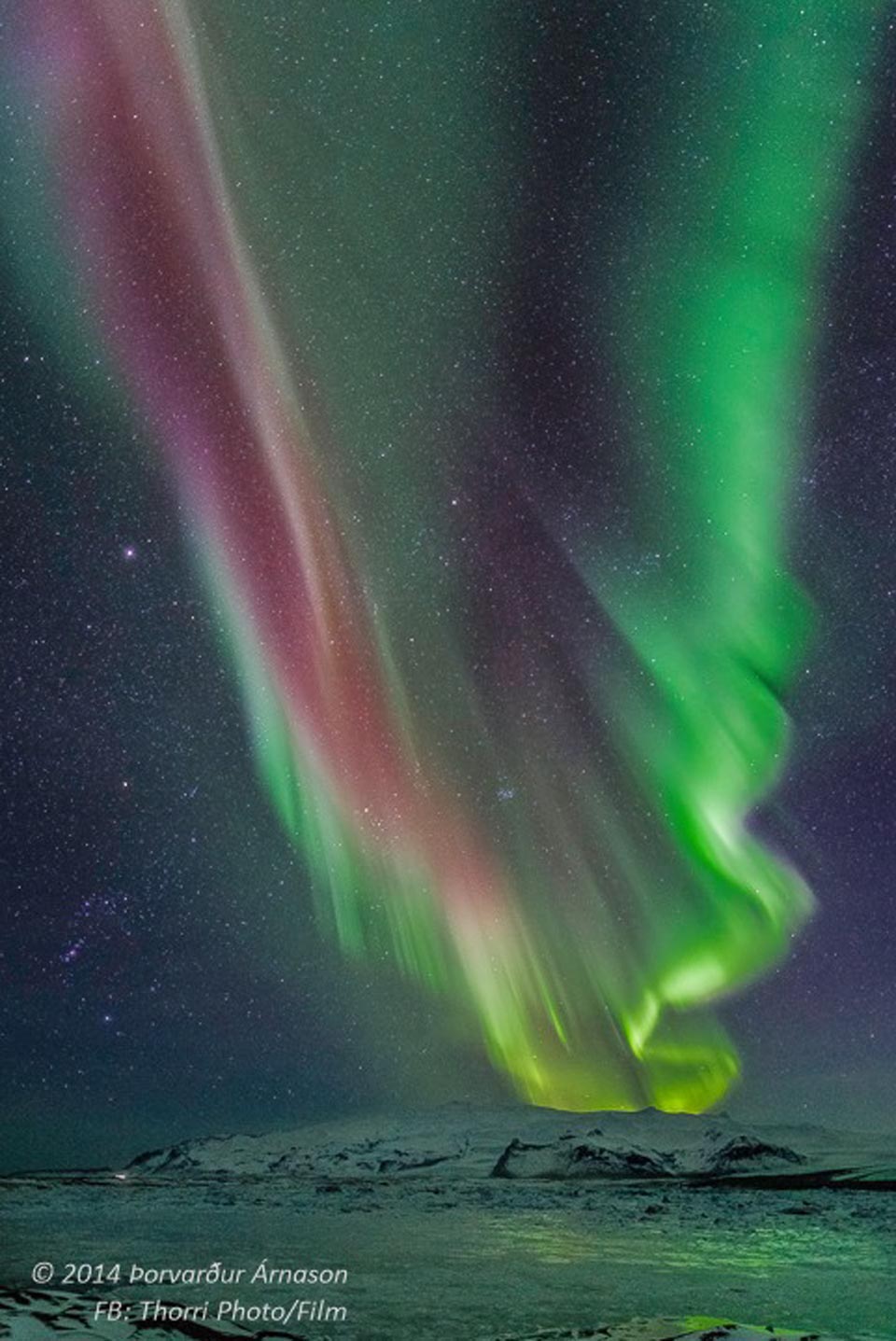
                    If you see a sky like this -- photograph it. A month ago in Iceland, an adventurous photographer (pictured) chanced across a sky full of aurora and did just that. In the foreground lies the stratovolcano Öræfajökull. In the background, among other sky delights, lies the constellation of Orion, visible to the aurora's left. Auroras are sparked by energetic particles from the Sun impacting the magnetic environment around the Earth. Resultant energetic particles such as electrons and protons rain down near the Earth's poles and impact the air. The impacted air molecules obtain excited electrons, and when electrons in oxygen molecules fall back to their ground state, they emit green light. Auroras are known to have many shapes and colors.
                    1st in Kommisar's 2009 SM Tournament
                    1st in I Love You`s 2009 New Year`s Tournament
                    3rd in EnR's Mashfest '08 tournament
                    5th in Phynx's Unofficial FFR Tournament
                    9th in D3 of the 2008-2009 4th Official FFR Tournament
                    10th in D5 of the 2010 5th Official FFR Tournament
                    10th in D6 of the 2011-2012 6th Official FFR Tournament

                    FMO AAA Count: 71
                    FGO AAA Count: 10

                    Bluearrowll = The Canadian player who can not detect awkward patterns. If it's awkward for most people, it's normal for Terry. If the file is difficult but super straight forward, he has issues. If he's AAAing a FGO but then heard that his favorite Hockey team was losing by a point, Hockey > FFR
                    PS: Cool AAA's Terry
                    - I Love You


                    An Alarm Clock's Haiku
                    beep beep beep beep beep
                    beep beep beep beep beep beep beep
                    beep beep beep beep beep
                    - ieatyourlvllol

                    Comment

                    • Bluearrowll
                      ⊙▃⊙
                      FFR Simfile Author
                      • Nov 2007
                      • 7376

                      #880
                      Re: Terry's Astronomy Thread.

                      Daily Suspicious0bserver's Weather Post:
                      March 25, 2014


                      What's in the sky tonight?
                      March 25, 2014
                      -The biggest and brightest asteroids, 1 Ceres and 4 Vesta respectively, are only about 2° apart in eastern Virgo in the early morning hours, some 12° northeast of Mars. They've brightened to magnitudes 7.3 and 6.1, respectively. They'll be at opposition in mid-April.

                      -Earth is looking down the double barrel of two potentially active sunspots: AR2010 and AR2014 have complex magnetic fields that harbor energy for strong eruptions, and both have grown since the week began. The CME expected to sideswipe Earth later today was propelled toward us by a C-flare from sunspot AR2014 on March 23rd. Otherwise the two sunspots have been mostly quiet. Is it the calm before the storm? NOAA forecasters estimate a 45% chance of M-class flares and a 5% chance of X-flares on March 25th


                      Astro Picture of the Day:
                      March 25, 2014

                      Source:
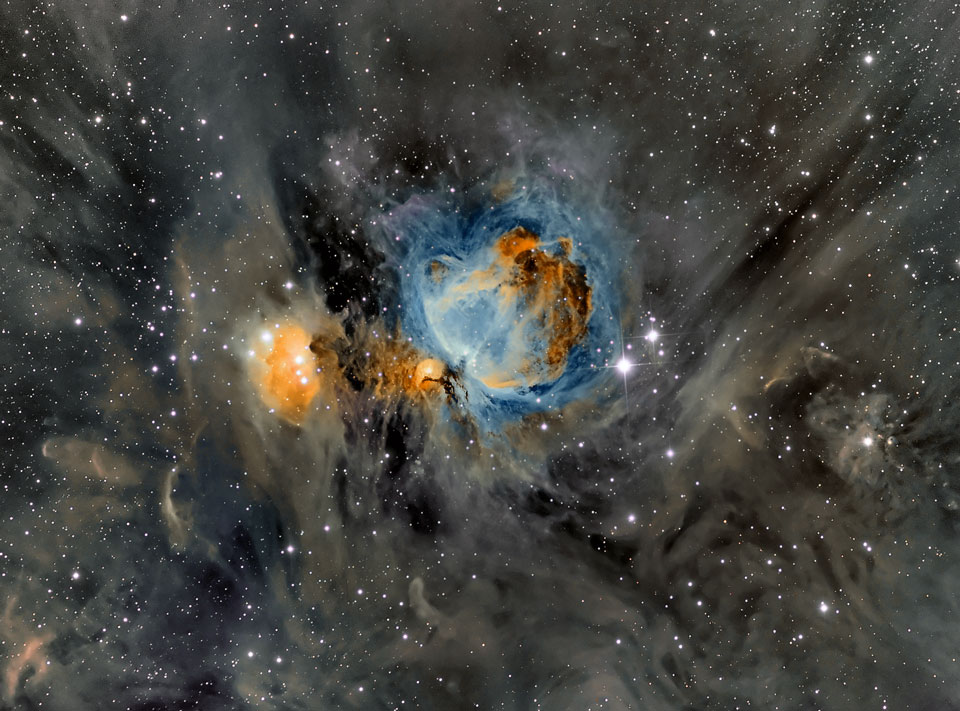
                      What surrounds a hotbed of star formation? In the case of the Orion Nebula -- dust. The entire Orion field, located about 1600 light years away, is inundated with intricate and picturesque filaments of dust. Opaque to visible light, dust is created in the outer atmosphere of massive cool stars and expelled by a strong outer wind of particles. The Trapezium and other forming star clusters are embedded in the nebula. The intricate filaments of dust surrounding M42 and M43 appear gray in the above image, while central glowing gas is highlighted in brown and blue. Over the next few million years much of Orion's dust will be slowly destroyed by the very stars now being formed, or dispersed into the Galaxy.
                      1st in Kommisar's 2009 SM Tournament
                      1st in I Love You`s 2009 New Year`s Tournament
                      3rd in EnR's Mashfest '08 tournament
                      5th in Phynx's Unofficial FFR Tournament
                      9th in D3 of the 2008-2009 4th Official FFR Tournament
                      10th in D5 of the 2010 5th Official FFR Tournament
                      10th in D6 of the 2011-2012 6th Official FFR Tournament

                      FMO AAA Count: 71
                      FGO AAA Count: 10

                      Bluearrowll = The Canadian player who can not detect awkward patterns. If it's awkward for most people, it's normal for Terry. If the file is difficult but super straight forward, he has issues. If he's AAAing a FGO but then heard that his favorite Hockey team was losing by a point, Hockey > FFR
                      PS: Cool AAA's Terry
                      - I Love You


                      An Alarm Clock's Haiku
                      beep beep beep beep beep
                      beep beep beep beep beep beep beep
                      beep beep beep beep beep
                      - ieatyourlvllol

                      Comment

                      • Bluearrowll
                        ⊙▃⊙
                        FFR Simfile Author
                        • Nov 2007
                        • 7376

                        #881
                        Re: Terry's Astronomy Thread.

                        Daily Suspicious0bserver's Weather Post:
                        March 26, 2014


                        What's in the sky tonight?
                        March 26, 2014
                        -As dawn brightens on Thursday morning the 27th, you'll find Venus near the thin waning crescent Moon, as shown here.

                        -The waning Moon pairs with Venus on Thursday morning the 27th in the longitudes of the Americas. European observers: move each Moon symbol a quarter of the way toward the one for the previous date. In the Far East, move it halfway. The Moon here is drawn three times actual size.

                        -A CME hit Earth's magnetic field on March 25th at approximately 19:45 UT. The glancing blow was relatively weak, but auroras appeared anyway. Hours after the impact, green lights dueled with the blue glow of dawn over Sørkjosen, Norway." The sky was really bright at 3am, but I could still see the auroras," says photographer Tommy Richardsen. "Times around equinoxes really are special. You can see auroras even when you should not be able to."

                        He's right. For reasons researchers do not fully understand, equinoxes favour auroras. As northern spring unfolds, even relatively small gusts of solar wind and weak CME impacts can spark a good display. NOAA forecasters estimate a 40% chance of geomagnetic storms on March 26th as Earth passes through the wake of the CME.


                        News Posted Today:
                        March 25, 2014
                        Have We Spotted Dark Matter in the Milky Way?


                        Astro Picture of the Day:
                        March 26, 2014

                        Source:
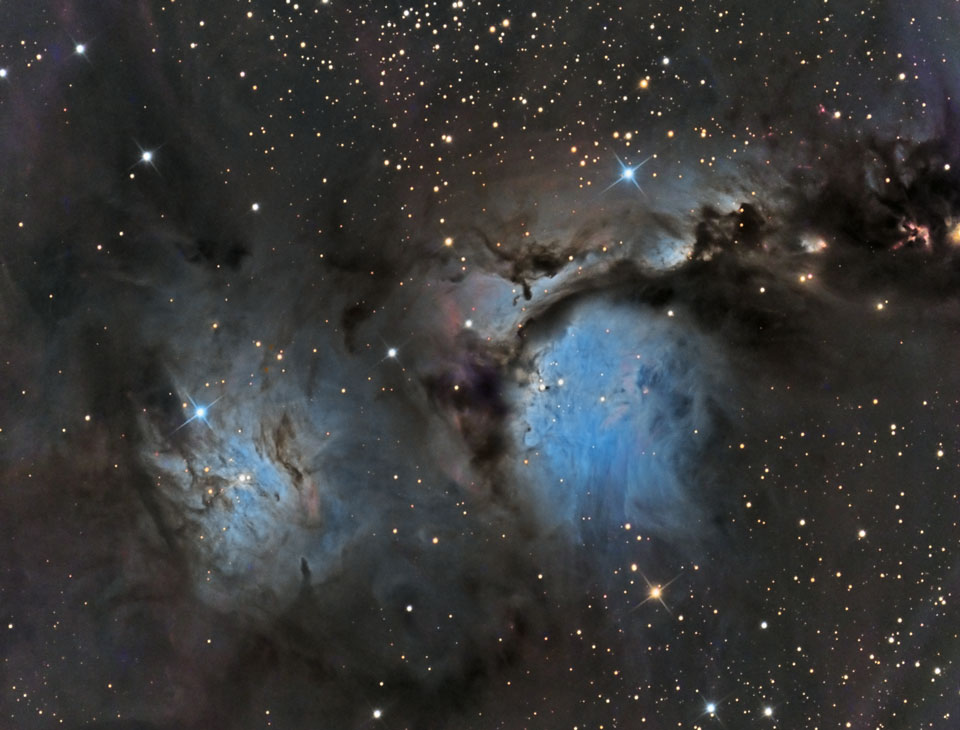
                        An eerie blue glow and ominous columns of dark dust highlight M78 and other bright reflection nebula in the constellation of Orion. The dark filamentary dust not only absorbs light, but also reflects the light of several bright blue stars that formed recently in the nebula. Of the two reflection nebulas pictured above, the more famous nebula is M78, in the image center, while NGC 2071 can be seen to its lower left. The same type of scattering that colors the daytime sky further enhances the blue color. M78 is about five light-years across and visible through a small telescope. M78 appears above only as it was 1600 years ago, however, because that is how long it takes light to go from there to here. M78 belongs to the larger Orion Molecular Cloud Complex that contains the Great Nebula in Orion and the Horsehead Nebula.
                        1st in Kommisar's 2009 SM Tournament
                        1st in I Love You`s 2009 New Year`s Tournament
                        3rd in EnR's Mashfest '08 tournament
                        5th in Phynx's Unofficial FFR Tournament
                        9th in D3 of the 2008-2009 4th Official FFR Tournament
                        10th in D5 of the 2010 5th Official FFR Tournament
                        10th in D6 of the 2011-2012 6th Official FFR Tournament

                        FMO AAA Count: 71
                        FGO AAA Count: 10

                        Bluearrowll = The Canadian player who can not detect awkward patterns. If it's awkward for most people, it's normal for Terry. If the file is difficult but super straight forward, he has issues. If he's AAAing a FGO but then heard that his favorite Hockey team was losing by a point, Hockey > FFR
                        PS: Cool AAA's Terry
                        - I Love You


                        An Alarm Clock's Haiku
                        beep beep beep beep beep
                        beep beep beep beep beep beep beep
                        beep beep beep beep beep
                        - ieatyourlvllol

                        Comment

                        • Bluearrowll
                          ⊙▃⊙
                          FFR Simfile Author
                          • Nov 2007
                          • 7376

                          #882
                          Re: Terry's Astronomy Thread.

                          Daily Suspicious0bserver's Weather Post:
                          March 27, 2014


                          What's in the sky tonight?
                          March 27, 2014
                          -On the traditional divide between the winter and spring sky is the dim constellation Cancer. It's between Gemini to its west and Leo to its east. Cancer holds a unique object: the Beehive Star Cluster, M44, in its middle. The Beehive shows to the naked eye as a dim, cloudy glow if your sky is fairly dark. Look for it a little less than halfway from Pollux to Regulus. With binoculars it's a snap even in a polluted sky.

                          -On the sun today, two sunspots (AR2010 and AR2014) have unstable magnetic fields that harbor energy for significant flares. However, neither one is flaring. Solar activity is low and likely to remain so for the rest of the day. NOAA forecasters estimate a 25% chance of M-class flares (that is, a 75% chance of no M-class flares) on March 27th.

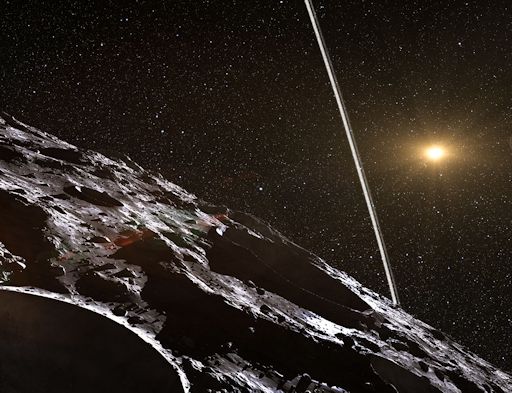
                          -At a press conference in Brazil, astronomers announced the surprising discovery of an asteroid with rings. The 250-km-wide asteroid, named Chariklo, is located in the outer solar system between Saturn and Uranus. In June 2013, observers used seven different telescopes in South America to watch the asteroid pass in front of a distant star. The star winked out not just once, as would be expected for a solitary asteroid, but multiple times, revealing a pair of dense narrow rings surrounding the space rock. Below is an artist's concept of the system.

                          "We weren't looking for a ring and didn't think small bodies like Chariklo had them at all, so the discovery — and the amazing amount of detail we saw in the system — came as a complete surprise!" says Felipe Braga-Ribas of Observatório Nacional/MCTI in Rio de Janeiro. He planned the observing campaign and is the lead author of a March 26th paper in Nature describing the results.

                          According to their analysis, the rings are only 3 km and 7 km wide, respectively, with a 9 km gap between them. "I try to imagine how it would be to stand on the surface of this icy asteroid and stare up at a such a ring system 1000 times closer than the Moon," adds team member Uffe Gråe Jørgensen of the Niels Bohr Institute in Denmark.

                          Because the rings are so narrow, they are probably confined and shepherded by small satellites. "So, as well as the rings, it's likely that Chariklo has at least one small moon still waiting to be discovered," adds Felipe Braga Ribas. For more information about this discovery, click here: http://www.eso.org/public/news/eso1410/


                          Astro Picture of the Day:
                          March 27, 2014

                          Source:
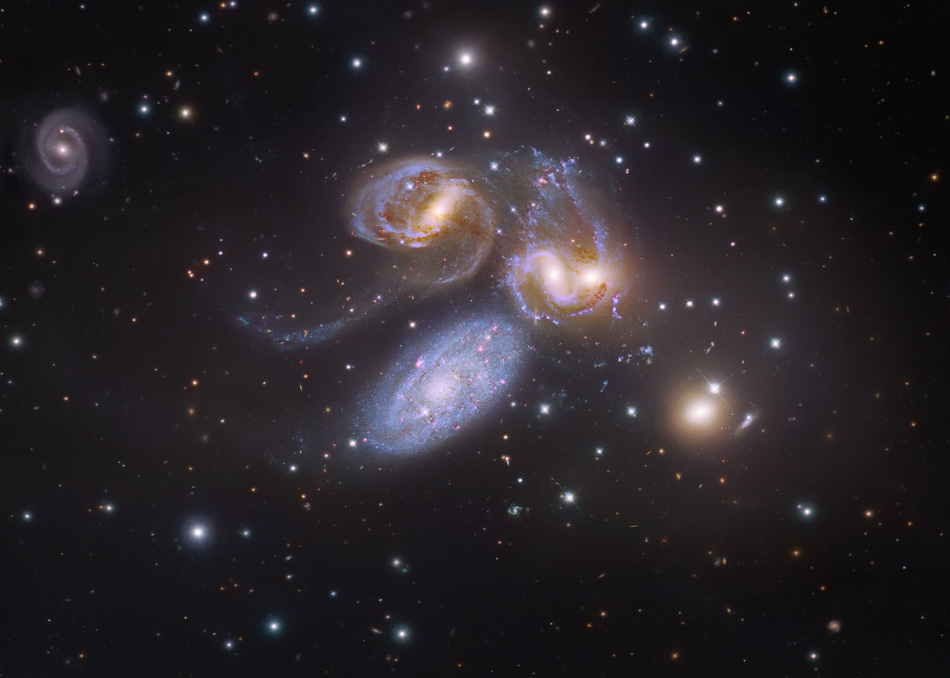
                          The first identified compact galaxy group, Stephan's Quintet is featured in this remarkable image constructed with data drawn from Hubble Legacy Archive and the Subaru Telescope on the summit of Mauna Kea. The galaxies of the quintet are gathered near the center of the field, but really only four of the five are locked in a cosmic dance of repeated close encounters taking place some 300 million light-years away. The odd man out is easy to spot, though. The interacting galaxies, NGC 7319, 7318A, 7318B, and 7317 have a more dominant yellowish cast. They also tend to have distorted loops and tails, grown under the influence of disruptive gravitational tides. The mostly bluish galaxy, NGC 7320, is in the foreground about 40 million light-years distant, and isn't part of the interacting group. Still, captured in this field above and to the left of Stephan's Quintet is another galaxy, NGC 7320C, that is also 300 million light-years distant. Of course, including it would bring the four interacting galaxies back up to quintet status. Stephan's Quintet lies within the boundaries of the high flying constellation Pegasus. At the estimated distance of the quintet's interacting galaxies, this field of view spans over 500,000 light-years.
                          1st in Kommisar's 2009 SM Tournament
                          1st in I Love You`s 2009 New Year`s Tournament
                          3rd in EnR's Mashfest '08 tournament
                          5th in Phynx's Unofficial FFR Tournament
                          9th in D3 of the 2008-2009 4th Official FFR Tournament
                          10th in D5 of the 2010 5th Official FFR Tournament
                          10th in D6 of the 2011-2012 6th Official FFR Tournament

                          FMO AAA Count: 71
                          FGO AAA Count: 10

                          Bluearrowll = The Canadian player who can not detect awkward patterns. If it's awkward for most people, it's normal for Terry. If the file is difficult but super straight forward, he has issues. If he's AAAing a FGO but then heard that his favorite Hockey team was losing by a point, Hockey > FFR
                          PS: Cool AAA's Terry
                          - I Love You


                          An Alarm Clock's Haiku
                          beep beep beep beep beep
                          beep beep beep beep beep beep beep
                          beep beep beep beep beep
                          - ieatyourlvllol

                          Comment

                          • Bluearrowll
                            ⊙▃⊙
                            FFR Simfile Author
                            • Nov 2007
                            • 7376

                            #883
                            Re: Terry's Astronomy Thread.

                            Daily Suspicious0bserver's Weather Post:
                            March 28, 2014


                            What's in the sky tonight?
                            March 28, 2014
                            -The huge, bright Winter Hexagon nearly fills the southwestern sky at dusk. Start with bright Sirius in the south, marking the Hexagon's lower left corner. High above Sirius is Procyon. From there look even higher to Pollux and Castor with bright Jupiter below them, then from Castor farther lower right to Menkalinen and Capella, then lower left to Aldebaran, then duck around lower left to Rigel at the bottom of Orion, and back to Sirius. Within the Hexagon shine Jupiter and Betelgeuse.

                            News Posted Today:
                            March 28, 2014
                            Rosetta Spots Its Comet


                            Astro Picture of the Day:
                            March 28, 2014

                            Source:
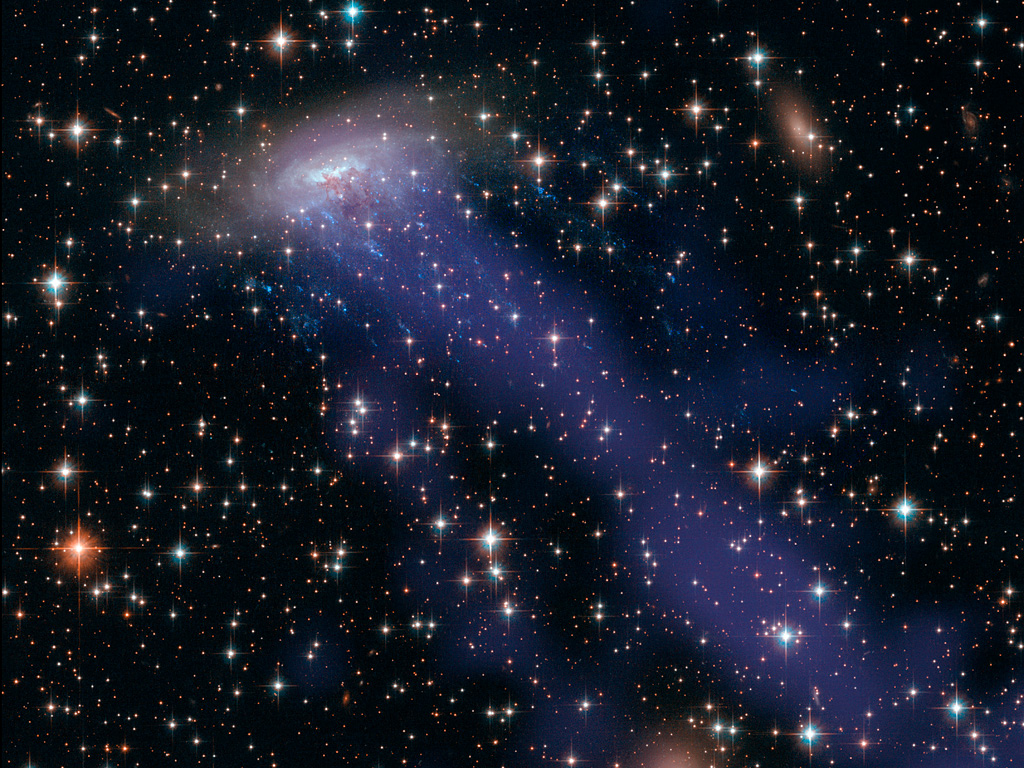
                            Spiral galaxy ESO 137-001 hurtles through massive galaxy cluster Abell 3627 some 220 million light years away. The distant galaxy is seen in this colorful Hubble/Chandra composite image through a foreground of the Milky Way's stars toward the southern constellation Triangulum Australe. As the spiral speeds along at nearly 7 million kilometers per hour, its gas and dust are stripped away when ram pressure with the cluster's own hot, tenuous intracluster medium overcomes the galaxy's gravity. Evident in Hubble's near visible light data, bright star clusters have formed in the stripped material along the short, trailing blue streaks. Chandra's X-ray data shows off the enormous extent of the heated, stripped gas as diffuse, darker blue trails stretching over 400,000 light-years toward the bottom right. The significant loss of dust and gas will make new star formation difficult for this galaxy. A yellowish elliptical galaxy, lacking in star forming dust and gas, is just to the right of ESO 137-001 in the frame.

                            Daily Suspicious0bserver's Weather Post:
                            March 29, 2014


                            What's in the sky tonight?
                            March 29, 2014
                            -You can tell winter is gone for good, astronomically speaking: As soon as the stars come out, the Big Dipper is already higher in the northeast than Cassiopeia is in the northwest.

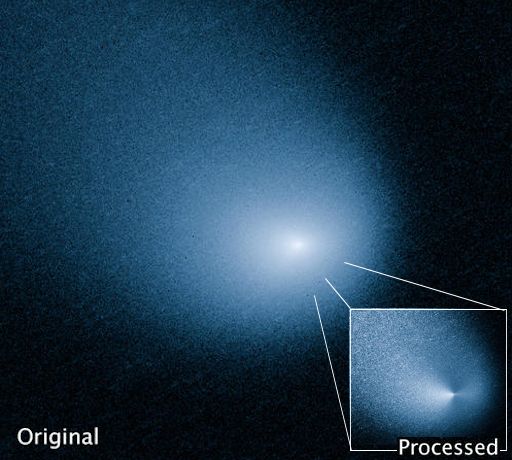
                            -Later this year, Mars is going to have a close encounter with a comet. On Oct. 19, 2014, Comet Siding Spring (C/2013 A1) will buzz the Red Planet about 10 times closer than any known comet has ever flown past Earth. Mars could actually find itself inside the comet's extended atmosphere as the comet passes by only 138,000 km away. Needless to say, NASA is watching carefully. The latest images from the Hubble Space Telescope show jets spewing from the comet's core. The image, captured on March 11th, shows comet Siding Spring at a distance of 353 million miles from Earth. Hubble can't see the icy nucleus because it is hidden inside the comet's glowing dusty atmosphere. Nevertheless, image processing did reveal what appears to be two jets of dust coming off the nucleus in opposite directions. This observation allows astronomers to calculate the direction of the nucleus's pole, and axis of rotation.

                            "This is critical information that we need to determine whether, and to what degree, dust grains in the [atmosphere] of the comet will impact Mars and spacecraft orbiting Mars," says Jian-Yang Li of the Planetary Science Institute in Tucson, Arizona.

                            Indeed, meteoroids from the comet could hit NASA's Mars orbiters and damage them even as the orbiters try to study the comet. The level of risk won't be known for months, but NASA is already evaluating possible precautionary measures. Data from Hubble and other observatories in the months ahead will clarify the dangers.


                            Astro Picture of the Day:
                            March 29, 2014

                            Source:
                            As dawn broke on March 27, the center of the Milky Way Galaxy stood almost directly above the European Southern Observatory's Paranal Observatory. In the dry, clear sky of Chile's Atacama desert, our galaxy's dusty central bulge is flanked by Paranal's four 8 meter Very Large Telescope units in this astronomical fisheye view. Along the top, Venus is close to the eastern horizon. The brilliant morning star shines very near a waning crescent Moon just at the edge of one of the telescope structures. Despite the bright pairing in the east, the Milky Way dominates the scene though. Cut by dust lanes and charged with clouds of stars and glowing nebulae, the center of our galaxy sprawls across the darker zenith even as the deep blue sky grows brighter and buildings still glint in moonlight.
                            1st in Kommisar's 2009 SM Tournament
                            1st in I Love You`s 2009 New Year`s Tournament
                            3rd in EnR's Mashfest '08 tournament
                            5th in Phynx's Unofficial FFR Tournament
                            9th in D3 of the 2008-2009 4th Official FFR Tournament
                            10th in D5 of the 2010 5th Official FFR Tournament
                            10th in D6 of the 2011-2012 6th Official FFR Tournament

                            FMO AAA Count: 71
                            FGO AAA Count: 10

                            Bluearrowll = The Canadian player who can not detect awkward patterns. If it's awkward for most people, it's normal for Terry. If the file is difficult but super straight forward, he has issues. If he's AAAing a FGO but then heard that his favorite Hockey team was losing by a point, Hockey > FFR
                            PS: Cool AAA's Terry
                            - I Love You


                            An Alarm Clock's Haiku
                            beep beep beep beep beep
                            beep beep beep beep beep beep beep
                            beep beep beep beep beep
                            - ieatyourlvllol

                            Comment

                            • Bluearrowll
                              ⊙▃⊙
                              FFR Simfile Author
                              • Nov 2007
                              • 7376

                              #884
                              Re: Terry's Astronomy Thread.

                              Daily Suspicious0bserver's Weather Post:
                              March 30, 2014


                              What's in the sky tonight?
                              March 30, 2014
                              -This is the time of year when the dim Little Dipper juts to the right from Polaris (its handle-end) during evening hours. The much brighter Big Dipper curls over high above it, "dumping water" into it.

                              -New Moon (exact at 2:45 p.m. Eastern Daylight Time).

                              -Polar geomagnetic storms are possible on April 1st when one or more CMEs are expected to deliver glancing blows to Earth's magnetic field. The source of the incoming CMEs is active sunspot AR2017. High-latitude sky watchers should be alert for auroras.

                              -On March 29th at 17:52 UT, the magnetic canopy of sunspot AR1890 erupted, producing a brief but intense X1-class solar flare. Radiation from the flare caused a surge in the ionization of Earth's upper atmosphere--and this led to a rare magnetic crochet, measuring 17 nT at the magnetometer in Boulder, Colorado.

                              A magnetic crochet is a ripple in Earth's magnetic field caused by electrical currents flowing in air 60 km to 100 km above our heads. Unlike geomagnetic disturbances that arrive with CMEs days after a flare, a magnetic crochet occurs while the flare is in progress. They tend to occur during fast impulsive flares like this one.

                              The explosion also hurled a CME into space. The bulk of the CME is sailing north of the sun-Earth line, but there appears to be a faint Earth-directed component that could deliver a glancing blow to our planet's magnetic field on April 1-2.

                              More flares are possible this weekend. NOAA forecasters estimate a 55% chance of M-class flares and a 20% chance of X-class flares on March 30th.

                              News Posted Today:
                              March 29, 2014
                              Global "Fail" for the Big Regulus Cover-up


                              Astro Picture of the Day:
                              March 30, 2014

                              Source:
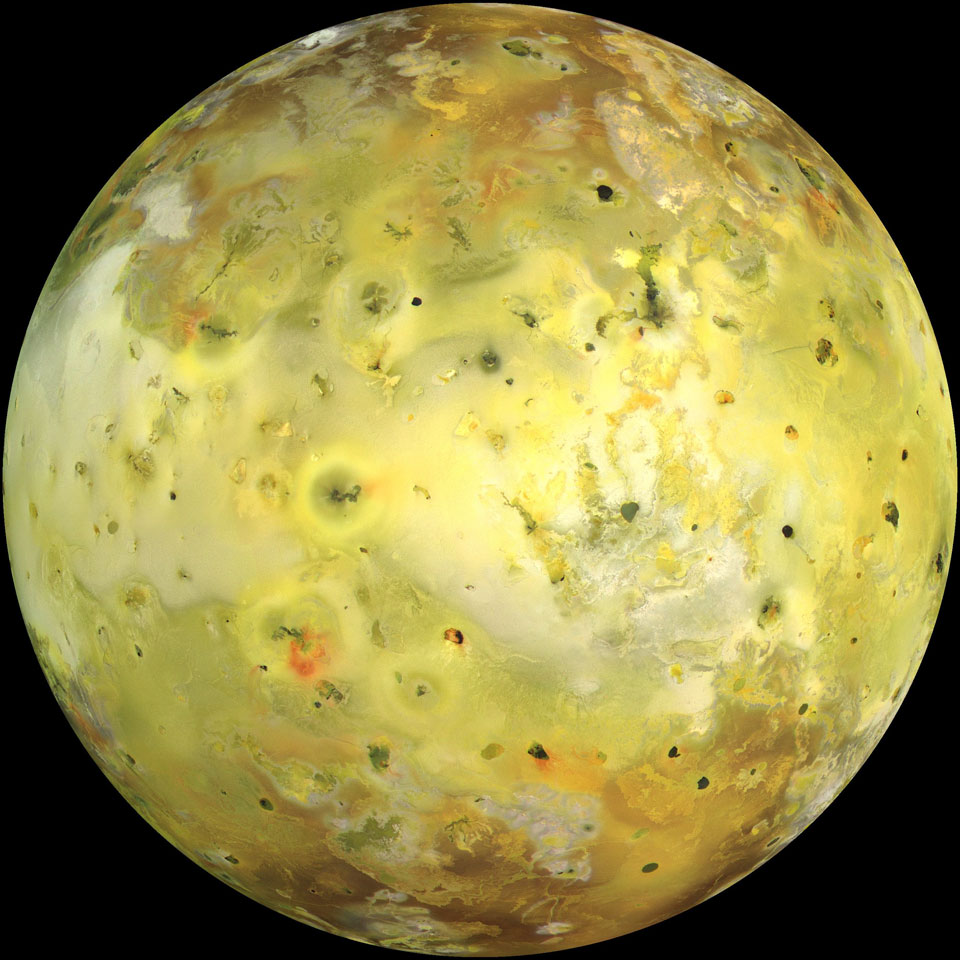
                              The strangest moon in the Solar System is bright yellow. This picture, an attempt to show how Io would appear in the "true colors" perceptible to the average human eye, was taken in 1999 July by the Galileo spacecraft that orbited Jupiter from 1995 to 2003. Io's colors derive from sulfur and molten silicate rock. The unusual surface of Io is kept very young by its system of active volcanoes. The intense tidal gravity of Jupiter stretches Io and damps wobbles caused by Jupiter's other Galilean moons. The resulting friction greatly heats Io's interior, causing molten rock to explode through the surface. Io's volcanoes are so active that they are effectively turning the whole moon inside out. Some of Io's volcanic lava is so hot it glows in the dark.
                              1st in Kommisar's 2009 SM Tournament
                              1st in I Love You`s 2009 New Year`s Tournament
                              3rd in EnR's Mashfest '08 tournament
                              5th in Phynx's Unofficial FFR Tournament
                              9th in D3 of the 2008-2009 4th Official FFR Tournament
                              10th in D5 of the 2010 5th Official FFR Tournament
                              10th in D6 of the 2011-2012 6th Official FFR Tournament

                              FMO AAA Count: 71
                              FGO AAA Count: 10

                              Bluearrowll = The Canadian player who can not detect awkward patterns. If it's awkward for most people, it's normal for Terry. If the file is difficult but super straight forward, he has issues. If he's AAAing a FGO but then heard that his favorite Hockey team was losing by a point, Hockey > FFR
                              PS: Cool AAA's Terry
                              - I Love You


                              An Alarm Clock's Haiku
                              beep beep beep beep beep
                              beep beep beep beep beep beep beep
                              beep beep beep beep beep
                              - ieatyourlvllol

                              Comment

                              • Bluearrowll
                                ⊙▃⊙
                                FFR Simfile Author
                                • Nov 2007
                                • 7376

                                #885
                                Re: Terry's Astronomy Thread.

                                Daily Suspicious0bserver's Weather Post:
                                March 31, 2014


                                What's in the sky tonight?
                                March 31, 2014
                                -NOAA forecasters estimate a 35% to 60% chance of polar geomagnetic storms on April 1-2 when at least three CMEs are expected to deliver glancing blows to Earth's magnetic field. The best-guess forecast calls for minor G1-class storms. High-latitude sky watchers should be alert for auroras.

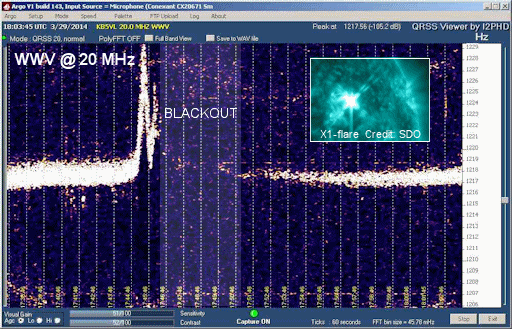
                                -On Saturday, March 29th, the magnetic canopy of sunspot AR2017 erupted, producing a brief but intense X1-class solar flare. A flash of extreme UV radiation sent waves of ionization rippling through Earth's upper atmosphere and disturbed the normal propagation of terrestrial radio transmissions. Radio engineer Stan Nelson of Roswell, NM, was monitoring WWV at 20 MHz when the signal wobbled then disappeared entirely for several minutes. "The Doppler shift of the WWV signal (the 'wobble' just before the blackout) was nearly 12 Hz, the most I have ever seen," says Nelson.

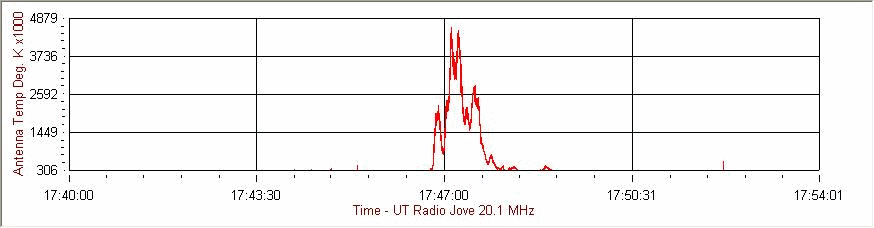
                                The flare not only blacked out radio signals, but also produced some radio signals of its own. The explosion above sunspot AR2017 sent shock waves racing through the sun's atmosphere at speeds as high as 4800 km/s (11 million mph). Radio emissions stimulated by those shocks crossed the 93 million mile divide to Earth, causing shortwave radio receivers to roar with static. A plot of the outburst detected by Nelson using a 20.1 MHz RadioJove receiver is shown below. Elsewhere, strong bursts were recorded at frequencies as high as 2800 MHz. It was a very broad band event.


                                Astro Picture of the Day:
                                March 31, 2014

                                Source:
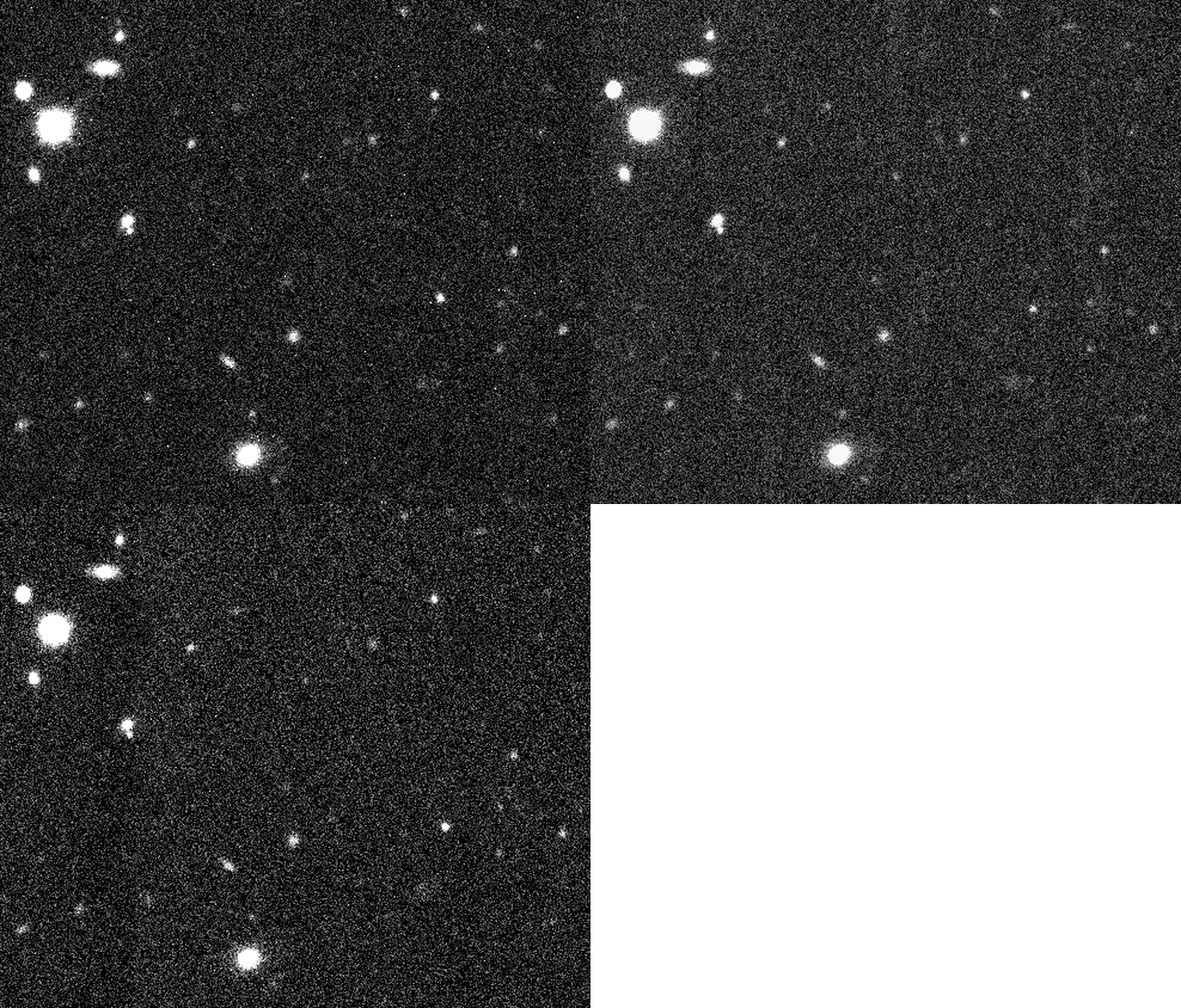
                                What is the furthest known object in our Solar System? The new answer is 2012 VP113, an object currently over twice the distance of Pluto from the Sun. Pictured above is a series of discovery images taken with the Dark Energy Camera attached to the NOAO's Blanco 4-meter Telescope in Chile in 2012 and released last week. The distant object, seen moving on the lower right, is thought to be a dwarf planet like Pluto. Previously, the furthest known dwarf planet was Sedna, discovered in 2003. Given how little of the sky was searched, it is likely that as many as 1,000 more objects like 2012 VP113 exist in the outer Solar System. 2012 VP113 is currently near its closest approach to the Sun, in about 2,000 years it will be over five times further. Some scientists hypothesize that the reason why objects like Sedna and 2012 VP113 have their present orbits is because they were gravitationally scattered there by a much larger object -- possibly a very distant undiscovered planet.
                                1st in Kommisar's 2009 SM Tournament
                                1st in I Love You`s 2009 New Year`s Tournament
                                3rd in EnR's Mashfest '08 tournament
                                5th in Phynx's Unofficial FFR Tournament
                                9th in D3 of the 2008-2009 4th Official FFR Tournament
                                10th in D5 of the 2010 5th Official FFR Tournament
                                10th in D6 of the 2011-2012 6th Official FFR Tournament

                                FMO AAA Count: 71
                                FGO AAA Count: 10

                                Bluearrowll = The Canadian player who can not detect awkward patterns. If it's awkward for most people, it's normal for Terry. If the file is difficult but super straight forward, he has issues. If he's AAAing a FGO but then heard that his favorite Hockey team was losing by a point, Hockey > FFR
                                PS: Cool AAA's Terry
                                - I Love You


                                An Alarm Clock's Haiku
                                beep beep beep beep beep
                                beep beep beep beep beep beep beep
                                beep beep beep beep beep
                                - ieatyourlvllol

                                Comment

                                Working...