Terry's Astronomy Thread.

Collapse
X
 
  • Time
  • Show
Clear All
new posts
  • Bluearrowll
    ⊙▃⊙
    FFR Simfile Author
    • Nov 2007
    • 7376

    #856
    Re: Terry's Astronomy Thread.

    Daily Suspicious0bserver's Weather Post:
    March 3, 2014


    What's in the sky tonight?
    March 3, 2014
    -Look high above the Moon in the west after dark for the stars of Aries hanging almost vertically.

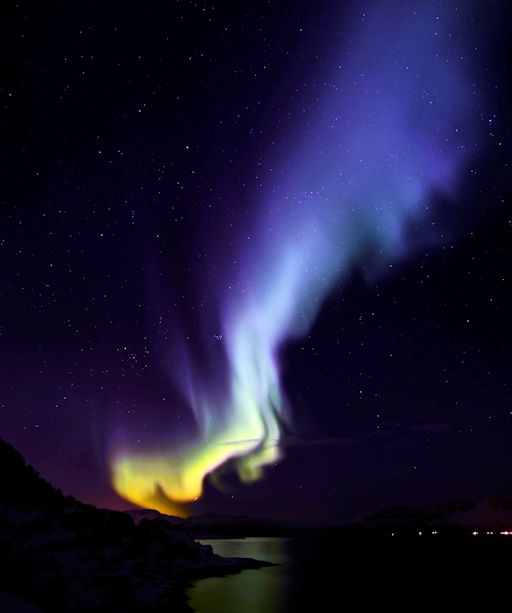
    -Northern Lights are usually green, and sometimes red. Those are the colors produced by oxygen when it is excited by electrons raining down from space. On Feb. 22nd, Micha Bäuml of Straumfjord, Norway, witnessed an appariton of aurora-blue. "All of a sudden the sky exploded," says Micha. "The aurora looked like a giant flame."

    -In auroras, blue is a sign of nitrogen. Energetic particles striking ionized molecular nitrogen (N2+) at very high altitudes produces a cold azure glow of the type captured in Micha's photo. Why it overwhelmed the usual hues of oxygen on Feb 22nd is unknown. Auroras still have the capacity to surprise.

    -Any auroras tonight, blue or otherwise, will be a bit of a surprise. Geomagnetic conditions are quiet. NOAA forecasters estimate a scant 5% chance of polar geomagnetic storms on March 3rd.


    Astro Picture of the Day:
    March 3, 2014
    Source:
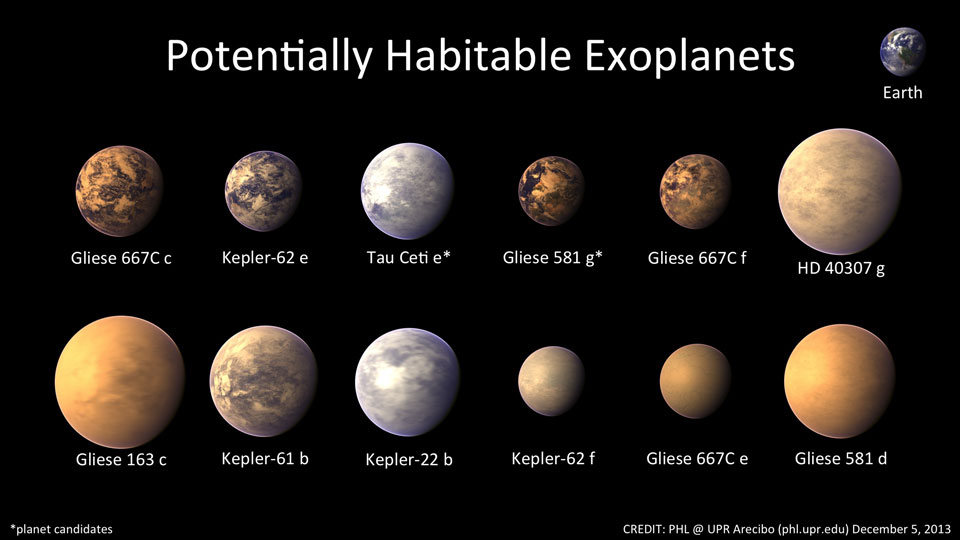
    Is Earth the only known world that can support life? In an effort to find life-habitable worlds outside our Solar System, stars similar to our Sun are being monitored for slight light decreases that indicate eclipsing planets. Many previously-unknown planets are being found, including over 700 worlds recently uncovered by NASA's Kepler satellite. Depicted above in artist's illustrations are twelve extrasolar planets that orbit in the habitable zones of their parent stars. These exoplanets have the right temperature for water to be a liquid on their surfaces, and so water-based life on Earth might be able to survive on them. Although technology cannot yet detect resident life, finding habitable exoplanets is a step that helps humanity to better understand its place in the cosmos.
    1st in Kommisar's 2009 SM Tournament
    1st in I Love You`s 2009 New Year`s Tournament
    3rd in EnR's Mashfest '08 tournament
    5th in Phynx's Unofficial FFR Tournament
    9th in D3 of the 2008-2009 4th Official FFR Tournament
    10th in D5 of the 2010 5th Official FFR Tournament
    10th in D6 of the 2011-2012 6th Official FFR Tournament

    FMO AAA Count: 71
    FGO AAA Count: 10

    Bluearrowll = The Canadian player who can not detect awkward patterns. If it's awkward for most people, it's normal for Terry. If the file is difficult but super straight forward, he has issues. If he's AAAing a FGO but then heard that his favorite Hockey team was losing by a point, Hockey > FFR
    PS: Cool AAA's Terry
    - I Love You


    An Alarm Clock's Haiku
    beep beep beep beep beep
    beep beep beep beep beep beep beep
    beep beep beep beep beep
    - ieatyourlvllol

    Comment

    • Bluearrowll
      ⊙▃⊙
      FFR Simfile Author
      • Nov 2007
      • 7376

      #857
      Re: Terry's Astronomy Thread.

      Daily Suspicious0bserver's Weather Post:
      March 4, 2014


      What's in the sky tonight?
      March 4, 2014
      -Mars (magnitude –0.5, in Virgo) rises around 9 or 10 p.m., a fiery blaze 6° to the left of icy Spica. The two of them are highest in the south around 2 or 3 a.m., with Spica now lower right of Mars.

      -In a telescope Mars has grown to about 12 arcseconds wide, on its way to an apparent diameter of 15.1″ when it passes closest by Earth in mid-April.

      -On the night of March 3rd, with green lights swirling overhead, scientists at the University of Alaska's Poker Flat Research Range launched a 48-foot sounding rocket directly into the aurora borealis. "For weeks we've been sitting out all night every night, and though we've seen many good aurora, we haven't seen the type we wanted, in the position we wanted - until now," says graduate student Jason Ahrns, who took this picture of the rocket in flight. The rocket launch was part of a NASA-sponsored campaign called GREECE - short for "Ground-to-Rocket Electrodynamics-Electrons Correlative Experiment." Marilia Samara, a space scientist at the Southwest Research Institute in San Antonio, Texas, is the principal investigator.

      -GREECE aims to solve a long-standing mystery about auroras: Often, when a display begins, the lights are placid and widely spread across thousands of kilometers. Then, for reasons no one fully understands, the auroras will break up into highly-structured and rapidly changing arcs, swirls, curls, pillars, even "flames," with changes occurring on fraction-of-a-second time scales. Sensors on the Data from the sounding rocket will help researchers unravel the electrodynamics underlying these sudden and unpredictable transitions.

      "Preliminary expectations are that the launch was a total and complete success with lots of good science to come out of it," reports Ahrns. Updates on GREECE can be found here: http://greece.ssl.berkeley.edu/nightly-update/


      News Posted Today:
      February 28, 2014
      New Record for Oldest Earth Rock


      Astro Picture of the Day:
      March 4, 2014

      Source:
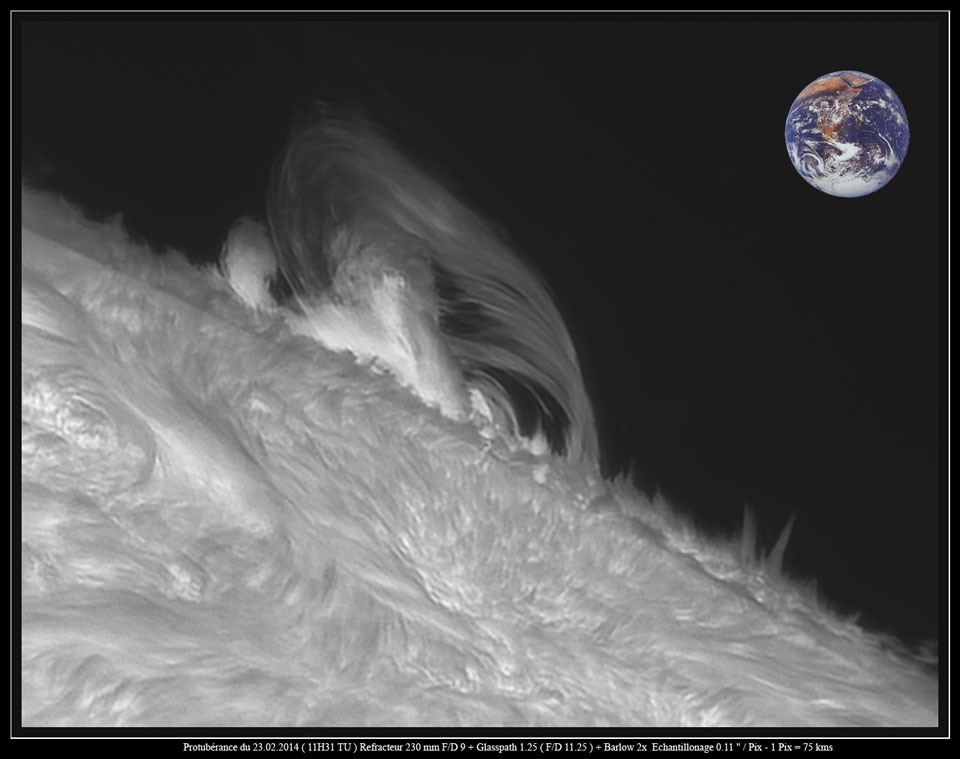
      Dramatic prominences can sometimes be seen looming just beyond the edge of the sun. Such was the case last week as a large prominence, visible above, highlighted a highly active recent Sun. A waving sea of hot gas is visible in the foreground chromosphere in great detail as it was imaged in one specific color of light emitted by hydrogen. A solar prominence is a cloud of solar gas held just above the surface by the Sun's magnetic field. The Earth, illustrated in the inset, is smaller than the prominence. Although very hot, prominences typically appear dark when viewed against the Sun, since they are slightly cooler than the photosphere below them. A quiescent prominence typically lasts about a month, and may erupt in a Coronal Mass Ejection (CME) expelling hot gas into the Solar System, some of which may strike the Earth and trigger auroras.
      1st in Kommisar's 2009 SM Tournament
      1st in I Love You`s 2009 New Year`s Tournament
      3rd in EnR's Mashfest '08 tournament
      5th in Phynx's Unofficial FFR Tournament
      9th in D3 of the 2008-2009 4th Official FFR Tournament
      10th in D5 of the 2010 5th Official FFR Tournament
      10th in D6 of the 2011-2012 6th Official FFR Tournament

      FMO AAA Count: 71
      FGO AAA Count: 10

      Bluearrowll = The Canadian player who can not detect awkward patterns. If it's awkward for most people, it's normal for Terry. If the file is difficult but super straight forward, he has issues. If he's AAAing a FGO but then heard that his favorite Hockey team was losing by a point, Hockey > FFR
      PS: Cool AAA's Terry
      - I Love You


      An Alarm Clock's Haiku
      beep beep beep beep beep
      beep beep beep beep beep beep beep
      beep beep beep beep beep
      - ieatyourlvllol

      Comment

      • Bluearrowll
        ⊙▃⊙
        FFR Simfile Author
        • Nov 2007
        • 7376

        #858
        Re: Terry's Astronomy Thread.

        Daily Suspicious0bserver's Weather Post:
        March 5, 2014


        What's in the sky tonight?
        March 5, 2014
        -The huge "Winter Diamond" of 2014 stands upright in the south around 8 p.m. now. It's formed by Jupiter on top and Sirius on the bottom — the two brightest points in the evening sky — and Procyon forming its left corner and Betelgeuse as its right corner.

        -The lifespan of a typical sunspot is two to three weeks. This one is about to turn three months. Carried around by the sun's 27-day rotation, AR1990 is making its third transit of the visible solar disk. In previous apparitions it was known as AR1944 and AR1967. Each time it has appeared, the sunspot has unleashed at least one strong flare, the most recent being the X4.9-class blockbuster of Feb. 25th. Since then, AR1990 has quieted and started showing signs of decay.


        Astro Picture of the Day:
        March 5, 2014

        Source:
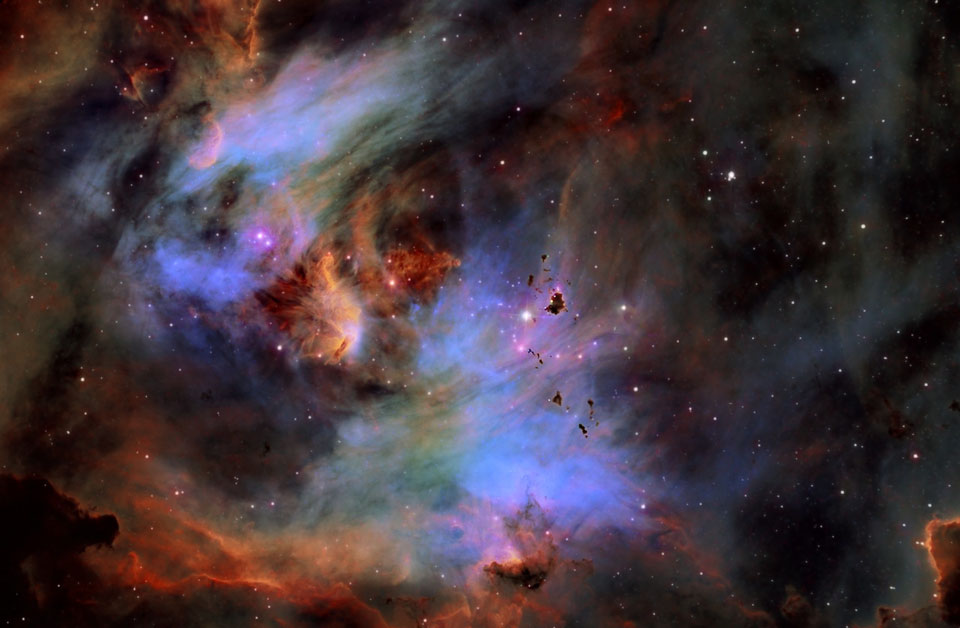
        The eggs from this chicken may form into stars. The above pictured emission nebula, cataloged as IC 2944, is called the Running Chicken Nebula for the shape of its greater appearance. The image was taken recently from Siding Spring Observatory in Australia and presented in scientifically assigned colors. Seen near the center of the image are small, dark molecular clouds rich in obscuring cosmic dust. Called Thackeray's Globules for their discoverer, these "eggs" are potential sites for the gravitational condensation of new stars, although their fates are uncertain as they are also being rapidly eroded away by the intense radiation from nearby young stars. Together with patchy glowing gas and complex regions of reflecting dust, these massive and energetic stars form the open cluster Collinder 249. This gorgeous skyscape spans about 70 light-years at the nebula's estimated 6,000 light-year distance.
        1st in Kommisar's 2009 SM Tournament
        1st in I Love You`s 2009 New Year`s Tournament
        3rd in EnR's Mashfest '08 tournament
        5th in Phynx's Unofficial FFR Tournament
        9th in D3 of the 2008-2009 4th Official FFR Tournament
        10th in D5 of the 2010 5th Official FFR Tournament
        10th in D6 of the 2011-2012 6th Official FFR Tournament

        FMO AAA Count: 71
        FGO AAA Count: 10

        Bluearrowll = The Canadian player who can not detect awkward patterns. If it's awkward for most people, it's normal for Terry. If the file is difficult but super straight forward, he has issues. If he's AAAing a FGO but then heard that his favorite Hockey team was losing by a point, Hockey > FFR
        PS: Cool AAA's Terry
        - I Love You


        An Alarm Clock's Haiku
        beep beep beep beep beep
        beep beep beep beep beep beep beep
        beep beep beep beep beep
        - ieatyourlvllol

        Comment

        • Bluearrowll
          ⊙▃⊙
          FFR Simfile Author
          • Nov 2007
          • 7376

          #859
          Re: Terry's Astronomy Thread.

          Daily Suspicious0bserver's Weather Post:
          March 6, 2014


          What's in the sky tonight?
          March 6, 2014
          -After nightfall, look for Aldebaran to the upper left of the Moon and the Pleiades to the Moon's upper right, as shown below.

          -For the second time in as many days, an asteroid is flying through the Earth-Moon system. Yesterday, March 5th, 30-meter asteroid 2014 DX110 passed just inside the orbit of the Moon--about 0.9 lunar distances away. Today, March 6th, 10-meter asteroid 2014 EC is coming even closer--only 0.2 lunar distances. Neither space rock poses an immediate threat to Earth. According to NASA, asteroids thread the Earth-Moon system more than 20 times a year.

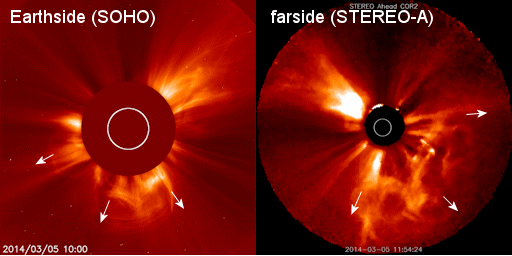
          -Hours ago, a bright coronal mass ejection (CME) flew over the sun's southeastern limb. If such an event had occured years ago, we wouldn't know if this CME was a threat because, as viewed from Earth orbit, CMEs heading toward and away from Earth look much the same. Today, however, all CMEs are observed from multiple points of view.

          Dual coronagraph images from SOHO (stationed on the Earthside of the sun) and the STEREO-A probe (stationed on the farside) clearly show that this CME is a farside event. Radio emissions from shock waves at the leading edge of the blast suggest the cloud is racing away from Earth at approximately 1400 km/s (3 million mph). If it were racing in the opposite direction, we would have a significant geomagnetic storm in the offing. Instead, space weather around Earth is expected to remain calm for the rest of this week.


          Astro Picture of the Day:
          March 6, 2014

          Source:
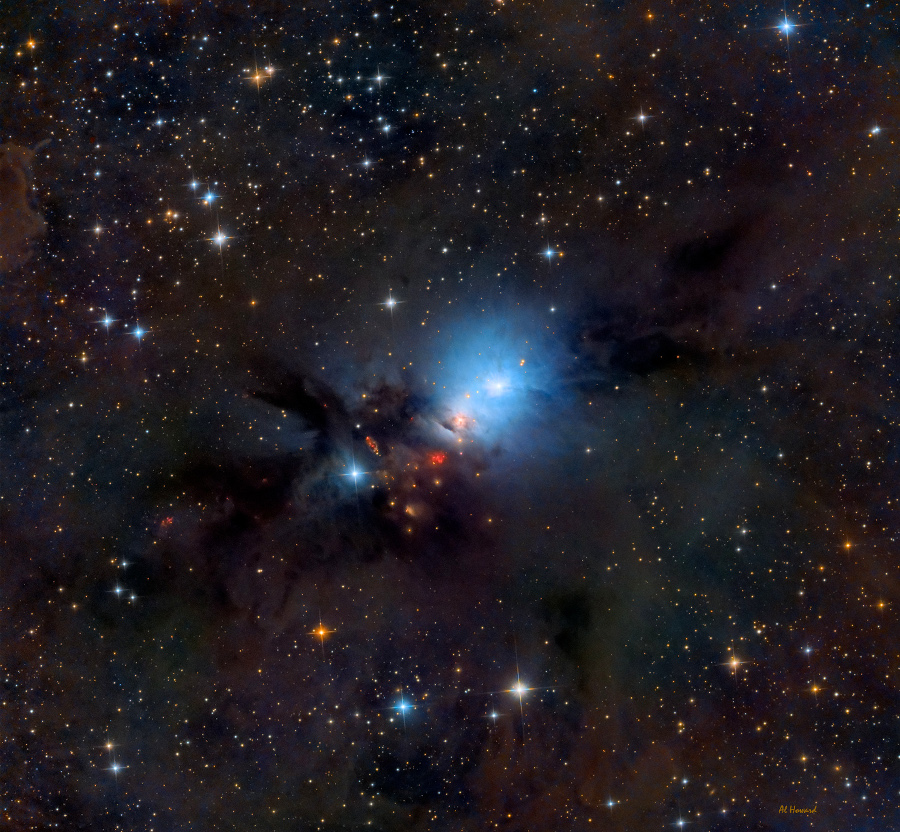
          NGC 1333 is seen in visible light as a reflection nebula, dominated by bluish hues characteristic of starlight reflected by dust. A mere 1,000 light-years distant toward the heroic constellation Perseus, it lies at the edge of a large, star-forming molecular cloud. This striking close-up view spans about two full moons on the sky or just over 15 light-years at the estimated distance of NGC 1333. It shows details of the dusty region along with hints of contrasting red emission from Herbig-Haro objects, jets and shocked glowing gas emanating from recently formed stars. In fact, NGC 1333 contains hundreds of stars less than a million years old, most still hidden from optical telescopes by the pervasive stardust. The chaotic environment may be similar to one in which our own Sun formed over 4.5 billion years ago.
          1st in Kommisar's 2009 SM Tournament
          1st in I Love You`s 2009 New Year`s Tournament
          3rd in EnR's Mashfest '08 tournament
          5th in Phynx's Unofficial FFR Tournament
          9th in D3 of the 2008-2009 4th Official FFR Tournament
          10th in D5 of the 2010 5th Official FFR Tournament
          10th in D6 of the 2011-2012 6th Official FFR Tournament

          FMO AAA Count: 71
          FGO AAA Count: 10

          Bluearrowll = The Canadian player who can not detect awkward patterns. If it's awkward for most people, it's normal for Terry. If the file is difficult but super straight forward, he has issues. If he's AAAing a FGO but then heard that his favorite Hockey team was losing by a point, Hockey > FFR
          PS: Cool AAA's Terry
          - I Love You


          An Alarm Clock's Haiku
          beep beep beep beep beep
          beep beep beep beep beep beep beep
          beep beep beep beep beep
          - ieatyourlvllol

          Comment

          • Bluearrowll
            ⊙▃⊙
            FFR Simfile Author
            • Nov 2007
            • 7376

            #860
            Re: Terry's Astronomy Thread.

            Daily Suspicious0bserver's Weather Post:
            March 7, 2014


            What's in the sky tonight?
            March 7, 2014
            -Look below the Moon this evening for orange Aldebaran, an orange giant star 65 light-years from Earth. Far off to their left is Betelgeuse in the top of Orion. Less far to their right are the Pleiades.

            -March 6th began with a bang. "Last night, here was a significant fireball over north central New Mexico at precisely 00:19:20 am MST," reports Thomas Ashcraft. "It was brighter than the full Moon and shook houses from its sonic boom." Ashcraft operates a fireball camera and forward-scatter meteor radar at his private observatory near Santa Fe. Turn up the volume and play the movie he recorded: http://www.spaceweather.com/images20...AshcraftSW.mp4

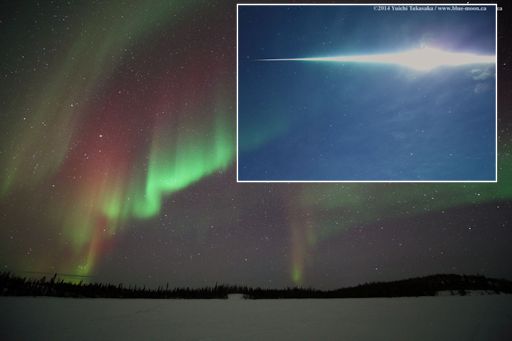
            Approximately two hours later, a similar fireball streaked over Yellowknife, Canada, exploding so brightly that the flash turned the night sky blue:

            Yuichi Takasaka took the picture from the verge of Vee Lake. "I was leading an Aurora Photography Tour," says Takasaka. "We had quite colourful auroras all night. All of sudden at 02:13 local time, one shooting star started from Western sky and exploded towards North. It got so bright that I had to close my eyes like someone used electric flash in front of me. A few minutes later, we could hear the huge explosion from the direction of the fireball fell. What an exciting night!!!"

            As far as we know there is no conection between these two events or the asteroid 2014 EC, which flew past Earth on March 6th. They are probably random meteoroids of the type that strike Earth's atmosphere every night.

            -NASA's Hubble Space Telescope has recorded the never-before-seen break-up of an asteroid into as many as 10 smaller pieces. http://science.nasa.gov/science-news...6mar_asteroid/


            Astro Picture of the Day:
            March 7, 2014

            Source:
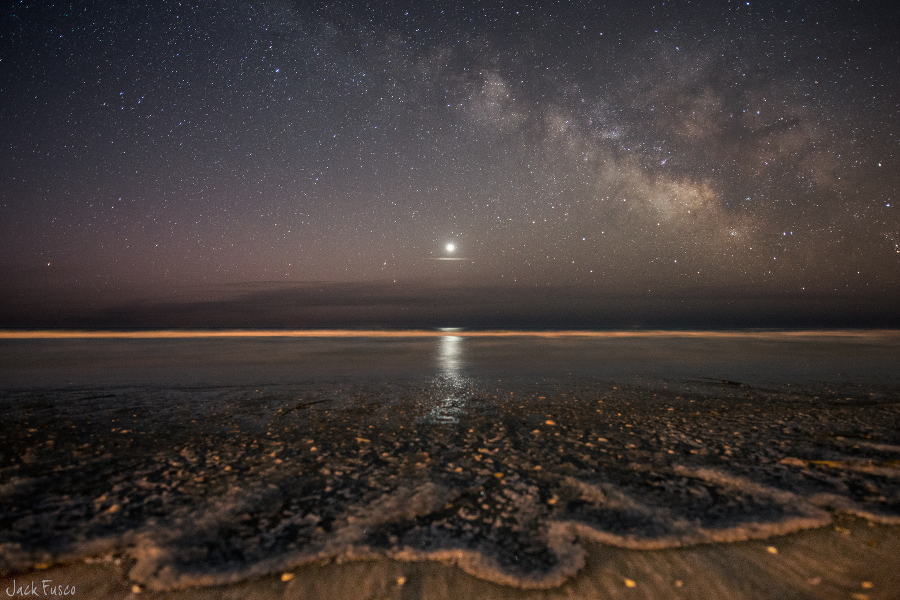
            Brilliant Venus and the central Milky Way rise in the early morning hours of March 1 in this sea and skyscape. The scene looks out from a beach at Sea Isle City, New Jersey, USA, planet Earth. Of course, Earth orbits well within the solar system's habitable zone, that Goldilocks region not too close and not too far from the Sun where surface temperatures can support liquid water. Similar in size to Earth, Venus lies just beyond the inner boundary of the habitable zone. The watery reflection of light from our inhospitable sister planet is seen along a calm, cold ocean and low cloud bank.
            1st in Kommisar's 2009 SM Tournament
            1st in I Love You`s 2009 New Year`s Tournament
            3rd in EnR's Mashfest '08 tournament
            5th in Phynx's Unofficial FFR Tournament
            9th in D3 of the 2008-2009 4th Official FFR Tournament
            10th in D5 of the 2010 5th Official FFR Tournament
            10th in D6 of the 2011-2012 6th Official FFR Tournament

            FMO AAA Count: 71
            FGO AAA Count: 10

            Bluearrowll = The Canadian player who can not detect awkward patterns. If it's awkward for most people, it's normal for Terry. If the file is difficult but super straight forward, he has issues. If he's AAAing a FGO but then heard that his favorite Hockey team was losing by a point, Hockey > FFR
            PS: Cool AAA's Terry
            - I Love You


            An Alarm Clock's Haiku
            beep beep beep beep beep
            beep beep beep beep beep beep beep
            beep beep beep beep beep
            - ieatyourlvllol

            Comment

            • Bluearrowll
              ⊙▃⊙
              FFR Simfile Author
              • Nov 2007
              • 7376

              #861
              Re: Terry's Astronomy Thread.

              Daily Suspicious0bserver's Weather Post:
              March 8, 2014


              What's in the sky tonight?
              March 8, 2014
              -As the stars begin to come out, the first-quarter Moon shines above Orion standing in the south.

              -Daylight-saving time begins at 2 a.m. Sunday morning for most of North America. Clocks spring forward an hour.

              -NOAA forecasters estimate a 25% to 35% chance of minor geomagnetic storms on March 8-9 when a solar wind stream is expected to brush against Earth's magnetic field. High-latitude sky watchers should be alert for auroras. The best time to look is during the hours around local midnight.

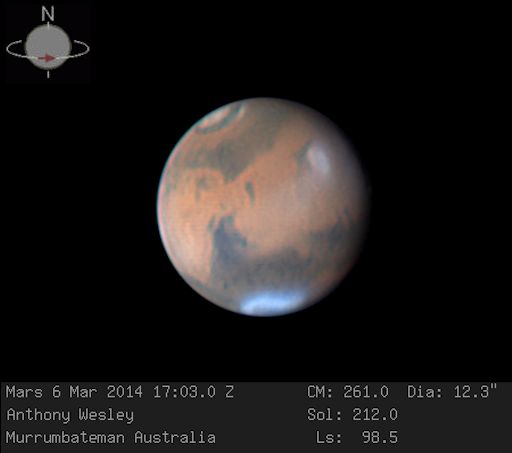
              -Next month, Earth and Mars will converge for their closest approach of 2014. Opposition occurs on April 8th. That's when Mars rises in the east at sunset, almost perfectly opposite the sun, and soars overhead at midnight shining 8 times brighter than a 1st-magnitude star. Although closest approach is still weeks away away, astronomers are already enjoying great views of the Red Planet. Australian astrophotographer Anthony Wesley took this picture using a 16-inch telescope on March 6th.

              -His high-resolution image shows orographic clouds over the Elysium volcanoes just north of the Martian equator and an even brighter blue cloud over the Hellas impact basin in the southern hemisphere. Hellas is the lowest point on Mars, and some of the haze evident there could be icy fog.

              Getting such Hubblesque results from a 16-inch telescope requires a combination of good seeing and long years of experience. Wesley, who is one of the world's top amateur astrophotographers, had both working for him on the morning of March 6th. "Skies were stable and clear," he says. "Using a Point Grey Research low-light Grasshopper3 camera, I recorded 2 minutes through red, green and blue filters with red @ 83fps, green @ 70fps and blue @ 50fps. I sorted all the frames according to image sharpness and stacked the best 2000 in each channel to make the color image, with additional wavelet sharpening in Registax, deconvolution in Astra Image and final color correction and touchups+captioning in the GIMP."

              Observers with less experience can take good photos, too, especially as March gives way to April and Mars approaches Earth. Look for burnt-orange Mars rising in the east around around 10 p.m. about 5° from the blue 1st-magnitude star Spica. The Moon passes by Mars on March 19-20 and provides a convenient "landmark" for finding the Red Planet.

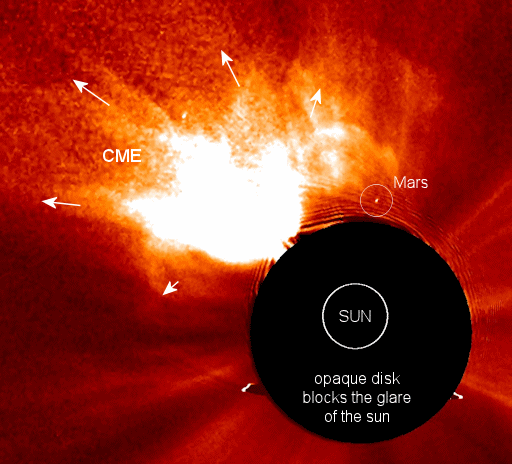
              -From Earth's point of view, Mars is approaching opposition. The Red Planet is in the midnight sky, almost directly opposite the sun. NASA's STEREO-Behind spacecraft has a different point of view. STEREO-B is stationed over the farside of the sun. From there, Mars and the Sun are in conjunction. This coronagraph image taken by STEREO-B on March 5th shows the sun and Mars side-by-side. On the day this picture was taken, several explosions occured on the farside of the sun, hurling CMEs into space.


              Astro Picture of the Day:
              March 8, 2014

              Source:
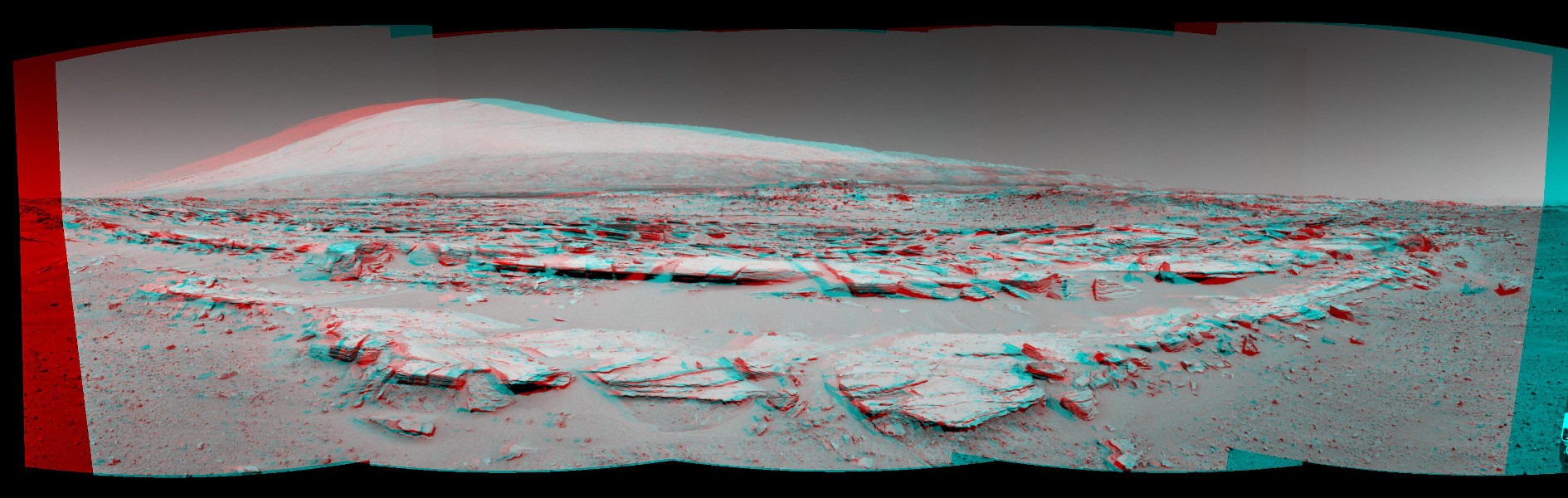
              Get out your red/blue glasses (red for the left eye) and look out over this expansive martian landscape. The panoramic stereo view is composed of images from the roving Curiosity's Navcam taken at a rest stop during a 100 meter drive on Sol 548 (February 19). The 5.5 kilometer high peak of Mount Sharp, also known as Aeolis Mons, is on the horizon, its base a destination for Curiosity. In the foreground are rows of striated rocks along the Junda outcrop. Centered toward the south-southeast the scene spans 160 degrees.
              1st in Kommisar's 2009 SM Tournament
              1st in I Love You`s 2009 New Year`s Tournament
              3rd in EnR's Mashfest '08 tournament
              5th in Phynx's Unofficial FFR Tournament
              9th in D3 of the 2008-2009 4th Official FFR Tournament
              10th in D5 of the 2010 5th Official FFR Tournament
              10th in D6 of the 2011-2012 6th Official FFR Tournament

              FMO AAA Count: 71
              FGO AAA Count: 10

              Bluearrowll = The Canadian player who can not detect awkward patterns. If it's awkward for most people, it's normal for Terry. If the file is difficult but super straight forward, he has issues. If he's AAAing a FGO but then heard that his favorite Hockey team was losing by a point, Hockey > FFR
              PS: Cool AAA's Terry
              - I Love You


              An Alarm Clock's Haiku
              beep beep beep beep beep
              beep beep beep beep beep beep beep
              beep beep beep beep beep
              - ieatyourlvllol

              Comment

              • Bluearrowll
                ⊙▃⊙
                FFR Simfile Author
                • Nov 2007
                • 7376

                #862
                Re: Terry's Astronomy Thread.

                Daily Suspicious0bserver's Weather Post:
                March 9, 2014


                What's in the sky tonight?
                March 9, 2014
                -Jupiter shines above the Moon this evening, as shown above. Although they look fairly close together, Jupiter is almost 1,800 times farther away — and 40 times larger in diameter.

                -Episode 1 of the reborn Cosmos series airs tonight (Fox network, 9 p.m. Eastern, 8 Central).

                -NOAA forecasters estimate a 30% chance of minor geomagnetic storms on March 9th when a solar wind stream is expected to brush against Earth's magnetic field. High-latitude sky watchers should be alert for auroras. The best time to look is during the hours around local midnight.


                Astro Picture of the Day:
                March 9, 2014

                Source:
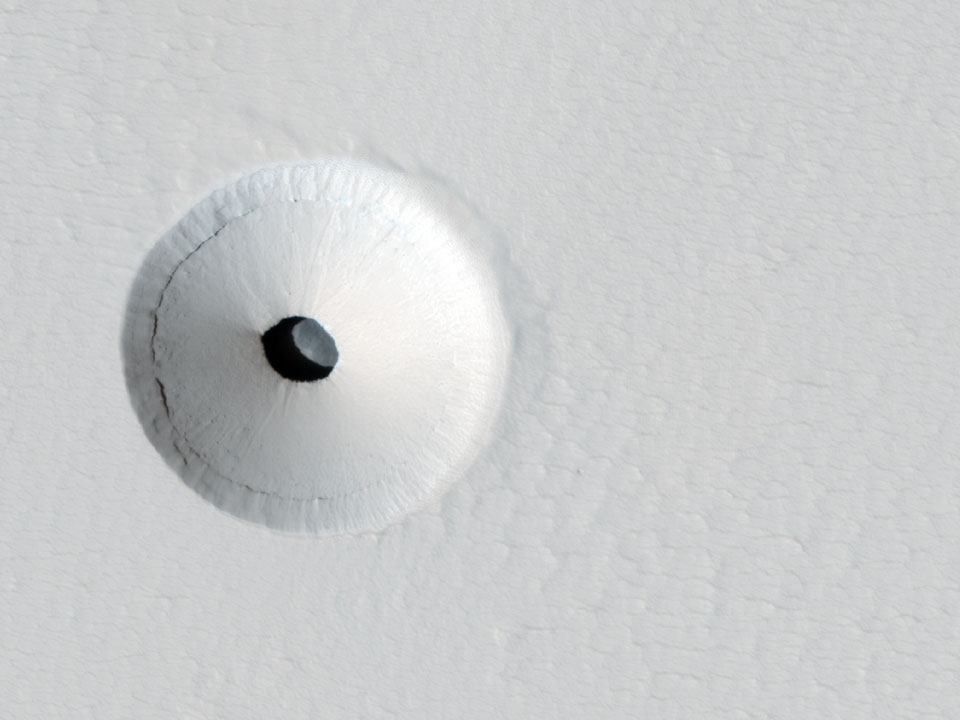
                What created this unusual hole in Mars? The hole was discovered by chance in 2011 on images of the dusty slopes of Mars' Pavonis Mons volcano taken by the HiRISE instrument aboard the robotic Mars Reconnaissance Orbiter currently circling Mars. The hole appears to be an opening to an underground cavern, partly illuminated on the image right. Analysis of this and follow-up images revealed the opening to be about 35 meters across, while the interior shadow angle indicates that the underlying cavern is roughly 20 meters deep. Why there is a circular crater surrounding this hole remains a topic of speculation, as is the full extent of the underlying cavern. Holes such as this are of particular interest because their interior caves are relatively protected from the harsh surface of Mars, making them relatively good candidates to contain Martian life. These pits are therefore prime targets for possible future spacecraft, robots, and even human interplanetary explorers.
                1st in Kommisar's 2009 SM Tournament
                1st in I Love You`s 2009 New Year`s Tournament
                3rd in EnR's Mashfest '08 tournament
                5th in Phynx's Unofficial FFR Tournament
                9th in D3 of the 2008-2009 4th Official FFR Tournament
                10th in D5 of the 2010 5th Official FFR Tournament
                10th in D6 of the 2011-2012 6th Official FFR Tournament

                FMO AAA Count: 71
                FGO AAA Count: 10

                Bluearrowll = The Canadian player who can not detect awkward patterns. If it's awkward for most people, it's normal for Terry. If the file is difficult but super straight forward, he has issues. If he's AAAing a FGO but then heard that his favorite Hockey team was losing by a point, Hockey > FFR
                PS: Cool AAA's Terry
                - I Love You


                An Alarm Clock's Haiku
                beep beep beep beep beep
                beep beep beep beep beep beep beep
                beep beep beep beep beep
                - ieatyourlvllol

                Comment

                • Bluearrowll
                  ⊙▃⊙
                  FFR Simfile Author
                  • Nov 2007
                  • 7376

                  #863
                  Re: Terry's Astronomy Thread.

                  Well as of today this thread is 2 years old. In a way, very little has changed from when it first opened. There's new features, new viewers, but other than that, it's still the same at its core. I've somehow managed to get up every morning for the past 2 years, scour some information hubs about what is happening in space at any given day, and report the findings here without missing a beat, even if it meant I had to pass the torch onto someone else while I went on a camping / photography trip for a few days (looking at you Sky Kitten, thanks for all your help!) I would also like to thank all who have decided to take a glance at the thread whether regularly or just to see what the fuss is about. The thread has never been as popular as it is today. Having said that, I keep track of how people visit the thread throughout the years. Here is what I have found:

                  Visitors Per Day, Year 2:


                  Visitors Per Day, Since Inception:


                  Viewership Growth, Year 2:


                  Viewership Growth, Since Inception:


                  Daily Suspicious0bserver's Weather Post:
                  March 10, 2014


                  What's in the sky tonight?
                  March 10, 2014
                  -The Moon forms a distorted rectangle with Jupiter, Castor, and Pollux this evening. In addition, the Moon and Jupiter form a bent line of three with Procyon to their lower left.

                  -Mercury (magnitude +0.2) is low above the east-southeast horizon during dawn, about 20° lower left of bright Venus.

                  -Saturn (magnitude +0.4, in Libra) rises around 11 p.m. and is highest in the south before dawn. By then it's far left of Mars and Spica, and less far to the upper right of Mars-colored Antares.


                  Astro Picture of the Day:
                  March 10, 2014

                  Source:
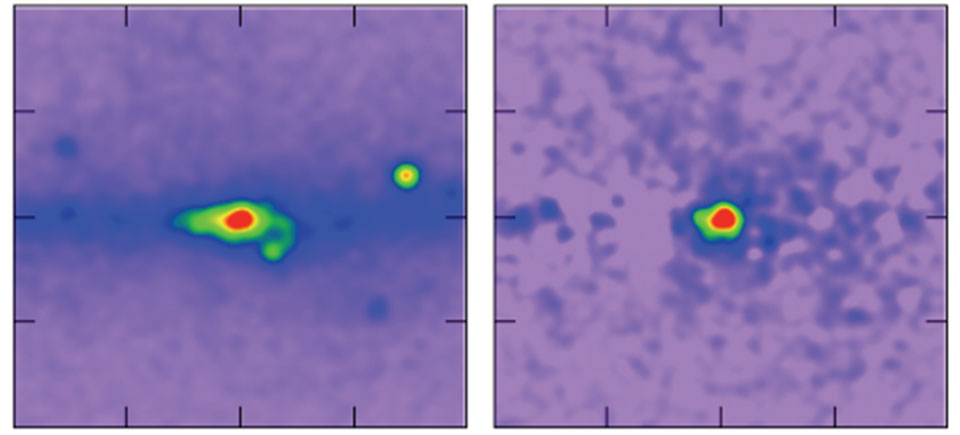
                  What is creating the gamma rays at the center of our Galaxy? Excitement is building that one answer is elusive dark matter. Over the past few years the orbiting Fermi Gamma-ray Space Telescope has been imaging our Galaxy's center in gamma-rays. Repeated detailed analyses indicate that the region surrounding the Galactic center seems too bright to be accounted by known gamma-ray sources. A raw image of the Galactic Center region in gamma-rays is shown above on the left, while the image on the right has all known sources subtracted -- leaving an unexpected excess. An exciting hypothetical model that seems to fit the excess involves a type of dark matter known as WIMPs, which may be colliding with themselves to create the detected gamma-rays. This hypothesis is controversial, however, and debate and more detailed investigations are ongoing. Finding the nature of dark matter is one of the great quests of modern science, as previously this unusual type of cosmologically pervasive matter has shown itself only through gravitation. The hypothesis can be found here: https://www.simonsfoundation.org/qua...l-strengthens/
                  1st in Kommisar's 2009 SM Tournament
                  1st in I Love You`s 2009 New Year`s Tournament
                  3rd in EnR's Mashfest '08 tournament
                  5th in Phynx's Unofficial FFR Tournament
                  9th in D3 of the 2008-2009 4th Official FFR Tournament
                  10th in D5 of the 2010 5th Official FFR Tournament
                  10th in D6 of the 2011-2012 6th Official FFR Tournament

                  FMO AAA Count: 71
                  FGO AAA Count: 10

                  Bluearrowll = The Canadian player who can not detect awkward patterns. If it's awkward for most people, it's normal for Terry. If the file is difficult but super straight forward, he has issues. If he's AAAing a FGO but then heard that his favorite Hockey team was losing by a point, Hockey > FFR
                  PS: Cool AAA's Terry
                  - I Love You


                  An Alarm Clock's Haiku
                  beep beep beep beep beep
                  beep beep beep beep beep beep beep
                  beep beep beep beep beep
                  - ieatyourlvllol

                  Comment

                  • gold stinger
                    Signature Extraordinare~~
                    Event Staff
                    Game Manager
                    FFR Simfile Author
                    FFR Music Producer
                    • Jan 2007
                    • 6428

                    #864
                    Re: Terry's Astronomy Thread.

                    Just wanted to come in here and thank you for your dedication on this. Not many people may sit down and read the stuff you're dishing out, but I've been keeping track on it enough to know that today marks your 2nd year since your first post on this thread.

                    <3 ya Terry.
                    Originally posted by YoshL
                    butts.


                    - Tosh 2014


                    Comment

                    • Bluearrowll
                      ⊙▃⊙
                      FFR Simfile Author
                      • Nov 2007
                      • 7376

                      #865
                      Re: Terry's Astronomy Thread.

                      Daily Suspicious0bserver's Weather Post:
                      March 11, 2014


                      What's in the sky tonight?
                      March 11, 2014
                      -Late twilight is when Sirius now stands due south, and twilight is also a time when the atmospheric seeing sometimes steadies. So it may be a good time to try to detect the faint white-dwarf companion of Sirius, now 10.2″ east of dazzling Sirius A.

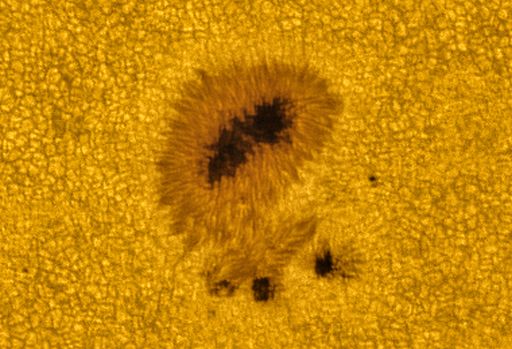
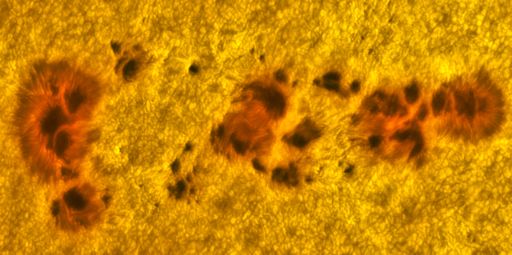
                      -Sunspot AR2002 poses a growing threat for solar flares. Since the week began, the active region has more than tripled in size. It now has more than a dozen dark cores and sprawls across 100,000 km of solar terrain. Karzaman Ahmad sends this picture, taken just hours ago, from the Langkawi National Observatory in Malaysia. "AR2002 is so large," says Ahmad, "that I was able to photograph it using an ordinary 11-inch Celestron telescope capped with a Thousand Oaks Glass Filter." The exceptionally crisp image shows thousands of boiling granules surrounding the sunspot's dark cores. Each granule is about the size of Texas.

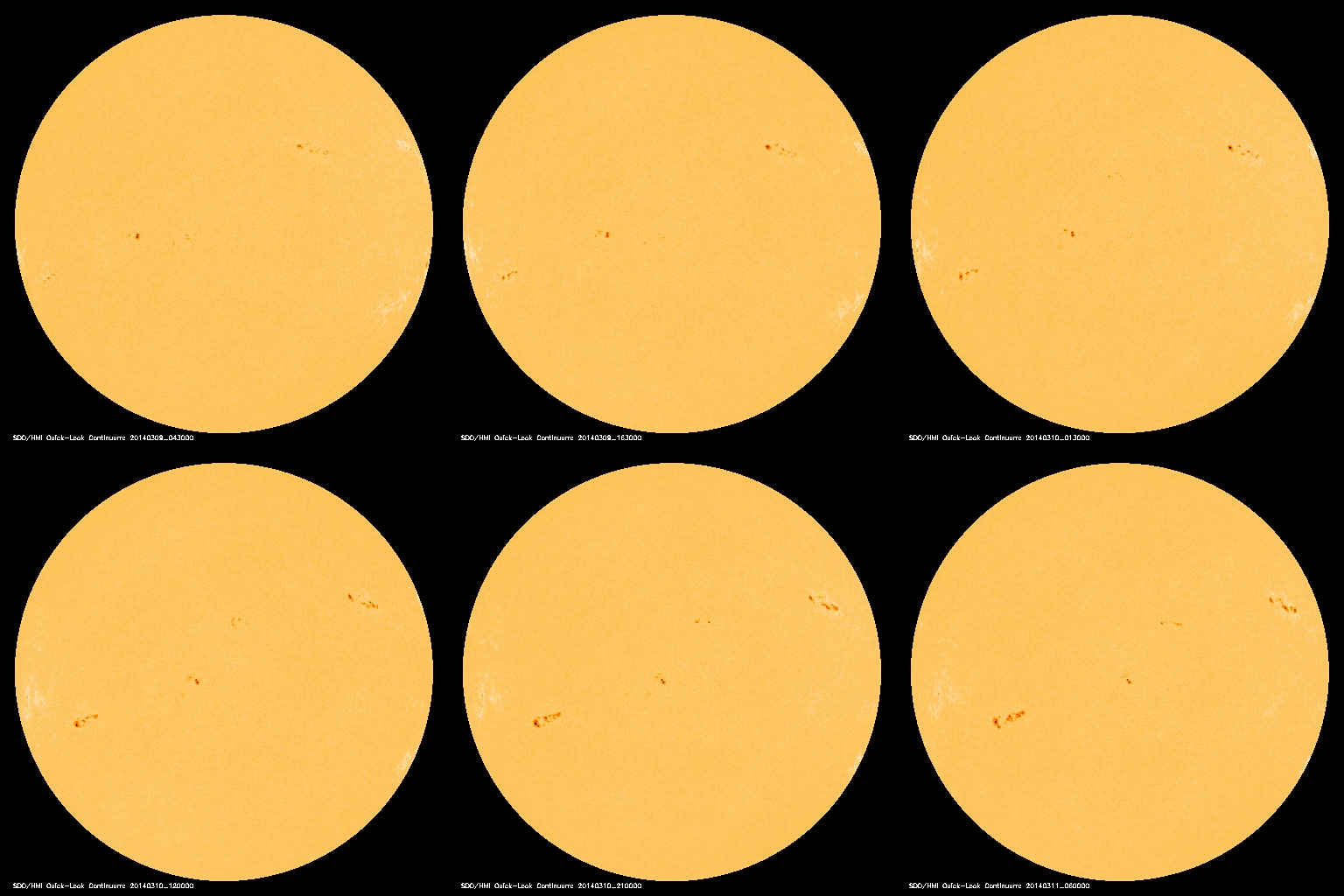
                      -A 48-hour movie from NASA's Solar Dynamics Observatory shows the sunspot's development. The rapid growth of AR2002 has destabilized its magnetic field, which makes it more likely to erupt. NOAA forecasters estimate a 60% chance of M-class flares and a 10% chance of X-class flares during the next 24 hours.


                      Astro Picture of the Day:
                      March 11, 2014

                      Source:
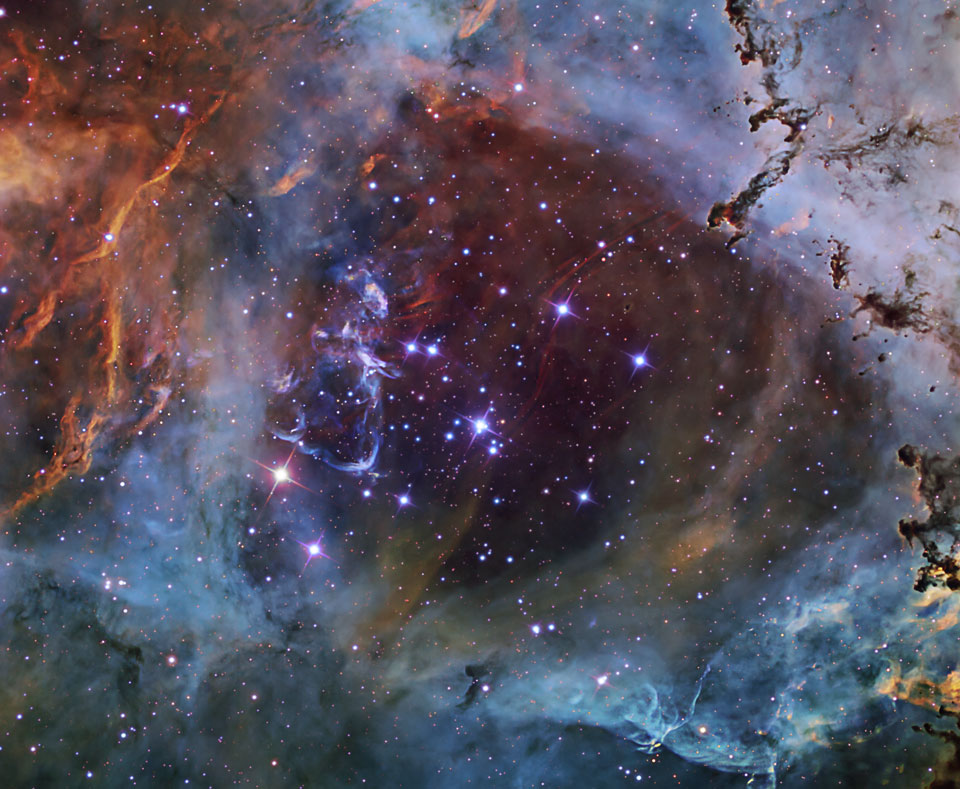
                      In the heart of the Rosette Nebula lies a bright open cluster of stars that lights up the nebula. The stars of NGC 2244 formed from the surrounding gas only a few million years ago. The above image taken in January using multiple exposures and very specific colors of Sulfur (shaded red), Hydrogen (green), and Oxygen (blue), captures the central region in tremendous detail. A hot wind of particles streams away from the cluster stars and contributes to an already complex menagerie of gas and dust filaments while slowly evacuating the cluster center. The Rosette Nebula's center measures about 50 light-years across, lies about 4,500 light-years away, and is visible with binoculars towards the constellation of the Unicorn (Monoceros).
                      1st in Kommisar's 2009 SM Tournament
                      1st in I Love You`s 2009 New Year`s Tournament
                      3rd in EnR's Mashfest '08 tournament
                      5th in Phynx's Unofficial FFR Tournament
                      9th in D3 of the 2008-2009 4th Official FFR Tournament
                      10th in D5 of the 2010 5th Official FFR Tournament
                      10th in D6 of the 2011-2012 6th Official FFR Tournament

                      FMO AAA Count: 71
                      FGO AAA Count: 10

                      Bluearrowll = The Canadian player who can not detect awkward patterns. If it's awkward for most people, it's normal for Terry. If the file is difficult but super straight forward, he has issues. If he's AAAing a FGO but then heard that his favorite Hockey team was losing by a point, Hockey > FFR
                      PS: Cool AAA's Terry
                      - I Love You


                      An Alarm Clock's Haiku
                      beep beep beep beep beep
                      beep beep beep beep beep beep beep
                      beep beep beep beep beep
                      - ieatyourlvllol

                      Comment

                      • Bluearrowll
                        ⊙▃⊙
                        FFR Simfile Author
                        • Nov 2007
                        • 7376

                        #866
                        Re: Terry's Astronomy Thread.

                        Daily Suspicious0bserver's Weather Post:
                        March 12, 2014


                        What's in the sky tonight?
                        March 12, 2014
                        -It's still 8 days until spring, so Orion's Belt isn't yet quite horizontal in early evening. But it's getting there, as Orion tips down toward the southwest for its seasonal decline and eventual departure.

                        -Unlike Jupiter's moons Io and Europa, Ganymede and Callisto are darker than most of Jupiter's surface, as seen dramatically in this high-resolution image of Ganymede near Jupiter's central meridian taken by Christopher Go at 11:20 UT March 2nd. You might even mistake it for its shadow! (The faint light ring that appears inside Ganymede is a processing artifact caused by its sharp dark edge against the lighter background).
                        South is up. The reddish oval near Ganymede is Oval BA in the South Temperate Zone.


                        Astro Picture of the Day:
                        March 12, 2014

                        Source:
                        Does the Sun change as it rotates? Yes, and the changes can vary from subtle to dramatic. In the above time-lapse sequences, our Sun -- as imaged by NASA's Solar Dynamics Observatory -- is shown rotating though the entire month of January. In the large image on the left, the solar chromosphere is depicted in ultraviolet light, while the smaller and lighter image to its upper right simultaneously shows the more familiar solar photosphere in visible light. The rest of the inset six Sun images highlight X-ray emission by relatively rare iron atoms located at different heights of the corona, all false-colored to accentuate differences. The Sun takes just under a month to rotate completely -- rotating fastest at the equator. A large and active sunspot region rotates into view soon after the video starts. Subtle effects include changes in surface texture and the shapes of active regions. Dramatic effects include numerous flashes in active regions, and fluttering and erupting prominences visible all around the Sun's edge. This year our Sun is near its Solar maximum activity of its 11-year magnetic cycle. As the video ends, the same large and active sunspot region previously mentioned rotates back into view, this time looking differently.
                        1st in Kommisar's 2009 SM Tournament
                        1st in I Love You`s 2009 New Year`s Tournament
                        3rd in EnR's Mashfest '08 tournament
                        5th in Phynx's Unofficial FFR Tournament
                        9th in D3 of the 2008-2009 4th Official FFR Tournament
                        10th in D5 of the 2010 5th Official FFR Tournament
                        10th in D6 of the 2011-2012 6th Official FFR Tournament

                        FMO AAA Count: 71
                        FGO AAA Count: 10

                        Bluearrowll = The Canadian player who can not detect awkward patterns. If it's awkward for most people, it's normal for Terry. If the file is difficult but super straight forward, he has issues. If he's AAAing a FGO but then heard that his favorite Hockey team was losing by a point, Hockey > FFR
                        PS: Cool AAA's Terry
                        - I Love You


                        An Alarm Clock's Haiku
                        beep beep beep beep beep
                        beep beep beep beep beep beep beep
                        beep beep beep beep beep
                        - ieatyourlvllol

                        Comment

                        • Bluearrowll
                          ⊙▃⊙
                          FFR Simfile Author
                          • Nov 2007
                          • 7376

                          #867
                          Re: Terry's Astronomy Thread.

                          Daily Suspicious0bserver's Weather Post:
                          March 13, 2014


                          What's in the sky tonight?
                          March 13, 2014
                          -Look left of the Moon this evening for Regulus. It's the bottom star in the handle of the Sickle of Leo.

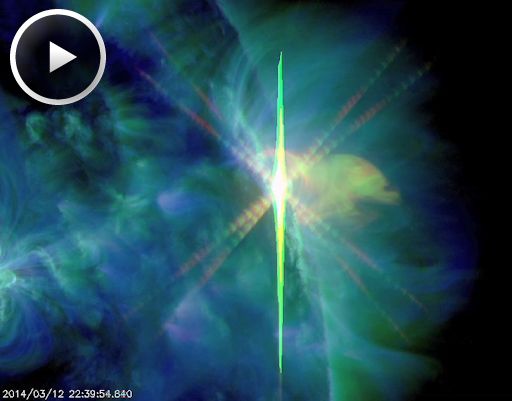
                          -Departing sunspot AR1996 erupted on March 12th at 2234 UT, producing an M9-category blast that almost crossed into X-territory. NASA's Solar Dynamics Observatory captured the extreme ultra-violet flash. UV radiation from the flare caused waves of ionization to ripple through Earth's upper atmosphere, but they quickly subsided. Otherwise the flare was not geoeffective. The sunspot's location near the sun's eastern limb mitigated any Earth effects.

                          The next flare could have a greater influence on our planet. Sunspot AR2002 is directly facing Earth, and it has a 'beta-gamma-delta' magnetic field that harbors energy for strong explosions. NOAA forecasters estimate an 80% chance of M-class flares and a 15% chance of X-flares on March 13th.

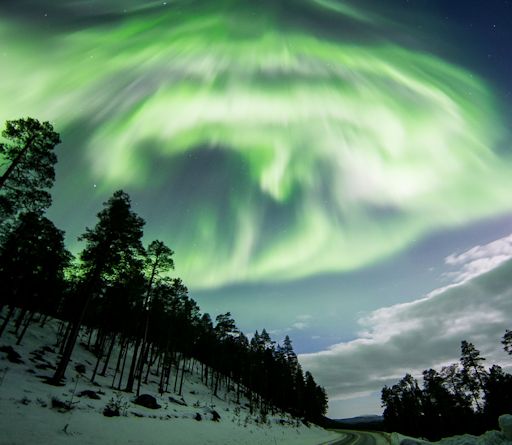
                          -Observers around the Arctic Circle were surprised last night when the skies overhead erupted in swirls of verdant color. Rayann Elzein sends this picture from Inari in the Finnish Lapland.

                          "Although there was no forecast of strong activity, auroras were dancing high in the sky--very bright and very fast," says Elzein. "They were the most breathtaking auroras that I have ever seen up here in Lapland!"

                          The unexpected storm, a relatively minor G1-class event, was caused by a fluctuation in the interplanetary magnetic field (IMF). As March 12th turned to 13th, the IMF tilted south, opening a crack in Earth's magnetosphere. Solar wind poured in and fueled the display.


                          News Posted Today:
                          March 4, 2014
                          Zodiacal Light in the Evening


                          Astro Picture of the Day:
                          March 13, 2014

                          Source:
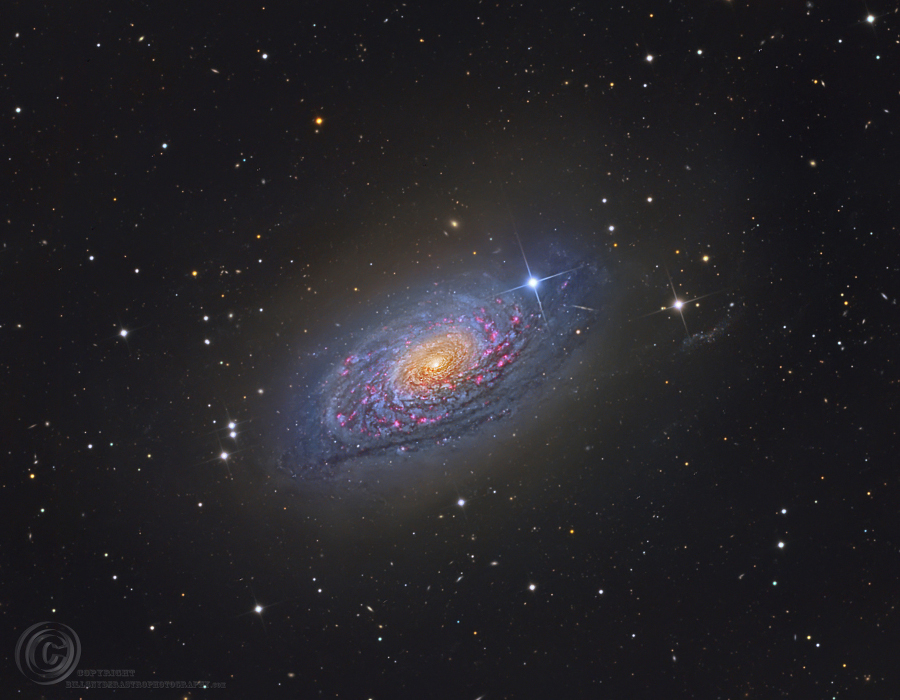
                          A bright spiral galaxy of the northern sky, Messier 63 is about 25 million light-years distant in the loyal constellation Canes Venatici. Also cataloged as NGC 5055, the majestic island universe is nearly 100,000 light-years across. That's about the size of our own Milky Way Galaxy. Known by the popular moniker, The Sunflower Galaxy, M63 sports a bright yellowish core in this sharp, colorful galaxy portrait. Its sweeping blue spiral arms are streaked with cosmic dust lanes and dotted with pink star forming regions. A dominant member of a known galaxy group, M63 has faint, extended features that could be the result of gravitational interactions with nearby galaxies. In fact, M63 shines across the electromagnetic spectrum and is thought to have undergone bursts of intense star formation.
                          1st in Kommisar's 2009 SM Tournament
                          1st in I Love You`s 2009 New Year`s Tournament
                          3rd in EnR's Mashfest '08 tournament
                          5th in Phynx's Unofficial FFR Tournament
                          9th in D3 of the 2008-2009 4th Official FFR Tournament
                          10th in D5 of the 2010 5th Official FFR Tournament
                          10th in D6 of the 2011-2012 6th Official FFR Tournament

                          FMO AAA Count: 71
                          FGO AAA Count: 10

                          Bluearrowll = The Canadian player who can not detect awkward patterns. If it's awkward for most people, it's normal for Terry. If the file is difficult but super straight forward, he has issues. If he's AAAing a FGO but then heard that his favorite Hockey team was losing by a point, Hockey > FFR
                          PS: Cool AAA's Terry
                          - I Love You


                          An Alarm Clock's Haiku
                          beep beep beep beep beep
                          beep beep beep beep beep beep beep
                          beep beep beep beep beep
                          - ieatyourlvllol

                          Comment

                          • Bluearrowll
                            ⊙▃⊙
                            FFR Simfile Author
                            • Nov 2007
                            • 7376

                            #868
                            Re: Terry's Astronomy Thread.

                            Daily Suspicious0bserver's Weather Post:
                            March 14, 2014


                            What's in the sky tonight?
                            March 14, 2014
                            -This evening, look for Regulus and the Sickle of Leo above the almost-full Moon.

                            -Today, March 14th (3.14), is Pi day, and all around the world pi-philes are celebrating one of the most compelling and mysterious constants of Nature. Pi appears in equations describing the orbits of planets, the colors of auroras, the structure of DNA. The value of pi is woven into the fabric of life, the universe and ... everything.

                            Humans have struggled to calculate for thousands of years. Divide the circumference of a circle by its diameter; the ratio is pi. Sounds simple, but the devil is in the digits. While the value of is finite, the decimal number is infinitely long.

                            Supercomputers have succeeded in calculating more than 2700 billion digits and they're still crunching. The weirdest way to compute: throw needles at a table or frozen hot dogs on the floor. Party time!

                            Make math fun with a sausage-centric Pi Day celebrationThrowing a pie in someone's face is good. Throwing food to discover pi is better. Believe it or not, of all the countless ways to approximate the most prolific irrational number in the...


                            News Posted Today:
                            March 13, 2014
                            Regulus Occultation: Asteroid to Black Out Bright Star


                            Astro Picture of the Day:
                            March 14, 2014

                            Source:
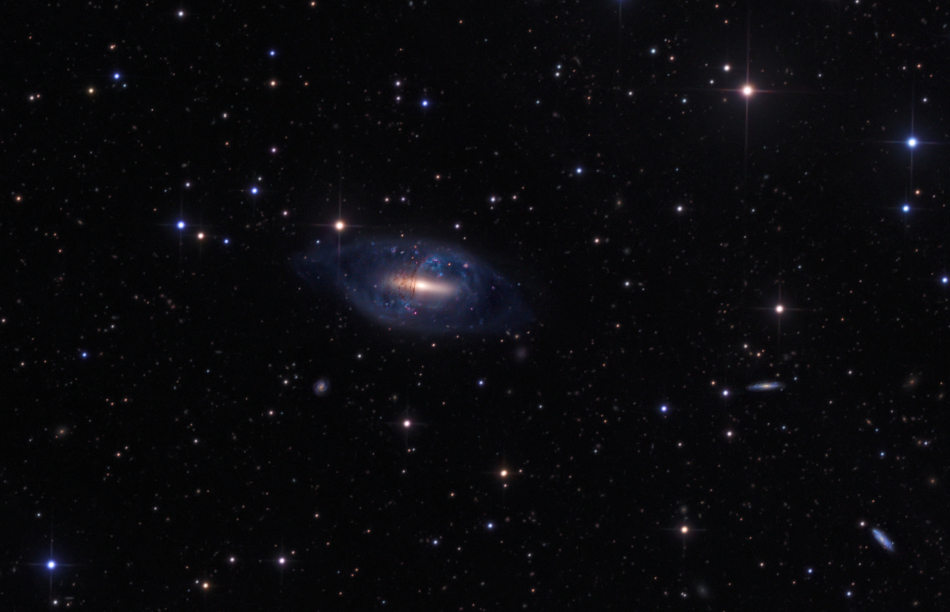
                            NGC 2685 is a confirmed polar ring galaxy - a rare type of galaxy with stars, gas and dust orbiting in rings perpendicular to the plane of a flat galactic disk. The bizarre configuration could be caused by the chance capture of material from another galaxy by a disk galaxy, with the captured debris strung out in a rotating ring. Still, observed properties of NGC 2685 suggest that the rotating ring structure is remarkably old and stable. In this sharp view of the peculiar system also known as Arp 336 or the Helix galaxy, the strange, perpendicular rings are easy to trace as they pass in front of the galactic disk, along with other disturbed outer structures. NGC 2685 is about 50,000 light-years across and 40 million light-years away in the constellation Ursa Major.
                            1st in Kommisar's 2009 SM Tournament
                            1st in I Love You`s 2009 New Year`s Tournament
                            3rd in EnR's Mashfest '08 tournament
                            5th in Phynx's Unofficial FFR Tournament
                            9th in D3 of the 2008-2009 4th Official FFR Tournament
                            10th in D5 of the 2010 5th Official FFR Tournament
                            10th in D6 of the 2011-2012 6th Official FFR Tournament

                            FMO AAA Count: 71
                            FGO AAA Count: 10

                            Bluearrowll = The Canadian player who can not detect awkward patterns. If it's awkward for most people, it's normal for Terry. If the file is difficult but super straight forward, he has issues. If he's AAAing a FGO but then heard that his favorite Hockey team was losing by a point, Hockey > FFR
                            PS: Cool AAA's Terry
                            - I Love You


                            An Alarm Clock's Haiku
                            beep beep beep beep beep
                            beep beep beep beep beep beep beep
                            beep beep beep beep beep
                            - ieatyourlvllol

                            Comment

                            • Bluearrowll
                              ⊙▃⊙
                              FFR Simfile Author
                              • Nov 2007
                              • 7376

                              #869
                              Re: Terry's Astronomy Thread.

                              Daily Suspicious0bserver's Weather Post:
                              March 15, 2014


                              What's in the sky tonight?
                              March 15, 2014
                              -The Big Dipper glitters high in the northeast these evenings, standing on its handle. You probably know that the two stars forming the front of the Dipper's bowl (currently on top) are the Pointers; they point to Polaris, currently to their left.
                              And, you may know that if you follow the curve of the Dipper's handle out and around by a little more than a Dipper length, you'll arc to Arcturus, now rising in the east.

                              But did you know that if you follow the Pointers backward, you'll land in Leo?

                              Draw a line diagonally across the Dipper's bowl from where the handle is attached, continue far on, and you'll go to Gemini.

                              And look at the two stars forming the open top of the Dipper's bowl. Follow this line past the bowl's lip far across the sky, and you crash into Capella.

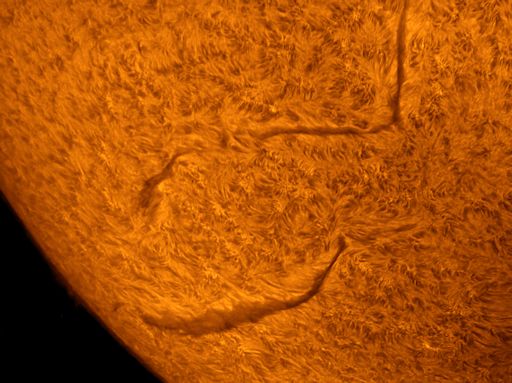
                              -Amateur astronomers are noting an outbreak of dark magnetic filaments on the sun. The longest, which measure 100,000 km to 250,000 km from end to end, are snaking around the sun's southeastern limb. Sergio Castillo sends this picture from his backyard observatory in Inglewood, CA.

                              "If they collapse, these monster solar filaments could produce a Hyder flare," says Castillo. Indeed, he continues, "one of them erupted just yesterday."

                              With all of the sunspots on the Earthside of the sun currently quieting, these filaments could be the source of greatest solar activity this weekend. Amateur astronomers with solar telescopes are encouraged to monitor developments.


                              Astro Picture of the Day:
                              March 15, 2014

                              Source:
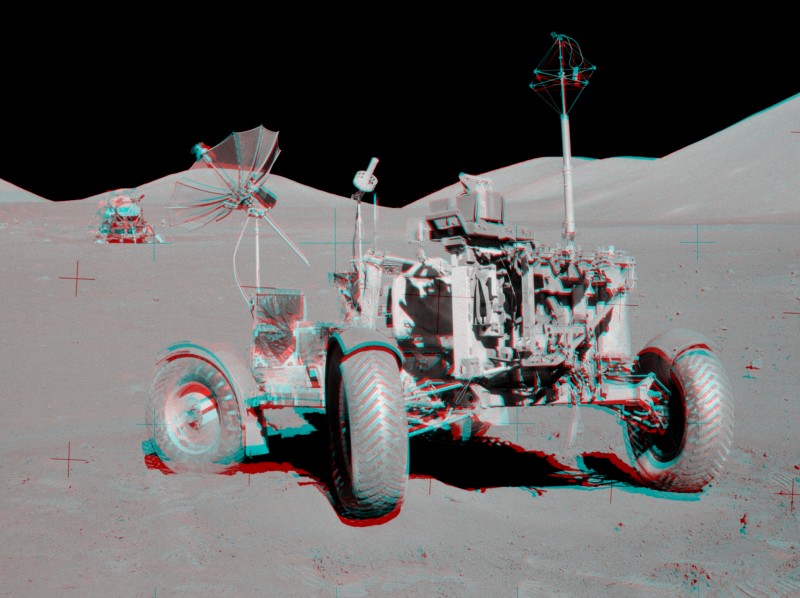
                              Get out your red/blue glasses and check out this stereo scene from Taurus-Littrow valley on the Moon! The color anaglyph features a detailed 3D view of Apollo 17's Lunar Rover in the foreground -- behind it lies the Lunar Module and distant lunar hills. Because the world was going to be able to watch the Lunar Module's ascent stage liftoff via the rover's TV camera, this parking place was also known as the VIP Site. In December of 1972, Apollo 17 astronauts Eugene Cernan and Harrison Schmitt spent about 75 hours on the Moon, while colleague Ronald Evans orbited overhead. The crew returned with 110 kilograms of rock and soil samples, more than from any of the other lunar landing sites. Cernan and Schmitt are still the last to walk (or drive) on the Moon.
                              1st in Kommisar's 2009 SM Tournament
                              1st in I Love You`s 2009 New Year`s Tournament
                              3rd in EnR's Mashfest '08 tournament
                              5th in Phynx's Unofficial FFR Tournament
                              9th in D3 of the 2008-2009 4th Official FFR Tournament
                              10th in D5 of the 2010 5th Official FFR Tournament
                              10th in D6 of the 2011-2012 6th Official FFR Tournament

                              FMO AAA Count: 71
                              FGO AAA Count: 10

                              Bluearrowll = The Canadian player who can not detect awkward patterns. If it's awkward for most people, it's normal for Terry. If the file is difficult but super straight forward, he has issues. If he's AAAing a FGO but then heard that his favorite Hockey team was losing by a point, Hockey > FFR
                              PS: Cool AAA's Terry
                              - I Love You


                              An Alarm Clock's Haiku
                              beep beep beep beep beep
                              beep beep beep beep beep beep beep
                              beep beep beep beep beep
                              - ieatyourlvllol

                              Comment

                              • Bluearrowll
                                ⊙▃⊙
                                FFR Simfile Author
                                • Nov 2007
                                • 7376

                                #870
                                Re: Terry's Astronomy Thread.

                                Daily Suspicious0bserver's Weather Post:
                                March 16, 2014


                                What's in the sky tonight?
                                March 16, 2014
                                -Full Moon (exact at 1:08 p.m. EDT). The Moon rises around sunset and shines far below Leo in the evening, as shown above. Later in the night, look far to the Moon's lower left for Mars and fainter Spica.

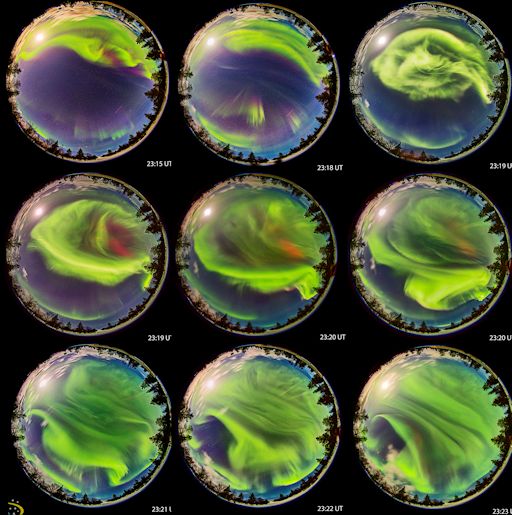
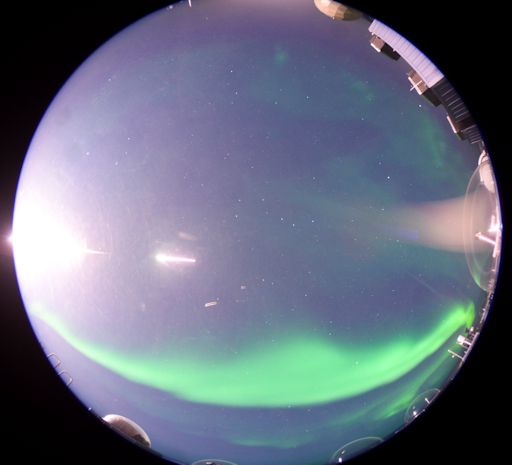
                                -On March 12th, an unexpected geomagnetic storm erupted around the Arctic Circle. The G1-class event was mostly minor, but a few longitudes experienced something more. Over the Finnish Lapland, geomagnetic activity and the auroras it sparked were locally intense. Juan Carlos Casado photographed the display from Saariselkä, a mountain village in northern Finland. "I took these pictures from the longest toboggan run in the world, in Saariselkä,using a circular fisheye lens,' says Casado. "I was with a group of observers and the reactions of people were very emotional, with shouts, laughter and tears in the eyes!"

                                "Time marks inserted in the full-sized image give an idea of the speed of the phenomenon," he continues. "You can see the big bang of activity (top right) and how only in two minutes the whole sky is filled with auroras."

                                The unexpected storm was caused by a fluctuation in the interplanetary magnetic field (IMF). As March 12th turned to 13th, the IMF tilted south, opening a crack in Earth's magnetosphere. Solar wind poured in and fueled the display. The time difference between the first image in the top left and the last image in the bottom right is 8 minutes. The full size image can be found here: http://spaceweathergallery.com/indiv...pload_id=95488


                                Astro Picture of the Day:
                                March 16, 2014

                                Source:
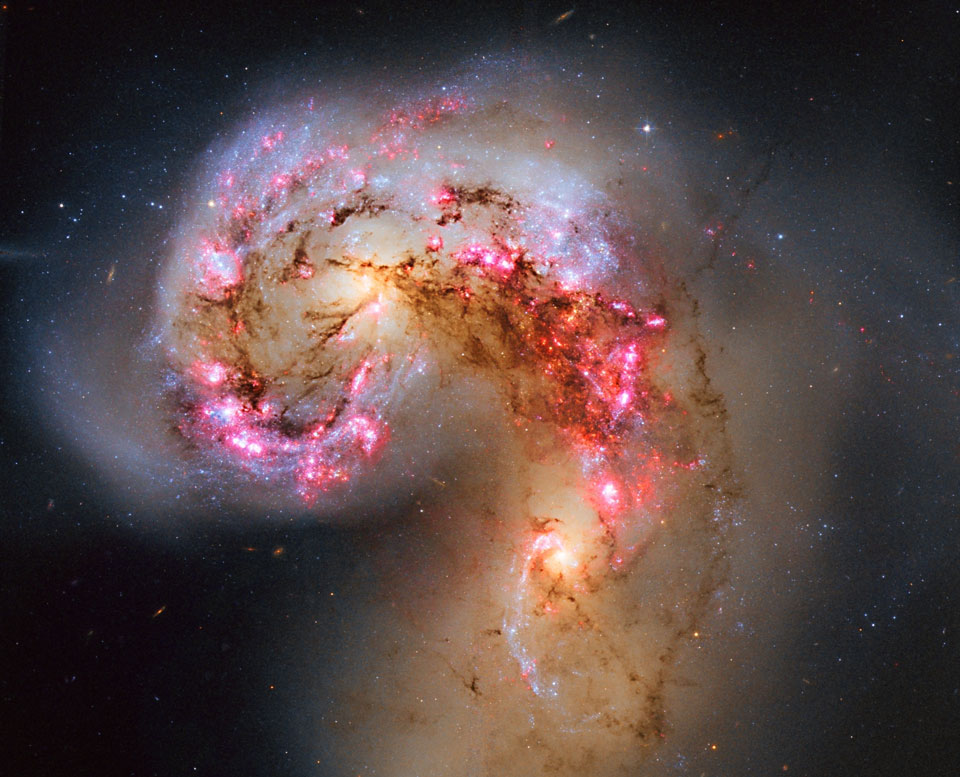
                                Two galaxies are squaring off in Corvus and here are the latest pictures. When two galaxies collide, the stars that compose them usually do not. That's because galaxies are mostly empty space and, however bright, stars only take up only a small amount of that space. During the slow, hundred million year collision, one galaxy can still rip the other apart gravitationally, and dust and gas common to both galaxies does collide. In this clash of the titans, dark dust pillars mark massive molecular clouds are being compressed during the galactic encounter, causing the rapid birth of millions of stars, some of which are gravitationally bound together in massive star clusters.
                                1st in Kommisar's 2009 SM Tournament
                                1st in I Love You`s 2009 New Year`s Tournament
                                3rd in EnR's Mashfest '08 tournament
                                5th in Phynx's Unofficial FFR Tournament
                                9th in D3 of the 2008-2009 4th Official FFR Tournament
                                10th in D5 of the 2010 5th Official FFR Tournament
                                10th in D6 of the 2011-2012 6th Official FFR Tournament

                                FMO AAA Count: 71
                                FGO AAA Count: 10

                                Bluearrowll = The Canadian player who can not detect awkward patterns. If it's awkward for most people, it's normal for Terry. If the file is difficult but super straight forward, he has issues. If he's AAAing a FGO but then heard that his favorite Hockey team was losing by a point, Hockey > FFR
                                PS: Cool AAA's Terry
                                - I Love You


                                An Alarm Clock's Haiku
                                beep beep beep beep beep
                                beep beep beep beep beep beep beep
                                beep beep beep beep beep
                                - ieatyourlvllol

                                Comment

                                Working...