Terry's Astronomy Thread.

Collapse
X
 
  • Time
  • Show
Clear All
new posts
  • Bluearrowll
    ⊙▃⊙
    FFR Simfile Author
    • Nov 2007
    • 7376

    #736
    Re: Terry's Astronomy Thread.

    What's in the sky tonight?
    November 11, 2013
    -Orion displays itself well up in the east-southeast by 9 or 10 p.m. now (depending on how far east or west you are in your time zone). Far left of Orion is Jupiter, shining brightly on its background of Gemini.

    -NOAA forecasters estimate a 60% chance of M-class flares and a 30% chance of X-flares on Nov. 11th. The most likely source is active sunspot AR1890, which has already produced three X-flares since Nov. 5th. In addition, a new flare threat is emerging over the sun's SE limb: Sunspot group AR1895 appears to be big and potent enough to produce some explosions of its own during the next 24 hours.

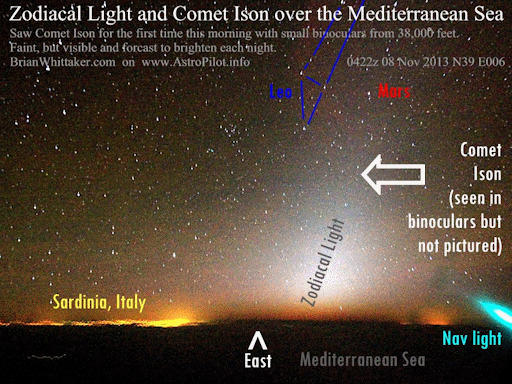
    -Comet ISON is brightening as it approaches the sun. Multiple observers now report that it is a binocular object. "I finally saw Comet ISON for the first time using small binoculars!" says pilot Brian Whittaker. He was flying 38,000 feet over the Mediterranean Sea on Nov. 8th when he took this picture showing where to look. "It was faint, but is predicted to brighten and move each day," he adds. "Exciting! "

    "I have made my first confirmed binocular sighting of C/2012 S1 ISON as well," reports Pete Lawrence of Selsey UK on Nov. 9th. "ISON's head appears small and stellar through a pair of 15x70s optics."

    -Comet ISON is currently moving through the constellation Virgo low in the eastern sky before dawn. Shining like an 8th magnitude star, it is still too dim for naked eye viewing, but an increasingly easy target for backyard optics. Don't delay, because Comet ISON is plunging toward the sun for a perilous encounter on Nov. 28th. At closest approach, the comet will be deep inside the sun's corona and little more than a million kilometers from the fiery stellar surface. If ISON survives--a big IF--it could emerge from solar fire as a naked-eye comet for northern-hemisphere observers in December. Monitoring is encouraged!


    Astro Picture of the Day:
    November 11, 2013
    Source:
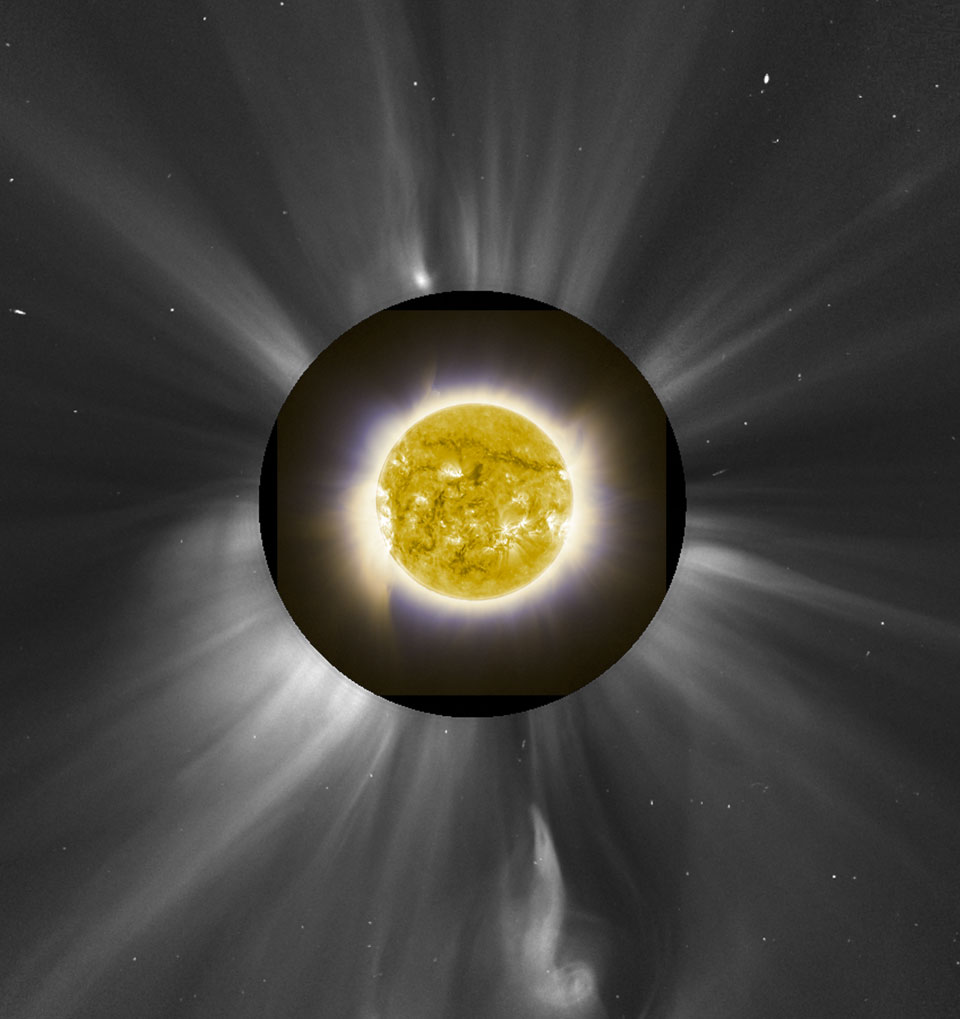
    Sometimes, a total eclipse of the Sun is an opportunity. Taking advantage of such, the above image shows the solar eclipse earlier this month as covered and uncovered by several different solar observatories. The innermost image shows the Sun in ultraviolet light as recorded over a few hours by the SWAP instrument aboard the PROBA2 mission in a sun-synchronous low Earth orbit. This image is surrounded by a ground-based eclipse image, reproduced in blue, taken from Gabon. Further out is a circularly blocked region used to artificially dim the central sun by the LASCO instrument aboard the Sun-orbiting SOHO spacecraft. The outermost image -- showing the outflowing solar corona -- was taken by LASCO ten minutes after the eclipse and shows an outflowing solar corona. Over the past few weeks, our Sun has been showing an unusually high amount of sunspots, CMEs, and flares - activity that was generally expected as the Sun is currently going through Solar Maximum - the busiest part of its 11 year solar cycle. The above resultant image is a picturesque montage of many solar layers at once that allows solar astronomers to better match up active areas on or near the Sun's surface with outflowing jets in the Sun's corona.
    1st in Kommisar's 2009 SM Tournament
    1st in I Love You`s 2009 New Year`s Tournament
    3rd in EnR's Mashfest '08 tournament
    5th in Phynx's Unofficial FFR Tournament
    9th in D3 of the 2008-2009 4th Official FFR Tournament
    10th in D5 of the 2010 5th Official FFR Tournament
    10th in D6 of the 2011-2012 6th Official FFR Tournament

    FMO AAA Count: 71
    FGO AAA Count: 10

    Bluearrowll = The Canadian player who can not detect awkward patterns. If it's awkward for most people, it's normal for Terry. If the file is difficult but super straight forward, he has issues. If he's AAAing a FGO but then heard that his favorite Hockey team was losing by a point, Hockey > FFR
    PS: Cool AAA's Terry
    - I Love You


    An Alarm Clock's Haiku
    beep beep beep beep beep
    beep beep beep beep beep beep beep
    beep beep beep beep beep
    - ieatyourlvllol

    Comment

    • Riotpolice
      "Reach For The Stars"
      • Nov 2010
      • 1921

      #737
      Re: Terry's Astronomy Thread.

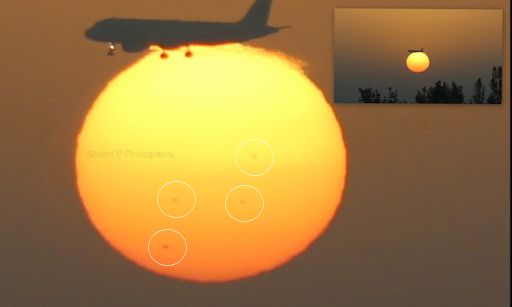
      Daaaaaang, look at that SUN! MAN that looks so cool!! It's no wonder there are so many backgrounds of space 'n shit on google lol. I'm sorry, I'm just nerding out a little, haha!!
      Originally posted by hi19hi19
      Also why is "summon" in quotation marks as usually that signifies an alternate meaning like for example last night I "visited" your mother but it really means last night I "fucked her in the ass" so exactly what is the subtext of "summon" because I am not sure I am comfortable with the implications

      Originally posted by m0de
      im usually the "nice guy" around these parts.. but this is bad, and you should feel bad. i would rather dip my balls in honey and hover them over a red ant hill than to ever hear such butchered crap.

      Comment

      • G.S.M
        He is watching
        • Mar 2006
        • 1068

        #738
        Re: Terry's Astronomy Thread.

        best thread

        ty
        "Someone once said, 'Don't try to be a great man, just be a man, and let history make its own judgments'."

        Comment

        • Bluearrowll
          ⊙▃⊙
          FFR Simfile Author
          • Nov 2007
          • 7376

          #739
          Re: Terry's Astronomy Thread.

          What's in the sky tonight?
          November 12, 2013
          -As evening grows late, catch Sirius for perhaps your first time this season! Look for it rising far below Orion (by about two fist-widths at arm's length), nearly at the place on the horizon where Orion's Belt points. Sirius rises around 10 or 11 p.m. depending on your location.

          -Amateur astronomers are getting a better look at Comet ISON as it dives toward the sun for a Nov. 28th close encounter with solar fire. As the heat rises, the comet brightens, revealing new details every day. This photo, taken Nov. 10th by Michael Jäger of Jauerling Austria, shows a beautiful double tail. One tail is the ion tail. It is a thin streamer of ionized gas pushed away from the comet by solar wind. The filamentary ion tail points almost directly away from the sun.


          Astro Picture of the Day:
          November 12, 2013
          Source:
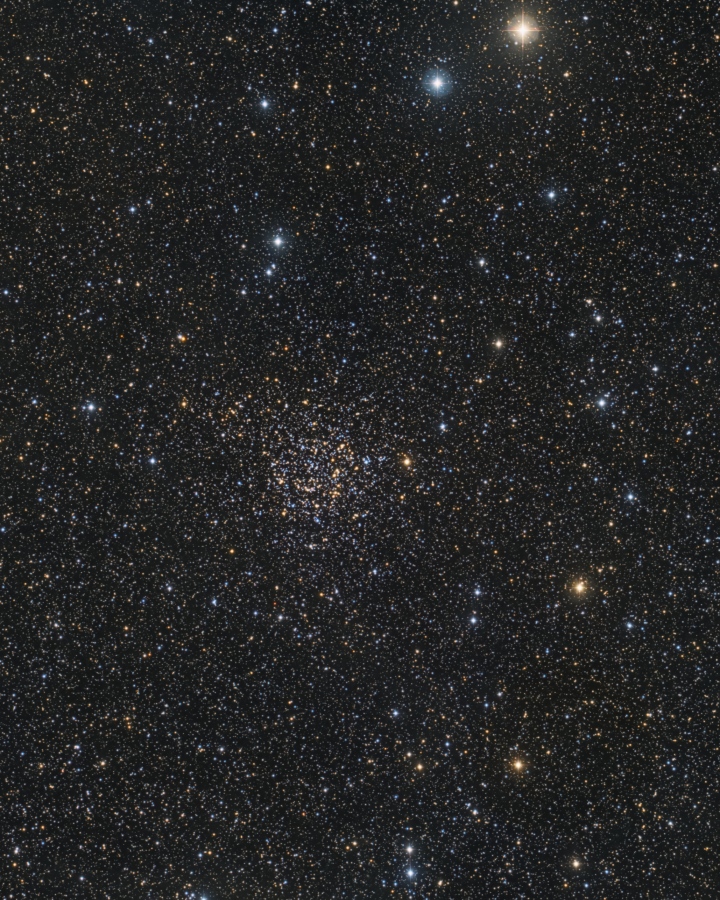
          Found among the rich starfields of the Milky Way toward the constellation Cassiopeia, star cluster NGC 7789 lies about 8,000 light-years away. A late 18th century deep sky discovery of astronomer Caroline Lucretia Herschel, the cluster is also known as Caroline's Rose. Its suggestive appearance is created by the cluster's nestled complex of stars and voids. Now estimated to be 1.6 billion years young, the galactic or open cluster of stars also shows its age. All the stars in the cluster were likely born at the same time, but the brighter and more massive ones have more rapidly exhausted the hydrogen fuel in their cores. These have evolved from main sequence stars like the Sun into the many red giant stars shown with a yellowish cast in this lovely color composite. Using measured color and brightness, astronomers can model the mass and hence the age of the cluster stars just starting to "turn off" the main sequence and become red giants. Over 50 light-years across, Caroline's Rose spans about half a degree (the angular size of the moon) near the center of the wide-field telescopic image.
          1st in Kommisar's 2009 SM Tournament
          1st in I Love You`s 2009 New Year`s Tournament
          3rd in EnR's Mashfest '08 tournament
          5th in Phynx's Unofficial FFR Tournament
          9th in D3 of the 2008-2009 4th Official FFR Tournament
          10th in D5 of the 2010 5th Official FFR Tournament
          10th in D6 of the 2011-2012 6th Official FFR Tournament

          FMO AAA Count: 71
          FGO AAA Count: 10

          Bluearrowll = The Canadian player who can not detect awkward patterns. If it's awkward for most people, it's normal for Terry. If the file is difficult but super straight forward, he has issues. If he's AAAing a FGO but then heard that his favorite Hockey team was losing by a point, Hockey > FFR
          PS: Cool AAA's Terry
          - I Love You


          An Alarm Clock's Haiku
          beep beep beep beep beep
          beep beep beep beep beep beep beep
          beep beep beep beep beep
          - ieatyourlvllol

          Comment

          • Bluearrowll
            ⊙▃⊙
            FFR Simfile Author
            • Nov 2007
            • 7376

            #740
            Re: Terry's Astronomy Thread.

            What's in the sky tonight?
            November 13, 2013
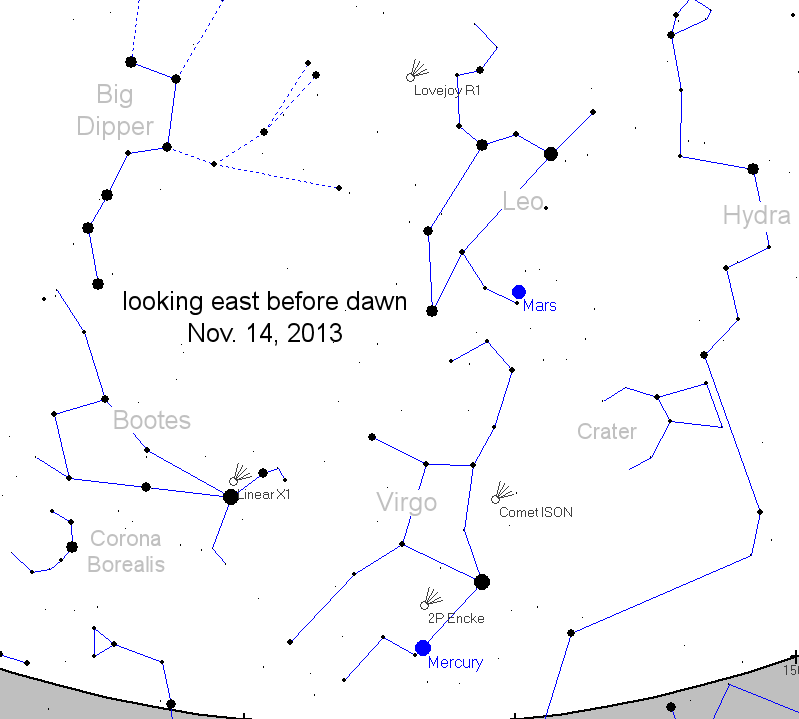
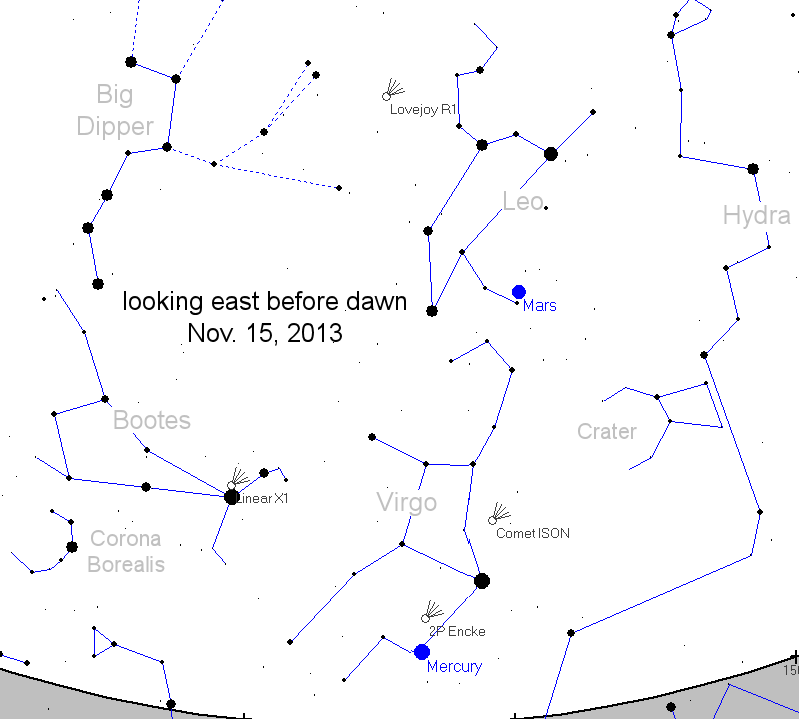
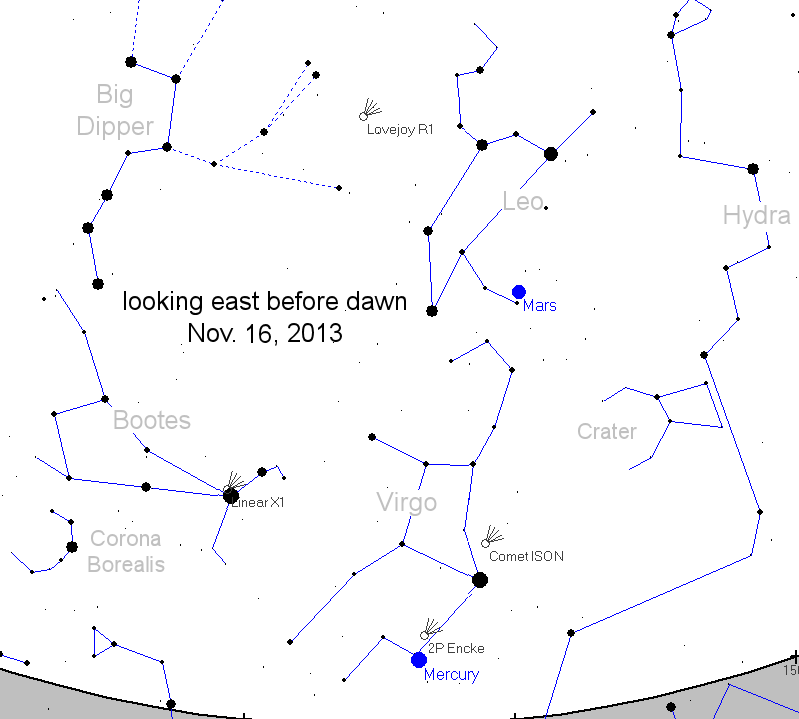
            -Go out very early Thursday morning to try for the four pre-dawn comets while the sky is still moonless. Print out your charts and get everything prepared the evening before. As dawn begins to brighten and you're packing up to go back in, don't miss Mercury rising low in the east-southeast. Mercury, brightening each day, is entering its best dawn showing of 2013.

            -Comet ISON is getting all the press, but another comet is outshining the media-favorite by nearly an order of magnitude. Comet Lovejoy (C/2013 R1) is almost 10 times brighter than Comet ISON as it passes just outside the orbit of Earth in mid-November: 3D orbit. Rolando Ligustri took this picture of Comet Lovejoy on November 12th using a remotely-controlled telescope in New Mexico.

            -The comet's pale green atmosphere is almost twice as wide as the planet Jupiter, and there are no fewer than three tails streaming behind the comet's nucleus. Sky watchers in dark sky sites say that can now see this lovely comet as a faint smudge using averted vision--no optics required. A telescope is, however, recommended.

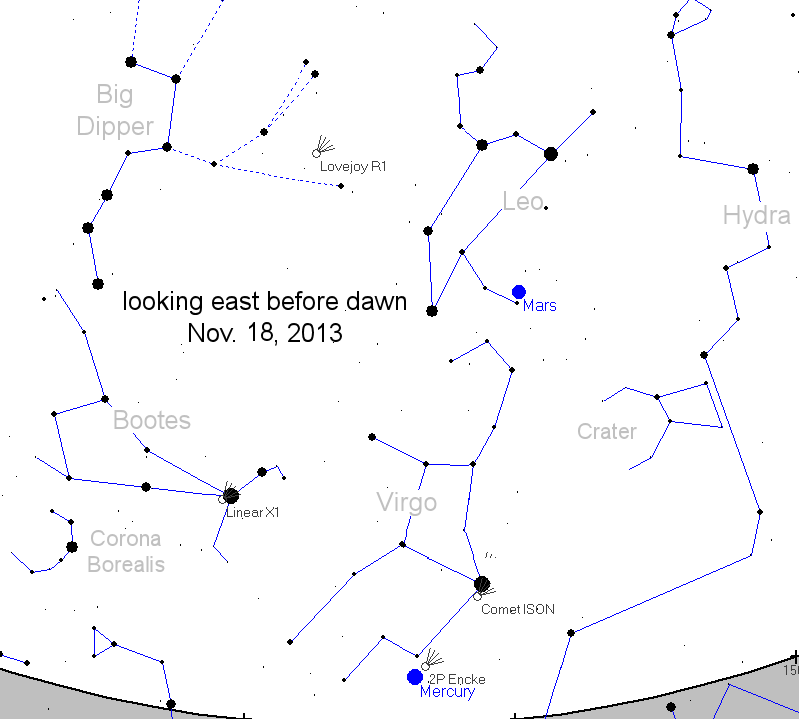
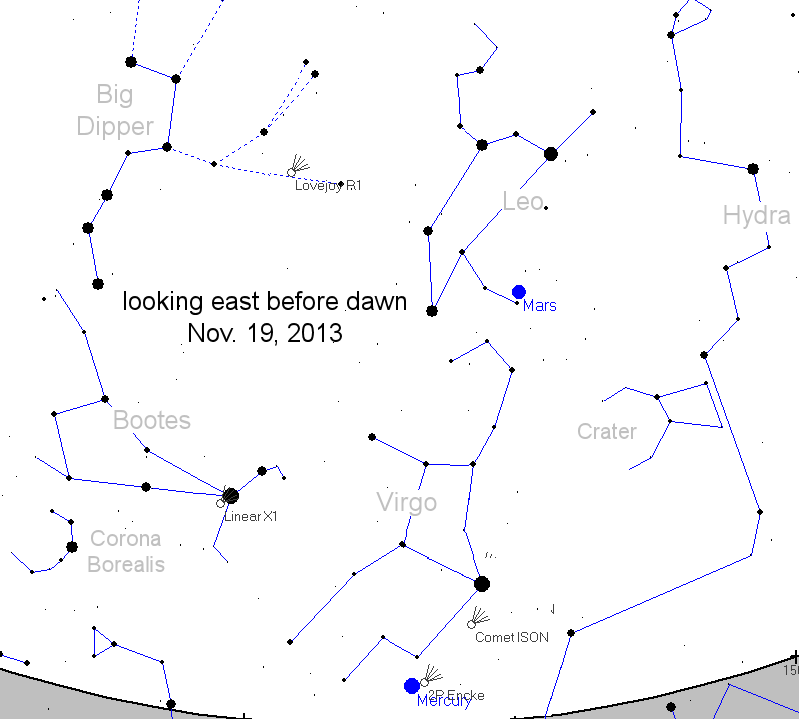
            -Comet Lovejoy is one of four comets now rising in the east before dawn. The other three are exploding Comet LINEAR X1, sungrazing Comet ISON, and short-period Comet Encke, and the brightest of them all. All four are easy targets for backyard optics. Dates of special interest include Nov. 15-18 when Comet LINEAR X1 passes by the bright star Arcturus, Nov 17-18 when Comet ISON has a close encounter with Spica, and Nov. 18-20 when Comet Encke buzzes Mercury. These stars and planets make excellent naked-eye guideposts for finding the comets. Meanwhile, bright Comet Lovejoy is approaching the Big Dipper; if you can't see it with your unaided eye, a quick scan with binoculars will reveal it.


            Astro Picture of the Day:
            November 13, 2013

            Source:
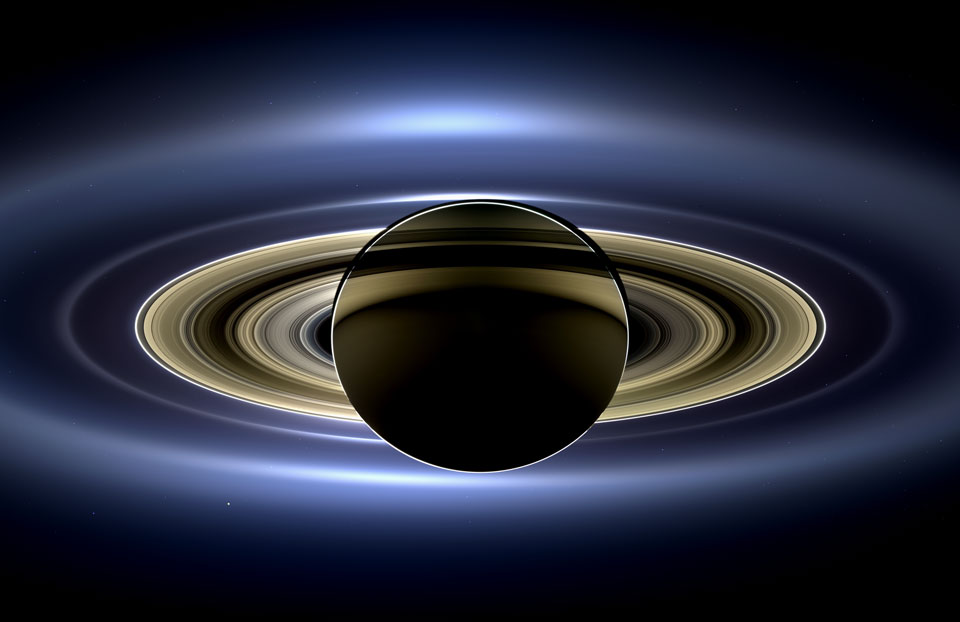
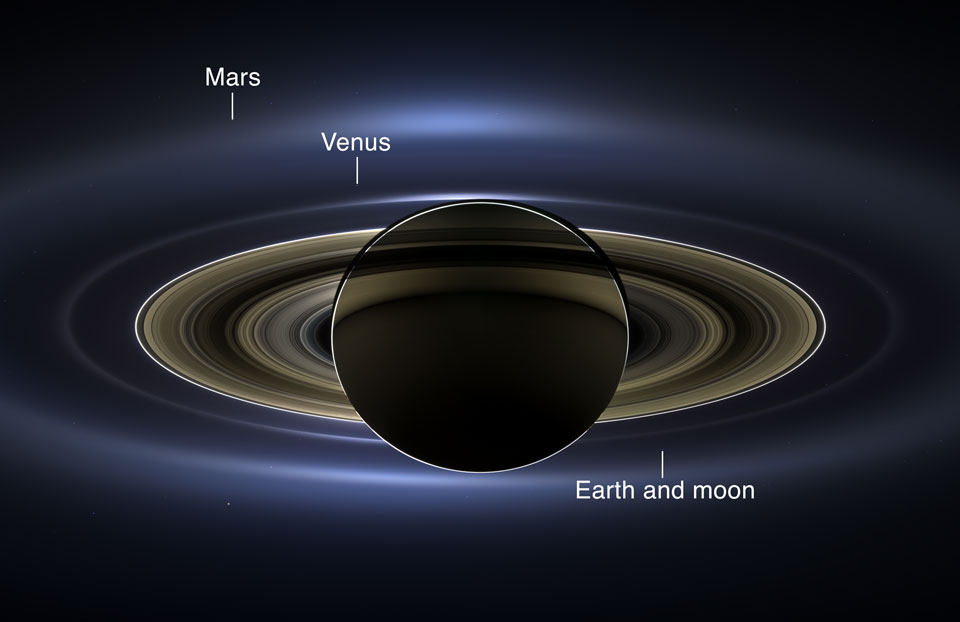
            In the shadow of Saturn, unexpected wonders appear. The robotic Cassini spacecraft now orbiting Saturn drifted in giant planet's shadow earlier this year and looked back toward the eclipsed Sun. Cassini saw a unique and celebrated view. First, the night side of Saturn is seen to be partly lit by light reflected from its own majestic ring system. Next, Saturn's expansive ring system appears as majestic as always even from this odd angle. Ring particles, many glowing only as irregular crescents, slightly scatter sunlight toward Cassini in this natural color image. Several moons and ring features are also discernible. Appearing quite prominently is Saturn's E ring, the ring created by the unusual ice-fountains of the moon Enceladus and the outermost ring visible above. To the upper left, far in the distance, are the planets Mars and Venus. To the lower right, however, is perhaps the most wondrous spectacle of all: the almost invisible, nearly ignorable, pale blue dot of Earth. For the full resolution image, click here: http://apod.nasa.gov/apod/image/1311...tated_9000.jpg
            1st in Kommisar's 2009 SM Tournament
            1st in I Love You`s 2009 New Year`s Tournament
            3rd in EnR's Mashfest '08 tournament
            5th in Phynx's Unofficial FFR Tournament
            9th in D3 of the 2008-2009 4th Official FFR Tournament
            10th in D5 of the 2010 5th Official FFR Tournament
            10th in D6 of the 2011-2012 6th Official FFR Tournament

            FMO AAA Count: 71
            FGO AAA Count: 10

            Bluearrowll = The Canadian player who can not detect awkward patterns. If it's awkward for most people, it's normal for Terry. If the file is difficult but super straight forward, he has issues. If he's AAAing a FGO but then heard that his favorite Hockey team was losing by a point, Hockey > FFR
            PS: Cool AAA's Terry
            - I Love You


            An Alarm Clock's Haiku
            beep beep beep beep beep
            beep beep beep beep beep beep beep
            beep beep beep beep beep
            - ieatyourlvllol

            Comment

            • Bluearrowll
              ⊙▃⊙
              FFR Simfile Author
              • Nov 2007
              • 7376

              #741
              Re: Terry's Astronomy Thread.

              What's in the sky tonight?
              November 14, 2013
              -Look left of the waxing gibbous Moon after dusk for the two or three leading stars of Aries, lined up more or less horizontally. High above the Moon and perhaps a bit right is the Great Square of Pegasus. The Moon itself inhabits dim Pisces.

              -Solar activity has been low for 24+ hours, but the forecast calls for flares. Two large, complex sunspots are transiting the Earthside of the sun with mixed-polarity magnetic fields that harbor energy for strong eruptions. The next big flare will probably come from one of these two circled regions. NOAA forecasters estimate a 60% chance of M-class flares and a 30% chance of X-flares during the next 24 hours. Flares from AR1890 could be particularly geoeffective. Because of the way the sun's magnetic field spirals through interplanetary space, AR1890 is magnetically connected to our planet. Particles accelerated by an explosion there would be guided in our direction, possibly causing a radiation storm around Earth.


              Astro Picture of the Day:
              November 14, 2013

              Source:
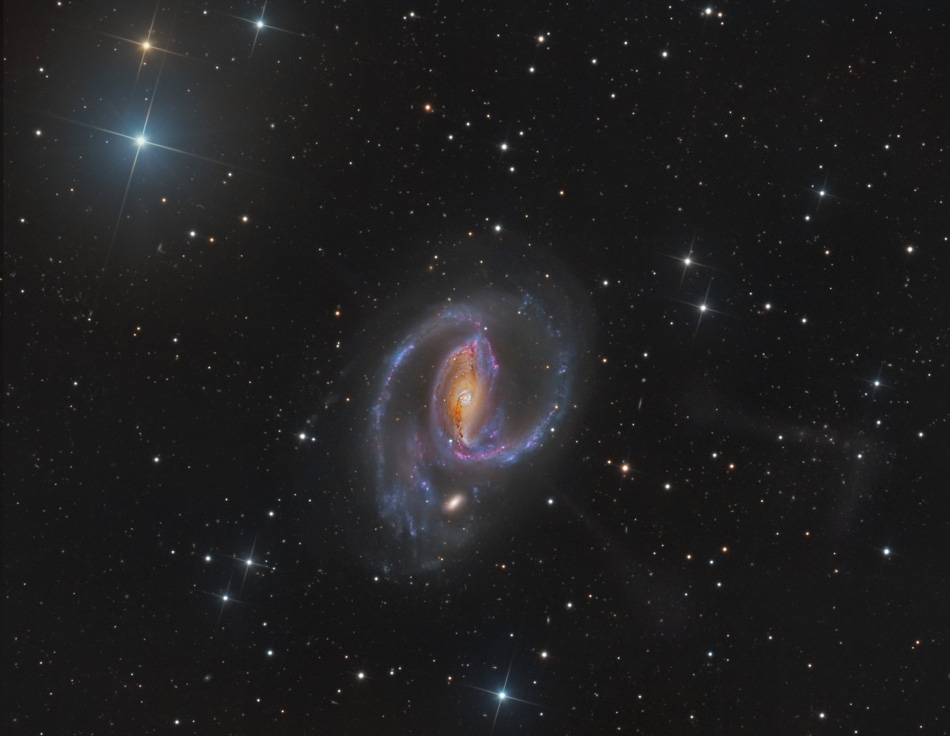
              Enigmatic spiral galaxy NGC 1097 shines in southern skies, about 45 million light-years away in the chemical constellation Fornax. Its blue spiral arms are mottled with pinkish star forming regions in this colorful galaxy portrait. They seem to have wrapped around a small companion galaxy below and left of center, about 40,000 light-years from the spiral's luminous core. That's not NGC 1097's most peculiar feature, though. The very deep exposure hints of faint, mysterious jets, most easily seen to extend well beyond the bluish arms toward the lower right. In fact, four faint jets are ultimately recognized in optical images of NGC 1097. The jets trace an X centered on the galaxy's nucleus, but probably don't originate there. Instead, they could be fossil star streams, trails left over from the capture and disruption of a much smaller galaxy in the large spiral's ancient past. A Seyfert galaxy, NGC 1097's nucleus also harbors a supermassive black hole.
              1st in Kommisar's 2009 SM Tournament
              1st in I Love You`s 2009 New Year`s Tournament
              3rd in EnR's Mashfest '08 tournament
              5th in Phynx's Unofficial FFR Tournament
              9th in D3 of the 2008-2009 4th Official FFR Tournament
              10th in D5 of the 2010 5th Official FFR Tournament
              10th in D6 of the 2011-2012 6th Official FFR Tournament

              FMO AAA Count: 71
              FGO AAA Count: 10

              Bluearrowll = The Canadian player who can not detect awkward patterns. If it's awkward for most people, it's normal for Terry. If the file is difficult but super straight forward, he has issues. If he's AAAing a FGO but then heard that his favorite Hockey team was losing by a point, Hockey > FFR
              PS: Cool AAA's Terry
              - I Love You


              An Alarm Clock's Haiku
              beep beep beep beep beep
              beep beep beep beep beep beep beep
              beep beep beep beep beep
              - ieatyourlvllol

              Comment

              • Bluearrowll
                ⊙▃⊙
                FFR Simfile Author
                • Nov 2007
                • 7376

                #742
                Re: Terry's Astronomy Thread.

                What's in the sky tonight?
                November 15, 2013
                -The bright star high in the west-northwest after dark this month is Vega, often associated with summer. The brightest star higher above it is Deneb. Farther to Vega's left or lower left is Altair, dimmer than Vega but outshining Deneb. These three form the Summer Triangle, which is sinking lower each week as summer becomes a distant memory.

                -Comet ISON has brightened suddenly in the last few days to 5th magnitude as of November 15th — a popsicle comet with a round, sharp-edged, bright green head and a long, thin, dim tail. It's speeding sunward near Spica and Mercury low in the east just before dawn. It passes less than 2° from Spica on the mornings of November 17th and 18th for the Americas, accelerating every day toward its November 28th perihelion and trial by fire. Mike Broussard of Lousiana shot Comet ISON on the morning of November 14th using a 200mm lens on a DSLR.

                -These changes (the increase in brightness and riotous emergence of gaseous streamers) could be caused by fresh veins of ice opening up in the comet's nucleus. Rapid vaporization of ice by solar heat is a sure-fire way to boost a comet's visibility. But, as NASA's Comet ISON Observing Campaign states, "we have no idea." The comet's nucleus is hidden from view by a hazy green atmosphere, so events in the interior remain a mystery.

                "I have a strong suspicion that this is Comet LINEAR (C/1999 S4) all over again," says Mark Kidger of the ESA's European Space Astronomy Centre in Madrid. In the year 2000, Kidger other astronomers monitored Comet LINEAR as it disintegrated en route to the sun. "The sudden appearance of ISON's gas tail, the increasing fuzziness of its coma, and now this sudden outburst all remind me of C/1999 S4 just before it broke apart."

                To reiterate: No one knows what is happening to Comet ISON. This could be the comet's death throes--or just the first of many brightening events the comet experiences as it plunges toward the sun for a close encounter on Thanksgiving Day (Nov. 28th).


                Astro Picture of the Day:
                November 15, 2013

                Source:
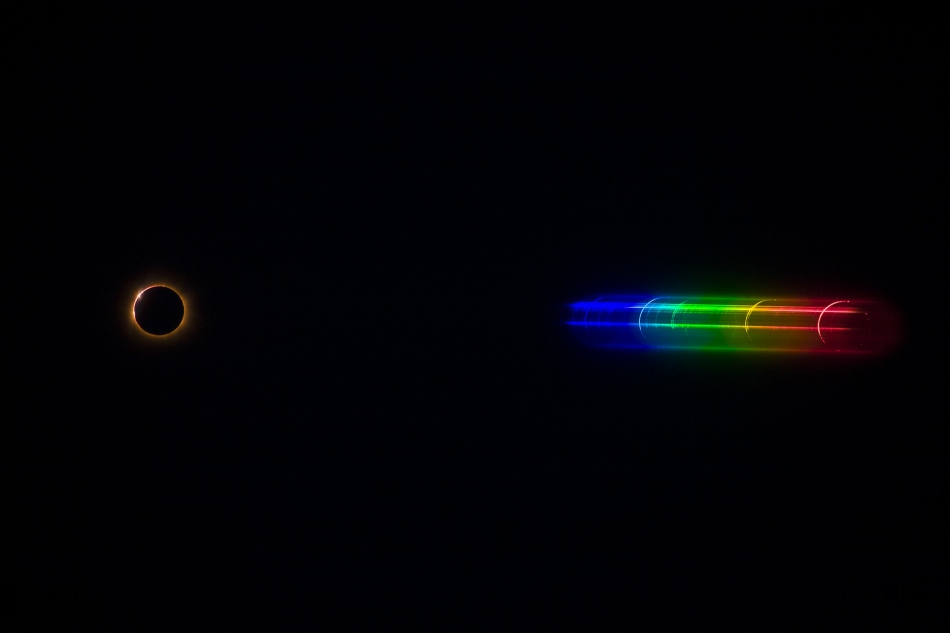
                In a flash, the visible spectrum of the Sun changed from absorption to emission on November 3rd, during the brief total phase of a solar eclipse. That fleeting moment is captured by telephoto lens and diffraction grating in this well-timed image from clearing skies over Gabon in equatorial Africa. With overwhelming light from the Sun's disk blocked by the Moon, the normally dominant absorption spectrum of the solar photosphere is hidden. What remains, spread by the diffraction grating into the spectrum of colors to the right of the eclipsed Sun, are individual eclipse images at each wavelength of light emitted by atoms along the thin arc of the solar chromosphere. The brightest images, or strongest chromospheric emission lines, are due to Hydrogen atoms that produce the red hydrogen alpha emission at the far right and blue hydrogen beta emission to the left. In between, the bright yellow emission image is caused by atoms of Helium, an element only first discovered in the flash spectrum of the Sun.
                1st in Kommisar's 2009 SM Tournament
                1st in I Love You`s 2009 New Year`s Tournament
                3rd in EnR's Mashfest '08 tournament
                5th in Phynx's Unofficial FFR Tournament
                9th in D3 of the 2008-2009 4th Official FFR Tournament
                10th in D5 of the 2010 5th Official FFR Tournament
                10th in D6 of the 2011-2012 6th Official FFR Tournament

                FMO AAA Count: 71
                FGO AAA Count: 10

                Bluearrowll = The Canadian player who can not detect awkward patterns. If it's awkward for most people, it's normal for Terry. If the file is difficult but super straight forward, he has issues. If he's AAAing a FGO but then heard that his favorite Hockey team was losing by a point, Hockey > FFR
                PS: Cool AAA's Terry
                - I Love You


                An Alarm Clock's Haiku
                beep beep beep beep beep
                beep beep beep beep beep beep beep
                beep beep beep beep beep
                - ieatyourlvllol

                Comment

                • Bluearrowll
                  ⊙▃⊙
                  FFR Simfile Author
                  • Nov 2007
                  • 7376

                  #743
                  Re: Terry's Astronomy Thread.

                  What's in the sky tonight?
                  November 16, 2013
                  -The Moon is almost equally full this evening and tomorrow evening. Tonight, look above the Moon for the leading star or two of Aries glimmering through the moonlight. To the Moon's left are the Pleiades, as shown at right. Much farther left twinkles bright Capella.

                  -The sunspot number is so high, it is starting to confuse photographers. Consider this story from Beijing, China, on the morning of Nov. 15th: "Beijing is usually very polluted and we often miss seeing the sun rise in the morning," says Shalini Purohit. "Today, however, the morning sky was clear and I decided to take some pictures. When I looked at the image I thought there must be come specks of dust on my lens." In fact, the lens was clean; those specks were sunspots. When the sunspot number is high, so is the chance of flares. NOAA forecasters estimate a 50% chance of M-class flares and a 15% chance of X-flares during the next 24 hours. As Purohit's image shows, at least four of the sun's spots are facing Earth. If any eruptions do occur, they will likely be geoeffective.


                  Astro Picture of the Day:
                  November 16, 2013

                  Source:
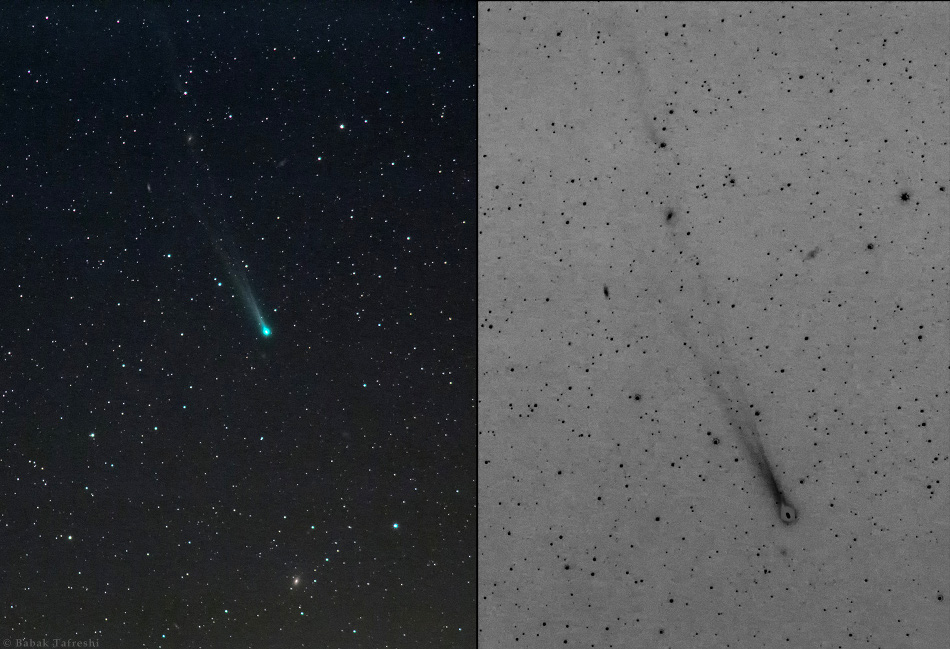
                  Falling through planet Earth's predawn skies toward its close encounter with the Sun on November 28, Comet ISON is coming to life. The much anticipated comet has now been reported to have substantially increased in brightness, surging to naked-eye visibility for dark sites and sprouting a more complex tail. ISON's tail stretches over two degrees in this telephoto skyview from southern Kenya, captured on the morning of November 15. Shown in two panels, the enlarged negative version on the right makes details of the long tail easier to trace, including the tail's separated filaments toward the top of the frame. A sungrazer and first time visitor to the inner solar system, the possibility of ISON's survival to become a bright comet in planet Earth's December skies remains a question.
                  1st in Kommisar's 2009 SM Tournament
                  1st in I Love You`s 2009 New Year`s Tournament
                  3rd in EnR's Mashfest '08 tournament
                  5th in Phynx's Unofficial FFR Tournament
                  9th in D3 of the 2008-2009 4th Official FFR Tournament
                  10th in D5 of the 2010 5th Official FFR Tournament
                  10th in D6 of the 2011-2012 6th Official FFR Tournament

                  FMO AAA Count: 71
                  FGO AAA Count: 10

                  Bluearrowll = The Canadian player who can not detect awkward patterns. If it's awkward for most people, it's normal for Terry. If the file is difficult but super straight forward, he has issues. If he's AAAing a FGO but then heard that his favorite Hockey team was losing by a point, Hockey > FFR
                  PS: Cool AAA's Terry
                  - I Love You


                  An Alarm Clock's Haiku
                  beep beep beep beep beep
                  beep beep beep beep beep beep beep
                  beep beep beep beep beep
                  - ieatyourlvllol

                  Comment

                  • Bluearrowll
                    ⊙▃⊙
                    FFR Simfile Author
                    • Nov 2007
                    • 7376

                    #744
                    Re: Terry's Astronomy Thread.

                    What's in the sky tonight?
                    November 17, 2013
                    -Comet ISON is within 2° of Spica this morning and Monday morning as seen from the Americas. Their closest approach, 1/3°, comes around 1h November 18th Universal Time, good timing for observers in the longitudes of eastern Europe and western Asia.

                    -Reports of naked-eye sightings of Comet ISON are coming in from around the world. Experienced observers put the comet's magntitude at +5.5 on Nov. 16th. This means it is now fully 10 times brighter than it was only three days ago before the outburst. To the naked eye, ISON appears as a faint smudge of pale green light low in the pre-dawn sky. The view through a telescope is more dramatic. The comet's tail has become a riotous crowd of gaseous streamers stretching more than 3.5 degrees across the sky. Amateur astronomer Waldemar Skorupa sends this picture from Kahler Asten, Germany.

                    -The tail is so long, he couldn't fit the whole thing in the field of view. How long is it? Comet ISON's tail extends more than 8 million kilometers behind the comet's nucleus. For comparison, that's 21 times the distance between Earth and the Moon.

                    Because so much gas and dust is spewing from the comet's core, it is impossible to see clearly what caused Comet ISON's outburst on Nov. 13-14. One possibility is that fresh veins of ice are opening up in the comet's nucleus, vaporizing furiously as ISON approaches the sun. Another possibility is that the nucleus has completely fragmented.

                    "If so, it will still be several days before we know for sure," says Karl Battams, an astronomer with NASA's Comet ISON Observing Campaign. "When comet nuclei fall apart, it’s not like a shrapnel-laden explosion. Instead, the chunks slowly drift apart at slightly different speeds. Given that ISON’s nucleus is shrouded in such a tremendous volume of light-scattering dust and gas right now, it will be almost impossible to determine this for at least a few days and perhaps not until the comet reaches the field of view of NASA's STEREO HI-1A instrument on November 21, 2013. We will have to wait for the chunks to drift apart a sufficient distance, assuming they don't crumble first."

                    In short, no one knows for sure what is happening to Comet ISON. This could be the comet's death throes--or just the first of many brightening events the comet experiences as it plunges toward the sun for a close encounter on American Thanksgiving Day.


                    Astro Picture of the Day:
                    November 17, 2013

                    Source:
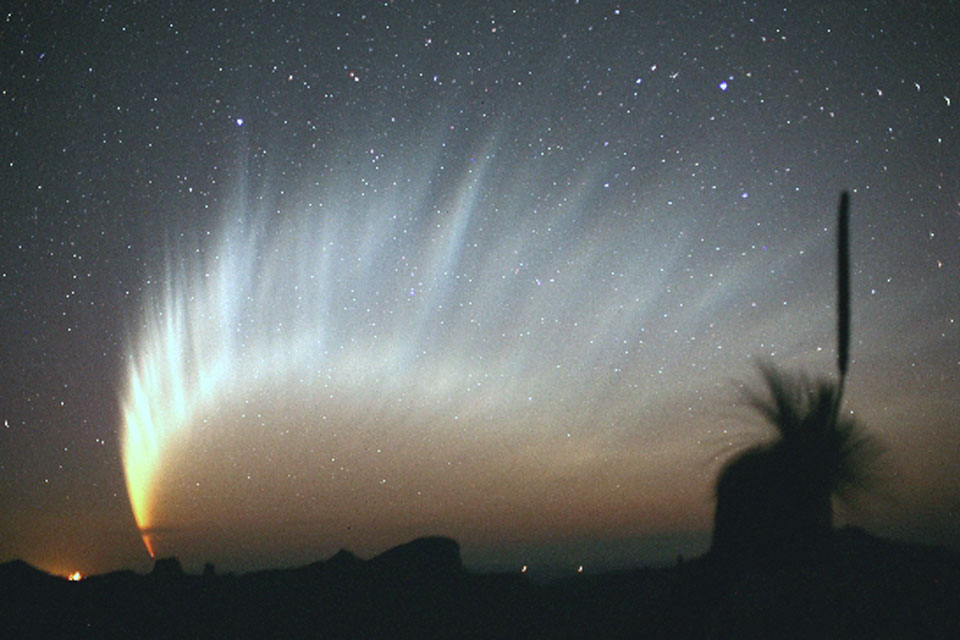
                    Comet McNaught, the Great Comet of 2007, grew a spectacularly long and filamentary tail. The magnificent tail spread across the sky and was visible for several days to Southern Hemisphere observers just after sunset. The amazing tail showed its greatest extent on long-duration, wide-angle camera exposures. During some times, just the tail itself estimated to attain a peak brightness of magnitude -5 (minus five), was caught by the comet's discoverer in the above image just after sunset in January 2007 from Siding Spring Observatory in Australia. Comet McNaught, the brightest comet in decades, then faded as it moved further into southern skies and away from the Sun and Earth. Within the next two weeks of 2013, rapidly brightening Comet ISON might sprout a tail that rivals even Comet McNaught.
                    1st in Kommisar's 2009 SM Tournament
                    1st in I Love You`s 2009 New Year`s Tournament
                    3rd in EnR's Mashfest '08 tournament
                    5th in Phynx's Unofficial FFR Tournament
                    9th in D3 of the 2008-2009 4th Official FFR Tournament
                    10th in D5 of the 2010 5th Official FFR Tournament
                    10th in D6 of the 2011-2012 6th Official FFR Tournament

                    FMO AAA Count: 71
                    FGO AAA Count: 10

                    Bluearrowll = The Canadian player who can not detect awkward patterns. If it's awkward for most people, it's normal for Terry. If the file is difficult but super straight forward, he has issues. If he's AAAing a FGO but then heard that his favorite Hockey team was losing by a point, Hockey > FFR
                    PS: Cool AAA's Terry
                    - I Love You


                    An Alarm Clock's Haiku
                    beep beep beep beep beep
                    beep beep beep beep beep beep beep
                    beep beep beep beep beep
                    - ieatyourlvllol

                    Comment

                    • Bluearrowll
                      ⊙▃⊙
                      FFR Simfile Author
                      • Nov 2007
                      • 7376

                      #745
                      Re: Terry's Astronomy Thread.

                      What's in the sky tonight?
                      November 18, 2013
                      -This evening look right of the just-past-full Moon for Aldebaran. Later in the evening, Orion rises below them.

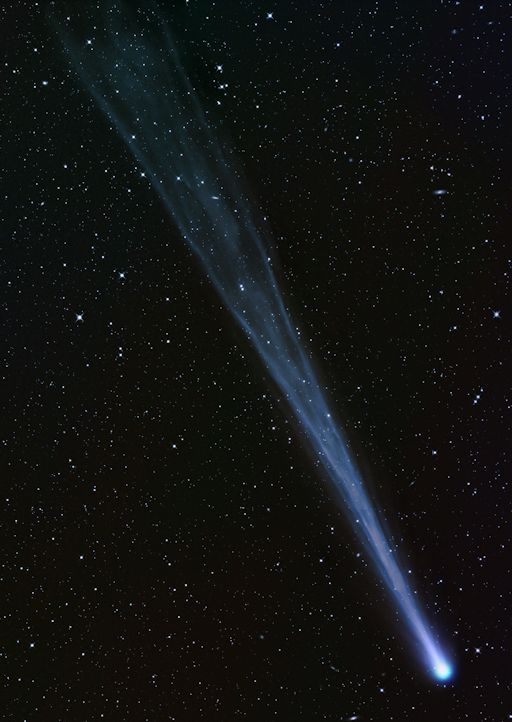
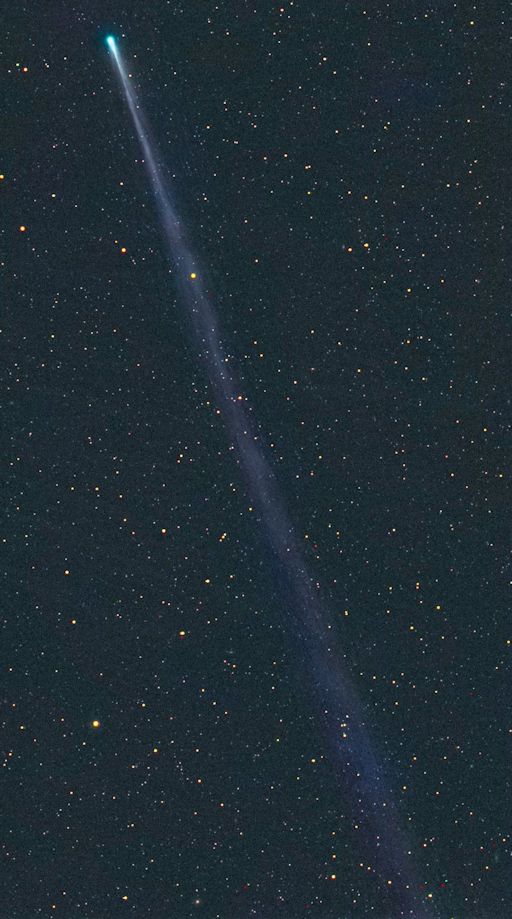
                      -Comet's ISON's recent outburst of activity has done more than simply brighten the comet. Whatever exploded from the comet's core also created a spectacularly-long tail, more than 16 million kilometers from end to end. Scroll down to see the full extent of Comet ISON as photographed on Nov. 17th by Michael Jäger of Ebenwaldhöhe, Austria.

                      "The tail of the comet stretches more than 7o across the sky," says Jäger. It's almost as wide as the bowl of the Big Dipper.

                      Physically, ISON's tail is about 12 times wider than the sun. So, when the head of ISON plunges into the sun's atmosphere on Nov. 28th, more than 15 million kilometers of the comet's tail will still be jutting into space behind it.

                      Because so much gas and dust is spewing from the comet's core, it is impossible to see clearly what caused Comet ISON's outburst on Nov. 13-14. One possibility is that fresh veins of ice are opening up in the comet's nucleus, vaporizing furiously as ISON approaches the sun. Another possibility is that the nucleus has completely fragmented.

                      "If so, it will still be several days before we know for sure," says Karl Battams, an astronomer with NASA's Comet ISON Observing Campaign. "When comet nuclei fall apart, it’s not like a shrapnel-laden explosion. Instead, the chunks slowly drift apart at slightly different speeds. Given that ISON’s nucleus is shrouded in such a tremendous volume of light-scattering dust and gas right now, it will be almost impossible to determine this for at least a few days and perhaps not until the comet reaches the field of view of NASA's STEREO HI-1A instrument on November 21, 2013. We will have to wait for the chunks to drift apart a sufficient distance, assuming they don't crumble first."


                      Astro Picture of the Day:
                      November 18, 2013

                      Source:
                      What's happening in the sky? On this cold winter night in Iceland, quite a lot. First, in the foreground, lies the largest glacier in Iceland: Vatnajokull. On the far left, bright green auroras appear to emanate from the glacier as if it was a volcano. Aurora light is reflected by the foreground lake Jökulsárlón. On the far right is a long and unusual lenticular cloud tinged with green light emitted from another aurora well behind it. Just above this lenticular cloud are unusual iridescent lenticular clouds displaying a broad spectral range of colors. Far beyond the lenticular is the setting Moon, while far beyond even the Moon are setting stars. The above image was captured in late March of 2012.
                      1st in Kommisar's 2009 SM Tournament
                      1st in I Love You`s 2009 New Year`s Tournament
                      3rd in EnR's Mashfest '08 tournament
                      5th in Phynx's Unofficial FFR Tournament
                      9th in D3 of the 2008-2009 4th Official FFR Tournament
                      10th in D5 of the 2010 5th Official FFR Tournament
                      10th in D6 of the 2011-2012 6th Official FFR Tournament

                      FMO AAA Count: 71
                      FGO AAA Count: 10

                      Bluearrowll = The Canadian player who can not detect awkward patterns. If it's awkward for most people, it's normal for Terry. If the file is difficult but super straight forward, he has issues. If he's AAAing a FGO but then heard that his favorite Hockey team was losing by a point, Hockey > FFR
                      PS: Cool AAA's Terry
                      - I Love You


                      An Alarm Clock's Haiku
                      beep beep beep beep beep
                      beep beep beep beep beep beep beep
                      beep beep beep beep beep
                      - ieatyourlvllol

                      Comment

                      • Bluearrowll
                        ⊙▃⊙
                        FFR Simfile Author
                        • Nov 2007
                        • 7376

                        #746
                        Re: Terry's Astronomy Thread.

                        What's in the sky tonight?
                        November 19, 2013
                        -After 9 or 10 this evening, you'll find the waning gibbous Moon shining inside a huge quadrilateral: Capella to the Moon's upper left, Aldebaran to the Moon's upper right, Betelgeuse closer to its lower right, and bright Jupiter far to its lower left.

                        -Today, Nov. 19th, Earth is passing through a narrow stream of debris from Comet Tempel-Tuttle, source of the annual Leonid meteor shower. "The Leonids are showing up nicely in our data from the Canadian Meteor Orbit Radar (CMOR)," reports Peter Brown of the University of Western Ontario. "Rates are only about 10 per hour, but the shower is definitely active, if muted due to moonlight this year!"

                        -To listen to the meteor shower tonight, visit http://spaceweatherradio.com/

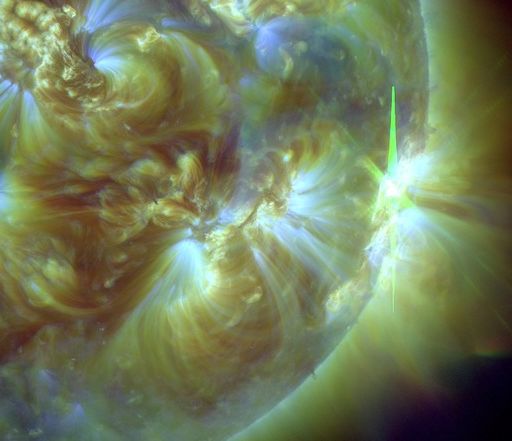
                        -prawling sunspot AR1897 erupted on Nov. 19th (10:26 UT), producing an X1-class solar flare. NASA's Solar Dynamics Observatory recorded the explosion's extreme ultraviolet flash. Although the sunspot is not directly facing Earth, the flare did affect our planet. Mainly, the UV flash produced a wave of ionization in the upper atmosphere over Europe, Africa and parts of Asia. A brief blackout of HF radio transmissions around the poles might have also occurred. First-look coronagraph data from NASA's STEREO-Ahead probe show a CME emerging from the blast site, but it is probably not heading for Earth.

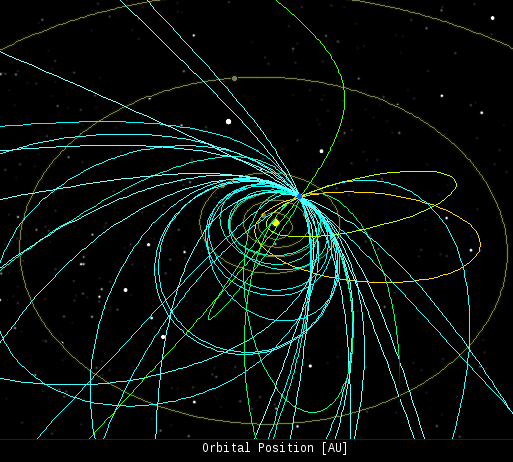
                        -On Nov. 19, 2013, the network reported 31 fireballs. (21 sporadics, 10 Leonids) This number is expected to increase tonight with the advent of the Leonid meteor shower. Refer to the meteor tracker for more detailed charts.


                        Astro Picture of the Day:
                        November 19, 2013

                        Source:
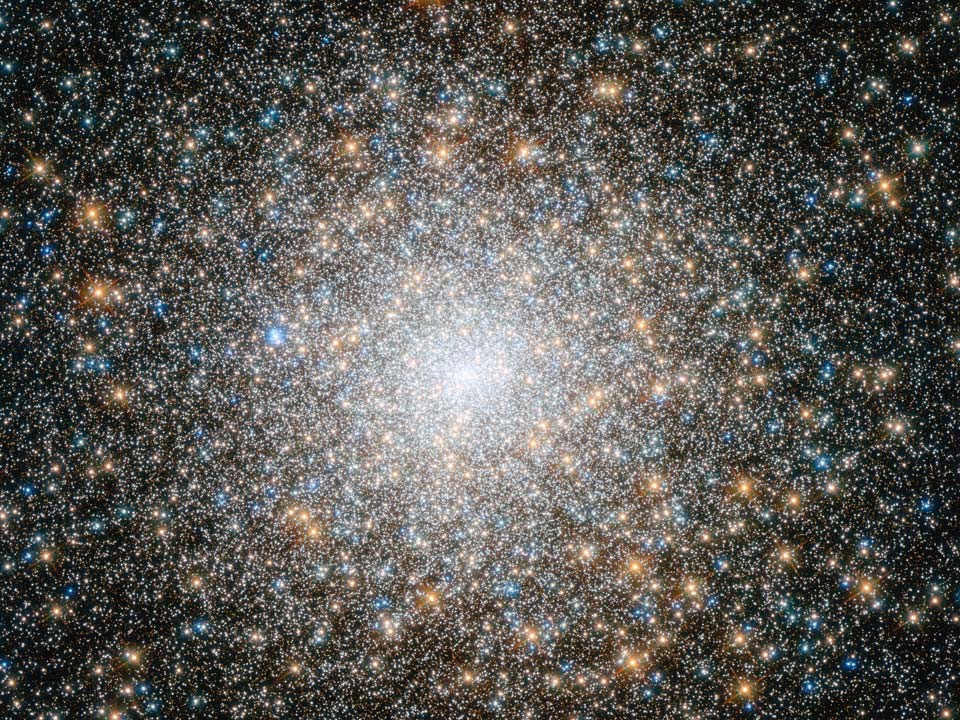
                        Stars, like bees, swarm around the center of bright globular cluster M15. This ball of over 100,000 stars is a relic from the early years of our Galaxy, and continues to orbit the Milky Way's center. M15, one of about 170 globular clusters remaining, is noted for being easily visible with only binoculars, having at its center one of the densest concentrations of stars known, and containing a high abundance of variable stars and pulsars. Released only recently, this sharp image taken by the Earth-orbiting Hubble Space Telescope spans about 120 light years. It shows the dramatic increase in density of stars toward the cluster's center. M15 lies about 35,000 light years away toward the constellation of the Winged Horse (Pegasus).
                        1st in Kommisar's 2009 SM Tournament
                        1st in I Love You`s 2009 New Year`s Tournament
                        3rd in EnR's Mashfest '08 tournament
                        5th in Phynx's Unofficial FFR Tournament
                        9th in D3 of the 2008-2009 4th Official FFR Tournament
                        10th in D5 of the 2010 5th Official FFR Tournament
                        10th in D6 of the 2011-2012 6th Official FFR Tournament

                        FMO AAA Count: 71
                        FGO AAA Count: 10

                        Bluearrowll = The Canadian player who can not detect awkward patterns. If it's awkward for most people, it's normal for Terry. If the file is difficult but super straight forward, he has issues. If he's AAAing a FGO but then heard that his favorite Hockey team was losing by a point, Hockey > FFR
                        PS: Cool AAA's Terry
                        - I Love You


                        An Alarm Clock's Haiku
                        beep beep beep beep beep
                        beep beep beep beep beep beep beep
                        beep beep beep beep beep
                        - ieatyourlvllol

                        Comment

                        • Bluearrowll
                          ⊙▃⊙
                          FFR Simfile Author
                          • Nov 2007
                          • 7376

                          #747
                          Re: Terry's Astronomy Thread.

                          What's in the sky tonight?
                          November 20, 2013
                          -By late evening the waning Moon is up in the east. It's now part of a long, ragged, roughly horizontal snake. From right to left: Rigel in Orion's foot in the east-southeast, Orion's Belt, Betelgeuse, the Moon, Jupiter, Pollux, and above Pollux, Castor.

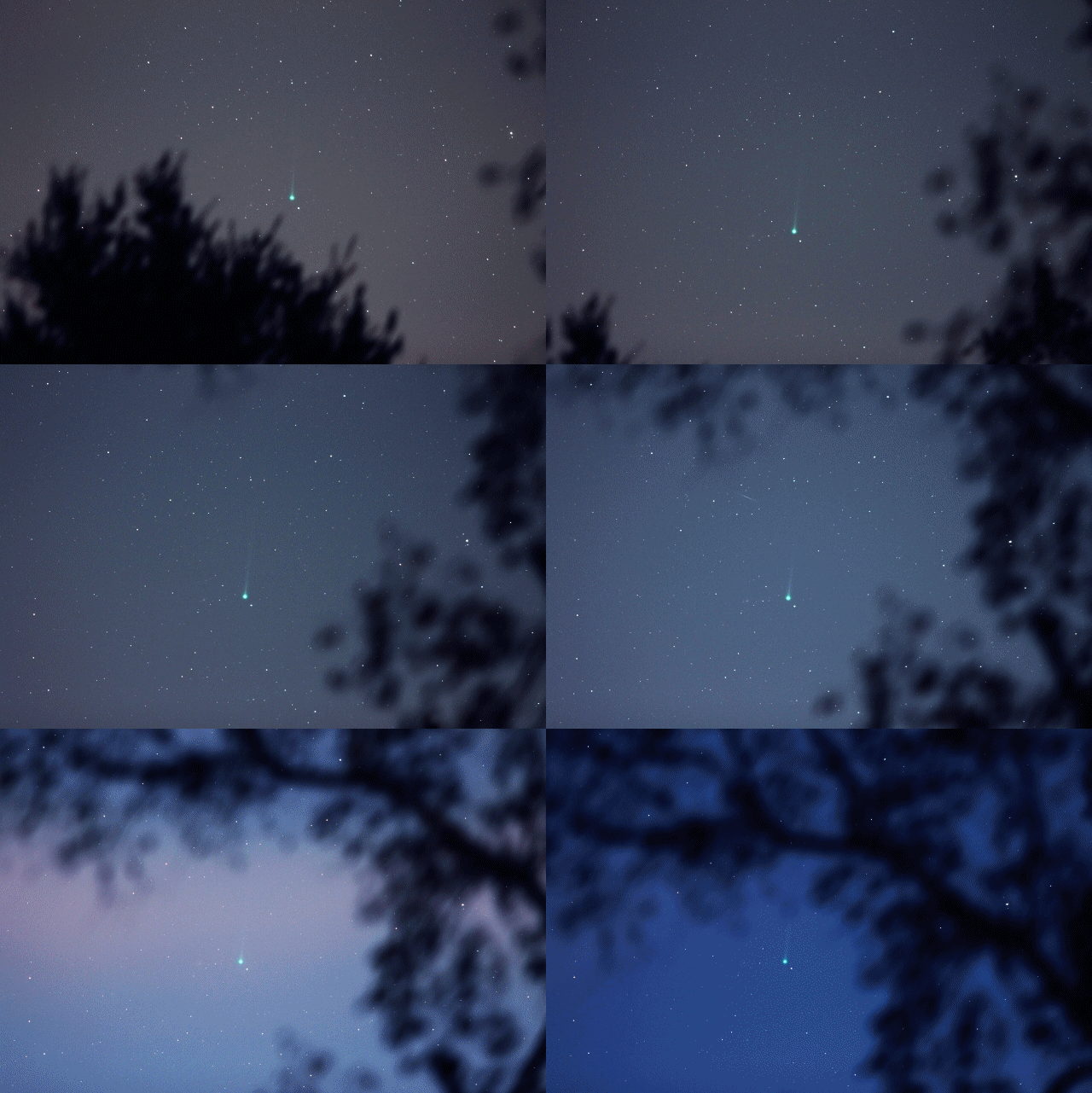
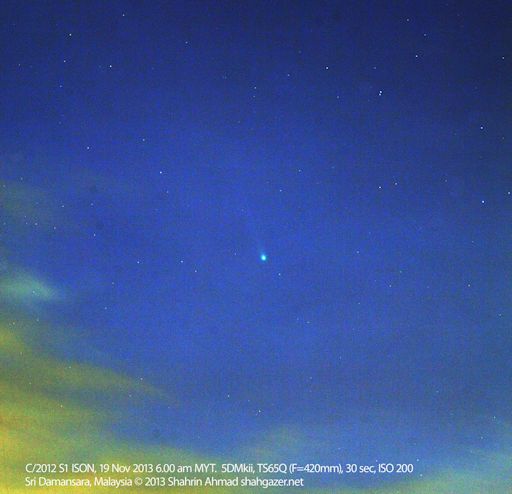
                          -Astronomers working with the TRAPPIST telescope at ESO's La Silla Observatory report that Comet ISON's production of gas and dust surged another six-fold during the early hours of Nov. 19th. This marks the second outburst since Nov. 13th. Experienced observers put the comet's rising magnitude near +4.0, well above the threshold of naked-eye visibility. The problem is, ISON is approaching the sun and becoming increasingly difficult to observe. Shahrin Ahmad of Kuala Lumpur, Malaysia, photographed the comet's green core framed by twilight blue on the morning of Nov. 19th.

                          -The situation is only going to worsen as the comet plunges toward its Nov. 28th close encounter with the sun. Amateur photography of the comet will be possible for a few more days and, soon, only NASA's fleet of solar observatories will be able to track the sundiver.


                          Astro Picture of the Day:
                          November 20, 2013

                          Source:
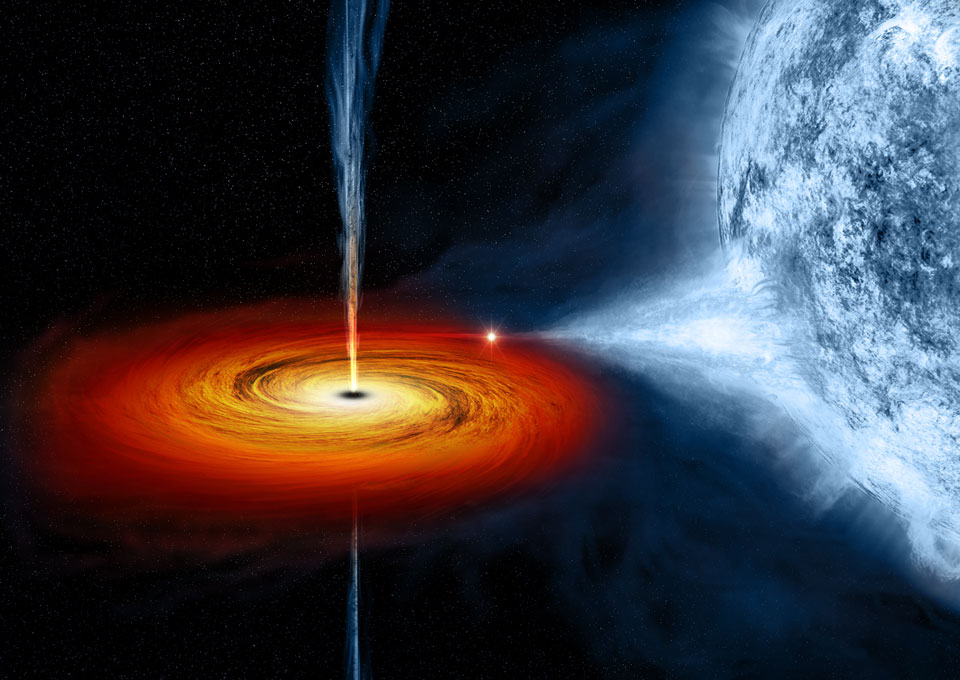
                          What are black hole jets made of? Many black holes in stellar systems are surely surrounded by disks of gas and plasma gravitationally pulled from a close binary star companion. Some of this material, after approaching the black hole, ends up being expelled from the star system in powerful jets emanating from the poles of the spinning black hole. Recent evidence indicates that these jets are composed not only electrons and protons, but also the nuclei of heavy elements such as iron and nickel. The discovery was made in system 4U1630-47 using CSIRO’s Compact Array of radio telescopes in eastern Australia, and the European Space Agency's Earth-orbiting XMM-Newton satellite. The 4U1630-47 star system is depicted above in an artist's illustration, with a large blue star on the right and jets emanating from a black hole in the center of the accretion disc on the left. Although the 4U1630-47 star system is thought to contain only a small black hole - a few times the mass of our Sun - the implications of the results may be larger: that black holes of larger sizes might also be emitting jets of massive nuclei into the cosmos.
                          1st in Kommisar's 2009 SM Tournament
                          1st in I Love You`s 2009 New Year`s Tournament
                          3rd in EnR's Mashfest '08 tournament
                          5th in Phynx's Unofficial FFR Tournament
                          9th in D3 of the 2008-2009 4th Official FFR Tournament
                          10th in D5 of the 2010 5th Official FFR Tournament
                          10th in D6 of the 2011-2012 6th Official FFR Tournament

                          FMO AAA Count: 71
                          FGO AAA Count: 10

                          Bluearrowll = The Canadian player who can not detect awkward patterns. If it's awkward for most people, it's normal for Terry. If the file is difficult but super straight forward, he has issues. If he's AAAing a FGO but then heard that his favorite Hockey team was losing by a point, Hockey > FFR
                          PS: Cool AAA's Terry
                          - I Love You


                          An Alarm Clock's Haiku
                          beep beep beep beep beep
                          beep beep beep beep beep beep beep
                          beep beep beep beep beep
                          - ieatyourlvllol

                          Comment

                          • Bluearrowll
                            ⊙▃⊙
                            FFR Simfile Author
                            • Nov 2007
                            • 7376

                            #748
                            Re: Terry's Astronomy Thread.

                            What's in the sky tonight?
                            November 21, 2013
                            -Jupiter is the bright "star" upper left of the Moon late this evening. Although they look close together, Jupiter is currently 1,660 times farther away. And Pollux and Castor, to Jupiter's left and upper left, are 500,000 and 730,000 times farther than Jupiter! (at 34 and 52 light-years, respectively).

                            -Comet ISON is plunging toward the sun at 140,000 mph (62 km/s). You can almost feel the velocity in this image taken on the morning of Nov. 20th by astronomers using the 0.4 meter telescope at the Observatorio de la Hita in La Puebla de Almoradiel, Toledo, Spain. "The comet looked very bright," report the observing team. "The tail was not as well defined today because of the proximity of morning twilight...but still splendid!!"

                            The comet is brightening rapidly as it approaches the sun. Experienced observers put ISON's rising magnitude near +4.0, well above the threshold of naked-eye visibility. The problem is, the glare of the sun is brightening even faster. Amateur photography of the comet will be possible for a few more days and, soon, only NASA's fleet of solar observatories will be able to track the sundiver.

                            -Observationally speaking, the next big event in the timeline of Comet ISON's journey comes on Nov. 21st when the comet enters the field of view of NASA's STEREO-A spacecraft. The Heliospheric Imager on STEREO-A will pick up the comet just as Earth-bound telescopes begin to lose it. In the days that follow, STEREO-B, SOHO and the Solar Dynamics Observatory will join the hunt, providing continuous views of Comet ISON all the way to perihelion (closest approach to the sun) on Nov. 28th.


                            Astro Picture of the Day:
                            November 21, 2013

                            Source:
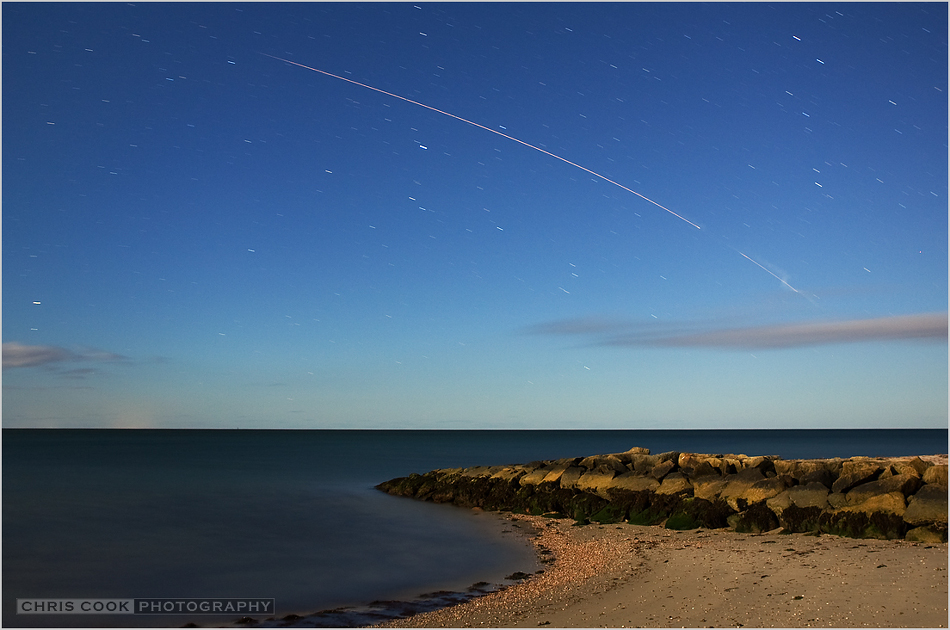
                            Star trails arc above a moonlit beach and jetty in this serene sea and night skyscape. Captured on November 19, the single time exposure looks south down the Atlantic coast from Cape Cod, Massachusetts, USA. But the longest and brightest trail is a Minotaur 1 rocket, a stage separation and exhaust plume visible along the rocket's fiery path toward low Earth orbit. The multi-stage Minotaur was launched from the Mid-Atlantic Regional Spaceport at NASA's Wallops Flight Facility at 8:15 p.m Eastern Time in Virginia, about 400 miles away. On board were a remarkable 29 satellites destined for low Earth orbit, including a small cubesat built by high school students, and Firefly, a satellite that will study lightning to see if they generate gamma ray bursts.

                            1st in Kommisar's 2009 SM Tournament
                            1st in I Love You`s 2009 New Year`s Tournament
                            3rd in EnR's Mashfest '08 tournament
                            5th in Phynx's Unofficial FFR Tournament
                            9th in D3 of the 2008-2009 4th Official FFR Tournament
                            10th in D5 of the 2010 5th Official FFR Tournament
                            10th in D6 of the 2011-2012 6th Official FFR Tournament

                            FMO AAA Count: 71
                            FGO AAA Count: 10

                            Bluearrowll = The Canadian player who can not detect awkward patterns. If it's awkward for most people, it's normal for Terry. If the file is difficult but super straight forward, he has issues. If he's AAAing a FGO but then heard that his favorite Hockey team was losing by a point, Hockey > FFR
                            PS: Cool AAA's Terry
                            - I Love You


                            An Alarm Clock's Haiku
                            beep beep beep beep beep
                            beep beep beep beep beep beep beep
                            beep beep beep beep beep
                            - ieatyourlvllol

                            Comment

                            • Bluearrowll
                              ⊙▃⊙
                              FFR Simfile Author
                              • Nov 2007
                              • 7376

                              #749
                              Re: Terry's Astronomy Thread.

                              What's in the sky tonight?
                              November 22, 2013
                              -The waning gibbous Moon is up in the east by about 10 p.m. tonight (depending on where you live). Look above it for bright Jupiter and, to Jupiter's left, Pollux and Castor. To the Moon's right twinkles Procyon. Much farther to the right, brighter Sirius is rising or soon to rise.

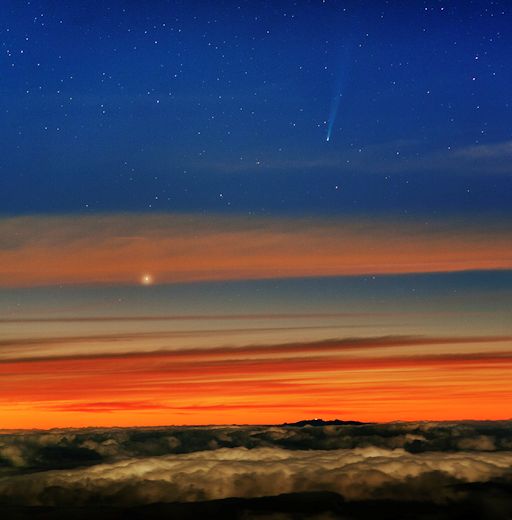
                              -Comet ISON is plunging toward the sun and brightening as it heads for a perilous close encounter on Nov. 28th. Yesterday morning, with the "final countdown" clock at T-7 days, Juan Carlos Casado photographed the sundiver over the Teide Observatory in the Canary Islands

                              -"The comet is over the distant island of Gran Canaria," he says, "while in the central cloud we can see the planet Mercury. ISON was at the limit of naked-eye visibility, but it was an easy target for my SLR camera with a small telephoto lens (85 mm focal length) on a static tripod and 6 seconds of exposure."

                              Because Comet ISON is moving into the rosy glow of dawn, it will soon be impossible for cameras on Earth to track it. Fortunately, NASA's fleet of solar spacecraft are able to follow the comet into the glare. NASA's STEREO-A spacecraft has already picked up Comet ISON. In the days ahead, STEREO-B, SOHO and the Solar Dynamics Observatory will join the hunt, providing continuous views all the way to perihelion (closest approach to the sun) on Nov. 28th.

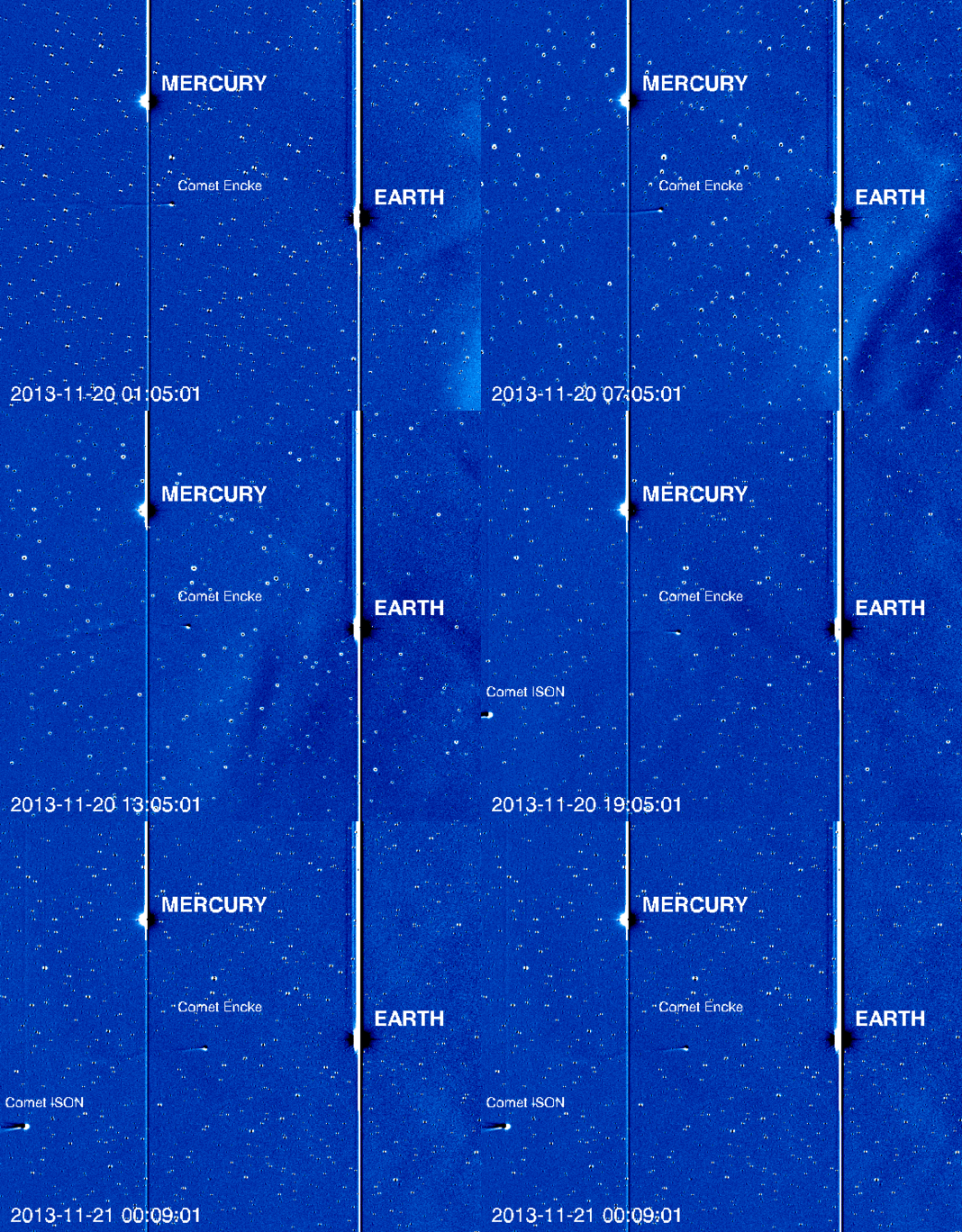
                              -Because NASA's twin STEREO probes are designed to observe the sun, they can see sundiving comets even when the glare becomes intense. Yesterday, Comet ISON joined Earth, Mercury, and Comet Encke in the field of view of STEREO-A's Heliospheric Imager. "The dark 'clouds' of stuff you see coming from the right are density enhancements in the solar wind, and these are what are causing all the ripples you see in comet Encke's tail," explains Karl Battams of NASA's Comet ISON Observing Campaign. "I can pretty much promise you that we're going to see ISON's tail doing that in a couple of day's time, but on a much larger scale!"

                              Battams points out another exciting development: Comet Encke and Comet ISON are converging for a photogenic close encounter. "No they're not going to hit each other - in reality they are millions of miles apart - but as seen from the STEREO-A spacecraft, they are going to get very close!" he says. "We are probably a couple of days away from seeing two comets almost side-by-side in that camera, with long tails flowing behind them in the solar wind. To say that such an image will be unprecedented is rather an understatement."


                              Astro Picture of the Day:
                              November 22, 2013

                              Source:
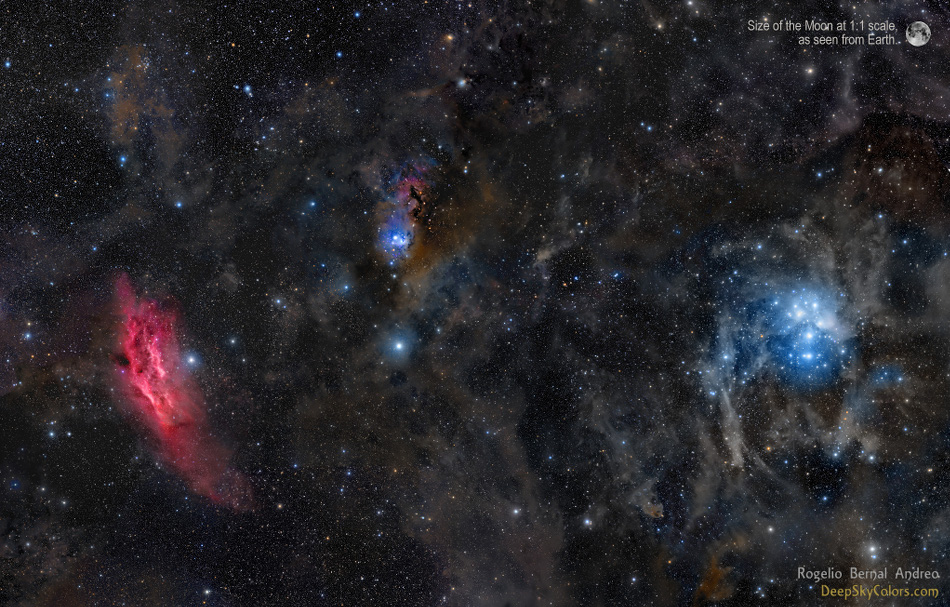
                              An astronomical trip from the California Nebula to the Pleiades star cluster would cover just over 12 degrees across planet Earth's night sky. That's equivalent to the angular extent of 25 Full Moons, as your telescope sweeps past the borders of the constellations Perseus and Taurus. This wide and deep mosaic image of the region explores the cosmic landscape's dusty nebulae and colors otherwise too faint for your eye to see. On the left, cataloged as NGC 1499, the California Nebula does have a familiar shape, though its coastline is actually over 60 light-years long and lies about 1,500 light-years away. The nebula's pronounced reddish glow is from hydrogen atoms ionized by luminous blue star Xi Persei seen just to its right. At the far right, the famous Pleiades star cluster is some 400 light-years distant and around 15 light-years across. Its spectacular blue color is due to the reflection of starlight by interstellar dust. In between are hot stars of the Perseus OB2 association and dusty, dark nebulae along the edge of the nearby, massive Perseus molecular cloud.
                              1st in Kommisar's 2009 SM Tournament
                              1st in I Love You`s 2009 New Year`s Tournament
                              3rd in EnR's Mashfest '08 tournament
                              5th in Phynx's Unofficial FFR Tournament
                              9th in D3 of the 2008-2009 4th Official FFR Tournament
                              10th in D5 of the 2010 5th Official FFR Tournament
                              10th in D6 of the 2011-2012 6th Official FFR Tournament

                              FMO AAA Count: 71
                              FGO AAA Count: 10

                              Bluearrowll = The Canadian player who can not detect awkward patterns. If it's awkward for most people, it's normal for Terry. If the file is difficult but super straight forward, he has issues. If he's AAAing a FGO but then heard that his favorite Hockey team was losing by a point, Hockey > FFR
                              PS: Cool AAA's Terry
                              - I Love You


                              An Alarm Clock's Haiku
                              beep beep beep beep beep
                              beep beep beep beep beep beep beep
                              beep beep beep beep beep
                              - ieatyourlvllol

                              Comment

                              • Bluearrowll
                                ⊙▃⊙
                                FFR Simfile Author
                                • Nov 2007
                                • 7376

                                #750
                                Re: Terry's Astronomy Thread.

                                What's in the sky tonight?
                                November 23, 2013
                                -The eclipsing binary star Algol should be at minimum light, magnitude 3.4 instead of its usual 2.3, for a couple hours centered on 9:06 p.m. Eastern Standard Time. It takes several more hours to fade and to rebrighten.

                                -A cluster of active sunspots has just rotated off the Earthside of the sun. The remaining sunspots facing Earth are quiet, prompting NOAA forecasters to downgrade the chance of geoeffective flares. The odds of an X-class eruption today are no more than 1%.

                                Astro Picture of the Day:
                                November 23, 2013

                                Source:
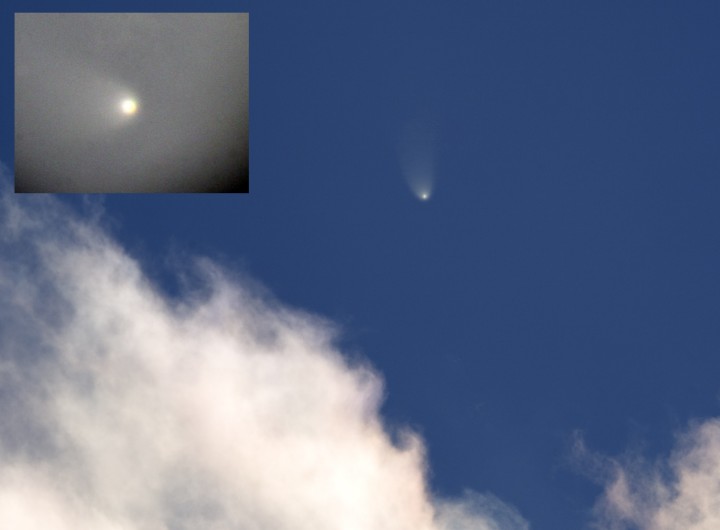
                                Comets grow bright when they're close to the Sun, basking in the intense solar radiation. Of course, they're also usually impossible to see against the overwhelming scattered sunlight. But surprising Comet McNaught - whose January 12 closest approach to the Sun (perihelion passage) in 2007 was well inside the orbit of Mercury - gave an enjoyable performance in bright blue daytime skies. In fact, comet expert David Levy captured this remarkable inset (upper left) telescopic view of McNaught within an hour of perihelion, with the comet in broad daylight only about 7 degrees away from the Sun's position. Stefan Seip's wider daytime view of the comet and fluffy clouds was recorded approximately a day later. Seip used a polarizing filter and a telescope/camera set up near Stuttgart, Germany. No longer visible in broad daylight, Comet McNaught is now touring twilight southern skies.
                                1st in Kommisar's 2009 SM Tournament
                                1st in I Love You`s 2009 New Year`s Tournament
                                3rd in EnR's Mashfest '08 tournament
                                5th in Phynx's Unofficial FFR Tournament
                                9th in D3 of the 2008-2009 4th Official FFR Tournament
                                10th in D5 of the 2010 5th Official FFR Tournament
                                10th in D6 of the 2011-2012 6th Official FFR Tournament

                                FMO AAA Count: 71
                                FGO AAA Count: 10

                                Bluearrowll = The Canadian player who can not detect awkward patterns. If it's awkward for most people, it's normal for Terry. If the file is difficult but super straight forward, he has issues. If he's AAAing a FGO but then heard that his favorite Hockey team was losing by a point, Hockey > FFR
                                PS: Cool AAA's Terry
                                - I Love You


                                An Alarm Clock's Haiku
                                beep beep beep beep beep
                                beep beep beep beep beep beep beep
                                beep beep beep beep beep
                                - ieatyourlvllol

                                Comment

                                Working...